Crypto AI Agent in 2026: How Web3 Platforms Are Automating Growth

Akansha
Last updated on February 17, 2026

Crypto companies deal with high volumes of data, constant user interactions, and fast-changing regulations. Managing this at scale is difficult with just manual processes.
AI agents help by automating repetitive tasks, handling routine support queries, and improving how information is processed and used across the organisation. They reduce workload, improve response times, and bring more structure to daily operations.
Whether it’s onboarding users, keeping support fast and consistent, or managing internal workflows, AI agents help teams move faster and focus on more important work.
For crypto businesses growing their product or user base, this shift isn’t optional. It’s a practical way to keep things running efficiently.

A crypto AI agent is an assistant designed to help businesses and users manage cryptocurrency-related tasks more effectively.
In 2025, these agents utilize advanced Large Language Models (LLMs) enhanced by techniques like Retrieval-Augmented Generation (RAG)—a method that enables the model to retrieve and reference relevant information from your existing data when generating answers.
Crypto AI agents can quickly analyze data, answer user questions accurately, and provide immediate insights based on specific company resources.
Crypto AI agents are assistants built for crypto businesses. They help teams handle tasks automatically, answer questions quickly, and work with your data — all without needing someone to manually step in every time.
Here’s how they work, in simple terms:
You can type a question or request — just like chatting with a support agent. The AI understands what you’re asking, whether it’s about a customer issue, a wallet transaction, or an internal process.
The AI looks it up from your company’s existing documents, systems, or databases. This method is called Retrieval-Augmented Generation (RAG) — it helps the AI give answers based on facts, not guesses.
Once the AI finds what it needs, it applies your business rules. For example, if a request needs approval or triggers a specific action, the agent knows what to do next.
The AI can reply with a clear answer, generate a report, send an alert, or even complete a task like updating a system or creating a ticket.
As more people use the agent and give feedback, it gets better. It learns which answers work, where it needs to improve, and how to respond faster and more accurately.
Crypto AI agents help platforms run more efficiently by automating routine tasks, improving accuracy, and responding instantly to user needs. Here’s how they support business operations:
AI agents work round the clock without breaks. Whether it’s handling user queries, verifying transactions, or processing routine tasks, they ensure uninterrupted support even during peak hours or global traffic spikes.
By automating repetitive work such as customer support, basic KYC checks, or data monitoring AI agents reduce the need for large support teams. This keeps costs low while maintaining fast service levels.
Fast, accurate replies build trust. AI agents can answer common questions, guide users through platform features, and provide real-time updates helping users feel supported and confident at every step.
As your user base increases, AI agents scale automatically. They can handle more tickets, conversations, or data processing without needing to expand your team making growth more manageable.
Instead of using Autonomous Agents, AI agents follow rules reducing errors in manual processes. Whether they’re sending notifications or verifying wallet activity, they bring consistency to operations that require precision.

Crypto AI agents are becoming essential for platforms that serve large user bases, manage complex interfaces, and deal with constant product updates. Here’s how they’re being used across the crypto ecosystem:
AI agents handle various questions from faqs to answering based on actions like wallet help, seed phrase recovery steps (without storing sensitive info), pending transactions, and token transfers. This reduces the load on support teams and gives users fast answers when urgency matters.
First-time users often struggle with wallets, gas fees, and token standards. AI agents answer onboarding questions, explain concepts (e.g., ERC-20 vs. NFTs), and guide users through actions like staking, bridging, or swapping all without needing human support.
Whether it’s a DeFi dashboard or an NFT minting platform, AI agents help users understand how to use platform features, connect wallets, approve transactions, and avoid common mistakes improving adoption and reducing abandonment.
Many crypto projects use AI agents in community channels to answer common questions, surface announcements, or help moderators manage high message volumes. This keeps communities informed and reduces repetitive admin work.
AI agents qualify potential users by asking about wallet preferences, investment goals, or technical knowledge. They can route high-intent users to sales, whitelist forms, or onboarding flows, improving conversion without manual effort.
As cryptocurrency trading becomes more competitive, AI-powered agents assist traders and firms in automating methods, managing risks, and improving efficiency. Choosing the appropriate platform is critical for successful automation.

YourGPT is an AI agent platform that lets businesses create custom AI agents and AI chatbots without any coding. It works with popular messaging apps like WhatsApp, Telegram, and Slack, and supports over 100 languages.
With features like voice agents, self-learning, sequential agents, and lead generation, businesses across industries are already using to automate task, customer support, sales, and marketing to reduce manual effort and saving time.
Crypto platforms confront a number of hurdles, including market swings, complex trading methods, and high customer service requirements. YourGPT contributes by:
Deploy a Crypto AI Agent to answer queries, monitor portfolios, and scale support

Dialogflow CX, created by Google Cloud, is a smart conversational AI platform for creating large-scale AI agents. It’s intended to help organizations, especially those in the cryptocurrency industry, that require complicated, multi-turn conversational processes and interfaces with popular messaging channels.
Dialogflow CX helps cryptocurrency businesses to create intelligent agents that automate customer care, manage trade-related inquiries, and walk customers through the onboarding process. Its smart flow management reduces human workload while providing 24/7 support during peak trade hours.

Rasa is an open-source conversational AI platform intended for enterprises that require complete control over their AI agents. It’s highly customisable, making it suitable for crypto companies looking to create safe, self-hosted AI chatbots.
Rasa lets cryptocurrency businesses to create customized AI agents capable of handling sensitive user data and providing improved customer service. It is ideal for firms with special regulatory or security needs in the cryptocurrency field.

Tars is a chatbot development platform for businesses who want to automate client interactions with simple, no-code methods. It is especially useful for cryptocurrency organizations that want to simplify client engagement, handle high-volume FAQs, and automate trading or support inquiries using conversational landing sites.
Tars uses conversational interfaces to assist cryptocurrency businesses reduce customer care costs, automate lead generation, and provide fast, customized assistance. It is ideal for cryptocurrency exchanges, wallet providers, and DeFi platforms.

Fetch.ai is an advanced decentralized AI platform that creates and deploys autonomous AI agents for Web3 and cryptocurrency ecosystems. Its technology allows businesses to automate operations across decentralized networks by merging blockchain with AI, resulting in smart, self-executing systems.
Fetch.ai allows cryptocurrency firms to streamline operations, automate trading, optimize blockchain transactions, and decrease human interference. Its agents can self-manage liquidity pools, perform DeFi techniques, and securely share data.

Crypto teams can deploy AI agents trained on their own data—fast, accurate, and without writing code, by following these steps:
Create an account on YourGPT.ai and access your dashboard. This is where you’ll build, train, and manage your AI agent.
Use the no-code chatbot builder to customise your crypto AI assistant. Define its tone, behaviour, and conversation flow to match your product experience — whether you’re running an exchange, NFT platform, or DeFi protocol.
Upload your platform FAQs, help guides, whitepapers, and documentation. Your agent will use this data to accurately answer crypto-specific user questions — from wallet support and feature explanations to onboarding and terminology.
Deploy the chatbot on your website, Web3 dashboard, mobile app, or community platforms like Telegram and Discord. It can respond instantly, 24/7, helping reduce support volume and improve response time.
For more complex tasks, use YourGPT AI Studio to create multi-step workflows, connect internal tools, or guide users through specific actions. This is ideal for crypto companies that want more control over how their AI agent behaves.
Crypto AI agents can streamline operations, but poor setup or oversight can introduce avoidable risks. Understanding these risks helps teams deploy AI more effectively and responsibly.
AI is a support tool not a replacement for human oversight. Relying entirely on automated decisions can result in errors, especially in unexpected scenarios.
Mitigation:
Use AI to assist, not replace. Always review sensitive actions manually and combine AI outputs with business context.
AI agents perform well in routine environments but may respond unpredictably to sudden regulatory changes, network issues, or protocol updates.
Mitigation:
Update models regularly. Define triggers to pause automation or escalate to humans during high-risk events.
AI agents often interact with user data, wallets, or backend systems making them a potential target for attacks.
Mitigation:
Use secure APIs, enable multi-factor authentication, and run regular security audits.
Crypto users range from first-time wallet holders to advanced DeFi users. AI agents may misinterpret unclear questions, leading to frustration or incorrect actions.
Mitigation:
Train your agent with real queries. Use fallback logic to route edge cases to human support.
AI agents may occasionally give wrong answers, miss context, or provide outdated information. This can confuse users, lead to errors, or reduce trust in your platform especially in high-stakes scenarios.
Mitigation:
Monitor conversations regularly, fine-tune responses based on real queries, and give users an easy way to escalate issues to a human when needed.
Yes, as long as it’s connected to your blockchain APIs or internal systems. Most crypto teams integrate AI agents with explorers, wallet services, and backend dashboards so users can instantly check transaction status, balances, pending transfers, or support issues. The agent pulls real-time data and responds with accurate, up-to-date information, significantly reducing support workload.
It doesn’t have to be. Well-designed AI agents never store private keys or sensitive credentials. They operate using secure APIs, strict permission layers, and predefined workflows. High-risk cases such as account recovery or large transactions are automatically escalated to human agents.
Platforms typically automate high-volume repetitive tasks such as answering wallet and transaction questions, onboarding users, explaining features, handling FAQs, routing tickets, and triggering simple workflows. These automations significantly reduce daily support volume.
No. AI agents handle routine and repetitive questions, allowing human teams to focus on complex cases, compliance matters, and strategic conversations. Most companies stay lean without sacrificing service quality.
Basic AI agents can go live the same day after uploading training data and connecting channels. Advanced agents with API integrations and workflows typically take a few days to fine-tune.
Yes. When trained on your FAQs, documentation, and product guides, AI agents understand wallets, gas fees, staking, swaps, NFTs, bridges, and platform-specific workflows, ensuring accurate and contextual responses.
AI agents scale automatically and can manage thousands of conversations simultaneously. Users continue receiving instant responses even during high market volatility or product launches.
Strong AI systems include confidence thresholds, fallback responses, and automatic escalation to human agents. Teams regularly review conversations and retrain the agent to continuously improve accuracy.
Yes. AI agents answer repetitive questions, guide new members, share updates, and support moderators during high activity periods, keeping communities organized and responsive.
Teams should organize clear FAQs, onboarding guides, feature documentation, workflows, security policies, and escalation rules. With structured knowledge in place, AI agents deliver accurate results from day one.
Crypto AI agents are no longer just a nice-to-have they’re becoming a practical need for Web3 platforms handling high volumes of users, data, and support queries.
They reduce manual workload, deliver instant responses, and keep operations running efficiently without the overhead of scaling support teams. Whether you’re running an exchange, a DeFi protocol, or an NFT marketplace, using AI agents helps your team focus on what actually moves the business forward.
But no system is perfect. Poor implementation, lack of oversight, or outdated data can lead to errors. That’s why it’s important to deploy crypto AI agents with proper guardrails, security, and human in the loop.
If you’re looking to scale operations without adding more members to team, a crypto AI agent is one of the most effective tools you can deploy today.
YourGPT offers a secure, no-code platform built specifically for crypto companies helping you launch, manage, and customise AI agents trained on your own data.
Join thousands of businesses transforming customer interactions with YourGPT AI
No credit card required • Full access • Limited time offer
TL;DR B2B customer service means supporting multiple people within the same account, including end users, admins, finance or procurement contacts, and executive sponsors, each with a different definition of a resolved ticket. Traditional support bots handle one conversation at a time and often lose account context when requests move between contacts, channels, or teams, forcing […]

TL;DR A vector embedding is a list of numbers that represents meaning, placing similar concepts closer together in a mathematical space. AI chatbots use embeddings to match questions by meaning rather than exact wording, which is a core part of retrieval-augmented generation (RAG). Anthropic recommends Voyage AI for embeddings, while OpenAI, Google, and Cohere provide […]

TL;DR An FAQ chatbot answers repetitive questions by matching user queries with a knowledge base and returning grounded responses using rules, AI retrieval, or both. Modern FAQ chatbots use confidence checks to deliver instant answers for strong matches and fall back to broader retrieval or human handoff when confidence is low. Rule-based bots work well […]
TL;DR Multimodal chatbots let customers share photos, screenshots, documents, video, or audio directly in a conversation, giving AI more context than text alone. YourGPT’s Attachment Capture node in AI Studio can collect these files mid-conversation, while vision-capable AI models can analyze and understand their contents. Key use cases include ecommerce returns, insurance and warranty claims, […]
A customer asks where their order is. A traditional bot pastes a tracking link and calls it done. An agentic system checks the carrier API, sees the shipment stuck at a depot, applies a credit under the delay policy, updates the CRM, and messages the customer before they’ve had time to get annoyed. Same question. […]
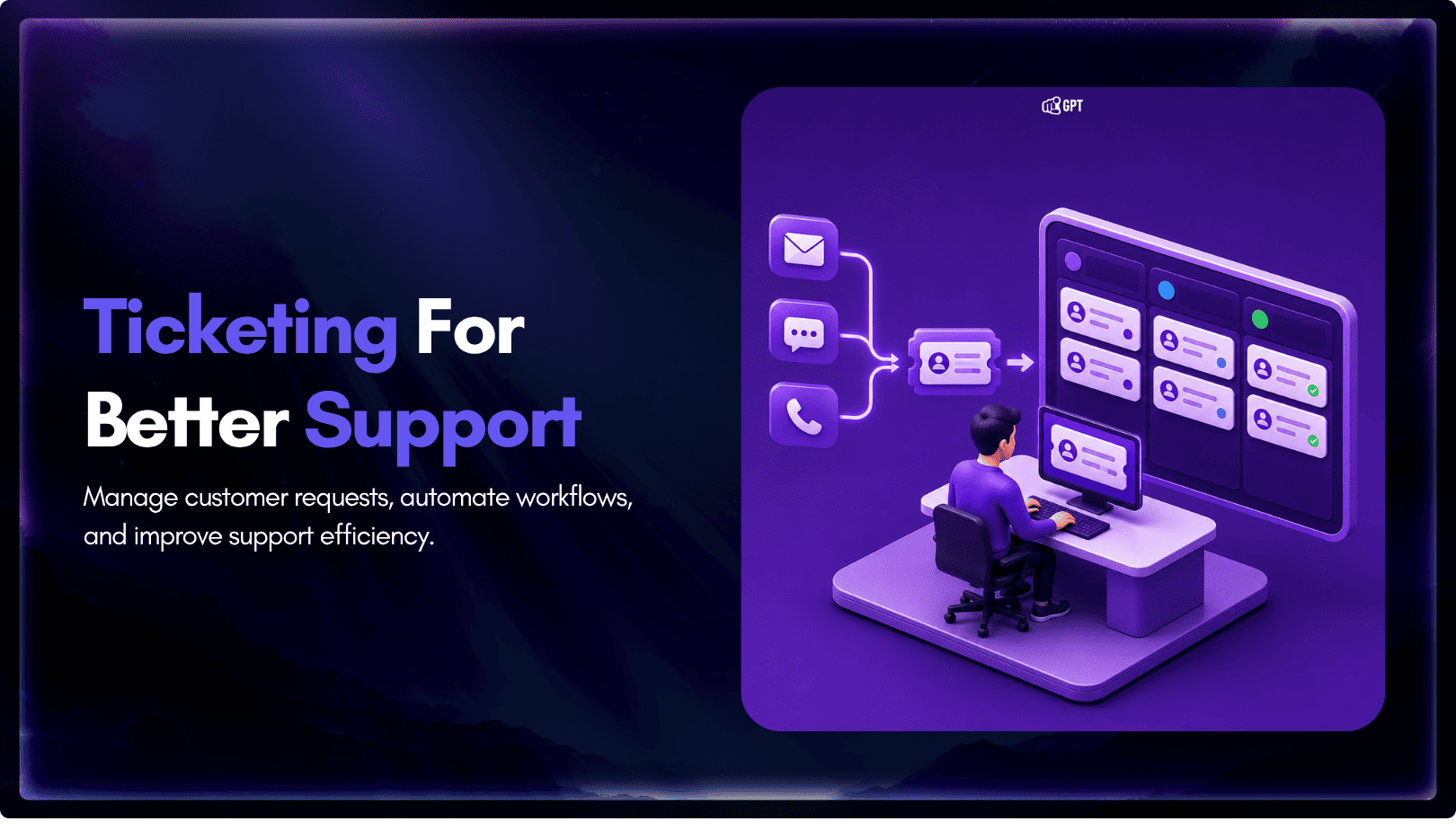
TL;DR A ticketing system converts requests that arrive by email, chat, phone, or web form into trackable records with an owner, a status, and a priority level. Centralizing requests this way cuts response delays, gives support teams visibility into backlogs, and creates a record useful for reporting and audits. Options range from lightweight help desk […]