AI vs. Human Customer Support: Who Should Handle What (and When)

Neha
Last updated on June 1, 2026

Customer support has changed a lot in recent years.
AI plays a growing role in meeting these expectations by handling structured, repeatable requests with speed and accuracy. Human agents continue to add value where context, judgement, and relationship building matter.
The strongest support teams do not choose between the two. They design systems where each does the work it is best suited for.
This blog compares AI-driven support and human support across real operational factors, highlighting their strengths, complement each other, limits, and how they work together in modern customer support teams.
In 2026, the goal is not to choose one over the other. It is to understand where each delivers the most value.
AI has already transformed first-line customer support. This is not a matter of opinion. It is a math.
A human support agent may handle 50 to 80 conversations a day. An AI agent can manage thousands of conversations simultaneously, across time zones and languages, without waiting for shifts to begin or end. For repetitive and predictable requests, that operational advantage is difficult to match.
Here’s how AI agents compare with human support teams across important customer service tasks:
As the table demonstrates, AI works best when speed and volume while humans excel when context, judgment, and relationships are involved. The most effective support teams in 2026 combine both, letting each handle the work they are naturally best at.
AI became part of customer support because the shape of support work changed. Most incoming issues now follow predictable paths, and handling them with people stopped making operational sense at scale.
McKinsey reports that AI can reduce support ticket volume by 40% to 50% when used for repetitive tier-1 requests. In well-defined support categories, many teams achieve 60% to 80% containment once the system is properly trained. The metric is your deflection rate, which measures the percentage of customer requests resolved without human involvement.
1. Most support requests are structurally predictable: Account access, order updates, billing questions, subscription changes, basic troubleshooting. These do not require judgment. They require accuracy and completion. Routing them to humans creates delays, introduces inconsistency, and raises costs without improving the customer experience.
2. Humans struggle with volume consistency: When request volume increases, response quality becomes uneven. Details get missed, steps are skipped, and outcomes vary based on timing and workload. Customers feel this immediately, even if the agent is skilled.
3. AI performs best where rules already exist: AI applies the same policies, checks the same data, and follows the same steps every time. There is no variation under pressure. For customers, this predictability matters more than tone in first-level interactions. Fast and correct resolution builds trust.
4. The shift from answering to resolving changed everything: Earlier systems explained processes. Modern AI systems execute them. Passwords get reset, orders get tracked, refunds get validated and applied. The interaction ends with closure, not instructions.
5. Human agents regained focus where judgement matters: Once AI owned routine resolution, humans stopped being interrupted for repetitive work. Their role shifted to exceptions, complex decisions, and emotionally sensitive cases where context and discretion are required.
6. Language became part of the workflow: AI operates directly in the customer’s preferred language while enforcing the same policies and actions. This removed the need for separate language queues for common issues and improved consistency across regions.
AI became the entry point for support because it absorbed work that did not benefit from human involvement. When used correctly, it reduces customer friction and protects human attention for problems that actually require it.
For insights into the role of live chat in customer support and how it compares to AI chatbots, check out this article: Live Chat vs. AI Chatbots – Customer Service.

AI handles a large share of support work well, but some situations benefit directly from human involvement. These are not edge cases. They are moments where judgement, context, and responsibility matter more than speed.
Support teams see better outcomes when humans are involved selectively. Agents focus on cases where their decision-making adds real value beyond automation.
Suggested Read: Smart Chatbot for Shopify: Improving Customer Engagement on Shopify Stores

Customer service chatbots were created to deal with practical support challenges. Each new version came from issues seen in real customer conversations.
The earliest customer service chatbots were built on fixed rules and decision trees. Every possible input had to be anticipated in advance, and responses were mapped manually.
These systems worked only in controlled scenarios such as answering store hours or directing users to static help pages. They could not understand intent, variation in phrasing, or context across messages. Any change in product or policy required manual updates, making them difficult to maintain as support volume increased.
The next phase introduced machine learning models trained on historical conversations. Instead of matching exact keywords, these systems classified user intent and extracted entities such as order IDs or product names.
This allowed chatbots to handle more language variation and reduced dependence on rigid rules. However, conversations still followed predefined flows. These systems required continuous retraining, careful data labeling, and frequent tuning. They often struggled with multi-part questions, ambiguity, or topic shifts within a single conversation.
Combining retrieval-augmented generation with large language models was the next real step. Instead of generating answers in isolation, these systems pulled relevant information from approved sources, including help docs, policy files, and product databases, and used language models to respond naturally. Accuracy improved. Conversations felt less rigid. Customers could ask questions naturally, follow up, or rephrase without breaking the flow.
But a clear ceiling appeared quickly. Explaining something is not the same as resolving it.
A RAG-based system could explain exactly how a refund works, but it could not process the refund itself. Likewise, it could outline the steps required for a subscription change, yet the actual change still needed to be completed elsewhere. As a result, customers received useful information but often still depended on a human to finish the task. For a full breakdown of where RAG chatbots excel and where they hit their limits, see RAG Chatbot vs. AI Agent: Which Is More Effective?
Current systems do not just answer questions. They validate rules against live data, retrieve real-time account information, trigger internal workflows, and complete actions: refunds, subscription changes, account updates, appointment bookings. The interaction ends with a closed issue.
This is what changed the staffing math. When AI can own the full resolution of a tier-1 request, not just the conversation, the number of tickets that need human involvement drops sharply. Salesforce’s Agentforce achieved an 84% autonomous resolution rate across 380,000 conversations, with only 2% requiring human escalation.
Clear escalation logic, confidence thresholds, and audit trails are built into these systems. AI owns first-level resolution within defined boundaries. Humans handle exceptions, judgment-driven cases, and situations where the stakes are too high for automated execution. Platforms like YourGPT operate in this phase by combining conversational AI, workflow execution, and human handoff in a single system.

GPT-based chatbots changed customer support in ways that show up during everyday use. The difference is not about sounding human, but about handling conversations and decisions more reliably.
The practical impact goes beyond better conversation. It brings smoother interactions, clearer results, and support exchanges that move forward efficiently.
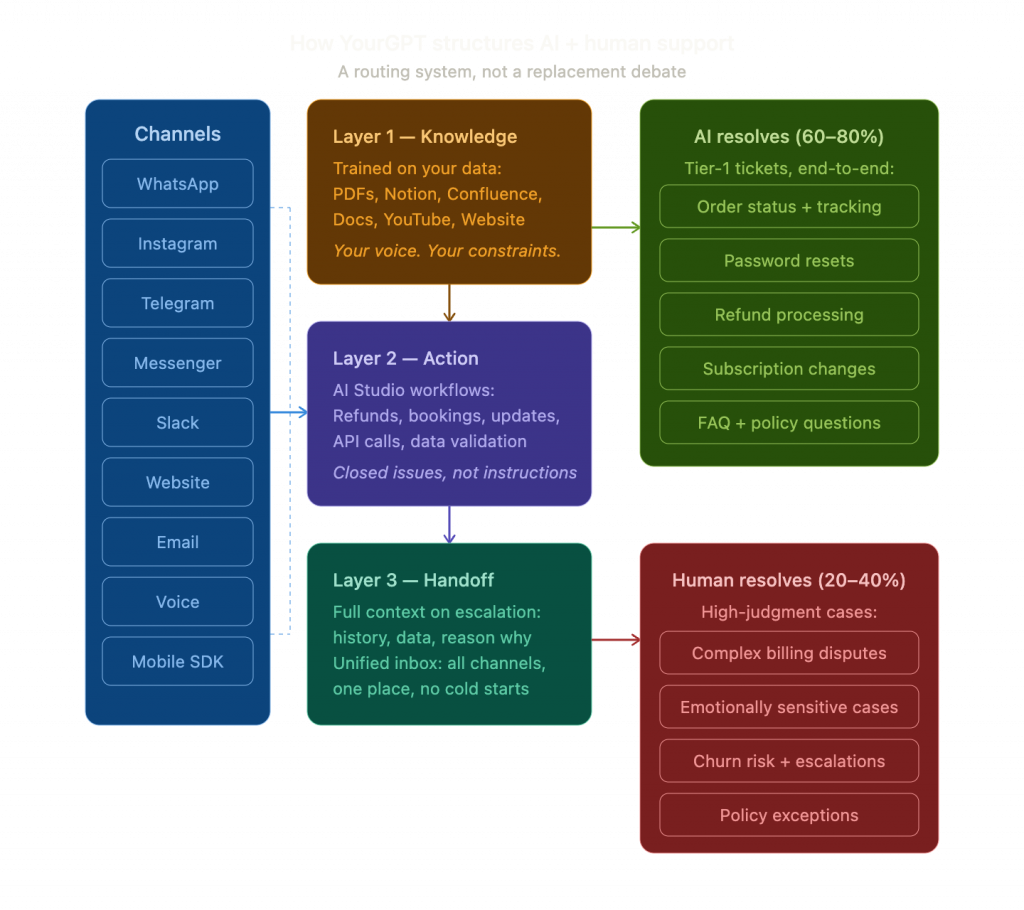
YourGPT is built around the premise that the AI versus human question is a routing question, not a values question. The platform is designed so each side of the operation handles the work it is built for.
1. The knowledge layer: YourGPT trains on your actual business data: help docs, PDFs, product documentation, Notion pages, Confluence wikis, YouTube tutorials, and website content. Not generic training data. The AI answers from your knowledge, with your constraints, in your voice. This is what makes high-accuracy deflection possible at scale without constant retraining. For the full training process, see How to Train Your AI Chatbot on Your Own Data.
2. The action layer: AI Studio lets teams build structured workflows with full control over conditional logic, API calls, data validation, and action execution. This is where AI moves from answering to completing: processing refunds, updating subscriptions, booking appointments, checking real-time order status. Customers get a closed issue, not instructions.
3. The handoff layer. When escalation happens, the human agent sees the complete conversation, the data retrieved, what was attempted, and why the AI escalated. No customer repeats themselves. No agent starts from zero. The unified inbox brings all channels, including WhatsApp, Instagram, Telegram, Messenger, Slack, and web, into one place so agents are not switching between tools to reconstruct context.
4. Omnichannel coverage: Conversations can happen on WhatsApp, Messenger, Telegram, Slack, or directly on your website without asking customers to switch channels. For support teams, this keeps everything in one place, reduces missed requests, and makes it possible to follow a conversation from first contact to resolution.
5. Security and compliance: YourGPT is GDPR compliant. Customer data and personally identifiable information are handled with encryption and privacy controls that meet requirements across regulated industries.
6. Instant Global Expansion (100+ Languages): Eliminate the cost and complexity of hiring regional support teams. YourGPT allows you to offer native-level support in over 100 languages instantly. This builds immediate trust with international markets and boosts conversion rates by speaking your customer’s language.
7. On-Demand Scalability: YourGPT is built to handle changes in demand without requiring extra setup. Whether inquiry volume is steady or suddenly increases, the system continues to respond consistently. This allows customers to get timely help at any hour, while support teams maintain the same workflows regardless of business size or traffic patterns.
YourGPT is designed to get you up and running quickly. Follow these steps to deploy your complete AI automation platform.
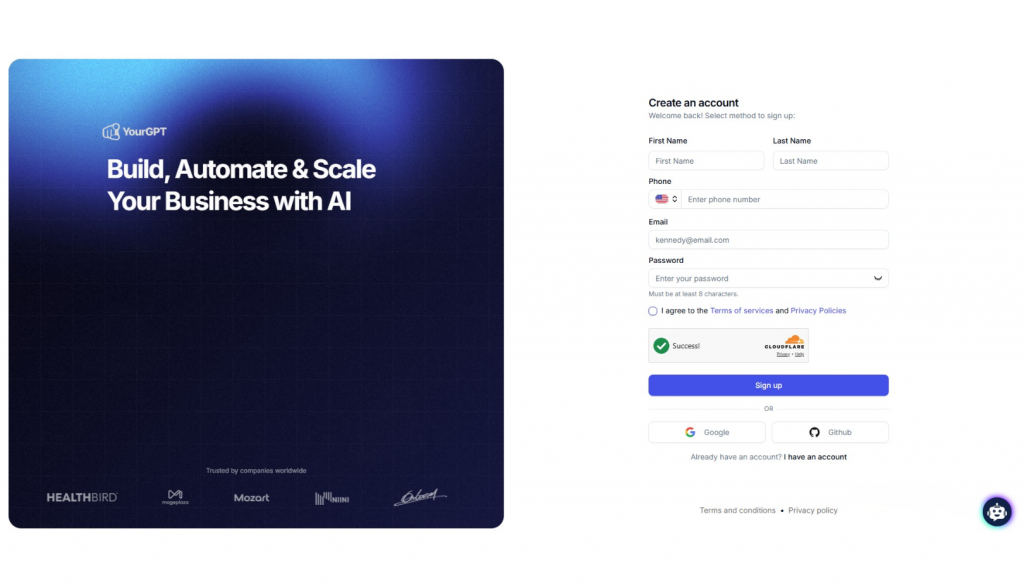
Visit YourGPT and create your account to get started in just a few minutes.
Once your account is ready, the next step is teaching your AI about your business.
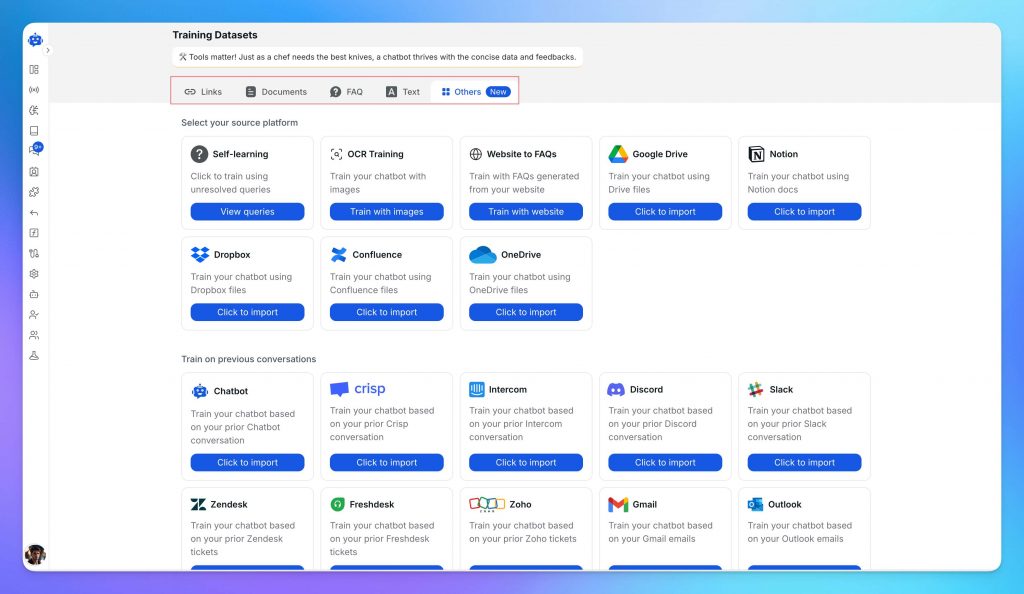
Upload your business content from multiple sources including website pages, documentation, PDFs, knowledge base articles, YouTube videos, multimedia content, and integrations with Notion, Dropbox, Confluence, and many more data sources.
YourGPT learns from your content, understanding your brand, products, and policies automatically.
With your AI trained, you’re ready to configure how it interacts with customers.
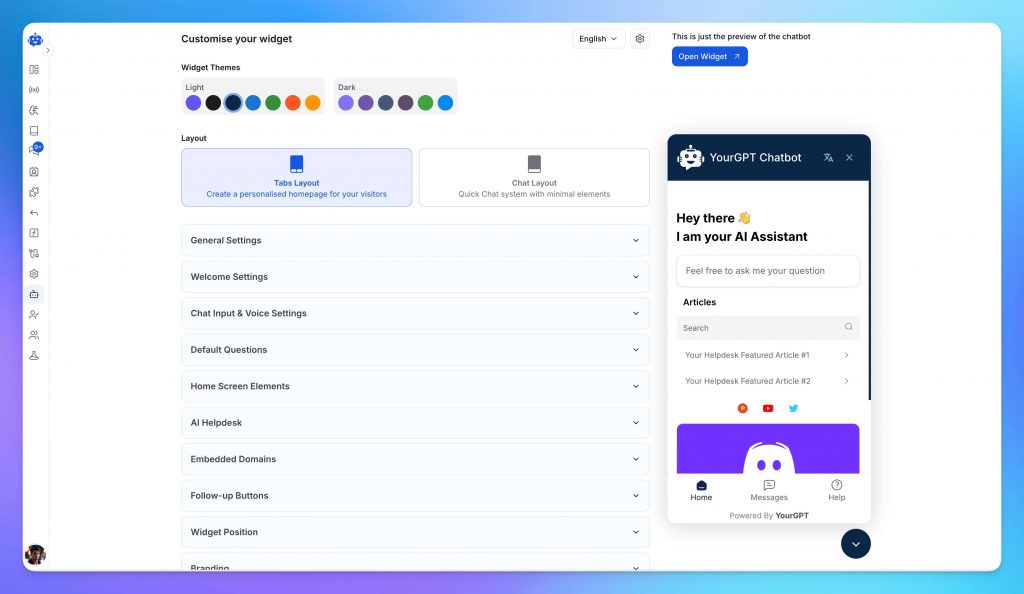
YourGPT gives you complete control over appearance, tone, branding, and domain so your AI agent fits your business perfectly.
For businesses with complex automation needs, Studio enables you to build custom multi-step processes without writing code. Create sophisticated business logic, design conditional workflows, and build automations tailored to your specific requirements. Studio puts enterprise-grade capabilities in your hands without technical barriers.
Before launching to your customers, it’s important to test everything thoroughly.
Simulate conversations instantly and refine your AI. Test responses in real time, adjust settings and conversation flows, and perfect your automation before going live.
When you’re satisfied with how your AI performs, it’s time to deploy.

Launch your AI agent wherever your customers are. Deploy on web and mobile through website widgets, web app embeds, and mobile SDKs. Connect to messaging platforms like WhatsApp, Instagram, Telegram, and Slack. Integrate with Shopify, WordPress, Crisp, Zapier, and 100+ tools via MCP. Add browser extensions for Chrome and Firefox.
Enable seamless handoff to human agents when needed for complex queries.
You’re now live with complete AI automation across support, sales, and operations. Your AI will continue learning and improving as it interacts with customers.
No. AI takes over tier-1 support work, including structured, repeatable, and policy-driven requests that do not require human judgment. Human agents are increasingly focused on higher-value conversations such as complex disputes, escalations, sensitive customer situations, and sales interactions where trust and relationship-building matter. While fewer agents may be needed for routine tasks, the work that remains requires deeper expertise, stronger communication skills, and better decision-making.
Standard chatbots rely on rigid scripts and keywords. AI Agents understand context and intent and can also perform actions. An AI Agent can integrate with your business systems to execute workflows, such as checking inventory or booking appointments, acting as a fully functional team member rather than just a text interface.
Modern AI platforms have made this process incredibly simple. With YourGPT, you do not need technical expertise. The platform features a powerful data ingestion engine that learns directly from your uploaded resources—website URLs, PDF files, Notion pages, or YouTube videos—automatically creating a secure knowledge base to provide accurate answers.
Yes, this is one of the primary benefits of adopting AI. YourGPT allows businesses to offer native-level support in over 100 languages instantly. This eliminates language barriers and the need to hire separate support teams for different regions, ensuring a consistent customer experience globally.
Security is a critical component of enterprise-grade AI. YourGPT prioritizes data protection by adhering to strict GDPR compliance standards.
YourGPT is designed with a “Human-in-the-Loop” architecture. If a query is too complex, the system intelligently escalates the conversation to a live agent, transferring the full chat history so the team can pick up exactly where the AI left off.
Yes. YourGPT is built to fit into your existing ecosystem. It integrates seamlessly with major platforms like Shopify, WordPress, and Wix. Additionally, it connects with communication channels including WhatsApp, Slack, Telegram, and Messenger, ensuring an omnichannel approach.

Customer support works best when responsibilities are clear. AI handles structured, repeatable work with speed and consistency, while human agents focus on situations that require judgement, context, and accountability. The goal is not to replace one with the other, but to design a system where each plays the role it is best suited for.
Businesses that approach support this way see practical benefits. Customers get faster resolution without unnecessary handoffs, and support teams spend less time on repetitive tasks and more time on meaningful cases. Quality improves not because more tools are added, but because work is routed correctly.
YourGPT is built around this model. It supports first-level resolution where automation makes sense and creates clean handoffs when human involvement adds value. This allows teams to scale support without losing clarity, consistency, or trust.
The future of customer support is not about choosing between AI and humans. It is about using both with intention.
Connect your website AI agent to a CRM with YourGPT. Capture lead details, map contact fields and verify the record your sales team will use.

Use YourGPT to help Black Friday shoppers choose products, check orders and understand returns. Prepare your answers and team before the sale.
Add in-app chat support to your SaaS or mobile app. Place it on the screens where users stall, pass who they are, and hand hard cases to your team.

Group new-account tickets by onboarding stage, train an AI agent on your docs, and place it in the product where new users get stuck.
AI agents can now find and buy products for shoppers. See what agentic commerce changes for a Shopify store and which support jobs stay yours.
Build a Halloween shopping assistant for Shopify with YourGPT. Set up product recommendations, stock checks, cart actions and human support before launch.
