Build a Custom ChatGPT Bot for Your Discord Server [Under 5 Mins]

Neha
Last updated on July 23, 2026
![Build a Custom ChatGPT Bot for Your Discord Server [Under 5 Mins]](https://s3.us-east-2.amazonaws.com/assets.yourgpt.ai/content/uploads/2024/09/23075008/Discord-AI-1.jpg)
An AI bot helps growing Discord servers handle moderation, support questions, and repetitive requests without increasing your team’s workload.
With YourGPT, setup takes five steps: create a Discord application, generate a bot token, connect your credentials, configure OAuth2 permissions, and test the bot with slash commands.
This blog covers the complete no-code setup, practical use cases, and best practices for keeping your Discord AI bot accurate after launch.
Most Discord server owners reach a point where keeping up stops being possible. Messages come in faster than any team can answer them. Important questions get buried. The same FAQ gets answered manually for the hundredth time.
An AI bot changes that ratio. Trained on your actual content, it handles the repeat questions, routes conversations to the right place, and responds instantly at any hour. The volume stays the same. The workload does not.
Setting one up takes five steps and no code. This guide covers exactly how, plus the best practices that keep it working well after launch.
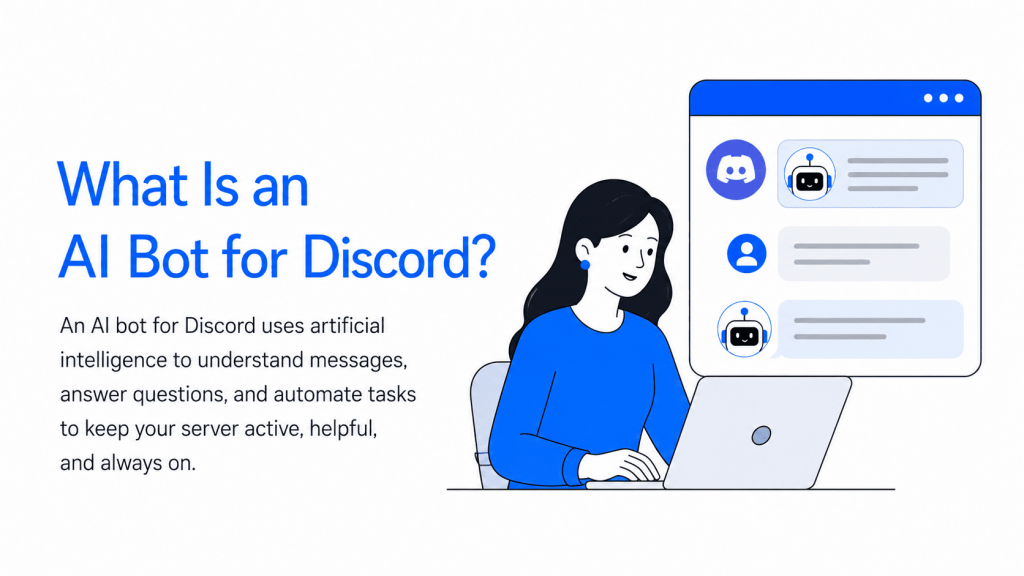
An AI bot for Discord is an automated program that uses artificial intelligence to understand and respond to user messages. Powered by ai models like GPT-4, claude3.5, these bots can:
As your server grows, handling the increasing number of messages can become challenging. Some of the common issues business face:
These challenges can affect customer satisfaction and put pressure on your team. AI bots can help address these issues, making server your more efficient and effective.
Adding a GPT-powered chatbot to your Discord server can improve communication and enhance user engagement. First you need to setup your YourGPT Chatbot, if you have not setup then follow: How to Make a Custom ChatGPT Chatbot in 2 Minutes
Here’s a straightforward guide to get your Discord GPT bot up and running in just five steps:
1. Sign Up or Log In: Start by creating an account or logging into the Discord Developer Portal.
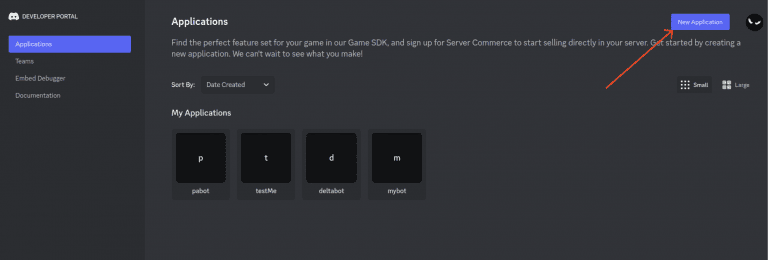
2. Create a New Application: Click on “New Application” and enter a name for your bot. This name will represent your bot within Discord.
3. Save Your Application: After naming your application, hit “Save Changes.” You now have a basic application that will host your bot.
1. Add a Bot to Your Application: Go to the “Bot” tab on the left sidebar within your application settings and click “Add Bot.” Confirm by clicking “Yes, do it!”.
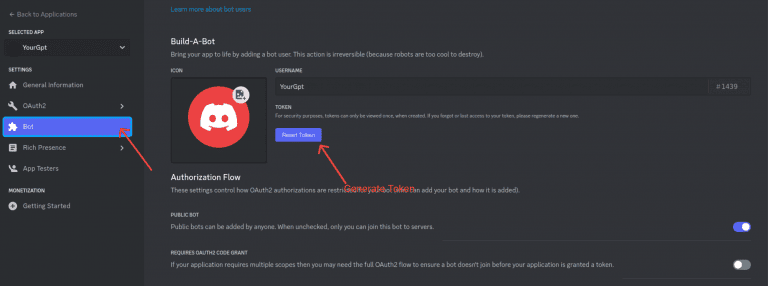
2. Generate a Bot Token: Under the “Bot” tab, click “Copy” next to the Token field. This token is crucial as it allows your bot to interact with Discord. Keep this token secure don’t share it with anyone.
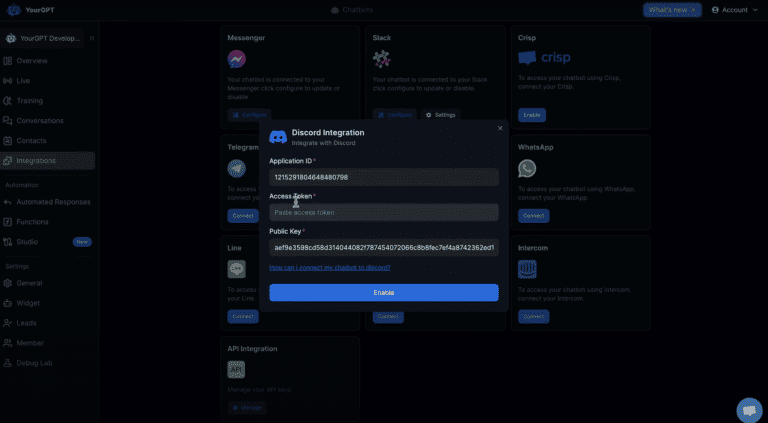
1. Add the Values like Application ID, Access Token and Public Key to active the bot.
1. Access OAuth2 Settings: Go to the “OAuth2” tab in your application settings. This section is where you’ll set the permissions your bot needs.
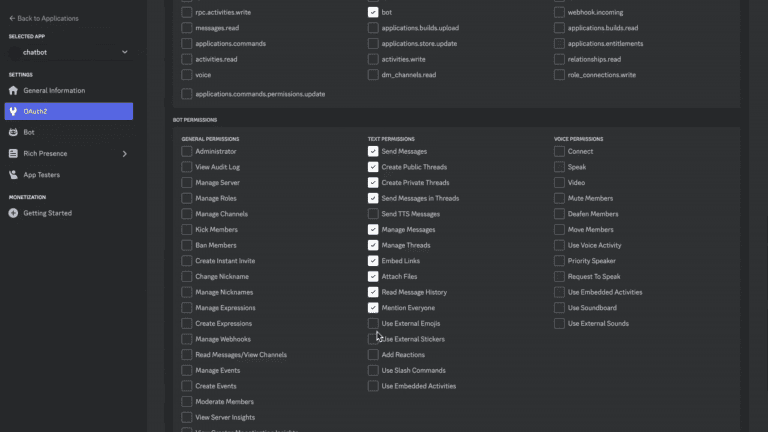
2. Set Permissions: In the “OAuth2 URL Generator” section, select the permissions your bot requires. For example, to send and manage messages, check “Send Messages” and “Manage Messages.”
3. Generate an Invite Link: Once you have set the permissions, copy the generated URL. Paste this URL into your browser to invite the bot to your server. Follow the prompts to authorize it.
/ask to start interacting with your bot.
Various industries are using GPT Discord bots to improve there server:
To make the most of your AI chatbot, consider these best practices:
Implementing these practices will help maximize the effectiveness of your AI chatbot and improve overall server management.
AI bots are constantly improving. Here is what you can expect in the near future:
An AI bot for Discord is an automated program that connects to your server and responds to user messages using artificial intelligence. Unlike rule-based bots, it understands user intent, answers FAQs, moderates conversations, routes requests, and escalates complex cases to a human when needed.
No. Platforms like YourGPT provide a guided, no-code setup. You create a Discord application, generate a bot token, connect your credentials in YourGPT, configure permissions, and test your bot without writing any code.
Setting up the Discord application usually takes 10 to 15 minutes. Training the bot with your FAQs, documentation, and product information typically takes another 20 to 30 minutes, allowing most bots to be ready within about an hour.
A Discord AI bot can answer FAQs, automate moderation, assign roles, route users to the right channels, collect feedback, send reminders, troubleshoot common issues using your documentation, and escalate complex requests to a human moderator with conversation history.
Upload your FAQs, help documents, product pages, policy files, or text into YourGPT. The platform indexes your content so the bot answers using your own knowledge instead of generic AI responses. You can retrain it whenever your content changes.
Yes. YourGPT supports more than 100 languages with automatic language detection, allowing users to receive responses in the same language they use without additional configuration.
Configure a fallback response that directs users to a moderator or support channel. YourGPT also lets you define confidence-based escalation rules so conversations automatically transfer to a human when the bot cannot provide a reliable answer.
The setup takes less than an hour. The value shows up in the first week. Questions that used to sit unanswered overnight get handled instantly. Your moderation team stops repeating themselves and starts focusing on conversations that actually need a human.
As the bot handles more conversations, it shows you exactly where your documentation has gaps and which questions your community asks most. That information makes your server better over time, not just faster.
YourGPT lets you build and deploy a Discord AI bot trained on your own content, no code required. Start with a free 7-day trial at yourgpt.ai.
Join thousands of businesses transforming customer interactions with YourGPT Chatbot
No credit card required • 7 days access • Limited time offer
Use YourGPT to help Black Friday shoppers choose products, check orders and understand returns. Prepare your answers and team before the sale.

Add in-app chat support to your SaaS or mobile app. Place it on the screens where users stall, pass who they are, and hand hard cases to your team.

Group new-account tickets by onboarding stage, train an AI agent on your docs, and place it in the product where new users get stuck.
AI agents can now find and buy products for shoppers. See what agentic commerce changes for a Shopify store and which support jobs stay yours.
Build a Halloween shopping assistant for Shopify with YourGPT. Set up product recommendations, stock checks, cart actions and human support before launch.

See what a good customer effort score looks like, how to word and calculate CES on each scale, and which support habits raise customer effort.