12 Tidio Alternatives and Competitors for 2026

Akansha
Last updated on September 4, 2026
If you are comparing Tidio alternatives, the constraint is probably already visible: the team has reached the 10-agent self-serve limit, Lyro and Flows create separate usage decisions, or customer requests now require API-backed actions rather than another knowledge answer. Build the shortlist around the operating model.
No-code AI Agent for answers, actions, and human handoff: YourGPT
Helpdesk with AI inside the support workspace: Intercom
Ecommerce support with order context and store actions: Gorgias
Enterprise voice and cross-system automation: Yellow.ai
Test these options with one knowledge question, one system action, and one human handoff from the current Tidio queue. Price the result using each platform’s actual billing unit.
On the customer’s screen, Tidio is one chat bubble. Behind it, Lyro answers from knowledge, Flows follows rules, the inbox routes conversations, and support agents make the decisions automation cannot.
When one of those layers stops fitting, replacing the entire stack can create more work than it removes. This comparison separates full support alternatives from specialist tools, then checks what each platform can answer, change, hand over, connect, and charge for. The goal is to replace the failing job rather than buy another familiar-looking widget.
Tidio combines a live-chat widget, shared inbox, Lyro AI Agent, and rule-based Flows. A comparison becomes useful when AI must complete tasks, more people need inbox access, or usage grows across several separately priced products.
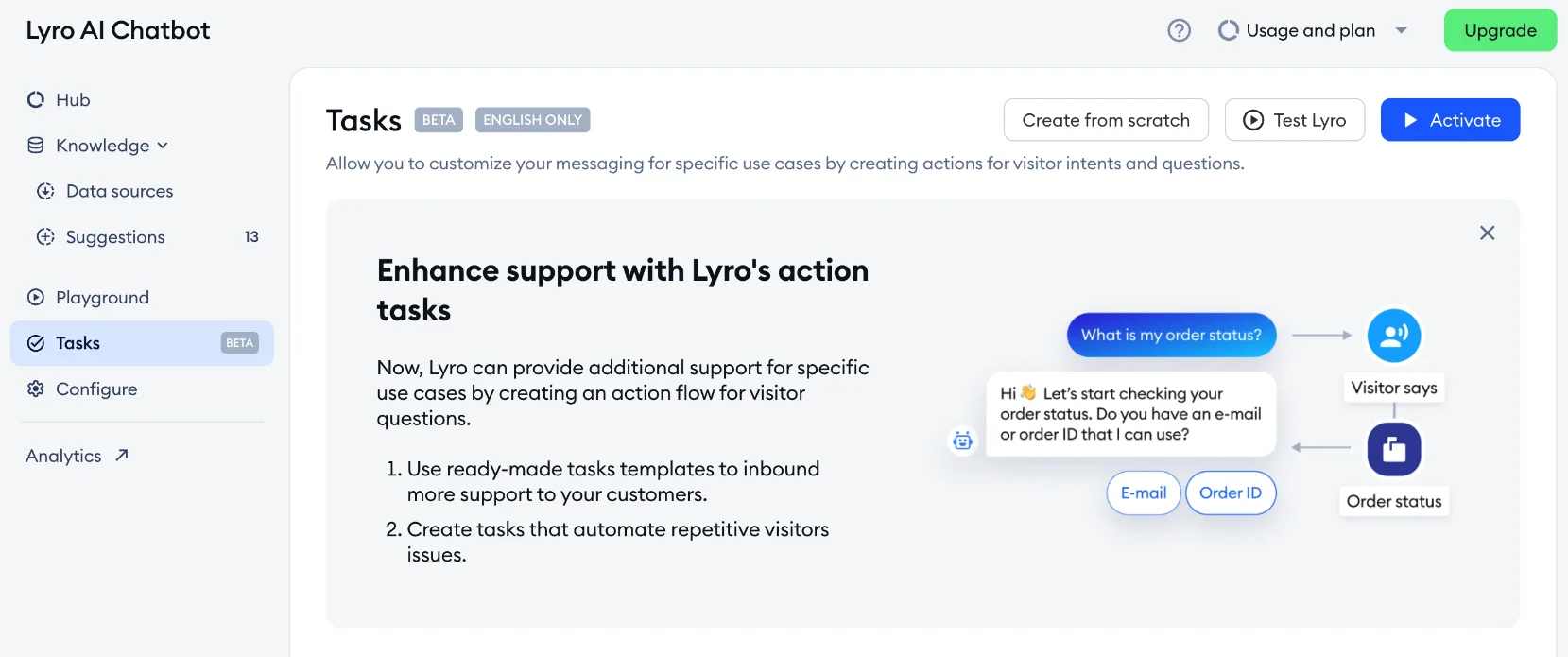
Tidio’s Lyro Tasks screen shows how an incoming order-status question can trigger an action.
The following reasons justify a comparison without pretending every Tidio customer has the same problem.
These are different buying triggers. A tool that solves one should not automatically receive credit for replacing the whole Tidio setup.
The table gives each product one honest position before the detailed review.
| Platform | Best Fit and Replacement Scope | Published Pricing and Boundary |
|---|---|---|
| 1. YourGPT | Lyro, Flows, handoff, and channels for a broad AI support replacement | From $39; compare Professional at $79 annual for actions and escalation |
| 2. Intercom | Helpdesk, widget, and AI for a mature SaaS support operation | From $29 per seat plus Fin outcomes |
| 3. Gorgias | Helpdesk, chat, and order actions for ecommerce support | Starter $40 (3 seats, 50 tickets); Basic $60 (500 seats, 300 tickets) |
| 4. Yellow.ai | AI, enterprise workflows, and voice | Custom pricing; official free-tier allowances conflict |
| 5. HelpCrunch | Inbox, chat, campaigns, and AI answers for human-led support | From $15 per member; backend Action Agents remain forthcoming |
| 6. Sendbird Chat | Developer-owned messaging inside a web or mobile product | 5K MAU from $349 annual; AI support is separate |
| 7. ManyChat | Social messaging automation for acquisition | From $14 annual for 250 Active Contacts; not a general helpdesk |
| 8. TARS | AI and workflow automation with retrieval evaluation | 50 free; Premium $499 annual view; Live Chat is separate |
| 9. Botsurfer | Focused Facebook Messenger automation | €99 per Facebook page monthly |
| 10. Botpress | Developer-owned AI, workflows, and handoff | Plus $150 annual plus conversation packs and AI spend |
| 11. Botsify | Managed Agent implementation across selected channels | $149 monthly or $1,490 annually with limited voice allowance |
| 12. Chatfuel | Meta-channel qualification, appointments, and human takeover | Official pricing structures conflict; confirm terms in the account |
The numbering follows replacement coverage. Platforms that address AI, inbox, actions, or handoff appear before tools built for one channel or deployment model.
The five capabilities in this visual are a useful starting checklist. The meaningful comparison comes from testing how each platform delivers them, where an integration stops, and which plan includes the required control.
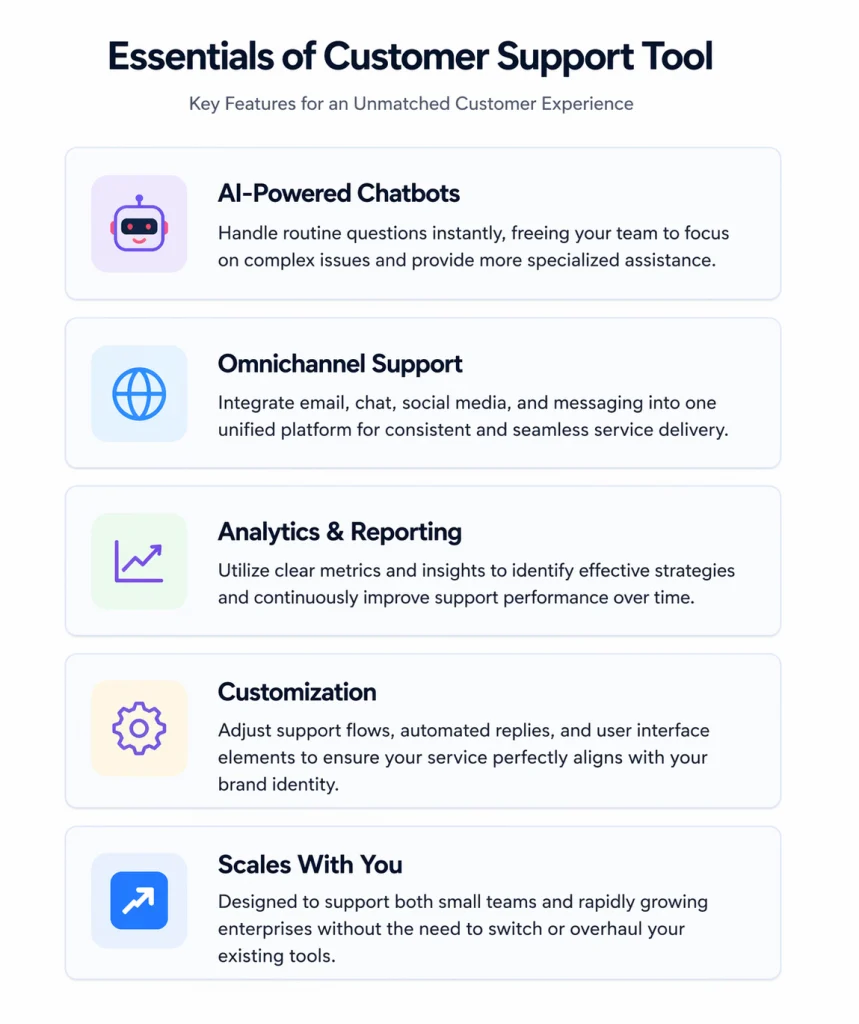
The checklist does not make every product comparable. It exposes the specific capability and operating cost that should decide the shortlist.
An integration logo only proves that two products can connect. Before treating a connection as a reason to migrate, verify what it can read, what it can change, how it authenticates, and what happens when the external system rejects a request.
Use five integration checks:
The product reviews below apply those checks to each platform’s documented integration model.
We checked each vendor’s official product documentation, help center, API references, and public pricing pages on 3 September 2026. Every capability, limit, and price used in this comparison comes from those first-party sources. Competitor blogs, unsourced feature grids, and review-count rankings were not treated as evidence. When a vendor’s own pages publish different figures, we show the conflict and explain what the buyer should confirm before approving a budget.
We evaluated each platform in the same order:
The seven-part method keeps the comparison useful without turning every vendor into an equal recommendation. This is a documented-capability review, not a claimed hands-on benchmark.
Each numbered review restores the same decision pattern: product definition, advanced features, pros, cons, pricing, and fit.
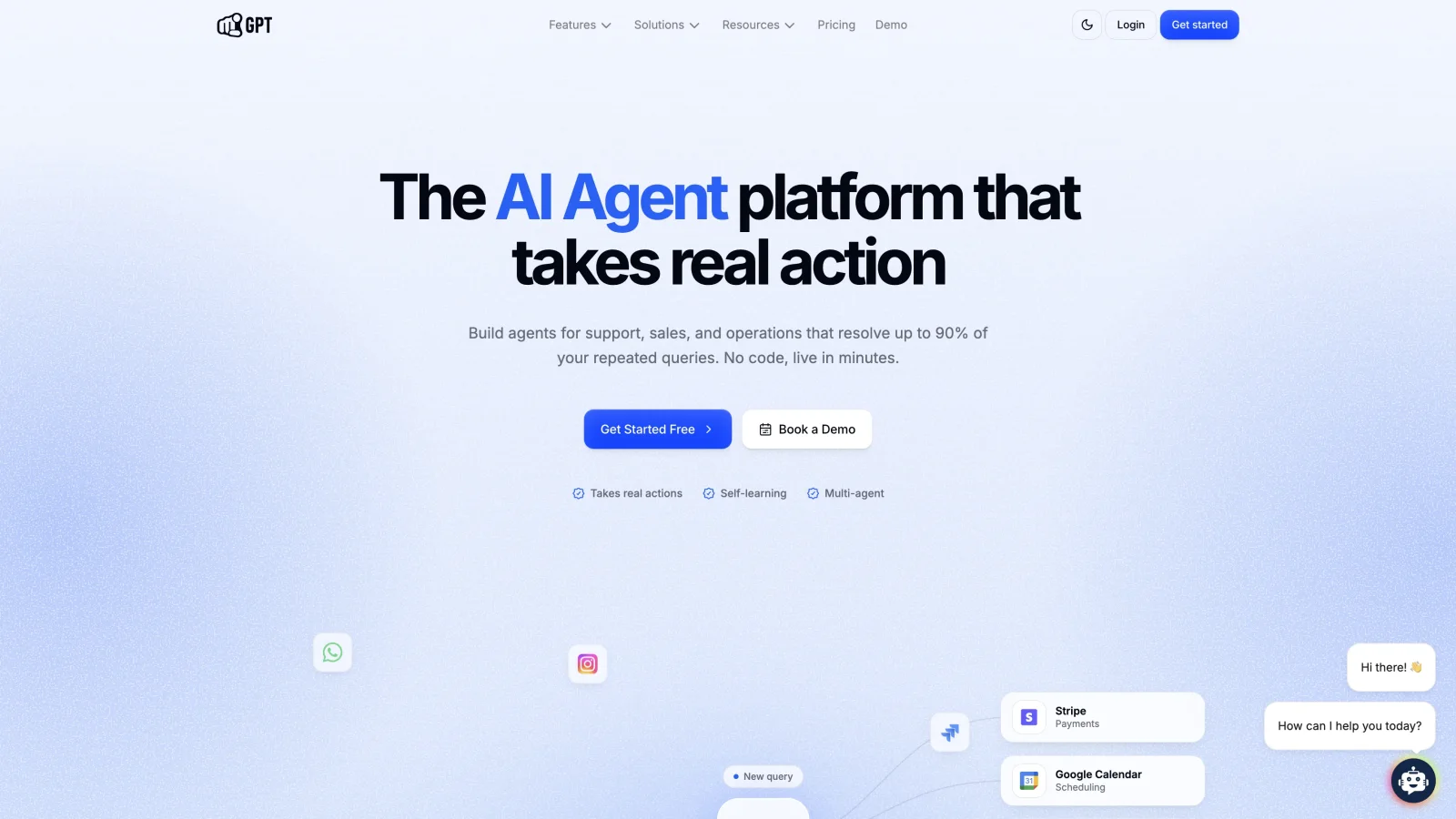
Best for: Teams that need a no-code AI Agent for support knowledge, actions, human handoff, and multiple channels.
YourGPT is a no-code AI platform for customer service, sales, and operational automation. For a Tidio replacement, the relevant job is customer service: teams give the Agent business data, policies, processes, and rules so it can answer questions, resolve supported requests, and transfer conversations to people when human judgment is required. Native live chat also lets human operators read and reply to conversations directly, so the product is not limited to autonomous support.
The setup can begin with knowledge and a website Agent. Later stages can add actions, APIs, workflow controls, model controls, multi-agent coordination, and omnichannel support. The first useful deployment does not require the most advanced workflow.
YourGPT pricing displays Essential at $39, Professional at $79, and Advanced at $349 a month with annual billing. The corresponding month-to-month prices are $59, $129, and $499. Professional is the relevant Tidio replacement boundary because it includes 30 million credits, five team members, Smart Learning, Functions, AI Studio, and human escalation.
The AI Studio guide shows how those events and actions fit into a controlled support workflow.
These first-party case studies are not independent benchmarks or guarantees for a new Agent.
Tidio centers on customer support, and both platforms support live human conversations. YourGPT can also apply the same Agent foundation to customer service, sales, and operational automation, while native live chat and AI Support Copilot keep human operators inside the support path. Compare YourGPT Professional when work crosses those functions or requires multi-step actions; keep Tidio when its existing widget, inbox, and rule automation already complete the support job with less implementation.
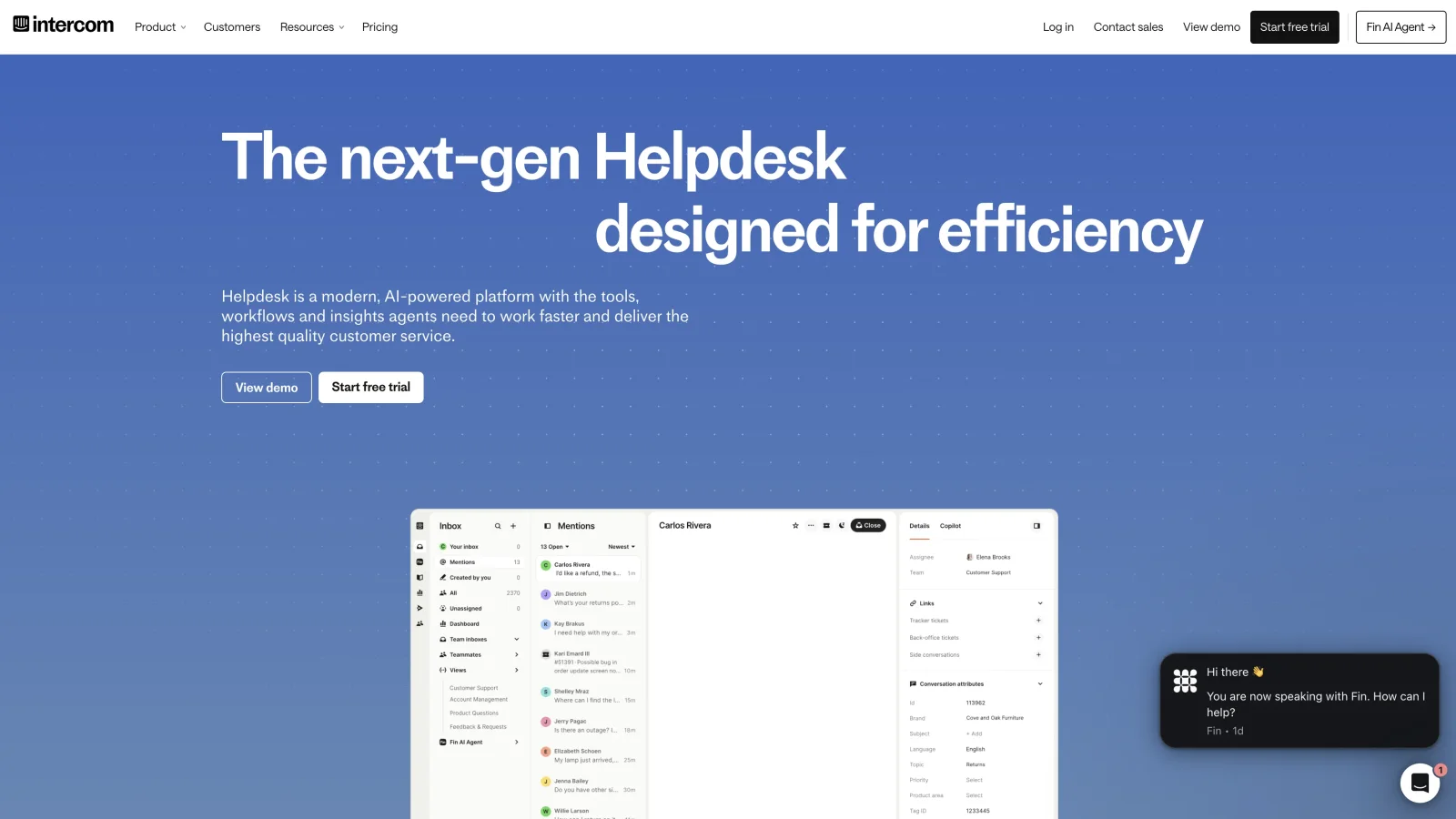
Best for: SaaS and product-led support teams that need a mature helpdesk with Fin as the AI Agent layer.
Intercom Helpdesk combines Messenger, Inbox, Tickets, Help Center, Knowledge Hub, automation, reporting, and integrations in one customer-service workspace. Fin adds the AI Agent layer. Together, they can replace both Tidio’s support workspace and Lyro, but Intercom seats and Fin outcomes use separate charges.
In 2026, the company formerly known as Intercom renamed itself Fin, while Intercom remained the name of its helpdesk software. Salesforce then signed a definitive agreement to acquire Fin for approximately $3.6 billion. As of 3 September 2026, Salesforce still described the transaction as pending, so it is more accurate to say that Salesforce plans to acquire Fin than that the purchase has closed.
Intercom pricing starts at $29 per seat for Essential, $85 for Advanced, and $132 for Expert. Fin charges $0.99 for a support resolution, Procedure handoff, or disqualification, while sales qualification costs $9.99.
Intercom is the closer replacement when the shared inbox, support process, and AI Agent must operate as one mature SaaS helpdesk. Fin Procedures go beyond rule-based Flows, but every seat and Fin outcome can change the bill, so it is less predictable than comparing one Tidio plan alone.

Best for: Ecommerce teams whose queue is dominated by orders, refunds, subscriptions, returns, and fulfillment.
Gorgias is an ecommerce support helpdesk and AI Agent built around store data. Its meaningful advantage over Tidio is the ability to inspect commerce context and complete supported order work from the support workspace.
POST, PUT, and DELETE requests from ticket events and macros. Requests time out after five seconds, error responses are not retried, and 500 consecutive failures disable the integration.Gorgias pricing bills by monthly ticket volume and automated AI interactions rather than per-agent seat charges. Starter is $40 a month ($10 for 50 helpdesk tickets with up to 3 user seats, plus $30 for 30 AI interactions). Basic starts at $60 a month for 300 tickets and includes up to 500 user seats. Extra Starter tickets cost $0.40 each and extra AI interactions cost $1.
Gorgias replaces Tidio’s inbox and AI most convincingly when agents need Shopify context and supported order actions beside each ticket. Tidio remains the simpler general website option; Gorgias earns the larger operational footprint only when commerce work defines the queue. Model both overages and every separate fulfillment connection before moving.

Best for: Enterprises building voice and text Agents across several business systems.
Yellow.ai is an enterprise customer and employee experience platform spanning chat, email, voice, and connected applications. The implementation requires an integration and testing program rather than a direct website-widget swap.
The public Yellow.ai pricing page lists one free Agent with 500 chat sessions, followed by $0.99 per resolution. Billing documentation updated 1 September 2026 instead lists 5,000 monthly bot conversations, unlimited seats, 500 chat or email tickets, and two channels on Freemium. Confirm which terms govern the account before using either number.
Yellow.ai adds enterprise voice, traces, registered tools, and integrations across multiple business systems. Tidio’s self-serve plans target a smaller implementation. Yellow.ai also requires more governance, credentials, testing, and procurement, so shortlist it for an enterprise program rather than a routine Tidio Starter replacement.
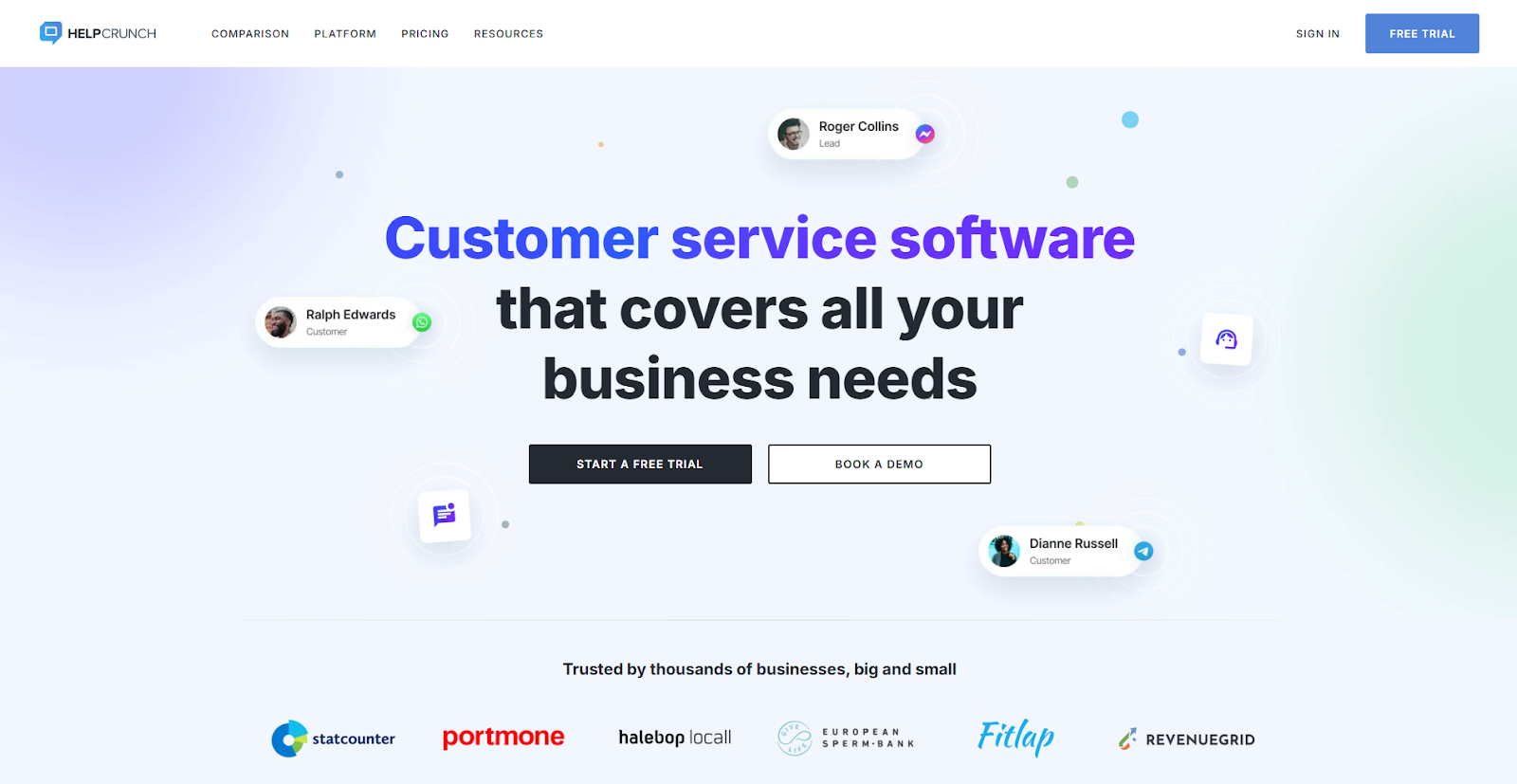
Best for: Human-led support teams that want chat, email campaigns, knowledge, and AI routing in one customer record.
HelpCrunch combines a shared inbox, live chat, email campaigns, knowledge content, visual automations, and knowledge-trained AI Agents. Its support and engagement tools sit together, which makes it more complete than a standalone bot builder.
The HelpCrunch subscription guide lists Standard from $15 and Premium from $25 per member, with a 20 percent annual discount. Separate AI pricing documentation uses Pro and Unlimited: Pro includes five Agents and 50 monthly AI conversations. Another 100 conversations cost $29 monthly or $23.20 on annual billing.
HelpCrunch is a close inbox and customer-communication replacement when people still own the queue and AI handles routing or knowledge answers. Its campaigns and unified customer record can replace more than a bot builder, but backend Action Agents remain forthcoming. Teams needing mature external-system actions should compare YourGPT, Intercom, or Gorgias instead.
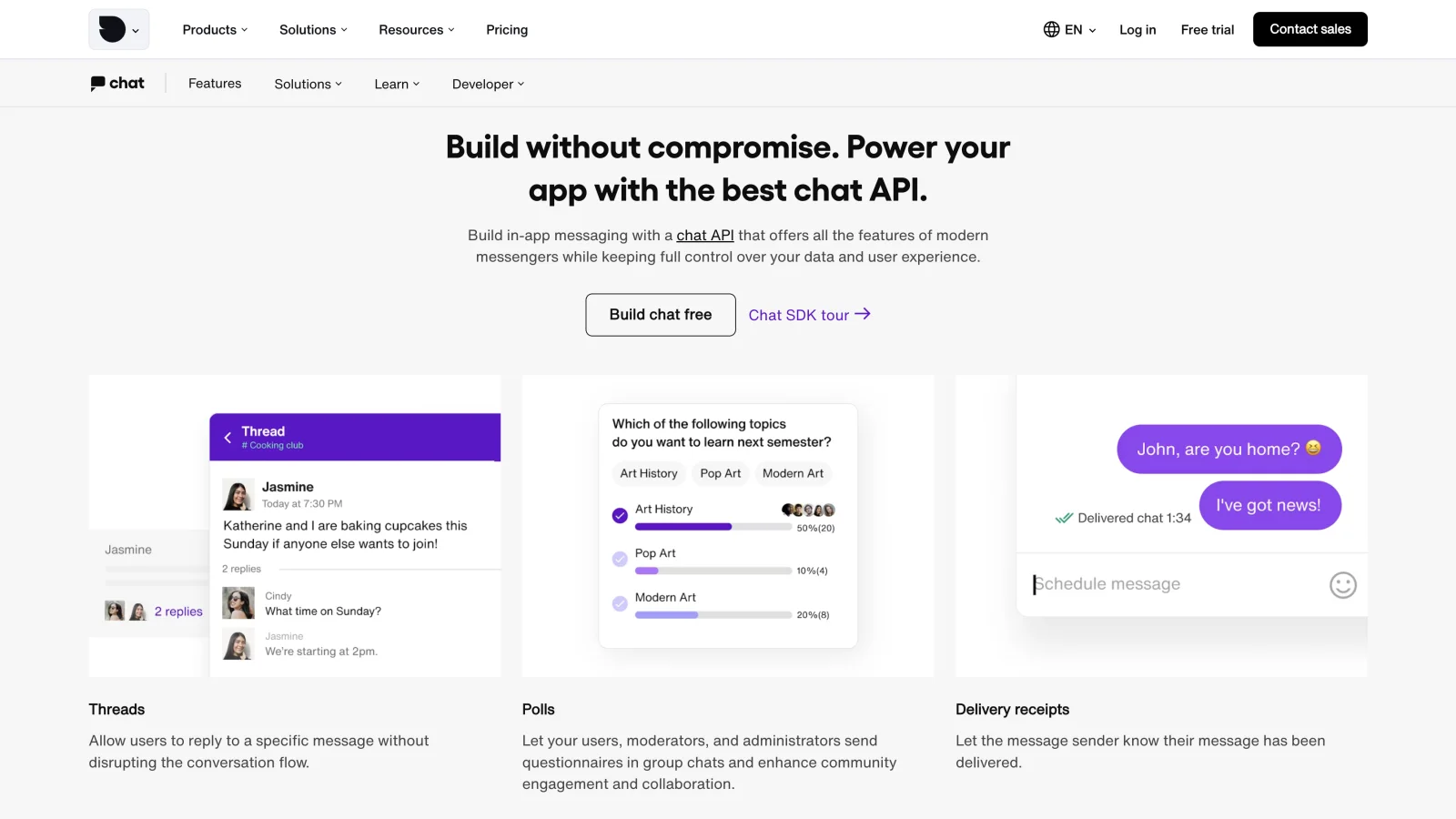
Best for: Product teams building messaging directly into a web or mobile application.
Sendbird Chat is developer infrastructure, not a ready-made Tidio helpdesk. Developers use its SDKs, UIKit components, and Platform API to build and control the messaging experience inside their own product.
Sendbird Chat pricing lists the 5K monthly-active-user Starter tier at $349 a month on annual billing or $399 month to month. delight.ai is a separate AI support Agent and Desk with custom pricing.
Sendbird replaces the messaging surface only when a product team needs to own chat inside its web or mobile application. Tidio supplies a ready-made support widget and inbox; Sendbird supplies APIs, interface components, and moderation that developers must assemble. Its Chat subscription does not replace Lyro or the complete support operation.

Best for: Brands and creators turning Instagram comments and social messages into leads.
ManyChat is a social chat marketing platform for Instagram, Messenger, and WhatsApp. Its automations focus on acquisition and follow-up rather than a broad support desk or a general Messenger support stack.
GET, POST, PUT, and DELETE calls to an HTTPS endpoint and can map response values into custom fields. Zapier and external requests require eligible paid plans.ManyChat pricing lists Essential at $14 a month on annual billing for 250 Active Contacts, or $17 month to month. Pro costs $29 annual or $39 monthly for 2,500 Active Contacts.
ManyChat can replace the social campaign and message-automation part of a Tidio setup, especially when Instagram comments must continue as private lead conversations. ManyChat does not replace the same breadth of website helpdesk, knowledge support, and external actions. Choose it when social acquisition is the main job and keep another system for broader support.

Best for: Teams that value retrieval evaluation and release controls for support and sales Agents.
TARS began with conversational landing pages and has expanded into an AI Agent platform. The current product covers retrieval, tools, evaluation, deployment controls, and conversation continuity across web, WhatsApp, and email.
TARS pricing includes 50 monthly conversations and five knowledge bases on Freemium. The annual-billing view lists Premium at $499 a month, starting with 500 conversations. Live Chat costs another $600 per seat each year.
TARS offers more explicit retrieval ranking, synthetic testing, and evaluator controls than Tidio’s standard AI and Flow setup. TARS can replace the automated conversation layer, but Live Chat carries a separate seat price and the Premium entry point is much higher. Choose it when release evaluation justifies that budget.

Best for: Small teams that need a focused Facebook Messenger automation.
Botsurfer is a no-code builder for scripted Messenger conversations and narrowly scoped AI answers. Botsurfer does not claim to replace a wider support suite.
Botsurfer pricing lists a 30-day trial and PRO at €99 a month per Facebook page, plus VAT.
Botsurfer replaces only a Facebook Messenger automation path. Tidio covers a website widget, shared inbox, knowledge Agent, and rule-based Flows across a broader support operation. Choose Botsurfer when one Messenger page is the entire requirement, not when the team needs a complete Tidio replacement.

Best for: Engineering teams that want to own support-agent logic in visual and code-based tools.
Botpress is a cloud platform for building Agents through visual Studio or a TypeScript ADK. Botpress mixes autonomous tool selection with deterministic workflow steps, API and code execution, and Botpress Desk for human takeover.
event.payload. The webhook returns no response body, and the workflow must store the payload before the next visitor or Agent message overwrites it.Botpress pricing gives Free 100 conversations. Plus costs $150 a month on annual billing for 250 conversations, then automatically buys $65 packs of 100 at the threshold. AI spend has a separate allowance and recharge mechanism.
Botpress can replace Lyro and Flows with a developer-owned Agent that mixes autonomous and deterministic logic. The platform offers more code control than Tidio, but teams still need to design handoff, maintain integrations, evaluate releases, and monitor two usage meters. Choose it when engineering ownership is an advantage rather than a burden.

Best for: Buyers who want managed implementation instead of building the first Agent internally.
Botsify combines a prompt-first builder with a done-for-you package. Its team handles strategy, the initial Agent, and ongoing optimization.
Botsify pricing lists the managed package at $149 a month or $1,490 a year.
Botsify changes the ownership model more than it reproduces Tidio’s daily support workspace. The managed package can reduce the effort required to build an Agent across selected channels, but vendor involvement becomes part of every substantial iteration and the product does not document equivalent inbox control. Choose it when implementation help is the primary requirement.

Best for: Teams qualifying leads and booking appointments inside Instagram, Facebook, and WhatsApp.
Chatfuel is a no-code sales and support automation platform for Meta channels. Fuely connects AI qualification with a visual lead pipeline and human takeover.
The public Chatfuel pricing page lists Light as free and AI PRO at $49 a month on annual billing. Its Help Center plans instead list a seven-day trial, Fuely Super from $39 to $279, and Fuely Max from $59 to $549 according to active contacts in a rolling 30-day window. Use the structure shown inside the account before approving a budget.
Chatfuel replaces social qualification, appointment, and campaign flows rather than Tidio’s full website support stack. Its Meta-channel pipeline and human takeover are useful when the conversation begins in Instagram, Facebook, or WhatsApp, but a general website helpdesk still needs another product. Confirm the account’s pricing model before approving the switch.
Do not choose from the comparison table alone. Use a short, repeatable test that gives every platform the same information.
The right choice completes your real work at a cost the team can model. A longer checklist cannot prove that.
Intercom is the closest helpdesk-led replacement because it combines an inbox, ticketing, knowledge, reporting, and Fin. Gorgias provides similar coverage for ecommerce support, while HelpCrunch fits a more human-led operation. YourGPT combines an AI Agent, native live chat, and human handoff, but it does not provide native ticket creation or built-in ticket management. Decide first whether the team needs a traditional ticket queue or an Agent-led support operation.
YourGPT can call configured APIs, code functions, system tools, and MCP servers during multi-step work. Intercom Fin Procedures can use tools and data connectors, Gorgias can perform supported Shopify order actions, and Botpress can run developer-owned tools and workflows. Do not score an integration from its logo alone. Test one authenticated read, one approved write, one rejected request, and one downstream failure before treating action support as proven.
YourGPT makes the Agent the operating layer rather than placing AI on top of a ticket queue. The Agent can interpret a request, use approved business context, call tools, coordinate another Agent, and hand the conversation to a person. The same foundation can support customer service, sales, and operational work. Choose that model when the goal is end-to-end resolution across systems; choose a traditional helpdesk when ticket management is the primary requirement.
Yes. A team can begin without code by connecting its knowledge and deploying a website Agent. The same setup can later add APIs, code functions, model controls, workflow conditions, more channels, human handoff, and single-agent or multi-agent coordination. Teams retain control over the approved knowledge, policies, tools, permissions, and escalation points. Production write actions still require credentials, safeguards, test data, and failure handling.
Replay real requests from the current queue rather than using generic demo questions. Include a knowledge answer, an authenticated account lookup, an approved update, an unsupported request, and a human handoff. Record answer accuracy, action success, failure visibility, escalation context, and the work required from an operator. Keep Tidio running during a short overlap so the team can compare outcomes against the same request set.
Model the billing unit against the last 30 days of real demand. Include seats, AI outcomes, tickets, conversations, active contacts, monthly users, credits, and overages where they apply. Add implementation, integration maintenance, and human review time. A lower subscription price can still cost more if the team must operate several add-ons or manually recover failed actions, so compare cost per completed request rather than the advertised starting price.
Staying with Tidio is a valid decision when its widget, inbox, Lyro capacity, Flows limits, seat count, and total bill still match the support operation. Migration should fix a documented gap, not replace a familiar product for the sake of changing tools.
When a broader AI replacement is necessary, test YourGPT Professional for trained answers, approved actions, channels, and human escalation under one credit pool. Compare Intercom when the human helpdesk and SaaS operating model matter more, Gorgias when order work defines the queue, HelpCrunch when people remain responsible for most conversations, and Yellow.ai when voice and enterprise integration are requirements from the outset.
Specialist requirements produce a different shortlist. Sendbird fits messaging embedded inside a product, Botpress fits a developer-owned Agent, TARS fits teams prioritizing retrieval evaluation, Botsify fits a managed build, and ManyChat, Chatfuel, or Botsurfer fit specific social acquisition and messaging jobs.
Whichever path fits, run the same knowledge question, system action, and human handoff before migration. Keep Tidio available during a short overlap, compare failures as closely as successes, and approve the move only when the new platform completes the required work at a cost the team can model.
Connect your business knowledge, configure system actions across connected tools, and test real support requests before replacing your widget.

Compare outsourcing customer service with an AI agent using your own ticket mix, a cost model you fill in, and a clear rule for a hybrid split.

Export the Zendesk ticket archive, train an AI Agent on the help center, and test one real ticket before you stop the old queue.


Compare six Yuma alternatives by ecommerce capabilities, helpdesk compatibility, pricing and human handoffs to choose a replacement for your support team.


Move from Gorgias with a verified ticket archive, tested AI workflows, human handoff and a channel cutover plan before ending your subscription.
TL;DR The Gorgias AI Agent is the automation layer inside the Gorgias helpdesk, split between a Shopping Assistant for pre-purchase conversations and a Support Agent for post-purchase support. A connected Shopify store is required, and Gorgias documentation rules out platforms such as BigCommerce, Magento, and WooCommerce for the AI Agent. Billing runs on two separate […]

TL;DR Gorgias is the closest Richpanel alternative for Shopify stores that need native order actions directly inside support tickets. YourGPT fits stores that want one AI agent handling requests across web, WhatsApp, Instagram, and email, while Tidio and Re:amaze suit smaller teams looking for lighter, lower-cost options. Richpanel’s AI pricing starts around $500/month for two […]