8 Best n8n Alternatives for AI Agents in 2026

Rajni
Last updated on October 9, 2026
n8n can build AI agents, but memory, tools, evaluation, and deployment often require manual setup and ongoing maintenance.
Zapier, Make, GPTBots, Gumloop, and viaSocket combine AI agents with workflow automation, each balancing ease of use, integrations, and customization differently.
Relevance AI and Dust focus on agent-first experiences with stronger support for multi-agent coordination, memory, and company knowledge.
YourGPT provides a trained, ready-to-deploy AI agent for customer support and business automation, reducing the need to assemble complex workflows from scratch.
Ask an n8n user to automate a Slack notification when a form gets submitted, and the platform earns its reputation in about ten minutes. Ask the same person to build an AI agent that remembers a customer, decides which tool to call, and hands off to a human when it’s unsure, and the canvas stops being the hard part. Everything n8n leaves for someone else to build becomes the hard part.
That gap is why this list exists. A workflow automation tool and an AI agent platform solve overlapping but genuinely different problems. n8n treats an agent as one more node type, sitting next to the HTTP request block and the email block. Building something that reasons and acts on top of that means assembling a vector database, writing memory logic, and wiring tool permissions by hand.
The eight platforms below split into three groups. Four grew agent capability on top of general automation tools. Two were built agent-first. One skips the building step and hands over a working agent instead. Each entry names what it does well, what it costs, and where it falls short, not just what the landing page promises.
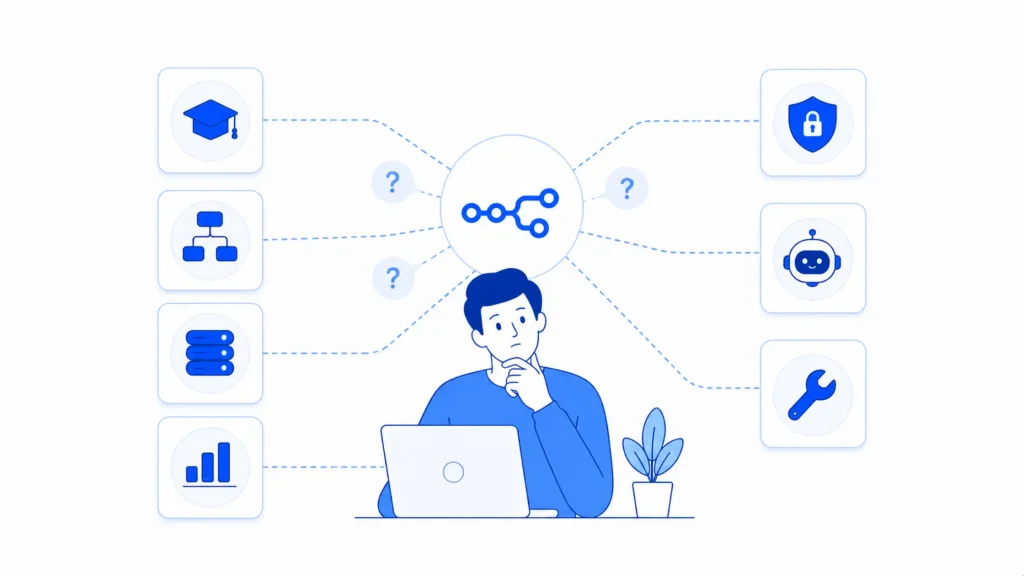
n8n is not a weak product. It handles conventional workflow automation about as well as anything on the market. The friction shows up once the goal shifts from automating a process to building something that reasons and acts.
n8n sets a real baseline. It bills by execution, connects to a large app library, and now ships AI and agent nodes with native MCP support. A genuine alternative needs to match or beat that on at least one front. Five factors carry the most weight for an AI agent platform specifically.
| Platform | Best For |
|---|---|
| Zapier | AI-powered automation across thousands of apps with agents and no-code workflows |
| Make | Visual automation with AI agents and prebuilt templates |
| YourGPT | AI agents that resolve up to 90% of repetitive support, sales, and operations queries |
| GPTBots | No-code AI agents for customer support and workflow automation |
| viaSocket | Built-in AI agents integrated with workflow automation across 2,200+ apps |
| Gumloop | AI-native workflows, agent chats, reflections, and multi-agent runs |
| Relevance AI | Coordinating multiple AI agents as an AI workforce |
| Dust | AI agents connected to company knowledge across Notion, Slack, and Google Drive |
Each platform below is evaluated against the criteria above, with the same level of scrutiny applied whether the agent story is a recent addition or the platform’s entire reason for existing.
Zapier added a dedicated Agents product on top of its existing 9,000+ app catalog, and that’s the detail worth understanding before anything else. Zapier Agents runs on its own activities quota, separate from the Zaps task pool that powers Zapier’s traditional automations.
An agent built here can reach every one of those 9,000+ apps as a callable tool, which is a genuinely wide surface for tool access. Non-technical teams already using Zapier for automation get agent capability without switching platforms, though the two products bill and scale independently, so evaluating cost means checking both quotas, not one.
Teams already running Zapier for automation who want to add agent capability without adopting a new platform, and who are comfortable managing two separate products under one account.
Make added AI Agents in beta directly onto its existing branching canvas, the same routers and filters that already fan a trigger out into multiple paths now support agent logic as one more module type. A library of prebuilt agent templates ships alongside it, aimed at teams that want a starting point rather than a blank canvas.
Credits meter both traditional scenarios and agent runs from the same pool, so there’s no separate quota to track the way there is with Zapier. The tradeoff is that agent building here still inherits the visual-canvas mental model Make has always used, a real strength for teams who already think in that shape, a real limitation for anything that needs true multi-agent coordination.
Teams that already think in Make’s visual canvas and want to add agent logic incrementally, without learning a second product’s mental model.
Building a customer-facing AI agent in n8n often means configuring memory, retrieval, messaging channels, escalation rules, and external tools separately. YourGPT combines these parts in one managed platform, reducing the need to maintain a separate RAG pipeline, chat interface, and channel infrastructure.
AI Studio lets teams build agent workflows with conditions, API calls, code execution, routing, and human handoff. The Autonomous Agent can also search company knowledge, use approved tools, connect with external systems, and decide which action to take based on the customer’s request.
The same agent can be deployed across websites, WhatsApp, Instagram, Telegram, Slack, email, and phone. External channels still require their normal account permissions and configuration, but the main agent logic and knowledge remain managed in one workspace.
Teams building customer-facing support, sales, or service agents that need company knowledge, external actions, multi-channel deployment, and human handoff without maintaining each component separately.
GPTBots is an enterprise-focused no-code AI agent platform, and its main advantage over n8n is the built-in infrastructure for developing and operating AI agents. Instead of assembling separate tools for knowledge retrieval, model access, deployment, and monitoring, teams can manage these capabilities within one platform.
GPTBots supports three agent types: standard Agents for knowledge-based conversations, FlowAgents for structured processes, and MultiAgents for tasks involving multiple specialized AI roles. Its visual builder supports APIs, MCP tools, conditional logic, and external systems. Teams can deploy agents across websites, APIs, and messaging channels, or connect them with tools like n8n and Zapier for broader automation.
Enterprises building customer support agents, AI sales agents, internal knowledge assistants, and multi-step business workflows that need built-in model access, knowledge management, integrations, and deployment controls.
viaSocket built AI agents directly into its core workflow builder rather than shipping them as a separate product with its own quota. An agent sits inside the same flow as your triggers and actions, reading data from connected apps, applying plain-English instructions, and taking the next step without a second tool to configure or bill separately.
Instead of task-count tiers, viaSocket runs on a single pay-as-you-go pool of tasks and credits. Every step in a workflow, including the trigger, consumes a task, and premium actions like AI steps, WhatsApp, or SMS draw from a shared credit balance. There’s no separate “agent plan” to unlock, which keeps the pricing model simpler to reason about than platforms that meter agents apart from core automation.
Teams that want agent capability and traditional automation in one product and one bill, particularly those who find Zapier’s split between Zaps and Agents, or Make’s beta-labeled agent layer, adds more overhead than they want to manage.
Agent chats, agent reflections, and multi-agent runs are literal line items on Gumloop’s own pricing page. That’s a company describing its actual product, not marketing language layered over a general workflow tool. GPT, Claude, and Gemini are all available inside a workflow without a team managing separate API keys, and MCP server hosting ships on every paid plan. The credit system is tuned specifically for model calls and agent reasoning, the exact opposite of how n8n meters usage around simple data transfers. Integration breadth is where the trade shows up. Gumloop’s engineering attention goes toward the agent experience, and matching Zapier’s app catalog was never the goal.
Teams whose n8n project was really an attempt to build an AI agent, not automate a data pipeline, and who want that agent-first focus reflected in the product itself, not just the marketing.
Relevance AI is built around the idea of an AI workforce, several specialized agents coordinating on real tasks rather than one agent handling everything end to end. Billing splits into two meters, Actions for what an agent actually does and Vendor Credits for the underlying model cost, with credits rolling over indefinitely and no markup over the provider’s own rates. Bringing a team’s own LLM API keys bypasses Vendor Credits entirely for teams that already have a provider relationship. The free tier caps at 200 Actions a month, generous enough to test the multi-agent pattern before committing, thin for anything resembling production use.
Teams that specifically need multiple agents working together on a shared task, and who are comfortable tracking a two-part usage meter to keep costs predictable.
Dust connects agents directly to a company’s existing knowledge, Notion, Slack, Google Drive, GitHub, then lets a team pick which model reasons over that knowledge, OpenAI, Anthropic, Google, or Mistral. That model choice is the platform’s clearest differentiator against a single-vendor assistant like Microsoft Copilot. Dust overhauled its pricing in June 2026, replacing a flat unlimited-message seat with a credit-metered structure, so a team evaluating cost today needs the new numbers, not whatever older reviews still describe. Paris-based and backed by more than $60 million in funding including a Sequoia-led round, the company reports zero customer churn through 2025, a genuine signal of retention even if it doesn’t guarantee future pricing stability.
Teams that want an agent grounded in existing company knowledge from day one, and who value model choice over being locked into a single AI vendor’s stack.
| Platform | Key Strength | Memory & Context | Self-Hosted | Starting Price | Main Limitation |
|---|---|---|---|---|---|
| Zapier | Access to more than 9,000 apps and a large callable tool ecosystem | Limited compared with dedicated agent-first platforms | No | Agents priced separately from standard Zapier plans | Zaps and Agents use separate quotas and billing models |
| Make | Agent logic inside Make’s visual scenario canvas | Conversation history supported through configured conversation IDs | No | Free plan or $12/month Core | AI Agents remain in beta and complex canvases can become difficult to maintain |
| YourGPT | Managed RAG, AI Studio, multi-channel deployment, and human handoff | Built-in conversation context and managed knowledge retrieval | No public self-hosted edition | $39/month billed annually | Less suitable for backend workflows without a conversational interface |
| GPTBots | No-code enterprise AI agents with multi-model, workflow, and MCP support | Managed knowledge bases, conversation context, and agent memory | Private-cloud and on-premises deployment available | Free plan; paid plans by quote | More enterprise-focused than basic app-to-app automation tools |
| viaSocket | Built-in AI agents integrated directly into workflows with 2,200+ app integrations and MCP support | Workflow context is maintained within automation runs using connected app data and agent instructions | No public self-hosted edition | Free plan with pay-as-you-go tasks and AI credits | Shared task-and-credit pricing takes time to learn, and the AI agent platform is newer than more established competitors |
| Gumloop | Agent evaluations, reflections, MCP hosting, and concurrent chats | Built for ongoing agent interactions and knowledge use | No public self-hosted edition | $37/month Pro | Narrower app ecosystem and credit usage can be difficult to estimate |
| Relevance AI | Multi-agent workforce design with separate roles and tools | Persistent context and knowledge designed for coordinated agents | No public self-hosted edition | Custom Enterprise pricing | No transparent self-service pricing and more setup than a single-agent platform |
| Dust | Native connections to Notion, Slack, Google Drive, GitHub, and other company sources | Strong knowledge grounding and shared conversational context | No public self-hosted edition | Free or $30/month per Pro seat | Better for employee knowledge work than complex backend automation |
The best n8n alternative depends on what the agent must accomplish after it understands a request.
Choose YourGPT when the agent must operate across a website, messaging apps, social channels, email, or phone, with business knowledge and human handoff inside the same platform.
Choose Make when agents need to operate inside detailed visual scenarios that already connect several business applications.
Choose GPTBots when you need no-code AI agents with built-in knowledge bases, multi-model support, workflow orchestration, and private-cloud or on-premises deployment options.
Choose Gumloop when the team wants evaluations, reflections, approval controls, collaborative building, and agent workflows without maintaining the underlying infrastructure.
Choose Zapier when the agent’s usefulness depends on reaching many existing SaaS tools through managed integrations.
Choose Relevance AI when a business process requires several specialist agents with separate roles and shared objectives.
Choose Dust when employees need agents that search company systems, use internal tools, generate work, and collaborate in shared conversations.
Stay with n8n when the team has the technical capacity to assemble and operate the agent stack, values self-hosting, and needs AI decisions inside complex backend workflows.
The best option depends on how much assembly your team wants to handle. Gumloop is a strong agent-first platform for teams that still want to design workflows, while YourGPT provides a more managed setup for customer-facing agents, knowledge retrieval, channels, and human handoff.
Yes. n8n supports AI Agent nodes, memory, evaluations, MCP tools, human approval, and multi-agent workflows. The main difference is assembly, since teams still need to configure the surrounding knowledge, channels, permissions, and deployment setup.
Lindy repositioned around a personal AI executive assistant focused on individual inboxes, calendars, meetings, and daily work. This comparison focuses on platforms used to build broader business agents and automation workflows.
Relevance AI is built specifically for this pattern. It lets teams create coordinated workforces of specialist agents with separate roles, tools, instructions, and responsibilities.
No. Dust changed its pricing in June 2026 and introduced credit-metered Free, Pro, and Max tiers. Reviews that describe an unlimited-message plan at around €29 use the previous pricing structure.
GPTBots offers private-cloud and on-premises deployment options for enterprises that need greater control over AI agent infrastructure and data. These options differ from n8n’s self-hosted offering and may require an enterprise agreement. Zapier, Make, Gumloop, Relevance AI, Dust, and YourGPT do not provide comparable public self-hosted editions.
n8n remains a strong choice for building AI agents within complex automation workflows. With memory, evaluations, MCP integrations, human approval, vector retrieval, and multi-agent orchestration, it already supports many capabilities teams look for in dedicated AI agent platforms. The reason to switch isn’t missing features but finding a platform better suited to your needs.
YourGPT is well suited for customer-facing AI agents with built-in knowledge management and human handoff. Make works well for visual business automation, while GPTBots provides enterprise AI agent development with private deployment options. Gumloop focuses on agent workflows and evaluations, Zapier offers broad SaaS integrations, Relevance AI supports coordinated agent teams, and Dust specializes in internal knowledge agents.
Before choosing, consider three things: what your agent needs to do, which systems it must connect to, and how much infrastructure your team can manage. The best n8n alternative is the one that meets those requirements without adding unnecessary cost or complexity.
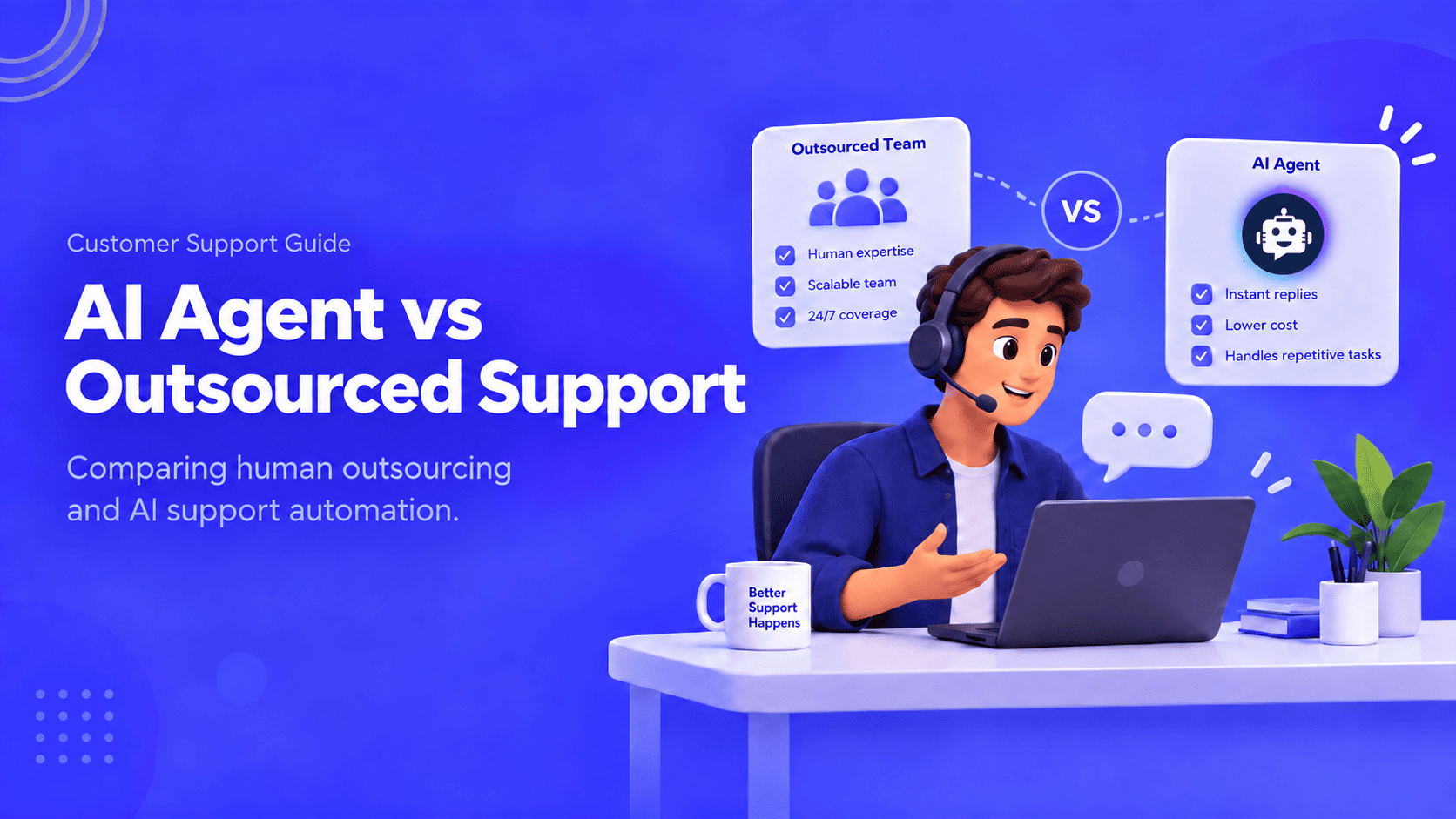
Compare outsourcing customer service with an AI agent using your own ticket mix, a cost model you fill in, and a clear rule for a hybrid split.
Export the Zendesk ticket archive, train an AI Agent on the help center, and test one real ticket before you stop the old queue.


Compare six Yuma alternatives by ecommerce capabilities, helpdesk compatibility, pricing and human handoffs to choose a replacement for your support team.


Move from Gorgias with a verified ticket archive, tested AI workflows, human handoff and a channel cutover plan before ending your subscription.
TL;DR The Gorgias AI Agent is the automation layer inside the Gorgias helpdesk, split between a Shopping Assistant for pre-purchase conversations and a Support Agent for post-purchase support. A connected Shopify store is required, and Gorgias documentation rules out platforms such as BigCommerce, Magento, and WooCommerce for the AI Agent. Billing runs on two separate […]

TL;DR Gorgias is the closest Richpanel alternative for Shopify stores that need native order actions directly inside support tickets. YourGPT fits stores that want one AI agent handling requests across web, WhatsApp, Instagram, and email, while Tidio and Re:amaze suit smaller teams looking for lighter, lower-cost options. Richpanel’s AI pricing starts around $500/month for two […]