Agentforce Review 2026: Pricing, Pros & Cons

Shreya
November 4, 2026
Salesforce Agentforce is an AI agent platform built into Salesforce’s CRM. It lets companies set up AI agents that handle customer support, sales, and other tasks by reading and acting on real business data, not just replying with text.
Pricing is where most of the confusion starts. Agentforce offers three separate pricing models, Flex Credits, per-conversation billing, and per-user licenses, and each one fits a different kind of deployment. The same use case can cost very different amounts depending on which model gets chosen, so picking the right one matters.
This review lays out what Agentforce costs in 2026, what verified users report once it is set up, and who the platform is best suited for. Everything here comes from Salesforce’s own pricing and product pages, its earnings reports, and real reviews on G2, not a hands-on trial. The “How We Evaluated” section below explains that approach in more detail.
Agentforce is Salesforce’s platform for building AI agents that handle customer support, sales, field service, and internal employee tasks. It runs on the Salesforce Platform, so an agent reads and writes CRM records directly instead of answering from a separate, manually uploaded knowledge base. Salesforce describes its agents as able to plan, reason, and evaluate their work in real time, which is the main difference from the fixed decision trees of older chatbot builders.
Salesforce’s pricing page names the main building blocks: Agentforce Builder and Prompt Builder for configuring agents, Digital Wallet for usage tracking, customer-facing and employee agents, Agentforce Voice, Agentforce Coworker, and Agentforce Grid.
On analyst recognition, Salesforce says Gartner named it a Leader in the 2026 Magic Quadrant for Conversational AI Platforms, its first appearance in that report (Gartner dated it July 7, 2026). Read that as Salesforce’s framing. The Gartner document itself is available from Salesforce on request.
On adoption, Salesforce’s Q2 FY27 results (quarter ended July 31, 2026) put Agentforce ARR above $1.5 billion, up more than 240% year over year. Salesforce widened the definition that quarter to include Slackbot and Headless 360, so the figure does not compare directly with the $1.2 billion it reported for Q1 FY27. On the earnings call, executives said Salesforce added 2,000 paying Agentforce customers in production, up 70% quarter over quarter, and that about half of Agentforce bookings came from customers replenishing usage credits. These are vendor-reported figures. They show usage large enough to need refilling, but they say nothing about whether any one deployment pays back.
This review covers what Agentforce costs, what G2 reviewers report, and who it suits. It rests on Salesforce’s pricing pages, its earnings disclosures, and G2 data rather than a hands-on trial. The How We Evaluated section explains the limits.
Status. Live and coexisting. Flex Credits, Conversations, and per-user licensing all currently ship as active options, and Salesforce confirms they will not be supported in the same org at the same time for Flex Credits and Conversations specifically.
What changed since the last version. The pricing page now lists Conversations at $2 per conversation. Pre-Commit, which Salesforce earlier said would be widely available later in the year, now appears next to PayGo in the page’s FAQ as a way to buy Flex Credits. Salesforce’s buying models page describes Pre-Commit as a commitment to a usage baseline with no upfront payment, with savings that grow with the size of the commitment. Pre-Purchase, paid upfront, is the option it says saves the most.
What stays the same. Conversation customers can move to Flex Credits, but the FAQ says that means swapping all existing Conversation SKUs, and it describes no path back. PayGo has no overages, because all usage is charged at list price. Under Pre-Commit and Pre-Purchase, usage above the commitment bills at the contracted rate. Conversations, Agentforce add-ons, and Agentforce 1 Editions are not available with PayGo or Pre-Commit.
What is still unclear. Edition names and credit allotments differ between regional pricing pages. The US page lists Agentforce 1 Editions with 2.5 million Flex Credits per org per year, while a regional version lists Agentforce Max Editions with 2.75 million. The free credit amount also varies by source: Salesforce’s launch announcement says 100,000 Flex Credits through Salesforce Foundations, while G2’s listing, which carries pricing provided by Salesforce, shows 200,000. At least one third-party comparison lists 200,000. The amount may have risen since launch, so confirm it with your account executive. Salesforce’s Q3 FY27 results are expected in early December. A market calendar lists December 3, but we did not find a date confirmed by Salesforce. Because the Agentforce ARR definition changed in Q2, compare the next figure with Q2 on the new basis only.
What to do about it. Ask your account executive which consumption model fits each use case before you sign. Salesforce positions Conversations for external-facing customer agents and says Flex Credits scale across any Agentforce use case. A customer-facing-only deployment can run on either. If you plan employee workflows, voice, or several agent types, plan on Flex Credits. Then ask which buying model applies (PayGo, Pre-Commit, or Pre-Purchase), what the contracted overage rate is, and which edition name and credit allotment your regional contract uses.
This list is limited to capabilities that Salesforce’s pricing page, release notes, or engineering posts document.
The pricing page lists six ways to pay for Agentforce. Which one applies depends on the use case. Prices below are USD list prices from the US page, checked November 4, 2026.
| Plan | Price | What it covers |
|---|---|---|
| Salesforce Foundations | $0 | Agentforce Builder and Prompt Builder. Requires Enterprise Edition or above. Salesforce’s launch announcement said 100,000 free Flex Credits, while G2’s listing, with pricing provided by Salesforce, shows 200,000. |
| Agentforce User License | $5 per user per month | Company-wide employee access to limited CRM objects. Requires Flex Credits, and usage is metered. |
| Flex Credits | $500 per 100,000 credits | Customer-facing and employee agents, Agentforce Voice, and Digital Wallet. A standard action costs 20 credits ($0.10), and a voice action costs 30 credits ($0.15). |
| Conversations | $2 per conversation | External-facing customer agents. Flat rate regardless of how many actions a conversation triggers. Not available with PayGo or Pre-Commit. |
| Agentforce add-ons | $125 per user per month ($150 for Industries clouds) | Unmetered Agentforce usage for employees, plus Salesforce’s wider AI suite, analytics, and Prompt Builder. |
| Agentforce 1 Editions | From $550 per user per month | Add-on included, plus 2.5 million Flex Credits per org per year. Regional pages list Agentforce Max Editions with 2.75 million. |
Three mechanics matter more than the headline numbers.
First, Flex Credits and Conversations cannot coexist in the same org. A company running a customer support agent and an internal HR agent needs Flex Credits for the whole deployment instead of mixing models.
Second, unused Flex Credits do not roll over between subscription terms. There is no overage penalty. Usage above your entitlement bills at your contracted rate, monthly in arrears, which removes the risk of a sudden cutoff but does nothing to cap a runaway month. Digital Wallet threshold alerts are the control Salesforce offers for that.
Third, the $5 user license is not an all-in price. It sits on top of a Flex Credit balance, and employee usage draws that balance down. The pricing page also lists Help Agent Resolutions at $2 each, so check the Agentforce Rate Card for exactly when that charge applies.
Salesforce’s own worked examples put a self-service order-status agent at about $120 a month and a 100-user case management deployment around $1,800, both built on a known action count. For a use case Salesforce hasn’t modeled, Clientell and MagicFuse estimate 5 to 15 actions per conversation, putting Flex Credit cost at $0.50 to $1.50 per conversation. Conversations offers a flat per-conversation rate as an alternative, though the exact figure is not consistently shown on Salesforce’s public pricing page and should be confirmed directly before comparing the two models.
Scaled up, the gap widens fast: 1,000 conversations a month runs $500 to $1,500 on Flex Credits, 10,000 runs $5,000 to $15,000, and 50,000 runs $25,000 to $75,000, all before any add-on, license, or Data 360 cost.
Flex Credits and Conversations cover the Agentforce action itself. Most advanced deployments also need Data 360 underneath for grounding responses in unified customer data, and Salesforce doesn’t publish a bundled price for that layer. Data 360’s Starter SKU lists at $60,000 per year on its own, and the same independent research puts a full enterprise stack, Data 360 plus supporting clouds plus integrator fees, at $360,000 to $750,000-plus in first-year costs. That range comes from a third-party source rather than Salesforce, so treat it as an estimate.
Budget implementation, admin time, and Data 360 licensing as separate line items from day one. A rough ROI calculation run before signing catches most of the sticker-shock risk covered in the complaints below.
What verified users and Salesforce’s own documentation say the platform does well.
Where Agentforce falls short, based on verified reviews and its own pricing structure.
Agentforce agents read customer records, execute actions inside business systems, and increasingly connect to external tools, which makes its security posture a first-order evaluation criterion rather than a footnote.
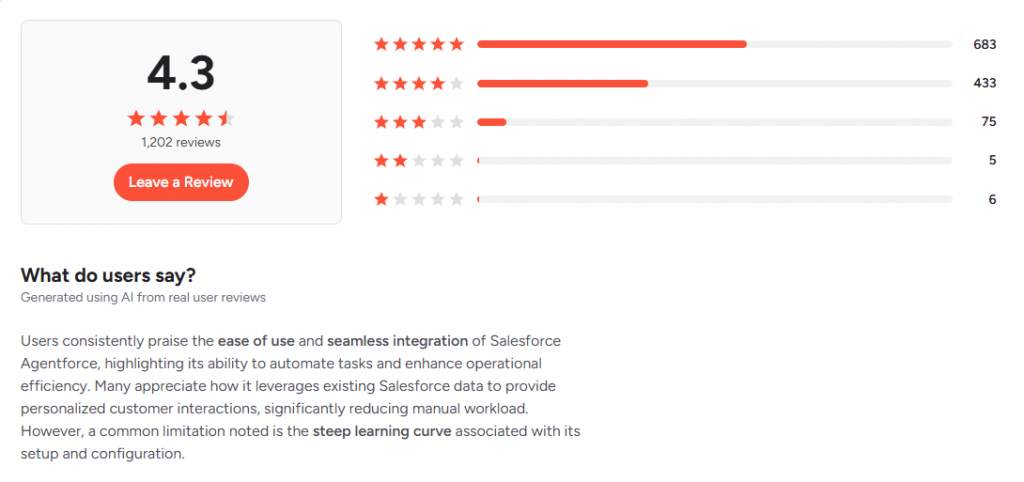
Salesforce Agentforce holds roughly 4.3 out of 5 on G2 from about 1,200 reviews in G2’s dedicated AI Agents category. That listing is worth distinguishing from G2’s separate “Agentforce Service” and “Agentforce Sales” pages, which are G2’s renamed listings for the legacy Salesforce Service Cloud and Sales Cloud products rather than the Agentforce AI agent platform itself. Confusing the two inflates the apparent review volume without reflecting genuine Agentforce-specific sentiment.
Within the AI Agents category listing, natural language configuration and CRM integration depth come up repeatedly as strengths. Complaints cluster around a familiar pattern: a smooth first build followed by friction on the second or third agent, an interface that gets harder to manage once multiple prompts and versions stack up, and cost concerns from teams still early in proving out value against the price.
None of this is unusual for a first-generation enterprise AI product category. It is worth reading against a specific deployment plan rather than the star average alone, since a complaint from a large enterprise account managing dozens of agents may not describe what a five-agent pilot experiences.
This review draws on Salesforce’s own pricing and product pages, its FY26 and FY27 earnings disclosures, and verified G2 review data rather than a hands-on trial account, since Agentforce sits behind an existing Salesforce Enterprise Edition subscription that a desk-research review does not have standing access to. Here is exactly what informed each section:
We did not assign Agentforce a single weighted score across these categories. That kind of scoring needs a live test org running real traffic, which a desk-research review should not pretend to substitute for.
Agentforce fits best for organizations already running Salesforce CRM at the Enterprise Edition tier or above, with admin or developer resources available to own configuration. Outside that profile, a few alternatives come up often.
For a broader view of the category beyond single-vendor comparisons, a rundown of enterprise chatbot platforms and a look at the build-versus-buy decision for AI agent platforms are both worth reading before committing budget either direction.
| If Your Priority Is | Choose | Why |
|---|---|---|
| A no-code AI agent platform with no CRM prerequisite | YourGPT | Usage-based pricing from $39/month, no Enterprise Edition or Data 360 requirement underneath |
| Deep, native automation on top of existing Salesforce CRM data | Agentforce | Reads and writes live CRM records directly, with multi-agent orchestration across departments |
| AI-assisted ticketing without a full CRM platform | Zendesk | Mature ticketing engine with AI layered on top, seat-based pricing that’s easier to forecast |
| In-app engagement and product-led onboarding | Intercom | Messaging-first support built for SaaS product teams |
| Lower entry cost with CRM grounding | HubSpot | Bundles marketing, sales, and service automation below Salesforce’s Enterprise Edition price floor |
Yes, but only for existing Salesforce customers. Salesforce Foundations gives Enterprise Edition subscribers 100,000 free Flex Credits at no cost, enough to run a real pilot before any paid commitment. It is not a standalone free plan open to organizations without a Salesforce subscription.
Agentforce runs on three separate pricing models: Flex Credits at $500 per 100,000 credits ($0.10 per standard action), flat-rate Conversations pricing for customer-facing agents only (Salesforce’s public page does not consistently display the exact rate, so confirm it directly), and per-user licensing that ranges from $5 a month up to $550-plus a month for bundled editions. Most advanced deployments also require Data 360, which adds cost that Salesforce does not include in the Agentforce price itself.
Yes, in most cases. Salesforce Foundations gives Enterprise Edition customers 100,000 free Flex Credits to start, but Agentforce is not sold as a standalone product to organizations that are not already running Salesforce.
Flex Credits charge per action, at $0.10 for a standard action and $0.15 for a voice action, and cover both customer-facing and employee-facing agents. Conversation pricing charges a flat rate per conversation but only applies to customer-facing agents, and the two models cannot run in the same Salesforce org at the same time. Salesforce’s public pricing page does not consistently display the exact Conversations rate, so confirm it directly before budgeting.
Agentforce delivers its strongest value on top of an existing Salesforce CRM subscription at the Enterprise Edition tier or above, with pricing spread across three separate models. YourGPT runs on a single usage-based structure with no CRM prerequisite, which makes it a more direct fit for teams that want AI agent automation without adopting Salesforce first.
There is no separate trial period. Salesforce Foundations serves that role for existing Enterprise Edition customers, providing 100,000 free Flex Credits to test real use cases before any paid commitment, but it is not available to organizations that are not already running Salesforce.
Agentforce earns its price for one kind of buyer: an organization already on Salesforce at Enterprise Edition or above, with admin capacity to own configuration, and a use case where reading and writing live CRM data mid-conversation matters. For that buyer, native CRM integration, multi-agent orchestration, and Trust Layer governance are real advantages over AI added to a CRM from outside.
Outside that profile, the case weakens fast. Three pricing models add real evaluation overhead, the Data 360 and implementation costs Salesforce doesn’t quote can multiply the sticker price several times over, and the setup complexity across hundreds of G2 reviews is a real barrier without dedicated Salesforce expertise. Model the fully-loaded first-year cost against a platform that doesn’t require an existing CRM before signing.
TL;DR The best business productivity tools help teams reduce repetitive work, improve collaboration, and save time. This guide compares 10 tools for 2026, including YourGPT, Proton Pass, Notion, Semrush, CoAnimator, Loom, Canva, Cal.com, Jira, and Airtable. Each tool serves a different purpose, from AI automation and project management to content creation and scheduling. Rather than […]

TL;DR Salesforce offers powerful CRM capabilities, but implementation and ongoing management can increase costs for smaller teams. Pipedrive and Nutshell simplify pipeline management, while HubSpot and Zoho CRM offer broader automation. Freshsales, monday CRM and Copper suit specific workflows. For customer support and lead qualification, YourGPT Chatbot works alongside your CRM, starting at $39/month billed […]
TL;DR Yellow.ai has spent a decade building an enterprise conversational AI platform out of Bangalore, and in 2026 it is asking Wall Street to value it at half a billion dollars while cutting a third of its staff and rebuilding its core product around a new “agentic interface” called Nexus. Both moves showed up in […]

Prepare a replacement support agent, test real requests and human handoff, then switch the storefront while keeping ownership of unfinished conversations.
The reader can shortlist one or two platforms by primary job, existing stack, action depth, handoff, governance, and billing unit.

A practical breakdown of Gorgias Helpdesk and AI Agent pricing, including what counts toward each allowance, how to compare plans and how to budget with your own volumes.