AI Agent vs Live Chat: What’s More Scalable?

Rajni
Last updated on December 5, 2025
AI agent and live chat each play a different role in customer support, and the choice between them influences how a team handles growth. Companies are moving toward faster support models, and one clear trend is the use of AI to reduce operating costs by up to 30%.
The difference shows up when ticket volume increases. Live chat scales through hiring: more agents, longer shifts, extended coverage hours. Each growth phase adds salary costs, training time, and management overhead. AI agents can handle growing workloads without slowing down. They respond just as quickly to 5,000 requests as they do to 50, and they work around the clock without the need for shift changes or downtime.
Most support teams use both. Live chat works better when a customer needs human help or wants to negotiate a solution. AI agents handle the questions that follow a pattern: order status checks, feature explanations, basic troubleshooting steps. This guide covers the cost differences, response time trade-offs, and scaling limitations of each approach.
Scalability in support means maintaining consistent service quality even when the number of conversations rises quickly. A scalable system handles higher load without slowing down, lowering clarity, or adding strain to the team.
A simple way to understand it is through three angles: system behaviour, team behaviour, and customer experience.
Support traffic is uneven. Product launches, outages, billing cycles, or marketing campaigns can multiply conversation volume with no warning.
A scalable system manages these spikes by:
This prevents queues from forming and avoids breakdowns during peak hours.
Volume pressure affects people before customers notice it. When systems do not scale well, teams start cutting corners, juggling too many chats, or pulling senior agents into triage.
A scalable setup protects the team by:
This keeps both quality and morale steady as the customer base grows.
Customers should not feel the internal pressure your team is facing. A scalable support system ensures that:
When growth is handled well, customers do not notice that volume has increased at all.
AI agents absorb volume without slowing down. Live chat depends on staffing limits. Understanding scalability through the lens of system behaviour, team workload, and customer experience makes the difference between the two approaches clear.
As your customer base grows, support volume rises in ways that are hard to predict. Traffic increases after product updates, marketing campaigns, or simple day-to-day growth. AI agents help stabilise these shifts by doing more than answering questions. They run tasks, follow rules, fetch data, and keep conversations moving even when activity spikes.
Their impact becomes clear when a business reaches the point where human-only support starts stretching thin.
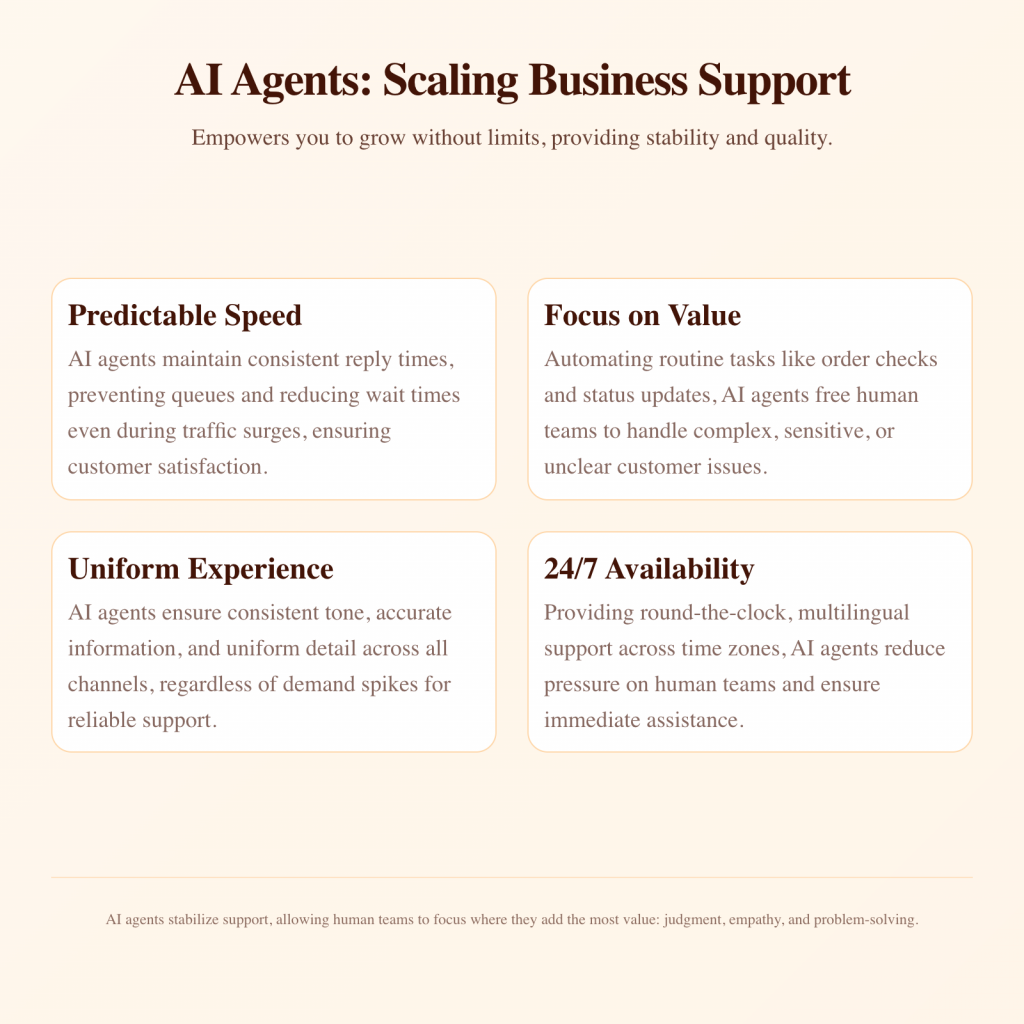
Support volume rarely grows evenly. Some days are quiet, and others surge without warning. AI agents keep responses steady during both. Whether ten people reach out or ten thousand, the reply time stays the same.
This prevents queues, reduces wait times, and ensures customers don’t feel the pressure your team is facing.
A large portion of support traffic comes from predictable questions: plan details, order checks, status updates, and simple troubleshooting. These are essential but do not require deep investigation.
AI agents handle these automatically, which gives human agents more room to focus on situations that are complex, sensitive, or unclear. As your user base grows, this balance keeps the team from getting overwhelmed by routine work.
As support volume grows, consistency often becomes harder to maintain. Different agents write differently, solve problems differently, and understand the product at different levels.
AI agents follow a single set of instructions across all channels. The tone stays steady, the information remains accurate, and the level of detail does not shift based on who is responding. This creates a uniform experience across web chat, WhatsApp, Instagram, and email, even when demand rises.
If your audience spans different time zones, customers expect the same level of attention whether they message during the afternoon or late at night. AI agents help by providing round-the-clock support and responding in multiple languages using the same system logic.
This keeps customers from waiting until specific hours to get basic answers and reduces the pressure on your team to cover every region manually.
AI agents are not meant to replace the judgment, empathy, or problem-solving humans provide. Their role is to give the support team stability. They absorb routine work, maintain predictable speed, and keep communication steady so humans can focus where they add the most value.
With clear escalation rules, AI agents and live chat complement each other, creating a support system that can grow without slowing down or losing quality.
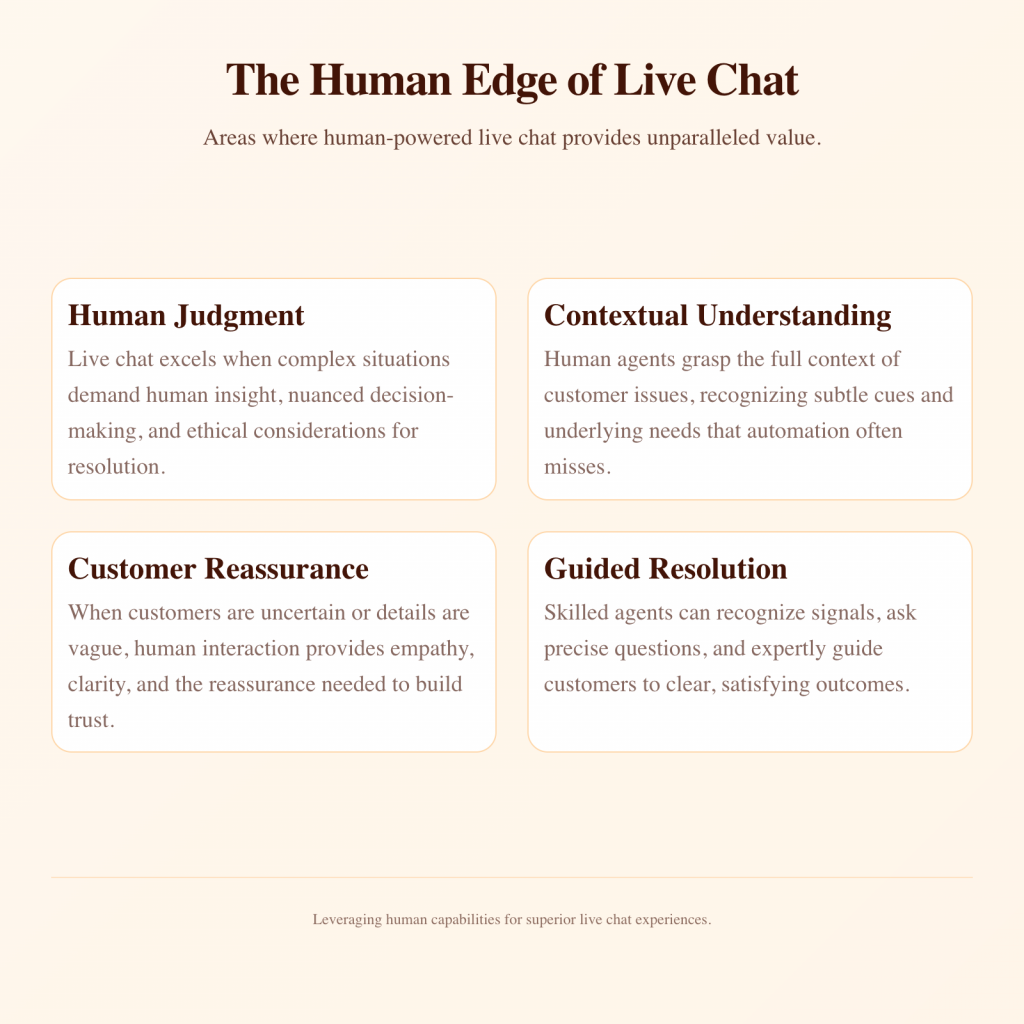
Live chat is important because some situations need human judgment, context, and reassurance. When details are unclear or the customer feels uncertain, a person can recognise signals, ask the right questions, and guide the customer with clarity.
These moments reveal where live chat adds real strength.
Customers don’t always express their full concern directly. A slow reply, a sudden change in tone, or an unusual hesitation often hints at a deeper issue.
A human agent can understand these subtle signals more better and take a moment to ask the right follow-up question. This creates space for customers to explain what is actually wrong, not just what they typed.
Many conversations start with a simple query and quickly branch into several related issues. A person might ask about a plan change, then mention a coupon problem, then realise they can’t access a feature.
Humans connect these pieces, check history, and understand how one detail may influence another. This kind of reasoning comes naturally and is hard to replicate with rules alone.
Human agents often take small actions that save a customer time or reduce friction. They check with another team, suggest a faster workaround, or prioritise a request when the situation calls for it.
These decisions depend on context, not fixed steps. They often turn a potentially frustrating moment into a smooth one.
When the topic involves billing, account access, identity verification, or personal information, customers want reassurance. A live agent can slow the pace, explain each step clearly, and stay with the customer until everything is resolved.
This human presence reduces uncertainty and builds confidence that the situation is being handled with care.
Human agents develop instincts from day-to-day experience. They notice patterns that aren’t written in any help article: recurring errors after a plan change, delays in certain regions, or issues linked to specific devices.
They bring this knowledge into conversations automatically, solving problems faster and preventing repeat issues.
Live chat delivers value in moments where flexibility, interpretation, and human understanding matter most. It fills the gaps that structured logic cannot cover. When a customer feels stuck, confused, or uneasy, having a person who can adjust to the situation makes all the difference.
Growing a live chat team brings new demands that are not always obvious at the start. Small operational issues gradually turn into larger challenges, and the work required to keep everything consistent increases with every new customer.
There is a natural limit to how many live chats a person can manage at the same time. Miller’s Law explains this clearly: humans can hold only a small number of active items in working memory. Once that limit is reached, accuracy drops, responses slow down, and mistakes become more common.
Most agents can comfortably manage only a few active conversations without losing clarity. As your customer base grows, incoming messages rise in step with it, and there is no practical way for one person to handle more without compromising the experience.
At this point, there is very little efficiency left to gain through individual performance. The only way to keep up usually is to hire more people. But every new hire brings onboarding time, training, coaching, and a period when they are still learning your product.
This creates a pattern where workload grows faster than the team can develop, and scaling becomes increasingly difficult.
As a support team grows, differences in communication become more noticeable. Some agents handle complex conversations with clarity and confidence, while others need more time or additional guidance before they feel fully prepared. Training and QA help, but each person naturally brings their own style to a situation.
Customers observe these differences directly. One conversation may feel clear and steady, while another may feel slower or less certain. As the team expands, maintaining a consistent experience requires more review, more alignment, and continuous coaching. This becomes an ongoing part of managing a larger support operation.
Supporting customers across different regions means conversations can arrive at any hour. Late evenings, early mornings, weekends, and holidays become regular parts of the workflow. To keep response times steady, teams split shifts or add people in different time zones, and each approach introduces its own operational challenges.
Support teams working outside standard hours often experience disrupted routines and limited overlap with the rest of the team. Over time, this leads to fatigue and makes long-term retention difficult.
Managers spend increasing amounts of time coordinating schedules, adjusting coverage, and filling unexpected gaps. As the operation grows, the effort required to maintain round-the-clock coverage expands much faster than the customer base itself.
Support teams achieve the best results when automation and human expertise operate side by side. AI agents manage the large volume of predictable work, while live chat handles the situations that require interpretation, judgment, or reassurance. Together, they form a system that stays stable as the business grows.
Modern AI agents can autonomously handle a large share of customer questions, often resolving from 70 to 80 percent when the queries follow clear patterns. This covers order checks, plan details, simple troubleshooting, and other tasks that do not require a human.
By resolving these cases upfront, AI creates meaningful deflection, reducing the number of chats that reach your human team. This keeps queues short and allows agents to focus on conversations that need their attention.
A smooth hand-off is a key part of hybrid support. When clear conditions determine when a conversation should move from AI to a human agent, customers transition without repeating information. This ensures human agents concentrate on work that requires their judgment rather than routine tasks.
Human conversations reveal where AI should refine its behaviour. Agents highlight unclear responses, add missing examples, and guide improvements. At the same time, AI identifies common patterns and frequent queries, helping teams plan updates and documentation. Each side benefits from the other’s input.
| Factor | AI Agents | Live Chat |
|---|---|---|
| Response Time | Delivers the same speed even during traffic spikes | Performance varies with queue length and agent workload |
| Availability | Covers every hour and every region without scheduling | Coverage depends on shifts, time zones, and staffing gaps |
| Cost as Volume Grows | Cost per conversation stays steady as demand increases | Costs rise as teams expand and coaching needs increase |
| Handling Repetitive Tasks | Resolves high-frequency questions and actions automatically | Routine queries take a large portion of daily workload |
| Quality & Accuracy | Follows one standard so tone and clarity stay uniform | Quality varies with skill, experience, and fatigue |
| Impact on Team Load | Reduces volume reaching humans, easing pressure in peak hours | Volume increases strain, especially during sudden traffic jumps |
| Support for Global Users | Responds in multiple languages using one system | Requires multilingual hiring and wide shift coverage |
| Scalability | Expands instantly with rising traffic; no operational changes needed | Scaling needs more agents, more oversight, and more coordination |
| Conversation Depth | Handles structured and rule-based tasks reliably | Handles emotional, unclear, or multi-step situations better |
Scalability depends on how well a support system absorbs higher conversation volume without slowing down, lowering quality, or increasing stress on the team. When you compare AI agents and live chat through that lens, the difference becomes clear.
AI agents scale by taking on more tasks, not by adding more people. They keep response times steady, even during a traffic surge, and they do not require shift planning or constant training. This makes them well suited for businesses that expect rapid growth or deal with unpredictable spikes in support requests.
Live chat scales in a different way. It grows through hiring, onboarding, scheduling, and quality management. Human insight remains valuable, especially during complex or sensitive conversations, but these strengths do not multiply as easily as automated systems do. The more your customer base expands, the more operational work is required to keep live chat stable.
For most teams, the practical answer is not choosing one over the other. It is about deciding which parts of support need human judgment and which parts benefit from consistent automation. AI agents carry the load so live agents can spend their time on conversations that genuinely need a person.
This balance creates a support system that feels personal where it counts and efficient everywhere else.
Support teams don’t choose between AI agents and live chat in theory. They make decisions based on the pressure they feel day to day: ticket spikes, long queues, limited hiring budgets, and customers who expect fast, reliable help. The best choice becomes clearer when you look at where the strain actually comes from.
1. Identify where conversations slow down
Most teams have a predictable bottleneck. It might be the morning rush, the weekly product update, or the end-of-month billing spike. If these slowdowns come from repeatable questions, AI agents can stabilise the workload. If the slowdown comes from messy, multi-step issues, live chat needs to stay involved.
2. Observe how often issues stretch beyond a single question
Customers frequently start with something simple, then reveal a bigger problem. When a conversation requires unpacking, probing, or cross-checking multiple systems, a human agent usually handles it better. AI agents support scaling, but humans handle the unpredictable layers.
3. Review the cost of delay, not just the cost of replies
Long queues often hurt conversion rates, onboarding, and renewal cycles. If speed in these moments affects revenue, AI agents create immediate stability. Live chat can then focus on the conversations with real business impact, not the ones that simply soak up time.
4. Look at the work your team avoids or pushes aside
Every support team has tasks that get postponed during busy hours: follow-ups, check-ins, proactive outreach, or digging into unusual bugs. AI agents absorb the mechanical workload so humans can focus on the work that often gets lost during peak periods.
5. Think about how your product evolves
Fast-changing products create more support requests. AI agents can be updated in batches, while large human teams need constant training and alignment. If your product iterates quickly, automation becomes easier to scale.
This approach helps you see the real dividing line.
Use AI agents to keep your system stable. Use live chat to keep your service human.
The combination gives your support team room to grow without losing quality or overwhelming the people behind it.
AI agents and live chat are not competing tools. Each one fits a different type of work, and their strengths show up clearly when a support team starts to grow.
1. When AI Agents Win
AI agents scale best in environments where speed and volume matter. If your product generates a high number of simple or predictable questions, automation absorbs the load without creating new hiring demands. They also perform well in global support, where customers expect consistent help regardless of time zone.
2. When Live Chat Wins
Live chat excels when conversations require empathy, negotiation, or contextual thinking. Customers prefer speaking with a person when they are confused, unsure, or dealing with something sensitive such as billing disputes or account access issues. These are situations where a human presence elevates the experience.
3. When Both Should Work Together
Most modern teams run a hybrid model. AI agents take care of repetitive questions and maintain fast response times. Live agents step in when a case needs deeper thinking. This creates a balanced system that handles growth without losing the human connection that customers trust.
This clarity helps teams decide what to automate and what to leave to people.
The outcome is not choosing one over the other, but using each where it makes the most sense.
AI driven support works best when customers feel clear about what is happening and can see steady progress toward a solution. The goal is not to make AI seem human; the goal is to help businesses deliver better service and guide customers forward without confusion or repeated steps. These principles determine how effective the system will be in real conversations.
When AI driven support follows these principles, customers receive dependable guidance and your team gains more room to handle situations that need human judgment.
No. AI agents handle repetitive and predictable questions at scale, while live chat handles complex or sensitive cases. Most teams get the best results by combining both.
Signs include rising wait times during predictable hours, repetitive questions taking up most of the queue, difficulty covering late-night shifts, and managers spending more time on scheduling than improvement.
Not usually. They need examples, guidelines, and access to your knowledge base, but they do not require the deep, ongoing training that human teams need as they grow.
Modern AI agents can follow context, reference previous messages, and complete multi-step tasks. They still struggle with emotionally sensitive cases, which is where human agents step in.
They reduce repetitive workload and help prevent burnout by handling the mechanical parts of support, especially during busy periods.
They might, but what matters is whether the conversation feels clear, helpful, and respectful. When AI uses simple language and smooth hand-offs, customers care more about the result than who answered.
No. Once your AI agent is set up, adding new channels like WhatsApp, Instagram, or in-app chat usually does not require additional hiring or large operational changes.
Yes. Most systems support hybrid setups where AI agents handle the first layer and hand off to humans when needed.
They hand the chat to a human agent, ideally with enough context so the customer does not need to repeat information.
Track response times, queue length during peak hours, the percentage of repetitive questions handled automatically, and the amount of time human agents spend on higher-value work. These signals show whether AI is absorbing volume effectively.
Scaling support is ultimately about keeping your service dependable as more customers rely on it. Live chat and AI agents both contribute, but they solve different parts of the challenge. Live chat provides the human understanding needed for sensitive or unclear situations. AI agents maintain speed, consistency, and round-the-clock coverage, even when request volume grows faster than your team can.
Most teams benefit from using both together. AI agents handle the routine questions that appear every day, and live chat focuses on conversations where people expect careful attention. This balance keeps response times short and protects your team from the pressure that often builds during growth.
YourGPT helps teams build this blend more easily by giving them tools to automate repetitive work while keeping human support available where it makes the most impact. The result is a support system that stays steady during busy hours, across different time zones, and as your customer base expands.
The goal is not to choose between humans and AI. It is to use each where it improves the experience. When you do that, support becomes faster for customers and more manageable for your team.
TL;DR WhatsApp plugins help WordPress websites respond faster, improve customer engagement, and turn more visitors into customers. From simple chat buttons to AI-powered automation and WooCommerce support, the right plugin can make communication easier and more effective. This guide compares the best WhatsApp plugins for WordPress in 2026 to help you choose the right option […]

TL;DR AI agents in game development handle scripting, debugging, content generation, and in-engine testing inside production tools. They reduce repetitive work across quests, characters, and environments where small changes often require updates across both design and code. These agents sit inside development workflows, differ from traditional game AI, and are used across production pipelines. Game […]


TL;DR Sierra AI is built for enterprise customer experience teams that want highly guided AI agent deployments, but it may not be the right fit for teams that need faster setup, clearer pricing, broader channel coverage, or more control over workflow execution. The strongest Sierra AI alternatives are not just chatbot tools. They differ by […]

TL;DR Post-purchase is a high-intent moment many Shopify stores underuse. The right upsell flow can increase AOV, improve retention, and capture valuable customer data through relevant offers like warranties, accessories, and care plans. This guide focuses on five Shopify post-purchase upsell apps for 2026 that help turn the checkout completion stage into a revenue opportunity. […]
TL;DR Vapi is flexible for building voice AI systems, but it often needs more setup, custom logic, integrations, and ongoing tuning before it works well in real use cases. YourGPT is a strong alternative for teams that need AI agents across voice, chat, and messaging, while tools like Retell AI, PolyAI, Synthflow, and Telnyx fit […]
TL;DR The best AI voice agent platform in 2026 depends on your workflow, call volume, technical resources, and how much control your team needs. YourGPT is a good fit for businesses that need AI agents to handle conversations, take real-time actions, and connect with support, sales, and operational workflows. Vapi works well for developer teams […]