Botpress Review 2026: Pricing, Pros & Cons

Rajni
July 13, 2026
Botpress evolved from a chatbot-building framework into a broader AI agent platform during 2025 and 2026. Following a $25 million Series B led by Framework Venture Partners in June 2025, it expanded beyond Agent Studio and its Autonomous Engine with Desk, a dedicated AI helpdesk product.
On May 14, 2026, Botpress introduced a new pricing model for newly created workspaces. AI usage is now bundled into per-conversation allowances instead of being charged separately as AI Spend on top of the subscription price.
Workspaces created before May 14, 2026 remain on the legacy pricing structure indefinitely. Legacy plans include a free pay-as-you-go tier, Plus at $89/month, Team at $495/month, and Managed at $1,495/month.
Under the legacy model, AI Spend is charged separately at the underlying language-model provider’s cost, with Botpress stating that it adds no markup. This can make the final monthly cost harder to predict as agent usage increases.
Botpress holds a rating of roughly 4.5/5 on G2 from more than 470 reviews. Users frequently praise its visual workflow builder and GPT integrations, while outdated documentation and unpredictable AI usage costs remain the most common complaints.
Botpress fits developer-led teams that need deterministic, code-level control over conversation logic. It’s a weaker fit for non-technical teams that want flat, predictable pricing and a same-day no-code setup.
Botpress has spent nine years building chatbot infrastructure, and it shows in how the platform is put together. It gives you a visual flow builder for conversation design, then lets you drop into JavaScript the moment a node needs logic the drag-and-drop canvas can’t express. That combination is why developer teams keep choosing it over simpler point-and-click tools.
It’s also why the platform confuses buyers who just want a working support bot by Friday. Botpress rewrote its pricing model in the middle of 2026, split its user base into two different billing structures depending on when you signed up, and layered an AI helpdesk product on top of its existing chatbot builder. None of that is disqualifying. All of it needs explaining before you commit a budget line to it.
This review breaks down what Botpress actually costs in 2026 under both pricing structures, what the platform does well, where teams hit friction, and who should be looking somewhere else entirely.
Botpress is a conversational AI and agent-building platform, founded in 2017 in Quebec City, that grew out of an open-source chatbot framework into a commercial cloud platform. Through 2025, the company raised a $25M Series B at a $120M post-money valuation, led by Framework Venture Partners with Deloitte Ventures and HubSpot Ventures joining, bringing total funding to roughly $45M.
That funding paid for a repositioning. Botpress no longer describes itself as a chatbot builder. The company now calls itself “an AI agent company that built a helpdesk, not the other way around,” and the product lineup reflects that shift: Agent Studio for building agents visually, an Autonomous Engine that blends scripted logic with LLM-driven reasoning, and Desk, a newer AI-native helpdesk that competes directly with tools like Intercom’s Fin and Zendesk’s AI agents rather than sitting purely in the developer-tooling category.
The core build environment is still Botpress Studio, a drag-and-drop canvas for designing conversation flows, branches, and API calls. What separates it from simpler visual builders is the escape hatch. Any node can drop into custom JavaScript, so a team that hits the ceiling of the visual flow builder doesn’t have to switch platforms, they just write code inside the one they’re already using.
Status. Live and split. Botpress changed its pricing structure on May 14, 2026, but only for new workspaces. Anyone who signed up before that date keeps the previous plan-plus-AI-Spend model.
What stays the same. Existing customers keep their current plan, pricing, and AI Spend billing exactly as they were before the change, with no forced migration.
What’s actually unknown. The exact price of the Team plan under the new structure remains unclear. CostBench listed it at $750 per month as of May 19, 2026, while Quiq’s analysis suggests a higher cost at comparable conversation volumes. Botpress’s pricing page loads plan prices client-side, which prevented a direct automated verification at the time of writing.
What to do about it. For a new signup, confirm whether the workspace falls under the pricing structure introduced after May 14, 2026. Since that date determines which billing model applies, request the current Team-plan price in writing from Botpress sales rather than relying only on third-party estimates.
Two pricing structures currently coexist, and which one applies to you depends entirely on when your workspace was created.
| Plan | Base Price | AI Spend | Key Inclusions |
|---|---|---|---|
| Pay-as-you-go | $0/month | $5/month free credit ($100/month default cap) | 500 incoming messages per month and 1 seat |
| Plus | $89/month | Billed separately at provider cost | 1GB Vector Database, human handoff, conversation insights, and branding removal |
| Team | $495/month | Billed separately at provider cost | 3 seats, 2GB Vector Database, role-based access control, real-time Studio collaboration, and up to 50,000 incoming messages per month |
| Managed | $1,495/month | Billed separately at provider cost | Monthly strategy calls, custom development by Botpress engineers, and ongoing maintenance |
| Enterprise | Custom | Custom | White-glove onboarding, a dedicated support manager, and custom usage limits |
Source: Lindy’s pricing breakdown, cross-checked against Botpress Academy, both reflecting the structure still active for pre-May 14 workspaces.
The Team-plan price under this new structure could not be confirmed against a single live figure. CostBench puts it at $750/month as of May 19, 2026. Confirm the current number directly with Botpress before budgeting.
Previously, Botpress bills counted incoming messages, and separately, whatever AI Spend the workspace consumed. That’s gone for new workspaces. Now, every plan includes unlimited AI agents, where bots previously cost $10/month each as an add-on. “Always Alive,” the feature that eliminates cold-start delay on bot responses, now ships free on every paid plan instead of being gated behind higher tiers. When a workspace runs out of its included conversations, Botpress automatically adds a pack of 100 rather than cutting the bot off, with alerts at 80% and 90% of quota. Unused conversations in a pack expire at month end and don’t roll over.
A few costs sit outside the base plan under either structure. Removing the “Powered by Botpress” branding requires the Plus tier or higher. Channel add-ons for certain messaging platforms can carry their own fees. And under the legacy structure specifically, AI Spend itself remains the single biggest source of budget surprise, since it scales with every LLM call the bot makes, including testing and knowledge-base indexing, not just live customer conversations.
Botpress agents can touch knowledge bases, external APIs, and, through Autonomous Engine actions, business systems that hold customer data, which makes the security posture a first-order question rather than a footnote.
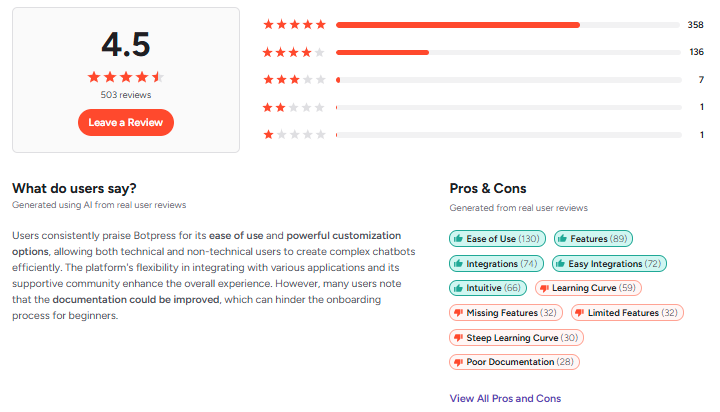
Review platforms broadly agree on Botpress, which is less common in this category than a wide rating spread.
G2 lists Botpress at roughly 4.5 out of 5 from 470+ reviews, with the large majority landing in the 5-star and 4-star bands. Capterra shows a similar 4.5/5 rating, though from a much smaller base of roughly 30 reviews. Reading the individual reviews rather than just the averages tells a more useful story. Praise clusters around the visual flow builder’s usability once a team gets past the initial learning curve, GPT integration quality, and the flexibility of the underlying architecture. Complaints cluster just as consistently around documentation that hasn’t kept pace with the product and specific configuration gaps, like one reviewer’s unresolved request to allow Node module imports inside code nodes.
That consistency across platforms is itself a signal. When G2 and Capterra tell different stories, it usually means different reviewer populations are weighing in. When they agree this closely, it suggests the strengths and weaknesses are structural to the product rather than an artifact of who happened to leave a review.
This review draws on published sources rather than a hands-on trial account, so here’s exactly what informed each section:
We didn’t assign Botpress a single weighted score. That requires a live test workspace running real traffic, which a desk-research review shouldn’t pretend to replace.
Botpress fits best for developer-led teams that need deterministic conversation control, multi-LLM flexibility, and are comfortable owning setup and maintenance themselves. Outside that profile, these alternatives come up most often.
| If Your Priority Is | Choose | Why |
|---|---|---|
| A visual builder that does not require a developer to operate | YourGPT | A no-code AI Studio workflow builder with unified pricing and no separate AI Spend line item |
| Native voice and phone support out of the box | Voiceflow | Voice is available as a first-party channel rather than relying primarily on external integrations |
| Fully open-source, on-premise deployment with active security maintenance | Rasa | Its NLU-first architecture is designed for self-hosted, production-grade deployments |
| The simplest possible no-code setup | Chatfuel | It trades Botpress’s deeper custom logic for a faster path to a working chatbot |
| Deterministic, code-level conversation control with multi-LLM flexibility | Botpress | The strongest fit for developer-led teams willing to manage setup, customization, and ongoing maintenance |
For a broader comparison, explore our roundup of the 10 Best Botpress Alternatives, especially if predictable pricing or more advanced AI automation is your priority.
Botpress earns its price for one specific buyer: a team with at least one developer who wants deterministic control over conversation logic, the flexibility to switch LLM providers per agent, and is comfortable owning setup and maintenance rather than handing it to a vendor. The May 2026 pricing change makes that proposition more predictable for new customers, bundling AI Spend into a single conversation price instead of leaving token costs as an open-ended line item.
It’s a harder case for anyone else. Non-technical teams will spend real time climbing the learning curve before the visual builder pays off, and the documentation gap that reviewers keep flagging doesn’t make that climb any shorter. If your team wants a workflow builder without needing a developer to run it, or a single price that doesn’t split into two different structures depending on your signup date, compare Botpress directly against YourGPT before committing a year of budget to either one.
TL;DR CustomGPT.ai is a no-code RAG platform for building AI agents on business content. Pricing starts at $99/month for Standard and $499/month for Premium, with lower rates on annual billing. Enterprise typically ranges from $2,000 to $6,000/month. The Standard plan includes 500 query credits, 2 AI agents, and 1 team member. These limits differ from […]
TL;DR Customer success tools fall into two groups: dedicated CS platforms such as Gainsight, ChurnZero, Totango, Planhat, Vitally, and Custify, and support or AI-agent tools such as Freshdesk, YourGPT, and Intercom. None of the six dedicated CS platforms publish list pricing, and third-party estimates can vary widely for the same tool. AI agent adoption in […]


TL;DR Zoho Desk keeps its strongest AI assistant, native live chat, and process automation behind Professional and Enterprise, and that gap drives most of the switching. YourGPT builds AI agents that resolve support, sales, and operations requests directly instead of routing everything into a ticket queue. Freshdesk, Zendesk, and HubSpot Service Hub offer a more […]
TL;DR Claude Opus 5 launched on July 24, 2026, at half the API token price of Fable 5, while matching or outperforming it on several agentic benchmarks. On AA-Briefcase, Opus 5 scored higher than Fable 5 at high and max effort while costing substantially less per task. Fable 5 still leads on some coding evaluations […]
TL;DR Voiceflow’s official pricing page no longer displays public self-serve plan prices. As of July 2026, it separates pricing into a usage-based Agencies & Partners plan and a Businesses plan that requires contacting sales, replacing the older Starter, Pro, and Business tiers. Most third-party pricing trackers still reference the previous structure, consistently listing Pro at […]

TL;DR Fin, the AI agent formerly sold under the Intercom name, uses a per-outcome pricing model. Salesforce agreed to acquire the company in June 2026, but the deal has not closed yet. Zendesk AI Agents, Salesforce Agentforce, Freshworks Freddy AI, Gorgias, Tidio, and Kustomer suit teams that want AI built into a helpdesk or CRM […]