HubSpot Review 2026: Pricing, Pros & Cons

Rajni
Last updated on August 11, 2026
HubSpot combines six products Marketing, Sales, Service, Content, Data, and Commerce Hub on top of its free CRM. Paid plans start at around $9 per seat per month, while Enterprise plans range from $150 to $3,600 per month per hub.
Mandatory onboarding fees significantly increase the upfront cost. Sales and Service Hub charge $1,500 for Professional and $3,500 for Enterprise, while Marketing Hub charges $3,000 and $7,000.
HubSpot receives strong overall reviews, but recurring complaints about contract lock-in and billing make it important to review renewal, cancellation, and payment terms before signing.
Breeze Customer Agent requires Service Hub Professional or Enterprise and uses HubSpot Credits, costing roughly $0.50 per resolved conversation in addition to regular seat fees.
HubSpot built its name on a generous free CRM and grew that into a full go-to-market platform used by hundreds of thousands of small and mid-sized businesses. In April 2026, at its Spring 2026 Spotlight event, the company doubled down on that platform bet, launching HubSpot AEO to help brands track their visibility in AI answer engines like ChatGPT and Gemini, alongside a wider rollout of AI agents across Marketing, Sales, and Service Hub. The timing wasn’t random. HubSpot said organic search traffic for its customers fell 27% year over year while AI referral traffic roughly tripled, and the company is betting its next growth phase on being the platform businesses use to adapt to that shift.
That expansion sits on top of a pricing structure that hasn’t gotten simpler. HubSpot still sells each hub separately, still charges onboarding fees most buyers don’t see until checkout, and still ties its most capable AI feature to its highest tier. None of that makes HubSpot a bad choice. It makes the gap between the advertised entry price and the real first-year bill worth understanding before you sign an annual contract.
This review breaks down what HubSpot actually costs across its main hubs in 2026, what real G2 and Capterra reviewers report once the free trial ends, and where the platform’s own AI story runs into gaps a buyer should know about going in.
HubSpot is a customer platform built around a free CRM, with six paid products layered on top: Marketing Hub, Sales Hub, Service Hub, Content Hub, Data Hub, and Commerce Hub. Brian Halligan and Dharmesh Shah founded the company in 2006 while attending MIT’s Sloan School of Management, built it around the idea of “inbound marketing,” and took it public on the NYSE under the ticker HUBS in October 2014. The company remains headquartered in Cambridge, Massachusetts, and is now used by businesses ranging from solo founders on the free plan to large enterprises running the full Customer Platform bundle.
Two changes define HubSpot’s 2026 so far. First, at INBOUND 2025 the company renamed Operations Hub to Data Hub, a repositioning rather than a pure rebrand. Pricing carried over unchanged, but the product gained Data Studio, a no-code dataset builder, and shifted its pitch from “a tool for RevOps specialists” to a data layer meant for marketing, sales, and service teams generally. Second, April’s Spring 2026 Spotlight event introduced HubSpot AEO, more than 100 smaller updates, and an expanded set of AI agents across the platform, framed around what the company calls a “context advantage”: the idea that AI performs better when it has access to a business’s own CRM data rather than generic web content alone.
For a buyer evaluating HubSpot today, both changes matter less as headline features and more as a signal of direction. HubSpot is betting its roadmap on AI-assisted go-to-market work built on top of CRM data it already has, and pricing across every hub increasingly reflects that bet, with AI capability sitting behind higher tiers and its own separate credit-based billing.
Status. No acquisition took place. Alphabet explored a possible offer for HubSpot in 2024, but no formal bid was submitted. The discussions reportedly ended before reaching the due-diligence stage, and Alphabet walked away from the potential deal in July 2024.
What stays the same. HubSpot remains an independent, publicly traded company. Its CRM, Marketing Hub, Sales Hub, Service Hub, Content Hub, Commerce Hub, Breeze AI products, pricing, customer contracts, and product roadmap remain under HubSpot’s control.
What’s actually unknown. Whether Alphabet could reconsider HubSpot in the future or whether another company could make an offer. There is currently no announced acquisition agreement or confirmed active sale process involving HubSpot.
What to do about it. Do not base a HubSpot purchase or migration decision on the old Google acquisition reports. Compare HubSpot using its current pricing, product limits, integrations, and contract terms. Larger teams should also review change-of-control clauses and keep a reliable CRM data-export process in place.
HubSpot combines CRM, marketing, sales, customer service, content management, and automation tools in one platform to help businesses manage leads, customers, and growth.
HubSpot doesn’t sell one product with one price. Each hub has its own Free, Starter, Professional, and Enterprise tiers, and the numbers below reflect each hub’s own pricing page rather than a bundled Customer Platform quote, since most buyers start with one or two hubs rather than all six.
| Plan | Price | Contacts Included | Seats | Onboarding Fee |
|---|---|---|---|---|
| Free | $0/mo | None (2,000 sends/mo) | Up to 2 users | None |
| Starter | $9/seat/mo (annual) or $15/seat/mo (monthly) | 1,000 | Per seat | None |
| Professional | $800/mo (annual) or $890/mo (monthly) | 2,000 | 3 core seats, $45/mo each additional | $3,000 one-time |
| Enterprise | $3,600/mo | 10,000 | 5 core seats, $75/mo each additional | $7,000 one-time |
| Plan | Price | Seats | Onboarding Fee |
|---|---|---|---|
| Free | $0/mo | 2 seats | None |
| Starter | $9/seat/mo (annual) or $15/seat/mo (monthly) | Per seat | None |
| Professional | $90/seat/mo (annual) or $100/seat/mo (monthly) | Per seat | $1,500 one-time |
| Enterprise | $150/seat/mo | Per seat | $3,500 one-time |
| Plan | Price | Seats | Breeze Customer Agent | Onboarding Fee |
|---|---|---|---|---|
| Free | $0/mo | Up to 2 users | No | None |
| Starter | $9/seat/mo promotional, normally $15 (annual) | Per seat | No | None |
| Professional | $90/seat/mo (annual) | Per seat | No, SLA tracking only | $1,500 one-time |
| Enterprise | $150/seat/mo (10-seat minimum) | Per seat | Yes | $3,500 one-time |
Marketing and Sales Hub figures verified against HubSpot’s own Marketing Hub pricing guide (updated December 31, 2025) and Sales Hub pricing guide (updated January 26, 2026). Service Hub figures come from HubSpot’s Service Hub pricing guide, last updated July 10, 2025, roughly a year old at the time of writing. Re-confirm Service Hub numbers against the live pricing page before quoting them in anything published.
Two things push the real bill well past the headline seat price. The first is onboarding fees, which apply once per hub and aren’t refundable once paid, so a team buying both Marketing Hub Professional and Service Hub Professional pays $4,500 in onboarding before a single month of the subscription starts. The second is AI. Breeze is included at every tier, but its most capable pieces run on HubSpot Credits, a separate consumption layer.
The free tier includes Breeze Assistant and over 100 embedded AI features at no cost. Starter adds a prospecting agent and data agent with 500 monthly credits. Professional unlocks AEO and the Customer Agent with 3,000 credits included. Enterprise includes all Breeze agents and 5,000 credits. Breeze Customer Agent itself bills separately at roughly $0.50 per resolved conversation once those included credits run out, so a support team automating a few thousand conversations a month should model that cost before assuming Professional’s advertised price is the real number.
HubSpot’s CRM holds contact records, email content, deal data, and increasingly payment information through Commerce Hub, so its compliance posture and contract terms both carry weight in a purchase decision.
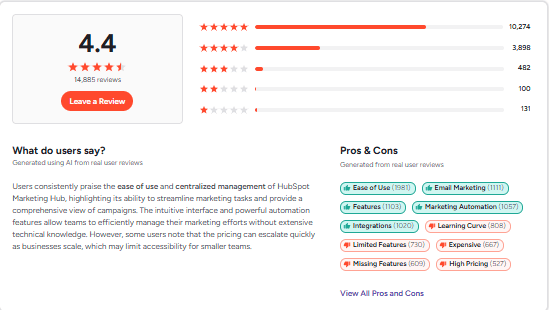
HubSpot holds a strong aggregate score. Across its full product line, HubSpot sits at 4.4 out of 5 from 35,744 verified G2 reviews. Looking at Sales Hub specifically, G2 shows roughly 4.4 out of 5 across more than 13,000 reviews, and Capterra shows 4.5 out of 5 from around 4,400 reviews for the same product. On G2’s own analysis, 88% of reviewers rate HubSpot 8 out of 10 or higher when asked whether they’d recommend it, with ease of use as the most commonly cited reason.
That said, the positive skew isn’t the whole picture. Pricing shows up as a recurring complaint in roughly one in ten reviews, particularly from teams that started on the free CRM and later hit the Professional price jump. Separately, BBB complaint records and a portion of verified Capterra reviews describe a rougher experience around contract terms specifically, auto-renewal catching customers off guard, downgrade requests denied mid-term, and in a few documented cases, accounts restricted during a billing dispute.
G2 and Capterra reviews skew toward buyers evaluating product features during a purchase decision, while BBB complaints, almost by definition, come from customers already in a dispute. Both are real signals. Reading the BBB and lower-starred Capterra reviews specifically for patterns around contract terms is worth five minutes before signing an annual plan, separate from checking the aggregate star rating.
This review draws on HubSpot’s own pricing and trust documentation, verified G2 and Capterra reviews, and public complaint records, rather than a hands-on trial account. Worth being clear about what that means for each category below.
We didn’t assign HubSpot a single weighted score across these categories. Doing that credibly needs a live test account across multiple hubs, not published documentation and aggregated reviews.
HubSpot fits best for teams that want marketing, sales, and service data living on one contact record and are comfortable with per-hub, per-seat pricing that scales with growth. Outside that profile, a few alternatives come up often.
| If Your Priority Is | Choose | Why |
|---|---|---|
| Enterprise-grade CRM depth and customization | Salesforce | Deeper configuration and a larger network of implementation partners, at higher cost and complexity |
| The lowest-cost all-in-one suite | Zoho CRM / Zoho One | Comparable hub structure at a fraction of HubSpot’s per-seat cost, with no onboarding fees |
| Sales pipeline management without marketing or service overhead | Pipedrive | Purpose-built for managing deals, with a cheaper entry point and simpler setup |
| A similar bundle at a lower price point | Freshworks | Sales, service, and marketing tools with a lower typical per-seat cost |
| AI-driven support or sales automation without switching CRMs | YourGPT | Usage-based AI pricing, direct HubSpot integration, and voice support through PhoneAI without a separate add-on |
A detailed roundup of seven HubSpot Service Hub alternatives is worth reading next if the support layer specifically, not the whole CRM, is what’s driving the search.
YourGPT is a no-code AI agent platform that automates customer support, sales, and operations from one connected system. It works alongside an existing CRM like HubSpot, allowing teams to add AI-driven conversations across websites, WhatsApp, voice, and other channels without engineering resources.
HubSpot is a full CRM and go-to-market platform where Breeze AI is one feature among many, with its most capable customer agent limited to Service Hub Professional and Enterprise. YourGPT focuses specifically on AI agents for support, sales, and operations, uses usage-based pricing, and connects directly to an existing HubSpot account rather than replacing the CRM.
HubSpot Service Hub supports email, live chat, phone, SMS, and WhatsApp through a shared inbox and connects with more than 1,500 marketplace apps. YourGPT supports channels including WhatsApp, Instagram, Telegram, Messenger, Slack, Discord, and native iOS and Android SDKs from one AI agent configuration.
HubSpot’s workflow automation handles triggers, routing, and multi-step sequences within CRM records and is available from the Professional tier. YourGPT’s AI Studio is a visual, node-based builder that supports custom Python and JavaScript, prompt-to-workflow generation, and automatic debugging for conversational AI agents.
Yes. HubSpot’s paid plans include a 14-day free trial with no credit card required. YourGPT offers a 7-day free trial without requiring a credit card, allowing teams to test either platform before choosing a paid plan.
For a team that wants marketing, sales, and service data on one contact record and can absorb onboarding fees as a cost of doing business, HubSpot earns its reputation. The free CRM alone justifies trying it, and the review data backs up what the marketing promises: real ease of use, a mature integration marketplace, and reporting depth that holds up once you’re on Professional.
The friction shows up specifically in the contract, not the product. Onboarding fees, auto-renewal defaults, and a 12-month minimum on annual plans are all things a buyer can plan around if they know to look for them before signing, and the complaint pattern in BBB and Capterra records suggests plenty of customers didn’t know to look. Model the full first-year cost, including onboarding and any Breeze Credit overage if AI-driven support matters to you, against a narrower tool built specifically for the piece you actually need, before committing a year of budget to any single hub.
TL;DR The Gorgias AI Agent is the automation layer inside the Gorgias helpdesk, split between a Shopping Assistant for pre-purchase conversations and a Support Agent for post-purchase support. A connected Shopify store is required, and Gorgias documentation rules out platforms such as BigCommerce, Magento, and WooCommerce for the AI Agent. Billing runs on two separate […]

TL;DR Gorgias is the closest Richpanel alternative for Shopify stores that need native order actions directly inside support tickets. YourGPT fits stores that want one AI agent handling requests across web, WhatsApp, Instagram, and email, while Tidio and Re:amaze suit smaller teams looking for lighter, lower-cost options. Richpanel’s AI pricing starts around $500/month for two […]

TL;DR Shopify Inbox is a good free option for stores that only need basic storefront chat and simple customer conversations. Stores usually look for alternatives when they need multichannel support, stronger team workflows, or automated order actions. YourGPT is strongest for cross-channel AI automation, Gorgias for Shopify-native order workflows, and Tidio for smaller stores that […]
TL;DR Tidio recently restructured its top paid plan, and many 2026 reviews still describe the old pricing model. Confirm current pricing directly on Tidio’s site before budgeting. Lyro, Tidio’s AI agent, runs on Anthropic’s Claude rather than ChatGPT. Only the Premium tier carries a guaranteed resolution rate, well below the average Tidio advertises elsewhere. Billing […]
TL;DR Drift’s situation goes well past “post-acquisition.” Clari and Salesloft announced a formal sunset after a major OAuth breach pushed Drift offline for weeks. Two of the other usual “alternatives” are getting bought too. Salesforce closed its acquisition of Qualified and signed a deal to acquire Intercom, now Fin. The real split is budget and […]
TL;DR Ada CX is a no-code enterprise AI platform for automating support across chat, voice, email, and messaging. Pricing is quote-only, with no public plans or self-serve signup. Admin reviews are generally positive, while end-customer feedback is more mixed. Ada supports SOC 2 Type II, GDPR, HIPAA, PCI DSS, and AIUC-1 certification. Ada CX shows […]