Crisp Review 2026: Pricing, Pros & Cons

Rajni
July 13, 2026
Crisp is a bootstrapped, French-built customer messaging platform with four public plans: Free at $0, Mini at $45/month, Essentials at $95/month, and Plus at $295/month. Plans are billed per workspace rather than per seat, with a custom Enterprise tier also available.
Paid plans include a fixed amount of AI credit for Hugo, Crisp’s AI agent. Essentials includes $25 in credit, covering roughly 450 automated conversations before Hugo stops responding unless pay-as-you-go billing is enabled.
As of July 2026, Crisp holds a 4.5/5 rating on G2 from 194 reviews and 4.6/5 on Capterra from 148 reviews. Its reported Trustpilot score is notably lower, with complaints focused on billing and reliability.
Crisp does not hold SOC 2 or ISO 27001 certification. Its compliance position is based primarily on its documented GDPR program and EU-based hosting rather than the independent audit standards many enterprise buyers expect.
Hugo works only inside Crisp, so testing the AI requires moving support operations onto the platform instead of adding it to an existing helpdesk as a separate AI layer.
Crisp started as a scrappy, cheaper alternative to Intercom and Zendesk, a live chat widget two French developers, Baptiste Jamin and Valérian Saliou, built in 2015 to be simpler than the enterprise options of the time. A decade later it has grown into a full messaging platform. A shared inbox, a knowledge base, a no-code chatbot and workflow builder, and now an AI agent called Hugo that is meant to hold real conversations instead of just drafting replies for a human to send.
This Crisp review looks at what the platform actually costs going into 2026, what Hugo can and cannot do on its own, and how the numbers hold up against the pitch on Crisp’s own pricing page. The short version is that the flat, per-workspace pricing is a genuine advantage for small teams, but the AI story gets more complicated the moment usage climbs past a demo.
Crisp remains independent and self-funded. There is no pending acquisition or ownership change to factor into a 2026 buying decision here, which puts it in a different position than some of the larger names it competes against.
Crisp is a customer messaging platform built around a shared inbox, a website chat widget, and an AI agent. Founded in 2015 by CEO Baptiste Jamin and CTO Valérian Saliou, the company is based in Nantes, France, and has stayed bootstrapped rather than raising venture funding, a detail that shows up in how deliberately (and sometimes slowly, per some long-term customer reviews below) it has rolled out AI features.
The core product covers live chat, a multichannel shared inbox, a knowledge base, a lightweight CRM, campaign messaging, and a no-code chatbot and workflow builder. In 2026, Crisp’s biggest addition is Hugo, an AI agent built to handle full conversations rather than just suggest replies. Hugo now has its own branding and a dedicated site at hugo.ai, even though it ships bundled inside Crisp’s paid plans rather than sold as a separate subscription.
Model choice. Hugo can run on several providers, including OpenAI’s GPT models, Anthropic’s Claude, Google’s Gemini, and Mistral. That gives Crisp customers more flexibility than platforms tied to a single model family.
What it can do. Through the Model Context Protocol, Hugo can connect to external tools and business systems. That means it can check an order, retrieve account data, or issue a refund directly instead of only explaining the next step.
Reported resolution rate. Third-party estimates place Hugo’s autonomous resolution rate between roughly 40% and 60%, depending on the source and operating conditions.
What to keep in mind. Crisp does not publish either figure as an official benchmark, so treat the range as directional rather than guaranteed. Actual performance will depend heavily on knowledge-base quality, workflow design, and how well the agent is maintained over time.
Crisp’s pricing model is flat and per-workspace rather than per-seat, which is the single most-cited reason reviewers give for choosing it over Intercom or Zendesk. Each plan includes a set number of agent seats at no extra cost, and only the Plus plan allows adding more.
| Plan | Price (Per Workspace, Monthly) | Agents Included | Hugo AI Credit | Notable Inclusions |
|---|---|---|---|---|
| Free | $0 | 2 | $0 (no AI) | Website widget, shared inbox, mobile and desktop apps, 100 customer profiles |
| Mini | $45 | 4 | $5 (~90 automated conversations) | Shared email inbox, chat triggers, shortcuts, custom email domain, 5,000 profiles |
| Essentials | $95 | 10 | $25 (~450 automated conversations) | Omnichannel inbox, workflow builder, Hugo AI chatbot, knowledge base, analytics, 50,000 profiles |
| Plus | $295 | 20+ (+$10/seat) | $75 (~1,350 automated conversations) | Unlimited task automation, ticketing system, white-labeling, 100+ integrations, 200,000 profiles |
| Enterprise | Custom | Custom | Custom | Dedicated onboarding, custom SLA, enhanced rate limits, unique pricing |
Prices verified directly against crisp.chat/en/pricing as of July 10, 2026. All plans include a 14-day free trial with no credit card required. Annual billing is available, but Crisp does not publish the annual discount percentage on its pricing page.
The seat math is where Crisp’s advantage is clearest. Ten agents on Essentials costs $95 a month flat, no per-agent multiplier, which several G2 reviewers below cite directly as their reason for switching from Intercom or Zendesk.
The AI math is where it gets more complicated. Doing the division on Crisp’s own numbers (5 dollars for roughly 90 conversations on Mini, 25 for roughly 450 on Essentials, 75 for roughly 1,350 on Plus) lands at approximately $0.056 per automated Hugo conversation, consistently across every paid tier. That’s genuinely cheap next to Intercom’s Fin, which bills $0.99 per resolved outcome. The catch is the ceiling. 450 conversations a month on Essentials is a light volume for any support team beyond a very small one, and once that credit runs out, Hugo stops answering unless pay-as-you-go billing is turned on.
Crisp also offers a 50% discount for nonprofits and students, and 20% off additional workspaces (Essentials and Plus only) for companies running more than one Crisp subscription.
Crisp handles live customer conversations, contact data, and, for teams that connect Hugo to their systems via MCP, potentially order and account information passed through automated actions. That makes its compliance posture worth checking closely before a support operation depends on it.
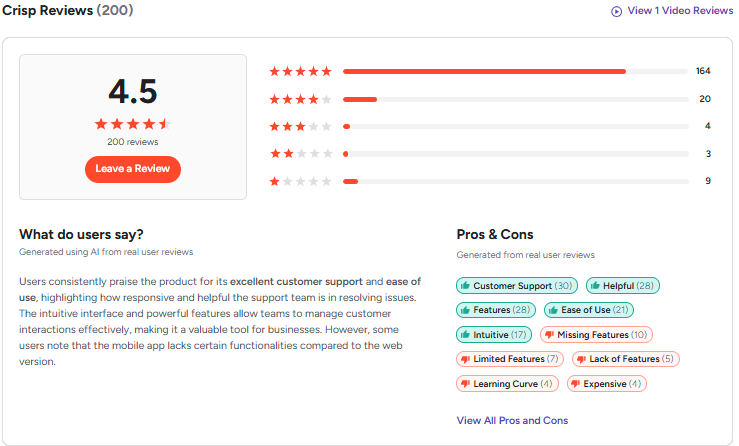
Crisp’s scores split the same way most support tools do: strong on the platforms buyers check before purchasing, weaker on the platform where existing customers vent about a specific incident. On G2, Crisp sits at 4.5 out of 5 across 194 reviews, with customer support responsiveness as the single most repeated praise (cited in 32 separate reviews) and ease of use close behind. Capterra shows a similar 4.6 out of 5 from 148 reviews, with 93% of that sentiment scored positive.
Trustpilot tells a different story. Secondary trackers put Crisp at roughly 1.9 out of 5 from a few dozen reviews, a gap wide enough to be worth understanding rather than dismissing. The pattern in the actual review text matches what shows up on other support platforms with the same split. G2 and Capterra reviewers are largely evaluating features and value during a purchase decision, while Trustpilot reviews more often come from existing customers reacting to a specific billing surprise or an unresolved support ticket. One detailed G2 review from a six-year Crisp customer, rated just 1.5 out of 5, captures this gap directly. The reviewer praised Crisp’s pricing and core chat product while describing the AI rollout as feeling more like marketing than finished product, alongside unresolved bug reports.
If that split matters to a purchase decision, it’s worth reading a handful of Trustpilot reviews filtered to a company size and use case that matches the buyer’s own, the same way it’s worth doing for any tool with this much variance between review platforms.
This review is built from Crisp’s own product and pricing pages, published G2 and Capterra reviews, and third-party pricing breakdowns, not a hands-on trial account. Here’s what that means for each category:
We didn’t assign Crisp a single weighted score across these categories. That needs a live trial account tested against real support volume, not published documentation and aggregated reviews.
Crisp fits best for small teams and startups that want a genuinely affordable, all-in-one inbox and are comfortable with AI that works well within a fixed credit budget. Outside that profile, a few alternatives come up often in the same comparisons.
| If Your Priority Is | Choose | Why |
|---|---|---|
| The lowest possible seat cost for a small team | Crisp | Flat per-workspace pricing beats per-seat tools at 10+ agents |
| A single AI agent with deep product and CRM context, budget allowing | Intercom | Fin’s reasoning and proactivity outperform Hugo, at a much higher cost |
| Enterprise-scale ticketing and multi-brand support | Zendesk | Built for larger support organizations than Crisp’s workspace model targets |
| Usage-based AI pricing across support, sales, and operations, not just chat | YourGPT | Priced on chatbots, webpages, and AI credits, with native MCP and model choice |
| Mature ticketing at a lower cost than Crisp Plus | Freshdesk | Less AI depth, but a more established ticketing layer |
| The cheapest possible entry point for a very small team | Tidio | Lighter feature set, with a lower starting cost than Crisp Mini |
A broader roundup of 10 Crisp alternatives covers more platforms in depth if cost predictability or deeper AI automation is the deciding factor.
For a small team that mainly needs live chat and a shared inbox across several channels, Crisp’s flat per-workspace pricing genuinely beats the seat-based tools it competes against, and the free tier is a real product, not a disguised trial. For a team planning to lean hard on Hugo for AI resolution, the math changes fast. The $25 monthly AI credit on Essentials caps out around 450 conversations, a light month for most support teams, and the jump to unlimited AI on Plus costs another $200 a month.
Anyone in a regulated industry, or facing a vendor security review that hard-requires SOC 2 or ISO 27001, should treat that gap as a real constraint rather than something to negotiate around later, since Crisp has been direct about not having gone through the audit.
The number worth modeling before signing up isn’t the plan price on the page. It’s monthly Hugo conversation volume divided against that roughly $0.056-per-conversation rate, checked against whichever plan’s included credit block applies, because that’s where a flat $95-a-month pitch turns into a $295 upgrade three months in.
TL;DR Ada CX is a no-code enterprise AI platform for automating support across chat, voice, email, and messaging. Pricing is quote-only, with no public plans or self-serve signup. Admin reviews are generally positive, while end-customer feedback is more mixed. Ada supports SOC 2 Type II, GDPR, HIPAA, PCI DSS, and AIUC-1 certification. Ada CX shows […]

TL;DR CustomGPT.ai is a no-code RAG platform for building AI agents on business content. Pricing starts at $99/month for Standard and $499/month for Premium, with lower rates on annual billing. Enterprise typically ranges from $2,000 to $6,000/month. The Standard plan includes 500 query credits, 2 AI agents, and 1 team member. These limits differ from […]
TL;DR Customer success tools fall into two groups: dedicated CS platforms such as Gainsight, ChurnZero, Totango, Planhat, Vitally, and Custify, and support or AI-agent tools such as Freshdesk, YourGPT, and Intercom. None of the six dedicated CS platforms publish list pricing, and third-party estimates can vary widely for the same tool. AI agent adoption in […]

TL;DR Zoho Desk keeps its strongest AI assistant, native live chat, and process automation behind Professional and Enterprise, and that gap drives most of the switching. YourGPT builds AI agents that resolve support, sales, and operations requests directly instead of routing everything into a ticket queue. Freshdesk, Zendesk, and HubSpot Service Hub offer a more […]
TL;DR Claude Opus 5 launched on July 24, 2026, at half the API token price of Fable 5, while matching or outperforming it on several agentic benchmarks. On AA-Briefcase, Opus 5 scored higher than Fable 5 at high and max effort while costing substantially less per task. Fable 5 still leads on some coding evaluations […]
TL;DR Voiceflow’s official pricing page no longer displays public self-serve plan prices. As of July 2026, it separates pricing into a usage-based Agencies & Partners plan and a Businesses plan that requires contacting sales, replacing the older Starter, Pro, and Business tiers. Most third-party pricing trackers still reference the previous structure, consistently listing Pro at […]