Agentic Frameworks: Why They’ll Never Work for Business Automation

Akansha
Last updated on August 12, 2026

Agentic frameworks like LangChain, AutoGen, and CrewAI give developers deep control for building custom multi-agent systems.
YourGPT Chatbot Studio takes a more flow-guided approach for customer-facing automation, with less configuration, more predictable outputs, and faster deployment.
The better choice depends on the use case: custom frameworks suit complex internal agents, while a no-code AI agent fits structured conversational experiences for customers.
A developer wires up LangChain to automate a support workflow. It works in testing. Three weeks into production, the same input produces three different outputs, and no one on the team can say exactly why.
That’s not a reason to write off agentic frameworks. It’s a reason to be precise about when they’re the right tool and when a no-code AI agent gets a business to a working result faster. This piece looks at both, using LangChain, AutoGen, and CrewAI as the reference frameworks and YourGPT as the no-code alternative.
Before comparing tools, it helps to name what a business automation solution is actually being judged on:
Agentic frameworks and no-code platforms score differently against this list, and the difference is the actual decision point.
Agentic frameworks are software libraries that let developers build AI systems capable of pursuing a goal with limited human intervention: reasoning through steps, calling tools, and adjusting course based on intermediate results. LangChain is the most widely adopted of the group and provides the underlying components several other frameworks build on. CrewAI, for instance, runs on top of LangChain and adds role-based multi-agent orchestration. AutoGen, developed by Microsoft, focuses on multi-agent conversation and supports running LLM-generated code inside isolated containers.
These frameworks give a development team real architectural control: which model runs which step, how agents hand off tasks, what happens when a step fails. That control is also what makes them a developer tool first, not a plug-and-play business solution.
Before getting into the limitations, it’s worth being direct about what these frameworks do better than a no-code platform:
For a company building a custom, internal, developer-owned agent, this is often the right starting point.
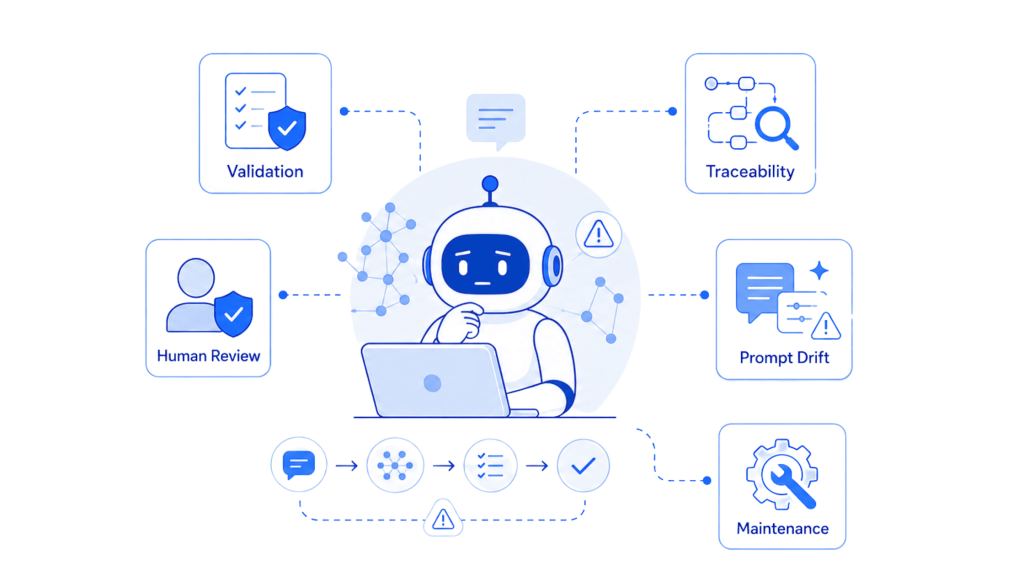
Several factors make these frameworks harder to run in production than a demo suggests:
Gartner’s research puts a number on this: over 40% of agentic AI projects are expected to be canceled by the end of 2027, citing escalating costs, unclear business value, and inadequate risk controls. The important detail is the reason. Gartner’s own analysis is explicit that this isn’t a story about agents failing to work — it’s a story about organizations deploying them as early-stage experiments without a clear definition of the value they’re supposed to deliver.
That distinction matters for how a business should read this piece. The framework itself is rarely the point of failure. Unclear scope, unclear success metrics, and underestimated operational overhead are.
A no-code AI agent is a stronger fit when:
YourGPT takes a flow-guided approach to building AI agents rather than an open agentic-reasoning approach. A few of the core capabilities, built inside AI Studio:
The trade-off is real: a flow-guided agent has a bounded set of building blocks compared to an open framework. What it gets in exchange is faster setup, more predictable output for a defined conversation, and no need for a dedicated engineering team to keep it running.
| Aspect | LangChain | CrewAI | AutoGen | YourGPT |
|---|---|---|---|---|
| Origin | Open source, the foundational framework most others build on | Open source, built on top of LangChain | Open source, developed by Microsoft | No-code platform |
| Primary Function | General-purpose agent and LLM orchestration | Role-based multi-agent delegation | Multi-agent conversation with code execution | Flow-guided conversational agents |
| Model Choice | Full control, any provider | Full control, any provider | Full control, any provider | Choice among supported models (OpenAI, Anthropic, Google, xAI) |
| Multi-Agent Support | Yes, via extensions | Yes, native and role-based | Yes, native | Not applicable, single guided flow |
| Code Execution | Custom, developer-configured | Custom, developer-configured | Native, runs in isolated Docker containers | Built-in Code Execution node |
| Setup | Requires code and ongoing engineering | Requires code and ongoing engineering | Requires code and ongoing engineering | No-code builder, live without a dev team |
| Output Predictability | Varies run to run without added guardrails | Varies run to run without added guardrails | Varies run to run without added guardrails | Bounded by conversation flow, more consistent |
| Customization Depth | Unlimited, largest integration ecosystem | Unlimited within LangChain’s ecosystem | Unlimited, strong for code-heavy tasks | Bounded by the platform, extendable via API calls and code execution |
| Best Fit | Complex, general-purpose internal agents | Internal workflows needing multiple specialized agents | Data or engineering tasks involving generated code | Customer-facing support, sales, and conversational automation |
| Ongoing Cost | Engineering time plus infrastructure | Engineering time plus infrastructure | Engineering time plus infrastructure | Subscription plus usage credits |
LangChain offers the broadest ecosystem and the most granular control, CrewAI adds role-based delegation on top of it, and AutoGen specializes in safely executing generated code. All three require a developer to build, test, and maintain the system. YourGPT trades some of that flexibility for a no-code setup that reaches a working customer-facing agent faster, without a dedicated engineering team keeping it running.
A simple way to decide: if the automation is internal, complex, and owned by a developer who wants full control over logic and model choice, an agentic framework is the right starting point. If the automation is customer-facing, needs to ship quickly, and doesn’t have a dedicated engineering team behind it, a no-code AI agent like YourGPT gets there faster with fewer moving parts to maintain.
Not directly. They solve different problems. Some teams use a framework for internal, developer-owned agents and a no-code platform for customer-facing automation at the same time.
Yes, through its Code Execution node, though it runs within YourGPT’s flow structure rather than as an open framework a developer can restructure freely.
Gartner attributes it mainly to unclear business value, escalating costs, and weak risk controls in early deployments, not to the underlying technology failing to work.
Yes, to some degree. A flow-guided platform trades some of the open-ended customization of a framework for more predictable, easier-to-maintain output. Whether that trade is worth it depends on the use case.
It depends on team size and use case. A no-code platform generally reduces the engineering cost of setup and maintenance, while an agentic framework can be cheaper at scale for a team that already has the engineering capacity to run and maintain it. See YourGPT’s pricing for current plan details.
Agentic frameworks and no-code AI agents solve different problems, not competing versions of the same one. A developer building a custom internal agent with full model control still has good reason to reach for LangChain, CrewAI, or AutoGen. A team automating customer-facing conversations without a dedicated AI engineering function generally gets there faster with a flow-guided, no-code platform like YourGPT. Start by defining what a working outcome actually looks like for the specific automation, then match the tool to that definition rather than the other way around.
Use YourGPT to help Black Friday shoppers choose products, check orders and understand returns. Prepare your answers and team before the sale.

Add in-app chat support to your SaaS or mobile app. Place it on the screens where users stall, pass who they are, and hand hard cases to your team.

Group new-account tickets by onboarding stage, train an AI agent on your docs, and place it in the product where new users get stuck.
AI agents can now find and buy products for shoppers. See what agentic commerce changes for a Shopify store and which support jobs stay yours.
Build a Halloween shopping assistant for Shopify with YourGPT. Set up product recommendations, stock checks, cart actions and human support before launch.

See what a good customer effort score looks like, how to word and calculate CES on each scale, and which support habits raise customer effort.