8 AI Tools for Sales and Marketing Teams in 2026

Rajni
Last updated on September 28, 2026
Sales and marketing teams often struggle less with AI adoption and more with choosing the right type of tool. The market includes AI BDRs, WhatsApp platforms, email sequencers, voice automation, data enrichment, and conversation intelligence software.
This blog compares seven platforms built for different needs, including Artisan, YourGPT, Sequenzy, AiSensy, Clay, and Gong. Each tool is assessed by its main use case, ideal user, pricing, and limitations.
Pricing ranges from free entry plans to about $250 per month, helping teams compare options before investing time in setup and implementation.
AI has genuinely changed what a small sales and marketing team can do. A two-person team can now run outbound prospecting at a scale that used to require a full SDR function. A SaaS founder can set up a lifecycle email system that fires automatically based on billing events. A service business can handle inbound calls and appointment reminders without adding front-desk staff.
The tools that make this possible are more specialized than most teams expect. An AI BDR does something fundamentally different from a WhatsApp marketing platform, which does something different from a conversation intelligence tool. Picking the right one comes down to identifying which specific workflow in your team is the actual bottleneck right now.
This post covers eight tools that address real, distinct sales and marketing problems in 2026. Each entry says what the tool is, who it fits, what it costs, and where it falls short. For more on how AI strategies can lift marketing revenue, that post covers the underlying mechanics.
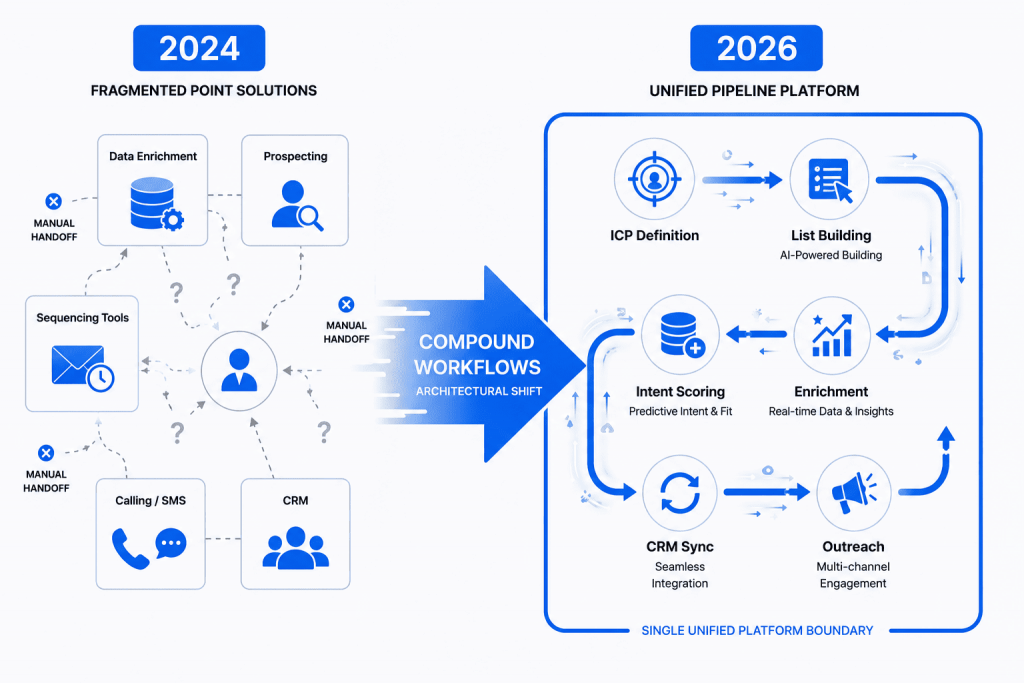
Two years ago, most teams ran separate tools for each step of the workflow. One tool to find accounts, another to enrich contact data, another to write and send sequences, another to track what happened on the call. Each handoff between tools meant manual work, data inconsistency, and someone updating a spreadsheet to keep everything in sync.
That architecture is becoming obsolete. The better platforms in 2026 connect those steps inside a single workflow. Feed in your ideal customer profile and the system builds the list, verifies contact data against live sources, scores intent, runs the outreach, and syncs records into your CRM. The gap between inputting criteria and having a booked meeting shrank significantly for teams that made the switch early.
Data freshness also became a genuine competitive edge. Databases built on periodic crawls lost ground to platforms that verify records against live sources in real time. A high nominal match rate on data refreshed six months ago often performs worse in practice than a lower match rate on records verified this week. Teams that internalized this rebuilt their outbound motion around data recency, not just volume.
The sales and marketing boundary at the data layer is also getting fuzzier. Intent signals, buying triggers, and behavioral data now inform both outbound sequences and paid retargeting. A tool bought for the sales team increasingly shapes what the marketing team sees, and vice versa. According to Gartner’s 2026 CMO Spend Survey of 401 senior marketing leaders, CMOs are allocating an average of 15.3% of marketing budgets to AI initiatives and organizations that are better equipped to scale the technology allocate an average of 21.3%. The gap between those two numbers is where the buying decisions on this list tend to live.
Hundreds of tools now claim to automate sales and marketing work. Most repackage an existing API with a cleaner interface, add an AI label to a workflow that was already automated, or solve a problem narrow enough that most teams will never encounter it. The seven tools in this guide cleared a different bar.
Each tool was evaluated against four standards before making this list:
| # | Tool | Primary Use Case | Best For | Starting Price | Rating |
|---|---|---|---|---|---|
| 1 | Artisan Ava | Autonomous AI BDR for outbound prospecting | SDR teams running email-first outbound that want autonomous prospecting without staffing a full BDR function | Free trial / $250/mo | 4.4/5 |
| 2 | YourGPT | AI agent platform for support, sales, and operations | Teams that want one platform to automate support, sales, and operations across chat, voice, and messaging channels | $39/mo annually | 4.8/5 |
| 3 | Sequenzy | AI email sequencing and lifecycle automation | SaaS founders and growth teams automating onboarding, trial conversion, dunning, and win-back emails | Free, 2,500 emails/mo | 4.5/5 |
| 4 | AiSensy | WhatsApp marketing, broadcasts, and chatbot automation | Businesses in WhatsApp-focused markets that need broadcasts, automated replies, and a shared team inbox | Free / $45/mo | 4.3/5 |
| 5 | Nutshell | CRM, sales pipeline management, and marketing automation | Small and mid-sized sales teams that want CRM, pipeline tracking, email automation, and contact management in one platform | Paid plans available | 4.3/5 |
| 6 | Otter.ai | Meeting transcription, summaries, and conversation analysis | Sales teams and professionals that need real-time transcription, searchable meeting summaries, highlighted keywords, and clear follow-up action items | Free plan available | 4.3/5 |
| 7 | Clay | Prospect data enrichment and AI GTM workflows | RevOps teams and growth marketers that need enriched prospect data for personalised outbound campaigns | Free / around $149/mo | 4.5/5 |
| 8 | Gong | Conversation intelligence and deal coaching | Mid-market and enterprise sales teams that need pipeline visibility and coaching based on call and email data | Custom pricing | 4.6/5 |
Sales and marketing teams now have AI tools built for every part of the workflow: prospecting, engagement, enrichment, and deal analysis. This list covers seven of the best, with verified pricing and honest guidance on who each one actually fits.
Best for: SDR teams running email-first outbound who want autonomous prospecting and sequencing without staffing a full BDR function.
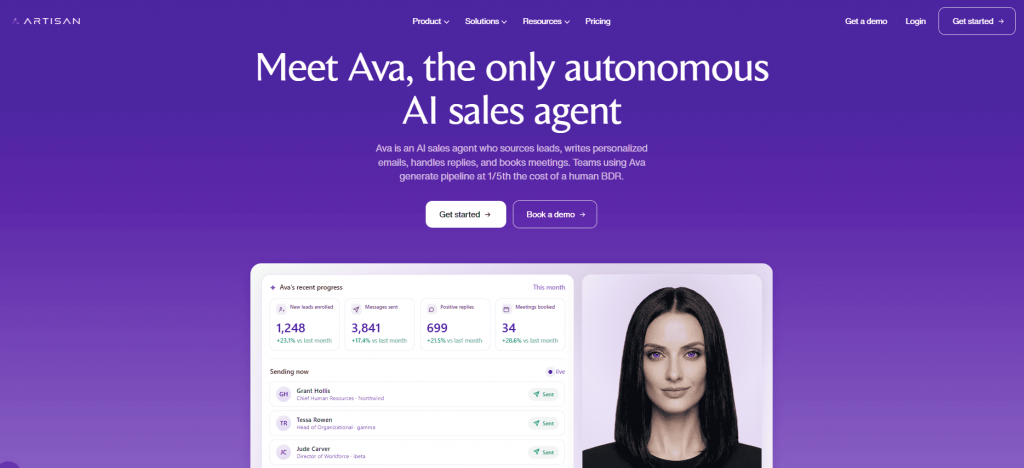
Artisan’s product is Ava, an AI business development representative built to run outbound sales without a human initiating each step. You provide your ideal customer profile, connect your email infrastructure, and Ava finds prospects, researches them, writes personalized sequences, and manages follow-ups across a multi-step campaign. The outreach continues while your team focuses elsewhere.
Ava 2.0 launched in May 2026 as a fully self-serve product, reducing entry pricing by 10x from the original sales-led model. Artisan positions Ava as handling roughly 80% of the outbound workflow rather than replacing human SDRs entirely. Email is the primary channel, with LinkedIn touchpoints available alongside it.
The platform ships with a B2B contact database of 300 million-plus records, so teams are not importing a separate list to get started. Personalization pulls from company-level research and contact-level intent signals rather than basic mail-merge variables. Deliverability infrastructure is bundled rather than sold separately.
Best for: Teams that want one platform to automate support, sales, and operations across chat, voice, and messaging channels without increasing headcount.
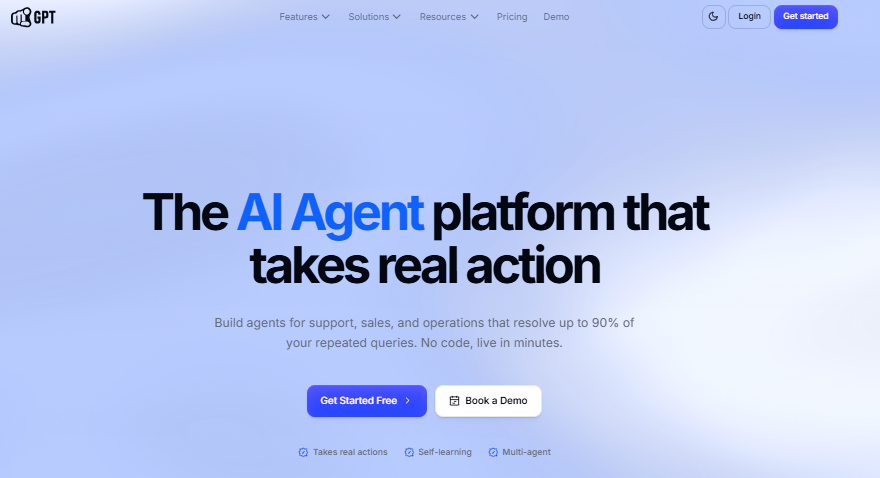
YourGPT describes itself as “the AI Agent platform that takes real action,” a description that separates it from chatbots that answer and stop there. The platform is built to run support, sales, and operations from a single connected system. An agent can answer a support question, qualify a lead, update a CRM record, and hand off to a human, all inside the same conversation thread. Per the yourgpt.ai homepage, agents resolve up to 90% of repeated queries end to end.
AI Studio is the visual workflow builder at the center of the platform. Teams build multi-step agents using drag-and-drop nodes: intent and event triggers, native API calls, custom Python or JavaScript for complex logic, human handoff with full context preserved, and rich interactive messages including cards, carousels, and buttons. Prompt-to-workflow generation turns a plain-English description of the automation into a working flow, with step-by-step auto-debug before going live.
Native MCP integration connects agents to live external data through Model Context Protocol servers. The marketplace includes ready-made connectors for Notion, CRM tools, SEO research, and more, so agents work from current data rather than stale training content alone.
PhoneAI handles voice channels alongside chat, applying the same agent logic to inbound calls, appointment booking, and lead qualification by phone. The platform deploys across WhatsApp, Instagram, Telegram, Messenger, Slack, Discord, email, website widget, and native iOS and Android SDKs.
Pricing confirmed from yourgpt.ai/pricing, fetched July 2026.
A 7-day free trial is available with no credit card required. Verify current figures at yourgpt.ai/pricing before budgeting.
Best for: SaaS founders and growth teams that want lifecycle email automation running automatically without configuring each step by hand.
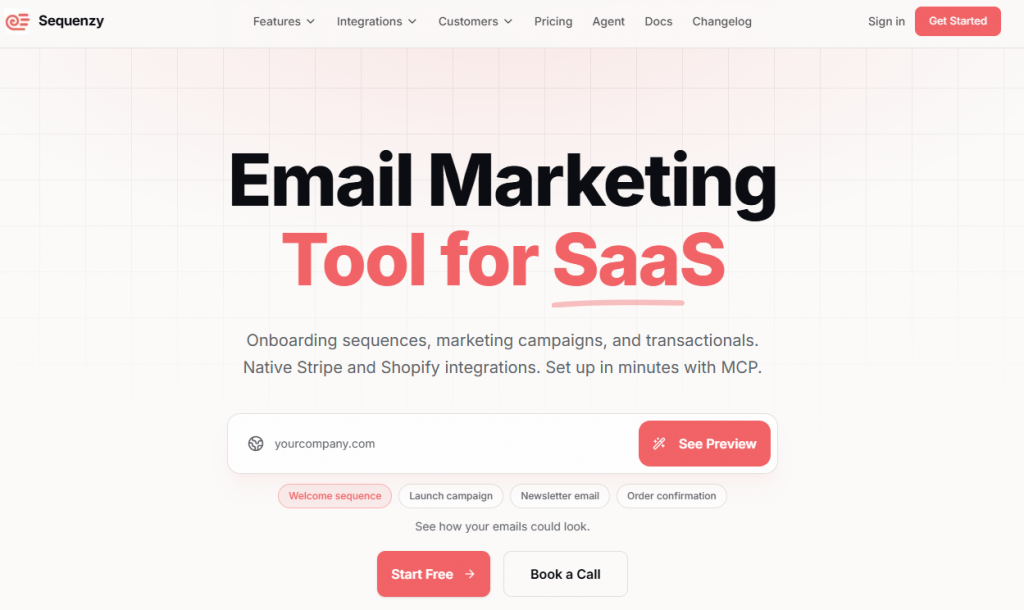
Sequenzy is an email marketing and automation platform built specifically for SaaS and developer-first teams. Describe what you need in plain English and the AI generates a complete email sequence: subject lines, copy, send delays, and trigger conditions. A founder setting up a new trial onboarding flow does not have to configure each step manually.
What separates Sequenzy from general email platforms is its native connection to revenue infrastructure. Stripe and Shopify connect directly, so dunning emails fire automatically on failed payments, cancellation win-back sequences trigger when a subscriber churns, and post-purchase flows start without a webhook written by hand. Transactional emails send from the same platform as marketing campaigns, which removes the need for a second vendor.
Sequenzy’s AI sequence builder produces context-aware drafts rather than generic templates. It accounts for the audience, the lifecycle stage, and the goal, then produces a complete flow with timing logic and subject line variants. Everything is editable before going live.
One founder reported $600 in revenue from email automations in the first 30 days after migrating to Sequenzy, and another described getting campaigns live in under 30 minutes. These are testimonials from the platform’s own customer stories page and individual results will vary.
Best for: Businesses in WhatsApp-dominant markets that want to run bulk campaigns, automate customer replies, and manage conversations from a shared team inbox.
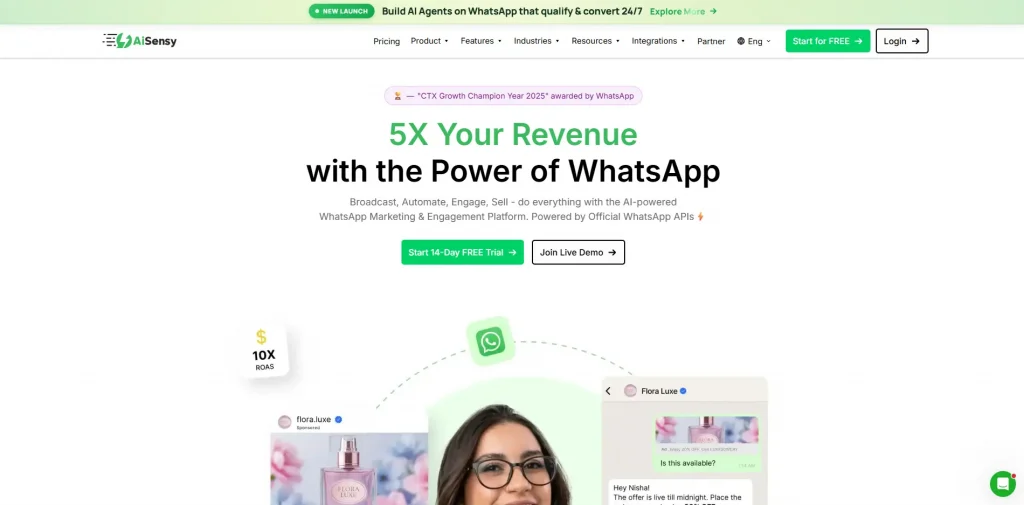
AiSensy is an official WhatsApp Business Solution Provider that lets businesses run broadcasts, build chatbot flows, manage customer conversations through a shared inbox, and collect payments through WhatsApp. It connects to the official WhatsApp Business API, which matters for businesses that need verified sending, template approval, and compliance with Meta’s messaging policies.
AiSensy states it serves 150,000-plus businesses across 60 countries (per coldiq.com secondary review, June 2026), with the largest concentration in India and Southeast Asia. Use cases cover ecommerce (abandoned cart recovery, order notifications), education (admission updates, course reminders), healthcare (appointment confirmations), and direct sales follow-up.
WhatsApp shifted from per-conversation to per-template-message pricing in January 2026. This affects total cost of ownership for businesses sending high-volume marketing messages, since charges now apply per template delivered rather than per session. The AiSensy subscription covers platform access, inbox management, and automation features. Meta’s per-message charges apply separately and vary by recipient country.
Best for: Small and mid-sized B2B teams that want an easy-to-use AI CRM for pipeline management and email marketing.
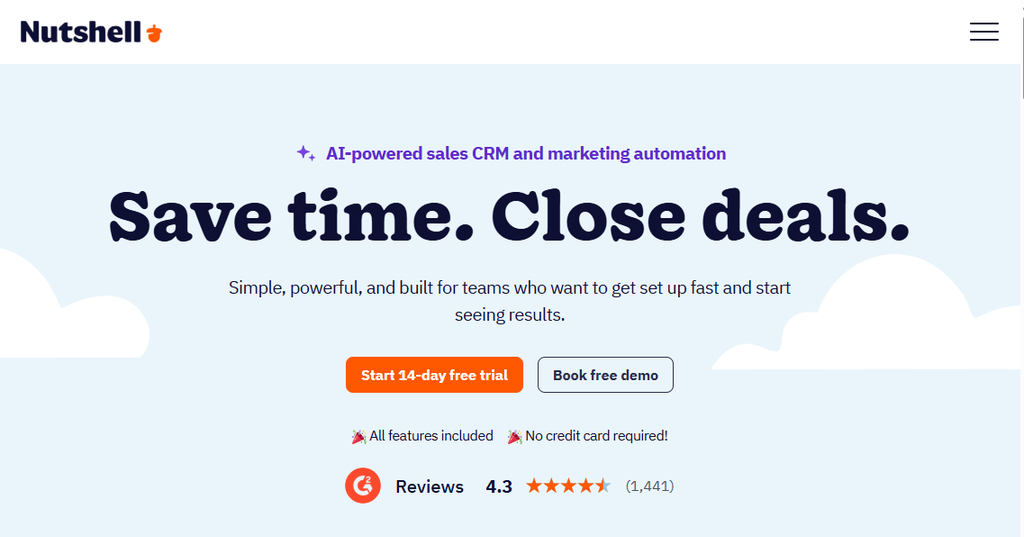
Nutshell is a CRM and sales automation platform for small and mid-sized B2B teams. It keeps leads, contacts, emails, calls, notes, and activities in one place, while visual pipelines show where each deal stands.
The platform also includes webchat, an AI chatbot, forms, landing pages, email and calendar sync, and email marketing tools, giving sales and marketing teams a shared customer record.
Nutshell separates its AI into AI assists and AI outcomes. AI assists include unlimited tools such as email reply suggestions and Smart Reports, while AI outcomes cover heavier tasks like call summaries, lead research, scoring, and AI-generated email campaigns. Monthly AI outcome allowances vary by plan.
Nutshell focuses on ease of adoption rather than deep enterprise configuration. Teams can get started without a dedicated CRM admin, while the optional Nutshell IQ add-on adds prospecting and verified contact data.
Best for: Sales teams and professionals needing real-time transcription, searchable summaries, and clear follow-up notes.
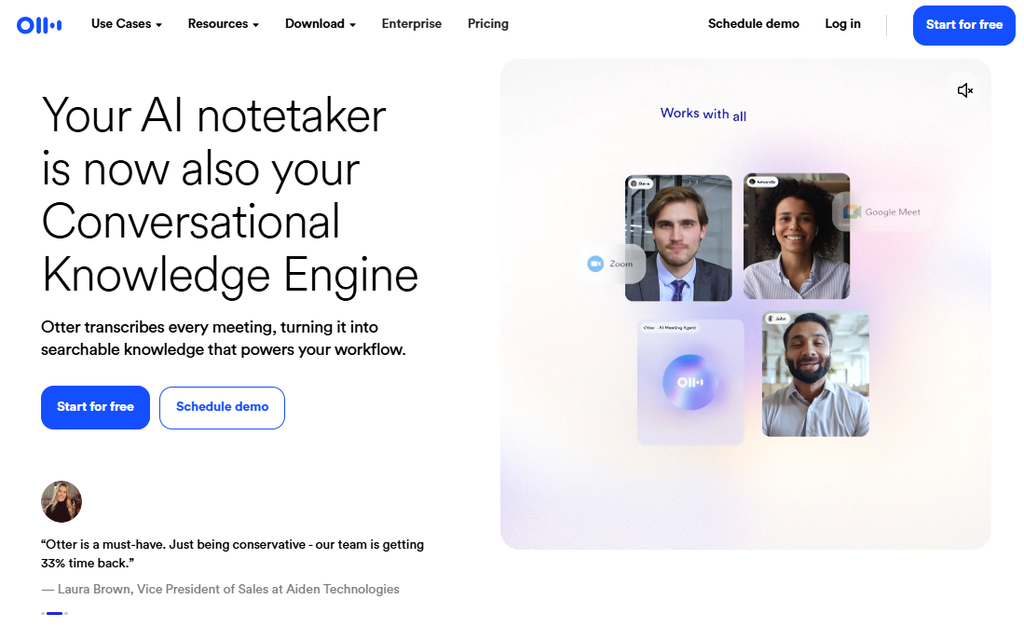
Otter.ai is an AI meeting assistant built to record, transcribe, summarise, and organise conversations across Zoom, Google Meet, Microsoft Teams, and in-person meetings. It helps sales teams stay focused during calls while automatically capturing what was discussed, who said it, and which next steps were agreed.
Otter’s AI layer produces searchable transcripts, meeting summaries, key takeaways, decisions, and action items. Team members can also use AI Chat to ask questions about individual meetings or search information across multiple conversations. This makes it easier to revisit pricing discussions, customer objections, commitments, and follow-up tasks after a sales call.
Unlike Gong and similar revenue intelligence platforms, Otter.ai is centred on meeting productivity rather than pipeline forecasting, deal scoring, or advanced sales coaching. It is therefore a practical choice for teams that primarily need accurate records and structured follow-ups without the cost and complexity of a broader sales platform.
Best for: RevOps teams and growth marketers who need enriched, research-backed prospect data before running any outbound campaign.
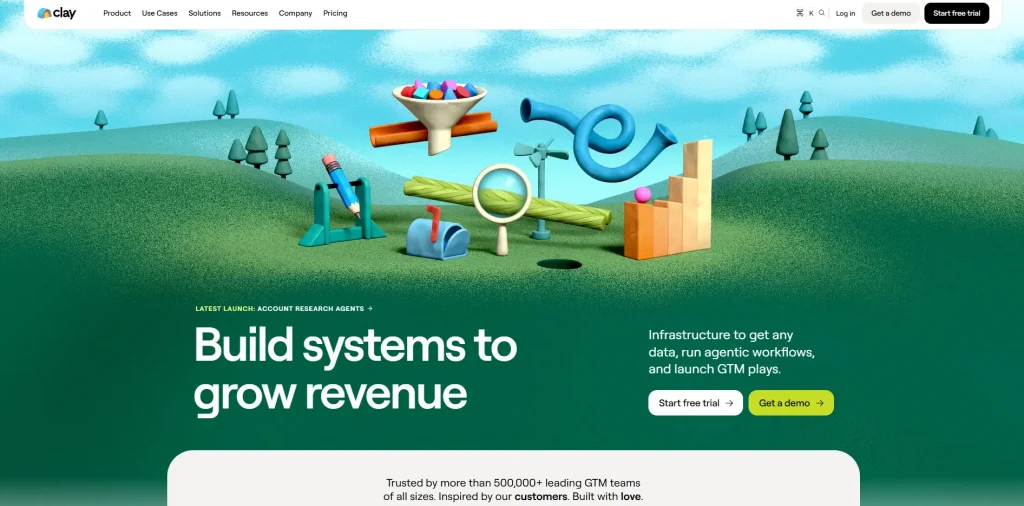
Clay is a data enrichment and workflow platform built for go-to-market teams that need to combine data from multiple sources before sending a single email. The core mechanic is a spreadsheet-like canvas where you pull contact and company data from 100-plus providers, run AI research agents against those records, and push the cleaned, enriched output into your CRM or outreach tool.
AI agents inside Clay can research a prospect’s recent funding rounds, read their current job postings, summarize their LinkedIn activity, or pull pricing information from their website, all without a human touching each row. That research feeds personalized email copy or enriches a CRM record with context a sales rep would otherwise spend hours gathering manually.
Clay is not an outreach platform. It builds and enriches the list that feeds your outreach platform, whether that is a sequencer, a CRM, or an AI BDR. Teams that run Clay alongside a sending tool typically report stronger reply rates because outreach starts from a more accurate picture of each prospect.
Clay’s learning curve is genuine. Full capability requires comfort with data pipelines, waterfall enrichment logic, and some tolerance for debugging. Teams without a RevOps owner or a technically comfortable growth hire may find the initial configuration time-consuming.
Best for: Mid-market and enterprise sales teams that want evidence-based coaching and deal intelligence from actual call and email data.
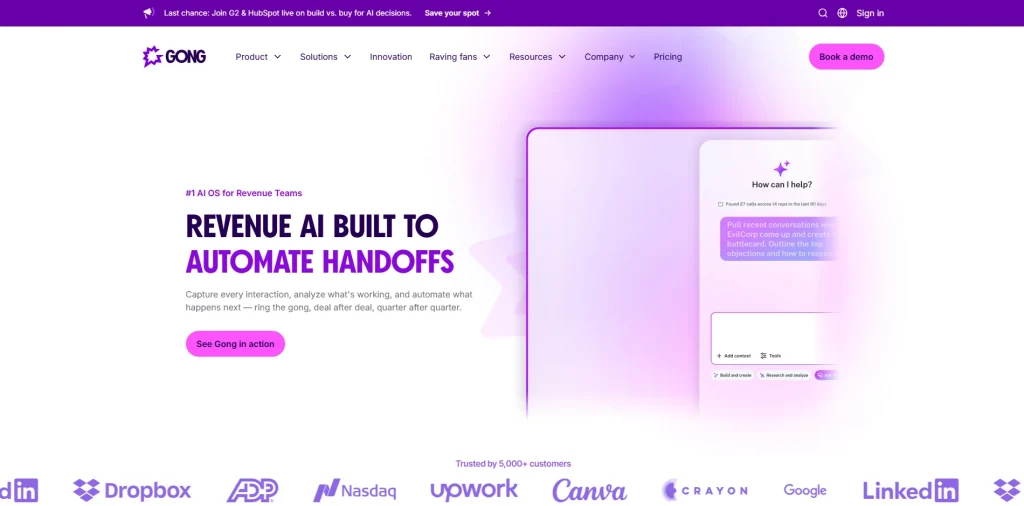
Gong records and analyzes sales calls, emails, and meetings, then surfaces what is actually happening across your pipeline. Sales leaders get a view of every customer interaction without relying on rep self-reporting: who joined the call, what was discussed, which objections came up, whether next steps were defined, and whether deal health has shifted since the last touchpoint.
Gong’s value is in the patterns a manager reviewing calls manually would miss. Which messaging frameworks close deals fastest at your company. Which objections appear consistently in lost deals but not won ones. Whether reps are following the sales process or doing something else entirely. Coaching shifts from opinion to evidence.
Gong is a late-funnel tool. It does not help with prospecting or top-of-funnel volume. It helps with what happens once a conversation is already in progress, which makes it most useful for teams with reasonable deal volume and a sales leader who has the time and mandate to act on what the data surfaces.
Most buying decisions here are not head-to-head comparisons. Each tool fills a different gap, and the right question is which gap matters most to your team right now.
Start with the use case, not the feature list. A team that needs to grow its outbound pipeline and has no BDR budget looks at Artisan. A SaaS team whose trial-to-paid conversion is weak looks at Sequenzy. A healthcare practice getting overwhelmed with inbound calls looks at Emitrr. A business with a WhatsApp-first customer base in India or Southeast Asia looks at AiSensy.
YourGPT fits when the problem spans more than one of those use cases. If you need support, sales, and operations automation connected across channels and you want it from one platform rather than four, that’s the use case it was built for. The AI agent builder and Studio cover the same ground that would otherwise require stitching together a chatbot, a sequencer, a WhatsApp tool, and a voice platform separately.
Clay and Gong fit best as additions to an existing stack rather than replacements. Clay enriches the data that feeds every other tool. Gong tells you whether your team is actually executing the conversations your other tools are generating.
A few practical checks before buying:
Check whether the AI billing is included or separate. Several platforms on this list charge subscription fees plus per-conversation, per-resolution, or per-credit usage on top. The sticker price and the actual monthly cost can diverge significantly at volume.
Test with real data, not demo accounts. Ava’s output quality depends on your ICP configuration. AiSensy’s campaign results depend on your template quality and contact list health. Sequenzy’s sequences depend on the quality of the lifecycle prompt you give it. These tools amplify what you put in.
Match the tool to your team’s technical tolerance. Clay rewards a RevOps operator. Sequenzy rewards a SaaS founder who can describe a lifecycle in a sentence. Emitrr rewards a practice manager who wants a setup wizard, not a flow builder.
Artisan Ava is a strong single-purpose option for outbound sales outreach. It finds prospects, researches accounts, creates personalized email sequences, and manages follow-ups automatically. Teams that want sales outreach alongside support and operations automation across multiple channels may prefer YourGPT.
Artisan Ava focuses on autonomous outbound prospecting, sequencing, and follow-ups through email and LinkedIn. YourGPT covers a broader range of inbound and outbound sales workflows, including lead qualification, CRM updates, human handoff, and conversations across WhatsApp, voice, web chat, and messaging channels.
YourGPT offers multiple plans for different team sizes and automation needs. Pricing can change, so check the official YourGPT pricing page before budgeting or comparing it with other platforms.
AiSensy is a good fit for businesses in markets where WhatsApp is the primary customer channel. It supports broadcasts, chatbot automation, a shared team inbox, and integrations with tools such as Shopify and HubSpot. Meta messaging fees may apply separately, so estimate costs using your expected message volume and recipient locations.
Sequenzy is designed for SaaS and developer-focused teams that want automated lifecycle email campaigns. It can create onboarding, trial-conversion, dunning, and win-back sequences from plain-language instructions and trigger emails using billing events from platforms such as Stripe and Shopify.
Most teams need one or two tools that match their biggest gaps. Artisan focuses on outbound pipeline, Sequenzy on lifecycle email, and AiSensy on WhatsApp communication. YourGPT is suited to teams that want support, sales, and operations automation managed through one connected AI agent platform.
Small teams should start with the tool that solves their most immediate problem. Sequenzy can work well for lifecycle email, AiSensy for WhatsApp campaigns, and YourGPT for combined support and sales automation. Clay and Gong are generally more useful once a team already has an established outbound process that needs better data or coaching insights.
Sales and marketing AI in 2026 is not one category. It’s six or seven distinct problems with six or seven distinct tools built for each one.
Artisan handles the prospecting and sequencing that used to require a junior SDR. Sequenzy handles the lifecycle email logic that SaaS teams have been building by hand for years. AiSensy handles WhatsApp-first customer communication at scale. Emitrr handles the inbound call and text volume that service businesses spend most of their support budget on. Clay handles the data enrichment that determines whether any outbound campaign reaches the right person. Gong handles the coaching and deal intelligence that determines whether your reps close the pipeline they generate.
YourGPT handles the case where you need more than one of those things inside a single platform, connected to each other and deployed across channels your customers already use.
Pick the tool that solves the problem in front of you. Build from there.
Build AI agents with YourGPT that qualify leads, answer customer questions, update business tools, and take action across chat, voice, and messaging channels.
Compare outsourcing customer service with an AI agent using your own ticket mix, a cost model you fill in, and a clear rule for a hybrid split.
Export the Zendesk ticket archive, train an AI Agent on the help center, and test one real ticket before you stop the old queue.

Compare six Yuma alternatives by ecommerce capabilities, helpdesk compatibility, pricing and human handoffs to choose a replacement for your support team.

Move from Gorgias with a verified ticket archive, tested AI workflows, human handoff and a channel cutover plan before ending your subscription.
TL;DR The Gorgias AI Agent is the automation layer inside the Gorgias helpdesk, split between a Shopping Assistant for pre-purchase conversations and a Support Agent for post-purchase support. A connected Shopify store is required, and Gorgias documentation rules out platforms such as BigCommerce, Magento, and WooCommerce for the AI Agent. Billing runs on two separate […]

TL;DR Gorgias is the closest Richpanel alternative for Shopify stores that need native order actions directly inside support tickets. YourGPT fits stores that want one AI agent handling requests across web, WhatsApp, Instagram, and email, while Tidio and Re:amaze suit smaller teams looking for lighter, lower-cost options. Richpanel’s AI pricing starts around $500/month for two […]