7 AI Strategies That Actually Increase Marketing Revenue

Rajni
Last updated on August 22, 2026
AI drives marketing revenue when it focuses on pattern recognition, repetition, and identifying buying intent rather than replacing strategy.
The biggest gains come from behavior-based segmentation, personalization, faster content production, predictive budget optimization, AI search visibility, and automated lead qualification across channels like WhatsApp.
Platforms like YourGPT help businesses build AI agents without code, but human input still matters for pricing, brand voice, strategy, and understanding what truly resonates with customers.
You have definitely heard about the use of AI in marketing.
But have you ever seen or learned how it can actually drive revenue?
Well, firms using AI in marketing and sales report significant benefits. According to a recent study by McKinsey & Company, revenue increases from AI show up most in marketing and sales, along with some other departments.
In this blog, we will dig into five practical ways AI helps boost your marketing revenue. We’ll look at real tools, data platforms, and what works in the field. Continue reading because you will find something that you can try tomorrow.
Businesses can utilise AI in various practical ways to boost conversions and revenue. Let’s explore them one by one.
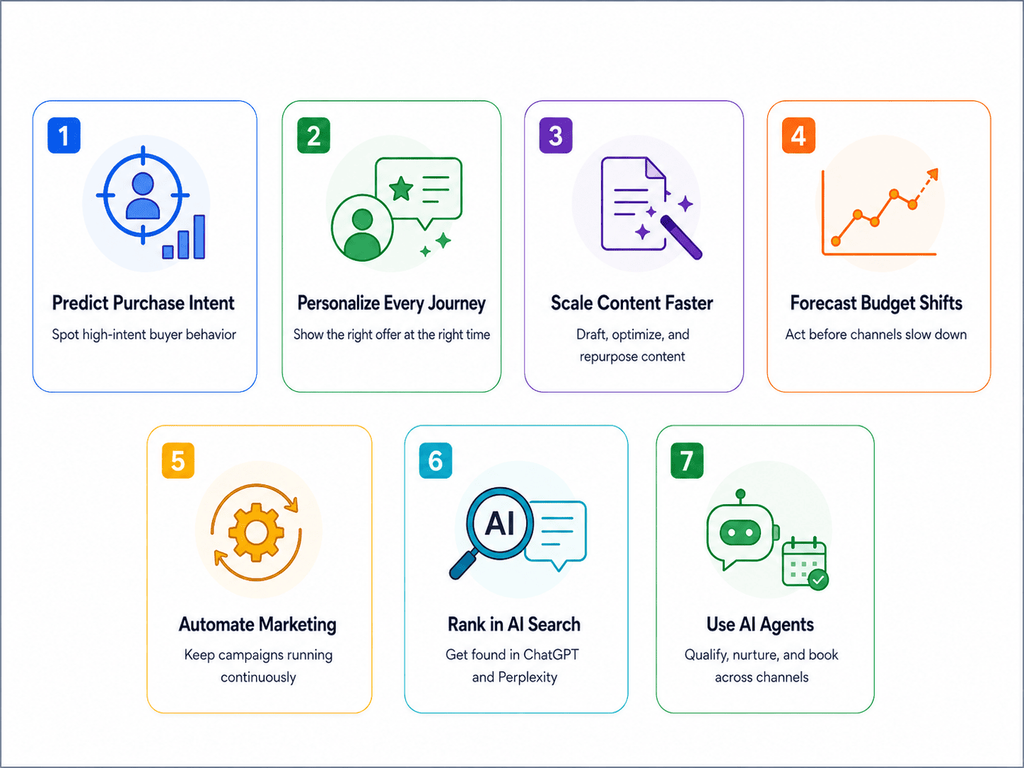
Explore the best AI strategies for increasing marketing revenue, improving conversions, and reaching the right customers more effectively.
Most businesses still segment by demographics: age, location, job title. AI segments by behavior patterns that actually predict who’s about to buy.
Someone visits your pricing page three times in two days, downloads a case study, then abandons cart. That’s different from someone who just signed up for your newsletter. One is evaluating. The other is exploring.
AI tracks these patterns across every touchpoint. When someone shows high-intent signals, you can reach out with a targeted offer instead of waiting for your automated email sequence to eventually get to them.
The companies doing this well don’t guess at purchase intent anymore. They let AI flag when someone’s behavior shifts from browsing to deciding. Your sales team talks to people when they’re ready, not when your calendar says to follow up.
Did you ever notice how Netflix shows you exactly what you are going to watch next? Or probably you have seen the ads by Amazon about the things you were just thinking or talking about.
This is not luck every time; it’s called customer personalization. And it is usually driven by AI.
AI tools like Dynamic Yield can study user behaviour. They look at clicks, time spent on the page or your purchasing history. Hence, they show you the exact product or send you a relevant message at the perfect time.
This level of hyper-personalization makes a real connection. People buy more and come back because the experience feels like it was made just for them. And that’s how brands quietly grow loyalty and lifetime value.
Publishing two blog posts per week requires full-time effort. Publishing ten requires a team or AI assistance.
AI doesn’t write your content. It handles the parts that slow you down: research compilation, outline structure, first-draft generation. You handle strategy, examples from actual customer conversations, and making sure the voice sounds human.
This matters for SEO. Google ranks sites that comprehensively cover topics. Covering a topic comprehensively means publishing 20-30 related articles, not just one pillar post. Most small teams can’t sustain that pace manually.
With AI assistance, Optimizing content tone and style for multiple social media channels has also become easier with the help of AI writing assistant. For example, instead of rephrasing the same content for different platforms, you can take a draft and run it through Prepostseo. It helps you adjust tone easily. You can make it fluent for LinkedIn, creative for Facebook, and short and catchy for Instagram captions.
Quantity matters, but quality does too. This mix of creativity and automation means you can scale content faster in less time. This ultimately saves you time and effort, and you can do more with a small marketing budget.
For social media, the same principle applies. Draft multiple caption variations, test different hooks, adjust tone for each platform. AI handles the volume. You pick what actually works for your audience.
Most marketing budgets get allocated based on last quarter’s performance. If paid search worked in Q1, we increase the budget in Q2. If organic traffic dropped, we scramble to figure out why.
Predictive analytics flips this. Instead of reacting to what happened, you see patterns forming before they show up in your dashboard.
Traffic from organic search typically drops in August? The system flags this in June based on historical patterns. You can shift budget to paid channels before the drop actually happens.
Customers who reduce product usage by 40% over two weeks usually churn within the month? You see the pattern forming and can intervene with targeted outreach or product help before they cancel.
The forecasts aren’t perfect. They’re directional. But directional beats reactive when you’re trying to hit revenue targets. You’re making budget decisions based on likely outcomes instead of past results.
For example, the sales of a specific product might drop or increase at a specific time each year. The AI-based tools, like Google Analytics 4, can spot this pattern and predict earlier that this is going to happen. They show which channels actually bring revenue and which ones just eat the budget. This will ultimately help increase revenue.
Marketing automation keeps campaigns running without manual effort. AI tools can handle things while you are busy or even when you are asleep. They send emails, manage ads, and reply to customers’ queries without needing a break.
Programmatic advertising uses AI to automatically buy and optimize ad placements in real time. AI can place and optimize ads where they perform best. This saves you a lot of time and needs much less workforce as compared to manual marketing campaigns. In the end, AI can reduce labor costs and increase revenue by improving marketing efficiency.
AI handles volume and pattern recognition. It doesn’t handle strategy or understand why customers choose your product over alternatives.
You can train a system to predict which leads will convert based on their behavior. You can’t train it to understand why your messaging resonates with healthcare buyers but falls flat with manufacturers. That requires talking to customers, interpreting feedback, and understanding context that goes beyond data patterns.
Use AI for repetitive tasks: drafting content, scoring leads, responding to common questions, analyzing campaign performance, and adjusting bids. Keep humans involved in strategy, creative direction, brand voice, and anything requiring empathy or cultural awareness.
The companies seeing real results aren’t replacing their marketing teams with AI. They’re removing the time-consuming tasks so marketers can focus on the thinking that actually drives growth.
SEO used to mean ranking on Google. Now it includes ranking in ChatGPT, Perplexity, and other AI platforms that cite sources when answering questions.
This matters because search behavior is shifting. People ask AI platforms questions and get synthesized answers with citations. If your content isn’t showing up in those citations, you’re invisible to a growing segment of searchers.
Companies optimizing for AI search platforms report 4-5x higher conversion rates from that traffic compared to regular organic visitors. The visitors arrive with more context and higher intent because they’ve already read a synthesized answer that cited your expertise.
Statistics show businesses using AI for SEO see organic traffic increases of 30-45% within six months. The results come from systematically covering topics more comprehensively than competitors can manage manually.
Chatbots answer questions from a script. AI agents connect to your business systems and complete tasks based on real data.
Someone lands on your site from a LinkedIn ad. An AI agent qualifies them with a few questions, checks if they match your ideal customer profile, finds an open slot on your calendar, and books a demo. Your sales rep sees a qualified meeting with full context already on their schedule.
A WhatsApp message asks about international shipping. The agent checks your policies, confirms availability for their country, shares costs, and processes the order.
YourGPT lets you build these agents without code. Train them on your business data (documentation, past conversations, product details), connect them to your tools through MCP360 integration (which links to 100+ platforms), and deploy across website, WhatsApp, Instagram, Messenger, and email.
Marketing operations these agents handle:
MCP360 makes the difference here. Instead of coding API connections to each tool individually, you connect once and your agents access everything: CRM updates, calendar scheduling, inventory checks, order processing, analytics pulls, and email triggers.
Companies using AI agents for marketing see 2-3x improvements in lead conversion. The gain comes from immediate, accurate responses regardless of when someone asks. Leads don’t wait for business hours. They get qualified and moved forward in real time.
Small teams see the biggest impact. One person with configured agents handles volumes that previously needed round-the-clock staffing. Agents manage repetitive work. Humans handle strategy and relationships requiring judgment.
The revenue impact is real when AI is used for the right jobs: spotting buying intent, personalizing offers, and qualifying leads faster than a human team can manually. It doesn’t work as a strategy replacement. Teams that see revenue gains use AI for pattern recognition and repetitive tasks while humans still own pricing, positioning, and brand voice.
Most teams see measurable shifts within 60 to 90 days, mainly in lead response time and content output. Behavioral segmentation and lead scoring start showing patterns almost immediately since they run on data you already have. Content and SEO gains take longer, usually 4 to 6 months, since search engines need time to index and rank the additional volume.
No. Platforms like YourGPT let you build and deploy an AI agent without writing code. You train it on your existing documentation and past conversations, connect it to your CRM or calendar through MCP360, and it starts qualifying leads across your website, WhatsApp, and email the same day.
Yes, if it’s built on a platform designed for multi-channel deployment. YourGPT agents run the same qualification and nurturing logic across WhatsApp, Instagram, Messenger, website, and email, so a lead doesn’t get a different experience depending on where they first reach out. This matters because most buyers now switch channels mid-conversation, and disconnected bots lose that context.
No. AI handles volume: drafting, scoring, tagging, and responding at scale. It can’t tell you why your messaging lands with healthcare buyers and falls flat with manufacturers. That still takes a human talking to customers and interpreting what they actually mean, not just what they click.
Traditional SEO targets ranking positions on a results page. AI search optimization targets getting cited inside a synthesized answer on platforms like ChatGPT and Perplexity. Both require solid on-page fundamentals, but AI search rewards content that answers a question completely in one place, since the AI is pulling from the most self-contained source it can find.
AI is changing how we market, no doubt about that. But as we get excited about all the cool tools and fast results, we also need to pause and think about
How are we using them?
AI works best when it’s used with honesty and care. That means protecting customer data and not crossing ethical lines just to grab attention or sales.
Smart marketers understand that AI does not replace people. It supports them. The real magic still comes from human judgment, empathy, and ideas. You can train an algorithm to predict behavior. However, you can’t train it to understand real human emotions and intent the way a human can.
So AI should be used in balance with human minds. For example, use AI tools for repetitive tasks, like content creation, analyzing customer behavior and chat support. And keep the creative part, like marketing strategies and decision-making about the product pricing and market analysis.
If used properly, AI helps businesses save a lot of costs in marketing and makes the process more efficient and results-driven.
Learn the practical methods teams use to improve conversions, strengthen campaigns, and generate more revenue with AI across every channel.
Research-backed insights • Updated for 2025 • Built for marketing teams
Use YourGPT to help Black Friday shoppers choose products, check orders and understand returns. Prepare your answers and team before the sale.

Add in-app chat support to your SaaS or mobile app. Place it on the screens where users stall, pass who they are, and hand hard cases to your team.
Group new-account tickets by onboarding stage, train an AI agent on your docs, and place it in the product where new users get stuck.
AI agents can now find and buy products for shoppers. See what agentic commerce changes for a Shopify store and which support jobs stay yours.
Build a Halloween shopping assistant for Shopify with YourGPT. Set up product recommendations, stock checks, cart actions and human support before launch.

See what a good customer effort score looks like, how to word and calculate CES on each scale, and which support habits raise customer effort.