Intercom Fin Pricing Explained (2026)

Rajni
November 19, 2026
Fin costs $0.99 per outcome, which means each conversation it resolves or hands off through a finished Procedure. On Intercom you pay that on top of seats that run from $19 to $139 a month, and on Zendesk, Salesforce or another helpdesk you pay a $49 base that includes 50 outcomes. The catch is that a customer who stops replying for 24 hours after Fin’s answer counts as a resolution, whether Fin helped them or not.
Fin’s price fits on a sticky note. The invoice doesn’t, because what you pay each month depends on how your conversations end, which of them Fin gets credit for, and whether your team works in Intercom or in another helpdesk.
A lot of what you’ll find in search results is also out of date. On March 12, 2026, Fin switched from billing resolutions to billing outcomes, which put Procedure handoffs on the bill. Two months later Intercom renamed the company to Fin, and Salesforce has owned it since September. Every price below is in US dollars
Four dates explain most of the confusion in older guides and sales decks.
| Date | Change | What it means for your bill |
|---|---|---|
| March 12, 2026 | Billing metric moved from resolutions to outcomes | You now pay $0.99 for Procedure handoffs that a teammate finishes, not only for conversations Fin closes alone. |
| May 12, 2026 | Intercom renamed the parent company to Fin | Intercom is still the name of the helpdesk, so quotes and invoices may use either name. |
| September 10, 2026 | Salesforce completed its acquisition of Fin | No pricing change has been announced. Renewal terms are the thing to check on a multi-year contract. |
| November 2026 | Essential new-customer price and Pro add-on price on the pricing page | New customers see Essential at $19 per seat on annual billing against a $29 list price. Pro is listed at $100 a month. |
The March change matters most for budgeting. Before it, you paid only when Fin closed a conversation on its own. Now you also pay when Fin does the groundwork and a teammate finishes the job, so a rising outcome count doesn’t always mean a lighter queue for your team.
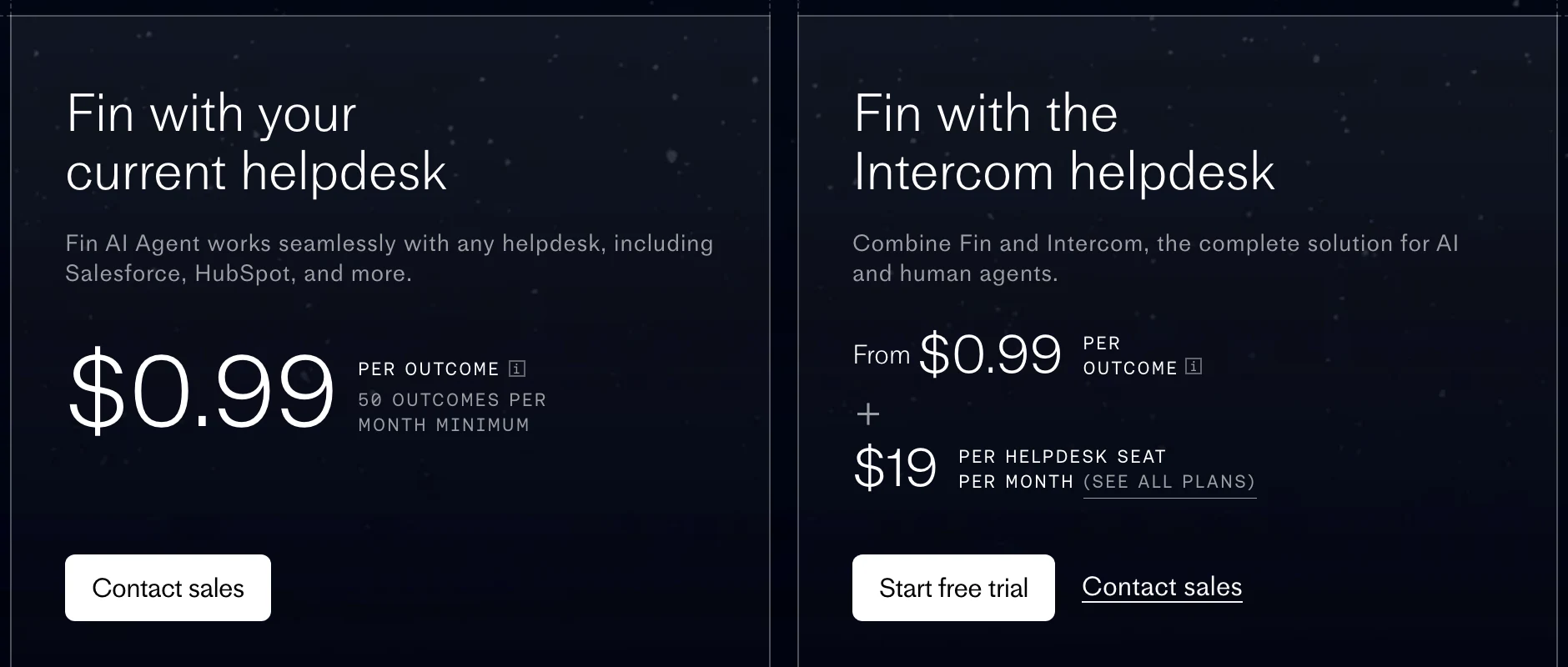
Start with the helpdesk your team already works in, because it sets your monthly floor. On Intercom you pay for seats and add $0.99 per outcome, with no separate Fin fee. On Zendesk, Salesforce, HubSpot, Freshworks, Dixa, Front, Zoho, Sprinklr or Gorgias, Fin comes as a standalone plan with a base fee and 50 outcomes included.
| Detail | Fin with Intercom seats | Fin on your current helpdesk |
|---|---|---|
| Base fee | None (seat cost covers access) | $49 a month |
| Included outcomes | No bundle listed; each outcome billed | 50 a month |
| Per outcome price | $0.99 | $0.99 (after the first 50) |
| Seat requirement | 1 paid seat minimum | Unlimited teammates, no seat cost |
| Minimum monthly spend | One paid seat (from $19 a month on annual billing for new customers, $39 monthly) | $49 a month |
| Sales outcomes (qualification) | $9.99 per qualification | Not available |
| Billing terms | Annual or monthly self-serve; contracts for enterprise needs | Monthly signup, cancel anytime; annual via sales |
Fin’s own pages describe that standalone plan in two ways. The pricing page shows a 50-outcome monthly minimum and a Contact sales button, while the help article on outcomes prices the same plan at $49 a month with 50 resolutions included. Both pages are live, so ask your rep which version your account will use.
Whichever version you land on, unused outcomes don’t carry over to the next month, and there are no setup or integration fees. Above the floor, both shapes charge the same $0.99, which puts all the weight on one question: which conversations count.
Two conversations can look the same in your inbox and land differently on the invoice. Fin charges at most one outcome per conversation, however many questions it answers or Procedures it runs, and the thing that decides the charge is how the conversation ends.
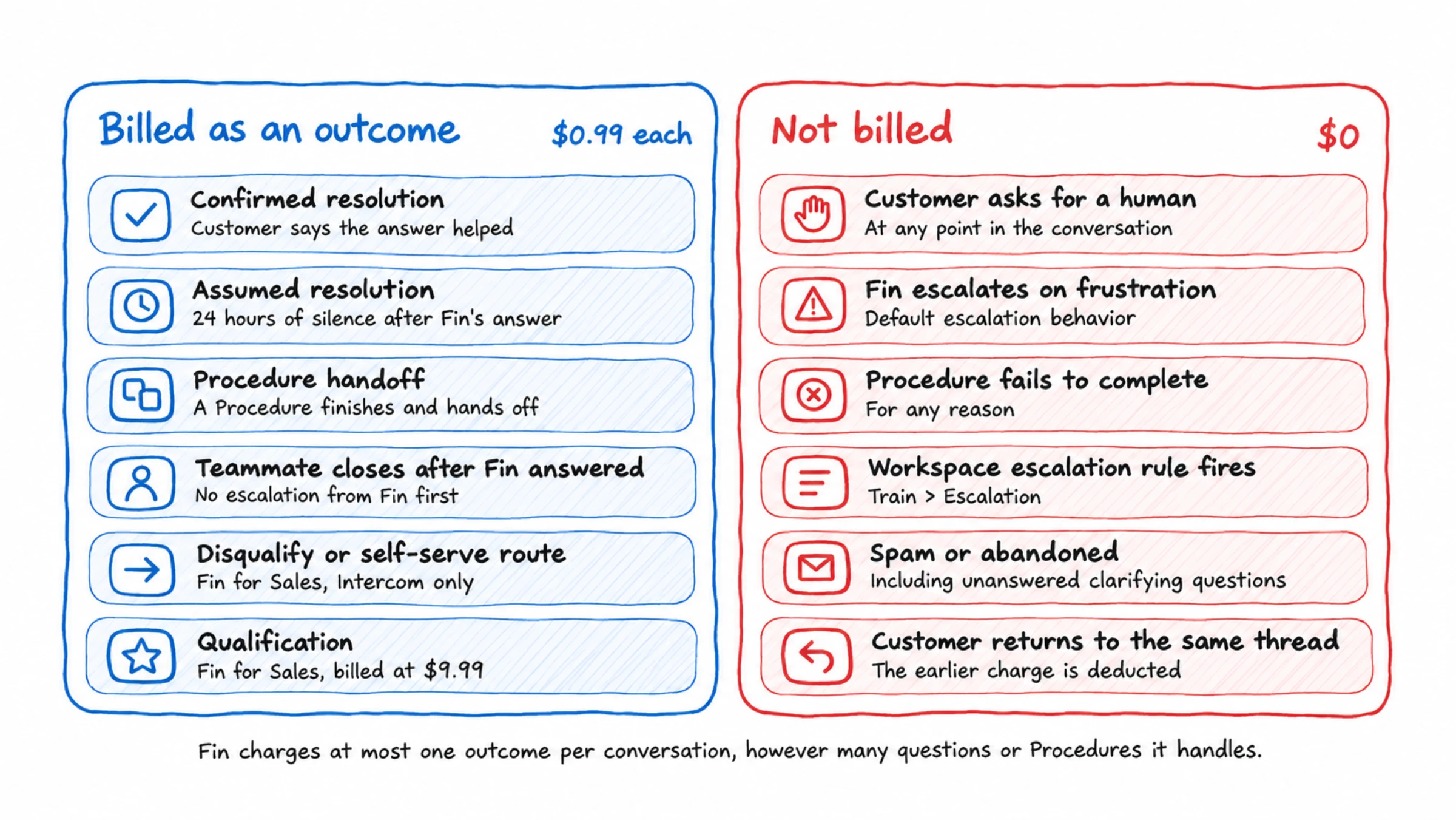
Those rules play out like this on four everyday conversations. All four are hypothetical.
The thank-you. A customer asks how long they have to return an order. Fin quotes the policy and the customer replies “thanks”. That’s a confirmed resolution, so it costs $0.99.
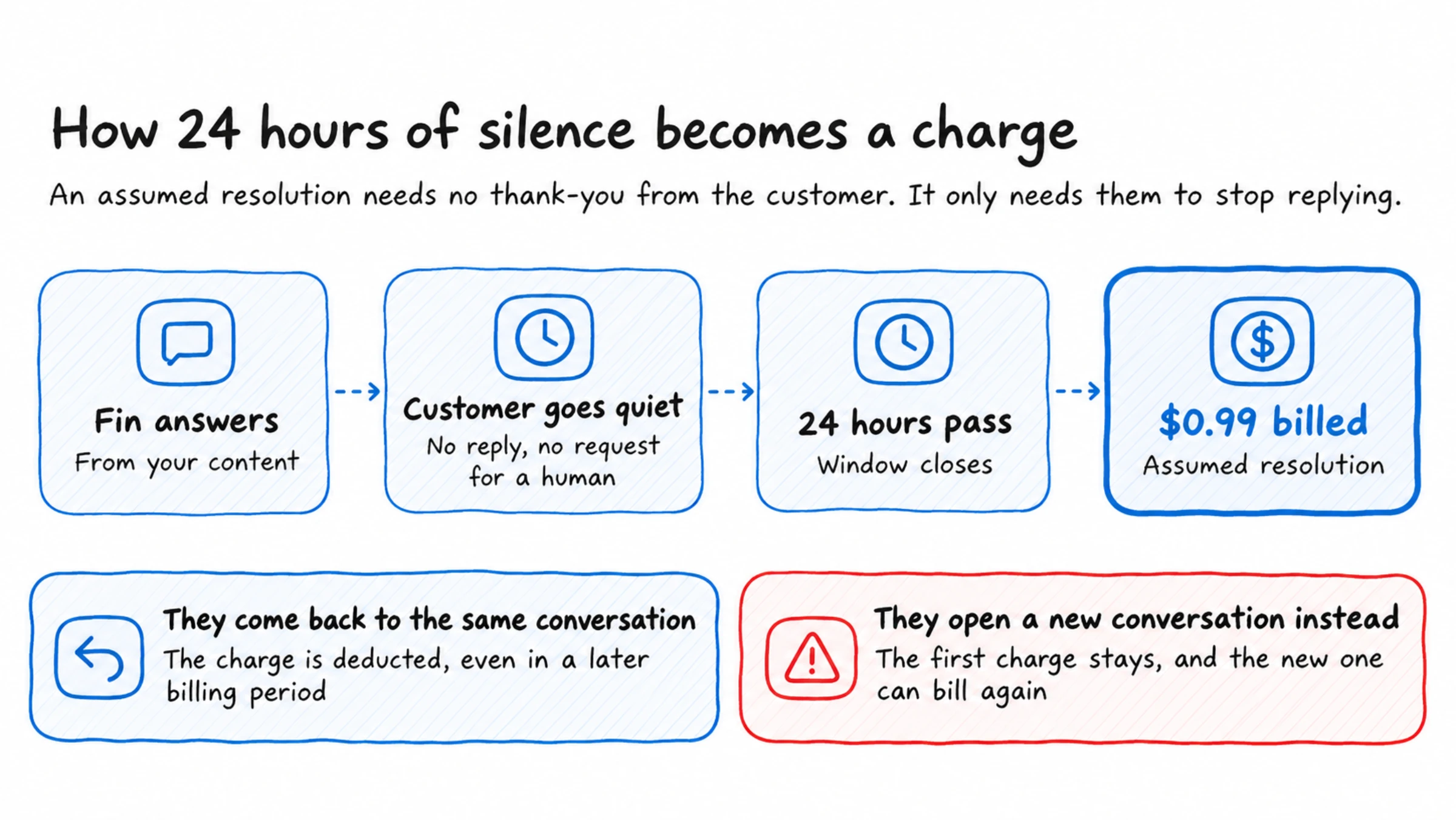
The closed tab. A prospect asks whether your Pro plan includes single sign-on. Fin answers, and the prospect closes the tab without another word. Twenty-four hours later it becomes an assumed resolution and costs $0.99, whether the answer was right or not.
The shortcut to a person. A customer opens the chat and types “I want to talk to someone.” Fin hands the conversation to your team straight away, and it costs nothing.
The damaged parcel. A customer reports a broken item. A Procedure collects the order number and a photo, then passes the case to your returns team as designed. That’s a Procedure handoff, so it costs $0.99 even though a person handles the replacement.
Teammates stepping in can change the result. If Fin answered from your content and a teammate later assigns or closes the conversation without Fin escalating, it still bills as a resolution. If Fin said it didn’t have an answer and a teammate replied, it doesn’t bill.
Customers coming back matter too. If they return to the same conversation, even in a later billing period, the charge is taken off your bill. The deduction only covers that conversation, so a customer who opens a new one about the same problem leaves the first charge standing.
Fin bills for silence. An assumed resolution only needs the customer to stop replying for 24 hours, whether they got what they needed or gave up. On the standalone plan, those silent closures also use up your 50 included outcomes.
Every Fin bill, on either price shape, comes down to one line.
Monthly bill = platform floor + ($0.99 × billable outcomes above any included ones) + add-ons and channel fees
The floor is your Intercom seats or the $49 base, and the add-ons are easy to price from a table. The middle term is the hard part. To estimate it, take the conversations you’ll route to Fin and multiply by the share you expect to end as a resolution or a Procedure handoff.
Your own trial is the most reliable source for that share, because the 14-day trial includes unlimited outcomes and shows real numbers from your own inbox. Once you have a figure, run your own numbers in our free Intercom cost calculator, which puts the Intercom bill next to a YourGPT plan for the same volume and team size. Enter the conversations you expect to become outcomes rather than your whole inbox, since the calculator bills every conversation you give it.
On the standalone plan, the $49 base covers your first 50 outcomes and every outcome after that costs $0.99.
| Outcomes | Monthly bill | Effective cost per outcome |
|---|---|---|
| 30 | $49.00 | $1.63 |
| 100 | $98.50 | $0.99 |
| 400 | $395.50 | $0.99 |
| 1,000 | $989.50 | $0.99 |
| 5,000 | $4,949.50 | $0.99 |
| 10,000 | $9,899.50 | $0.99 |
Below 50 outcomes you’re paying for capacity you didn’t use, which is why 30 outcomes work out to $1.63 each. Above 50, the base gets spread across more conversations and the effective rate settles just under $0.99.
One wrinkle is worth getting in writing. Fin’s own help article prices 100 resolutions at $99.50, a dollar more than its stated rule gives ($49 + 50 × $0.99 = $98.50). If you’re weighing this against Zendesk’s own AI agents, remember that Zendesk counts automated resolutions in its own unit, so compare the total monthly bill rather than the per-resolution price.
On Intercom, part of the bill follows headcount. Every teammate who works in the inbox needs a paid seat on one of the Intercom seat tiers, and each outcome adds $0.99 on top. Lite seats are free, and Advanced includes 20 of them while Expert includes 50.
| Plan | Annual per seat a month | Monthly per seat | Lite seats included | What the plan adds |
|---|---|---|---|---|
| Essential | $29 (shown at $19 for new customers) | $39 | None | Fin, Messenger, shared inbox, ticketing, pre-built reports, public help center |
| Advanced | $85 | $99 | 20 | Multiple team inboxes, workflows automation builder, round robin assignment, multilingual help center |
| Expert | $132 | $139 | 50 | SSO, HIPAA support, SLAs, multibrand Messenger and help center |
Three team sizes show how the two parts of the bill move together. All three use annual billing and hypothetical outcome volumes.
| Team scenario | Seats | Outcomes | Seat cost | Outcome cost | Monthly total |
|---|---|---|---|---|---|
| Three people on Essential, new-customer price | 3 | 300 | $57 | $297 | $354 |
| Six people on Advanced | 6 | 1,500 | $510 | $1,485 | $1,995 |
| Twenty people on Expert | 20 | 5,000 | $2,640 | $4,950 | $7,590 |
The three-person team pays $57 for seats at the new-customer Essential price and $297 for 300 outcomes, so $354 a month. At the $29 list price the seats alone would cost $87, and on monthly billing they’d cost $117.
The six-person Advanced team pays $510 for seats and $1,485 for 1,500 outcomes, which comes to $1,995. Add Copilot for all six on annual billing ($174) and the month comes to $2,169.
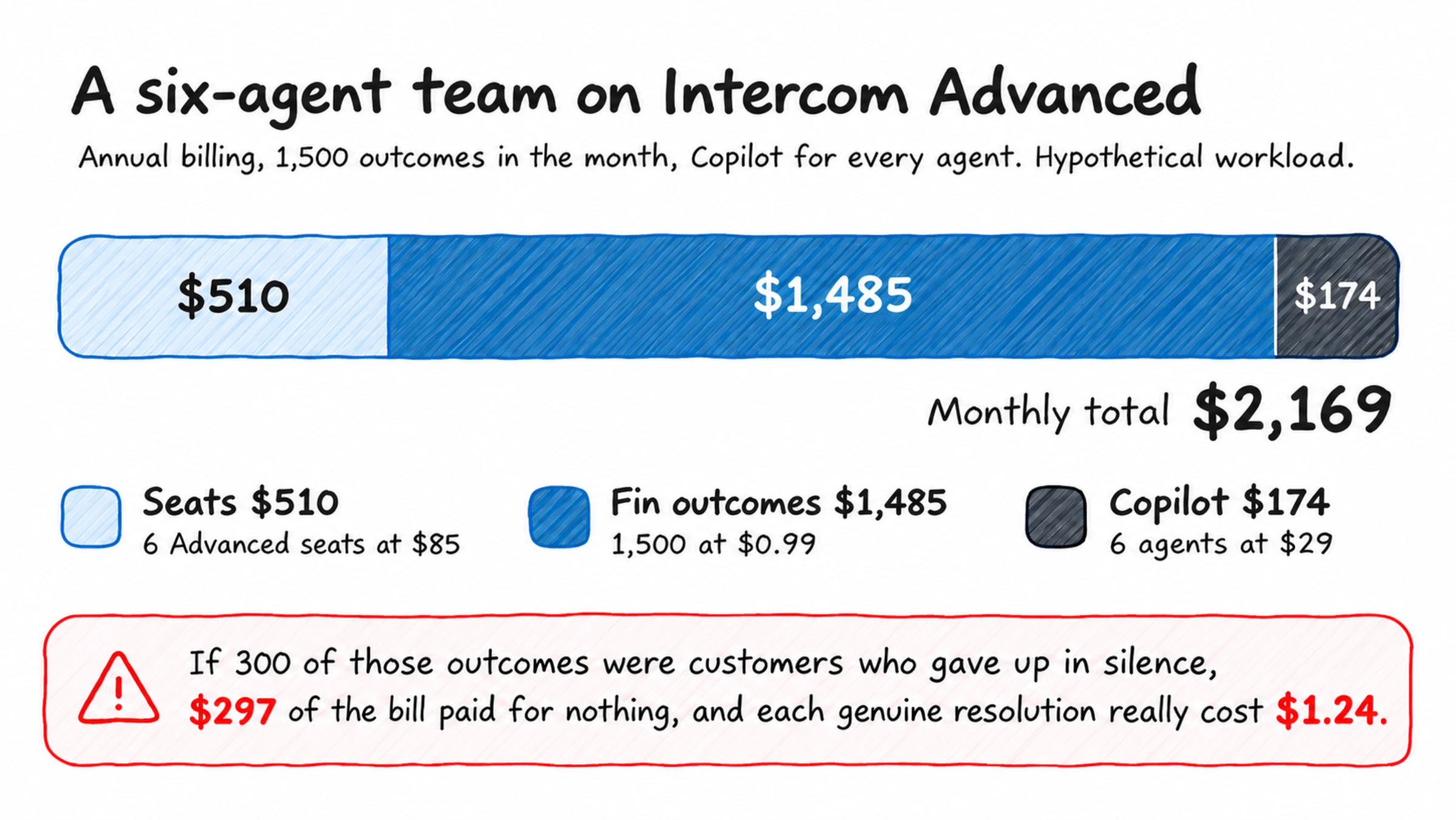
The twenty-person Expert team pays $2,640 for seats and $4,950 for 5,000 outcomes. That’s $7,590 a month on annual billing, or $7,730 if the seats are billed monthly at $139.
Whichever tier you pick, the 14-day trial needs no credit card, but you’ll need to add a payment method before it ends or the service may pause. Startups can apply to the Early Stage program for up to 93% off and a year of Fin free. If you’re judging the helpdesk itself as well as Fin, our Intercom review covers what each tier gives your team.
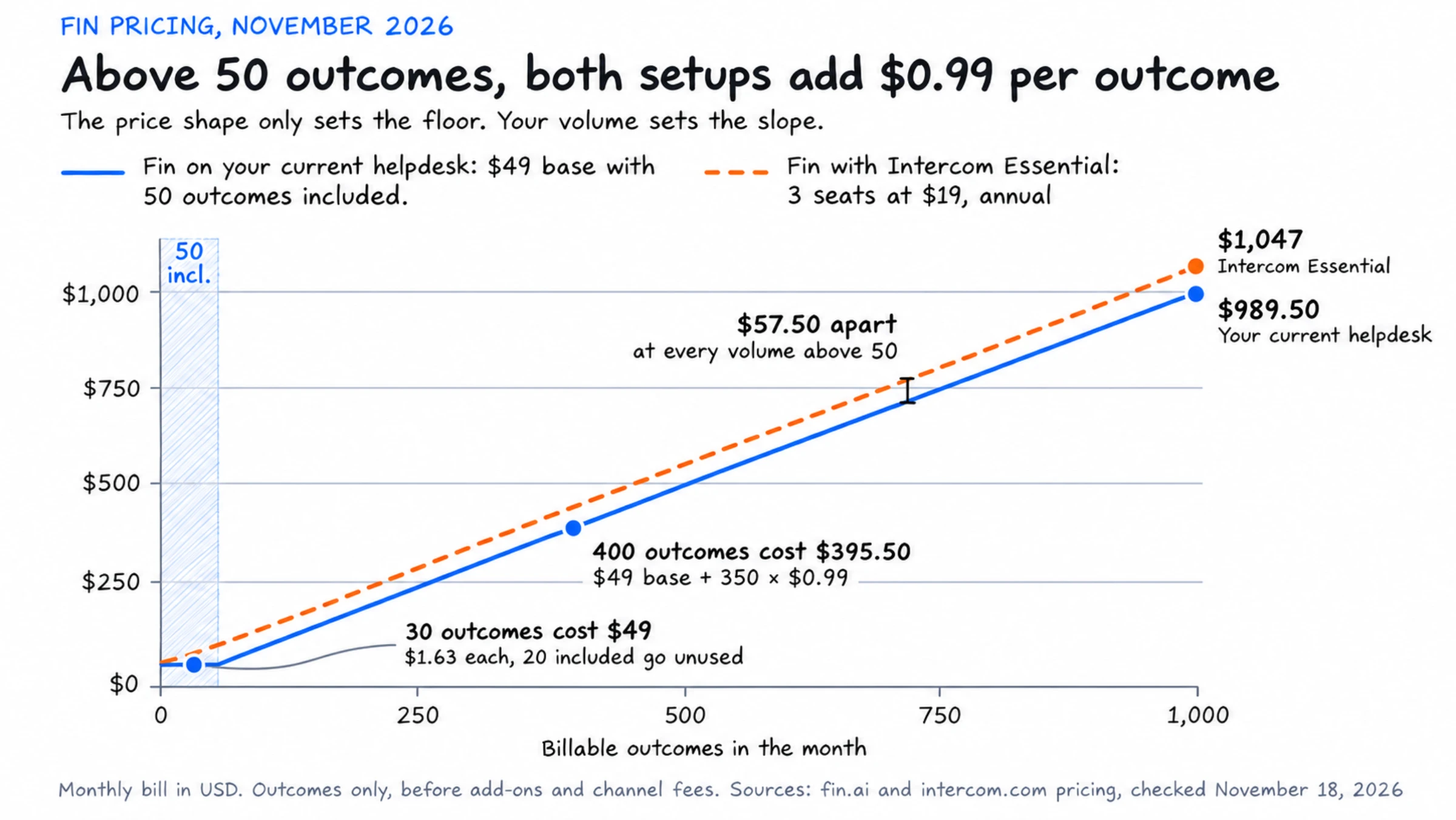
Above 50 outcomes, the standalone plan and three Essential seats climb at the same $0.99 slope and stay $57.50 apart. The price shape sets the floor, and your volume sets everything above it.
Seats and outcomes make up most of an Intercom bill, but not all of it. These charges appear as separate lines once you turn them on.
| Charge | Price | When it shows up |
|---|---|---|
| Copilot | $29 per agent a month billed annually, $35 monthly | Per agent who gets Copilot. Agents without it still get 10 free Copilot conversations a month. |
| Pro add-on | $100 a month on the pricing page | Covers 500 conversations and 6,000 credits, with extra credits at $0.01. A help article describes a $99 version with up to 1,000 conversations, so confirm the allowance on your quote. |
| Proactive Support Plus | $99 a month | When you send outbound campaigns. Includes 500 messages a month. |
| SMS | Per segment, from $0.06 in the US | Billed under usage-based channel pricing. No segments are included in any plan. |
| $0.10 per bulk outbound message at tier 1 | Outbound broadcasts only. Inbound WhatsApp conversations are free. | |
| Fin Voice | Custom, through sales | Offered to select customers, with its own alert and limit card. |
| Sales qualifications | $9.99 each | Intercom only. Forty qualified leads in a month add $399.60. |
Watch these closely if marketing or sales share your Intercom workspace. Outbound campaigns and lead qualification can add charges that have nothing to do with how many support conversations Fin handles.
The $0.99 only means something next to what the same conversation costs when a person handles it. To find that number, divide a teammate’s fully loaded monthly cost by the conversations they close in a month. As a hypothetical, a teammate who costs $4,000 a month and closes 800 conversations costs $5.00 per conversation.
Against that, a genuine resolution at $0.99 saves $4.01. If one in five outcomes turns out to be a customer who gave up, the real price of each genuine resolution rises to $0.99 ÷ 0.80, about $1.24, and the saving drops to $3.76. Our free chatbot ROI calculator works out your own cost per conversation from team size, hours, ticket volume and handling time.
Procedure handoffs need different math, because a person still finishes the job. The value is the minutes the Procedure saves rather than the whole conversation. If a teammate costs $30 an hour, or 50 cents a minute, a Procedure that saves two minutes of collecting order details is worth $1.00. That’s barely above its $0.99 fee, and a Procedure that saves a single minute costs more than it saves.
A healthy resolution rate can hide customers who simply gave up. When someone leaves after an unhelpful answer and Fin doesn’t escalate, the silence becomes a billed outcome 24 hours later. On the six-person Advanced team, 300 conversations like that would cost $297 a month while the reports count them as wins.
That’s survivorship bias in your support data. Customers who walked away get counted alongside customers who were helped, so the rate shows who stopped replying rather than who got an answer. The only way to see the difference is to read the conversations.
A weekly sample is enough to keep the number honest:
The exercise measures the gap between answering a question and resolving it. Pair the sample with a short survey to measure CSAT on the same conversations, and you’ll know how many silent closures actually helped someone.
An alert tells you the bill is growing. A limit stops it. Until you set one in your usage settings, a busy month has no ceiling, and setting both takes a couple of minutes:
A hard limit cannot go below the minimum you already pay for. If your plan includes 50 outcomes, a limit of 30 still bills 50. You also can’t set limits during the 14-day trial, so watch volume by hand while you test.
Usage refreshes about every 30 minutes, and invoices live under Settings > Subscription > Billing. Alerts email your billing contacts at 50%, 80% and 100% of the threshold, and changes take effect within the next hour. Fin Voice has its own card, so cap it separately if you use it.
Fin’s official pages disagree with each other in a few places, and a sales quote can fold seats, minimums and add-ons into one number. These six questions get the unit prices into writing.
With those answers in hand, you can judge outcome billing on your real numbers instead of list prices.
Whether outcome billing suits you depends less on the $0.99 than on how your volume behaves from month to month.
Outcome billing fits when:
Outcome billing gets harder to forecast when:
Before you decide, test any agent on your own conversations, and our AI customer support benchmark lays out how to judge a configured platform on more than price. If you’d rather pay a fixed amount each month, YourGPT, our AI agent platform, bills from a shared pool of AI Credits instead of per outcome. Our plans run from Essential at $39 a month on annual billing ($59 monthly) with 10 million credits, to Professional at $79 ($129) with 30 million, to Advanced at $349 ($499) with 100 million, plus custom Enterprise contracts.
How far credits go depends on the model you choose and how long your conversations run, and the AI credits calculator shows the estimate for each model. Plans have limits too, and Essential covers two AI agents, 200 trained webpages and three team members. We don’t sell a per-resolution plan, we aren’t a ticketing inbox, and advanced workflows take more setup.
We connect to the helpdesk you already run, including Zendesk, Salesforce and HubSpot. Our YourGPT vs Intercom comparison goes feature by feature, and if outcome billing doesn’t fit, the Fin alternatives breakdown sorts the options by how they bill. The questions below cover the details that tend to come up once a trial is running.
Yes. Fin on another helpdesk doesn’t need Intercom seats and includes unlimited teammates. The 14-day trial gives you unlimited outcomes. After that, the $49 base plan with 50 included outcomes applies and each extra outcome costs $0.99. You can’t set usage limits during the trial, so keep an eye on volume while you test.
No. Fin Voice has no public rate and is priced through sales for select customers, so the $0.99 chat and email rate doesn’t apply automatically. It also has its own Fin Voice outcomes card with separate alerts and a separate limit, which means capping chat outcomes won’t cap voice.
No. The $0.99 rate and the outcome rules are the same for chat and email, so an inbound email thread that ends in a confirmed or assumed resolution bills exactly like a chat. Answering inbound email is included in Intercom plans. Bulk email campaigns are a separate pay-as-you-go charge and never count as outcomes.
Fin switches off for the rest of the billing period. New conversations go straight to your handover steps, and conversations already in progress hand over on the customer’s next reply. Set up those handover steps before you turn the limit on, so customers land with a team that’s expecting them.
Your billing contacts get an email at 50%, 80% and 100% of the alert threshold, and an in-app notice appears when a limit is reached. An alert never stops Fin. To change alerts, a teammate needs the Can manage usage alerts permission. Hard limits need the Can manage hard limits permission.
Yes. Fin on another helpdesk is a monthly plan you can cancel anytime, with annual terms available through sales. On Intercom, Essential and Advanced are sold monthly or annually as self-serve plans, though monthly seats cost more ($39 and $99 against $29 and $85). Formal contracts are for enterprise needs, premier support or custom terms.
Intercom Fin’s $0.99 charge can cover a resolved issue or a handoff that still needs a teammate’s time. Before you roll it out, check which of those outcomes saves your team enough work to justify the cost.
Estimate your bill for a typical month and a busy one. Include seats or the standalone minimum, expected outcome charges, and any add-ons. During the trial, spot-check conversations that ended in silence and measure how much time teammates save on Procedure handoffs.
Start with request types Fin resolves reliably and handoffs that save enough time to cover their cost. Once you’re on a paid plan, set a usage alert and a hard limit before expanding.
Check credits and agent limits on each plan, then compare them with your Fin estimate.
Compare published AI rates, separate the five billing meters, and calculate the true cost per resolution for your support queue.


A comparison of 10 AI customer support tools for electronics retailers, with findings from live store chats and a 10-ticket trial plan.
Model the cost of Zendesk AI agents with your ticket volume, then test order lookups, handoffs, and billing against your own support queue.
TL;DR Agentforce is Salesforce’s AI agent platform, built into its Sales, Service, and Field Service clouds, letting agents read and write live CRM records and execute multi-step tasks instead of only replying with text. Pricing splits into three parallel models built for different use cases, and picking the wrong one for a given deployment can […]

TL;DR The best business productivity tools help teams reduce repetitive work, improve collaboration, and save time. This guide compares 10 tools for 2026, including YourGPT, Proton Pass, Notion, Semrush, CoAnimator, Loom, Canva, Cal.com, Jira, and Airtable. Each tool serves a different purpose, from AI automation and project management to content creation and scheduling. Rather than […]

TL;DR Salesforce offers powerful CRM capabilities, but implementation and ongoing management can increase costs for smaller teams. Pipedrive and Nutshell simplify pipeline management, while HubSpot and Zoho CRM offer broader automation. Freshsales, monday CRM and Copper suit specific workflows. For customer support and lead qualification, YourGPT Chatbot works alongside your CRM, starting at $39/month billed […]