Intercom Review 2026: Pricing, Pros & Cons

Rajni
Last updated on July 14, 2026
Intercom’s parent company rebranded to Fin in May 2026, and Salesforce signed a deal to acquire it for roughly $3.6 billion on June 15, 2026.
Intercom’s pricing starts at $29 per seat/month, with Advanced and Expert plans at $85 and $132 per seat/month. Fin AI Agent is billed separately at $0.99 per resolved outcome.
Reviews are mixed: Intercom performs strongly on G2 with a 4.5/5 rating, but has a much lower Trustpilot score, where support-response complaints appear more often.
The biggest 2026 evaluation risk is cost predictability, because seats, Fin outcomes, and channel add-ons can push the final monthly bill far beyond the base plan price.
Intercom spent 15 years building one of the more recognizable names in customer support software, then renamed itself Fin in May 2026 and agreed to a Salesforce acquisition a month later. That timing puts anyone evaluating Intercom in 2026 in an unusual spot. The helpdesk is still called Intercom, the AI agent is still called Fin, but the company behind both now operates under new ownership terms mid-transition.
None of that changes the core product, a messaging-first support platform with an AI agent handling first-line resolution. What has changed is the pricing model, the resolution-rate claims Intercom now makes, and the math around choosing a platform whose ownership is in flux. This review breaks down Intercom pricing in 2026, what the platform does well, where it falls short, and what to verify before committing a year of budget to it.
Intercom is a customer messaging and helpdesk platform built around a shared inbox, live chat widget, and an AI agent that answers customer questions using your help center content. Founded in 2011 by Eoghan McCabe and Des Traynor, it grew into one of the more recognizable names in SaaS customer support, used by companies like Atlassian, Amazon, and Anthropic.
The naming gets confusing because the company operates two brand layers now. The parent company, founded as Intercom, renamed itself Fin in May 2026, positioning Fin (the AI agent) as the flagship product. Intercom is still the name of the helpdesk and messenger you’d actually configure day to day. A month after the rename, Salesforce signed a definitive agreement to acquire the company for approximately $3.6 billion, a deal expected to close in the fourth quarter of Salesforce’s 2027 fiscal year, pending regulatory approval. Until then, Intercom and Fin keep operating independently, and CEO Eoghan McCabe has said day-to-day product direction stays the same through close.
For a buyer in July 2026, this matters practically. You are evaluating a product mid-acquisition, worth building into contract terms and renewal timing rather than treating as a footnote.
Status. Signed, not closed. Salesforce and Fin signed a definitive agreement on June 15, 2026. Close is expected in the fourth quarter of Salesforce’s 2027 fiscal year, pending regulatory approval.
What stays the same until close. Product, pricing, and support run under existing terms. CEO Eoghan McCabe remains in place, and Intercom has said day-to-day direction won’t shift before the deal closes.
What’s actually unknown. Whether current pricing, existing compliance certifications, and support SLAs carry over unchanged once Fin folds into Salesforce’s Agentforce platform.
What to do about it. Ask Intercom’s sales team directly what happens to your contract terms after close, and avoid multi-year commitments until the acquisition clears regulatory review.
Intercom’s core product hasn’t changed much in concept, even as the AI layer has expanded fast.
Intercom pricing has two layers, and missing this is the single most common source of budget surprises. The first layer is a seat price per teammate. The second is usage, mainly Fin AI outcomes, but also messaging channels and add-ons.
| Plan | Seat Price Annual | Seat Price Monthly | Notable Inclusions |
|---|---|---|---|
| Essential | $29/seat/mo ($19 promo as of July 2026) | $39/seat/mo | Fin AI Agent, shared inbox, messenger, basic reporting |
| Advanced | $85/seat/mo | $99/seat/mo | Multiple inboxes, workflow automation, 20 free Lite seats |
| Expert | $132/seat/mo | $139/seat/mo | SSO, HIPAA support, SLAs, multibrand messenger, 50 free Lite seats |
Prices verified against intercom.com/pricing as of July 2026. Essential is confirmed directly on the live page. Advanced and Expert figures are corroborated consistently across multiple independent trackers citing the same page, since the live pricing widget renders as an animated counter rather than static text.
On top of seats, Fin AI Agent is billed at $0.99 per outcome, where an outcome means a resolution, a procedure handoff, or a disqualification. A sales qualification runs $9.99. You’re not charged for attempts that don’t land, escalations to a human, or conversations where Fin never answers. There’s a 50-outcome monthly minimum and a 14-day trial with unlimited outcomes.
Add-ons stack on top of that. Copilot runs $29 per agent per month annually (or $35 monthly) for unlimited use, the Pro add-on for CX scoring and analytics costs $99 a month, and Proactive Support Plus for outbound campaigns adds another $99 a month with 500 messages included. WhatsApp, SMS, phone, and additional email volume are pay-as-you-go on top of all of that.
Here’s a rough real-world example. A 10-seat team on the Advanced plan pays $850 a month in seats alone (annual billing). Add a few hundred Fin resolutions a month and Copilot for the team, and the monthly total commonly lands somewhere between $1,800 and $2,600, well above the headline seat price.
Intercom handles customer conversation data, help center content, and often payment or account details passed through Fin’s actions, so its compliance posture carries more weight here than for a typical SaaS tool.
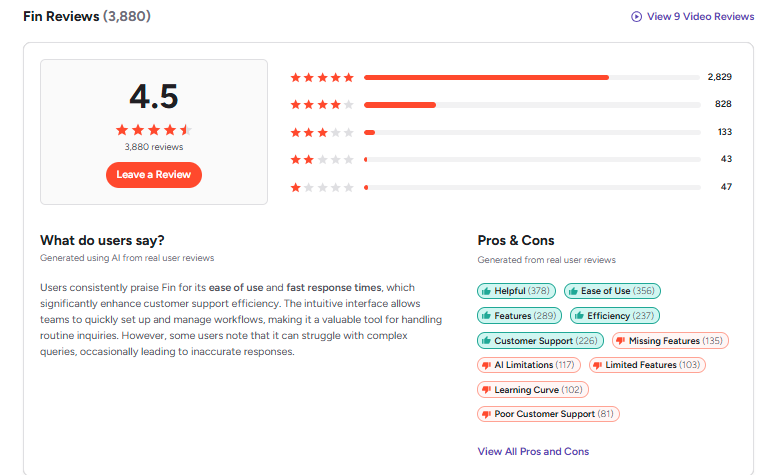
Rating platforms tell noticeably different stories here. On G2, Intercom sits at 4.5 out of 5 across 3,855 reviews, with users repeatedly praising ease of use, the breadth of integrations, and how quickly Fin handles repetitive questions. Capterra shows a similar 4.5/5 from over 1,100 reviews.
Trustpilot paints a rougher picture. One aggregation of Trustpilot feedback puts Intercom at roughly 1.9 out of 5 from 950+ reviews, with recurring complaints about slow support response times, unexpected billing changes when accounts get migrated to newer pricing, and frustration that a company selling customer support software has, by its own users’ account, inconsistent support of its own. The gap between the two scores likely comes down to who’s reviewing. G2 and Capterra skew toward buyers evaluating features during a purchase decision, while Trustpilot reviews often come from existing customers reacting to a specific billing or support incident.
If that gap matters to your decision, it’s worth spending five minutes filtering Intercom’s Trustpilot page for reviewers who match your company size and use case. A billing complaint from an enterprise account running thousands of monthly conversations on the Expert plan may not apply to a five-person startup evaluating Essential, and a support-response complaint from a high-volume account may not be representative of what a smaller team experiences. Read for pattern match to your own situation, not just the raw star count.
This review draws on published sources rather than a hands-on trial account, so it’s worth being clear about what that means. The verdict above weighs the same categories a structured software evaluation typically covers, sourced this way:
We didn’t assign Intercom a single weighted score across these categories. Doing that credibly needs a live test account, not published documentation and aggregated reviews. If a numeric score matters for how this runs on the site, that’s a separate pass involving an actual Intercom trial rather than a desk-research edit.
Intercom fits best for product-led SaaS companies under roughly 20 agents that want messaging and in-app engagement in one place and have budget for the Fin resolution fees. Outside that profile, a few common alternatives come up.
The list above covers what each tool is good at. This table is meant to move faster, matching a specific priority to a specific pick.
| If Your Priority Is | Choose | Why |
|---|---|---|
| Complex, enterprise-scale ticketing with skills-based routing and multiple brands | Zendesk | Built for large support orgs and multi-brand setups, at a higher price point than Intercom |
| Predictable, usage-based cost instead of seats plus per-resolution AI fees, or native voice AI without a separate add-on | YourGPT | Priced on chatbots, webpages, and AI credits rather than stacking seat cost and per-outcome AI cost, with PhoneAI built into the platform |
| The lowest entry price with solid, straightforward ticketing | Freshdesk | Cheaper starting tier, with less AI depth than Fin |
| A small, email-first team that wants minimal setup | Help Scout | Simplicity over feature breadth, not built for complex automation |
| In-app engagement, product tours, and a strong AI resolution rate, with budget to match | Intercom | Best fit for product-led SaaS under roughly 20 agents that can absorb the Fin outcome fees |
A detailed side-by-side comparison and a broader roundup of 15 Intercom alternatives are worth reading if cost predictability or AI-first automation is your priority.
YourGPT is a no-code AI agent platform that automates customer support, sales, and operations from one connected system. Rather than a single-purpose chat widget, it lets teams build, train, and deploy AI agents across web, mobile, and messaging without needing engineering resources.
Intercom is built primarily around support automation through its Fin AI Agent. YourGPT covers that same ground but extends across support, sales, and operations in one platform, with a visual workflow builder called AI Studio, native MCP connections for pulling in live data, and a choice of models across OpenAI, Anthropic, Google, and xAI instead of a single AI provider.
Intercom supports website live chat, email, WhatsApp, SMS, and phone, plus 350-plus integrations for connecting to the rest of a support stack. YourGPT covers a similar spread, including WhatsApp, Instagram, Telegram, Messenger, Slack, Discord, and native iOS and Android SDKs, all deployed from one agent configuration.
Intercom’s Workflows tool, available from the Advanced plan up, handles routing, triggers, and basic automation. YourGPT’s AI Studio goes further with a visual node-based builder that supports custom Python and JavaScript, prompt-to-workflow generation, and step-by-step auto-debugging, and it is available at a lower entry tier than where Intercom’s equivalent automation unlocks.
Yes, both platforms offer one. Intercom’s trial runs for 14 days with no credit card required. YourGPT’s trial runs for 7 days, also with no credit card required, so you can test either before committing to a paid plan.
For a product-led SaaS team with steady conversation volume and budget certainty, Intercom pricing can work, especially if Fin’s resolution rate lands closer to the 76% figure the company cites than the 67% floor. For anyone evaluating it while support ticket volume is unpredictable, or anyone uncomfortable committing to a platform mid-acquisition, it’s worth running the numbers through Intercom’s own calculator before signing an annual contract, and worth comparing against a usage-based alternative that doesn’t multiply seat costs and AI costs at the same time.
The rebrand to Fin and the Salesforce deal don’t change what Intercom does today, but they add a variable most reviews from before June 2026 don’t account for. Budget for the possibility that pricing, support, and roadmap priorities shift once Salesforce integration begins.

Compare six Yuma alternatives by ecommerce capabilities, helpdesk compatibility, pricing and human handoffs to choose a replacement for your support team.


Move from Gorgias with a verified ticket archive, tested AI workflows, human handoff and a channel cutover plan before ending your subscription.

TL;DR The Gorgias AI Agent is the automation layer inside the Gorgias helpdesk, split between a Shopping Assistant for pre-purchase conversations and a Support Agent for post-purchase support. A connected Shopify store is required, and Gorgias documentation rules out platforms such as BigCommerce, Magento, and WooCommerce for the AI Agent. Billing runs on two separate […]

TL;DR Gorgias is the closest Richpanel alternative for Shopify stores that need native order actions directly inside support tickets. YourGPT fits stores that want one AI agent handling requests across web, WhatsApp, Instagram, and email, while Tidio and Re:amaze suit smaller teams looking for lighter, lower-cost options. Richpanel’s AI pricing starts around $500/month for two […]

TL;DR Shopify Inbox is a good free option for stores that only need basic storefront chat and simple customer conversations. Stores usually look for alternatives when they need multichannel support, stronger team workflows, or automated order actions. YourGPT is strongest for cross-channel AI automation, Gorgias for Shopify-native order workflows, and Tidio for smaller stores that […]
TL;DR Tidio recently restructured its top paid plan, and many 2026 reviews still describe the old pricing model. Confirm current pricing directly on Tidio’s site before budgeting. Lyro, Tidio’s AI agent, runs on Anthropic’s Claude rather than ChatGPT. Only the Premium tier carries a guaranteed resolution rate, well below the average Tidio advertises elsewhere. Billing […]