7 Best Fin AI Alternatives for Customer Support Teams in 2026

Rajni
August 4, 2026
Fin, the AI agent formerly sold under the Intercom name, uses a per-outcome pricing model. Salesforce agreed to acquire the company in June 2026, but the deal has not closed yet.
Zendesk AI Agents, Salesforce Agentforce, Freshworks Freddy AI, Gorgias, Tidio, and Kustomer suit teams that want AI built into a helpdesk or CRM they already use.
Sierra suits teams with enterprise budgets and complex, multi-step resolution needs, although it does not publish its pricing.
YourGPT suits teams that want flat, predictable pricing and no-code control across support, sales, and operations, including AI that acts directly inside a product through Copilot Builder.
Every platform prices AI differently, including per resolution, conversation, session, credit, or flat plan. Once support volume grows, the pricing model often matters more than the advertised price.
Customer support leaders comparing Fin against other options in 2026 are running into a moving target. The rename from Intercom and the pending Salesforce acquisition don’t change what the product does today, but they add real uncertainty for anyone signing a multi-year customer service contract.
The other reason “Fin alternatives” searches are climbing is the per-resolution math itself. As an AI agent, Fin bills for every outcome it delivers, including a customer who simply goes quiet after Fin’s last message. The better it performs, the more it resolves, and the larger the monthly bill grows.
This blog compares seven AI chatbot and AI agent platforms teams are actually shortlisting against Fin in 2026: how each one prices AI, whether it requires adopting a new helpdesk, and who it genuinely fits.
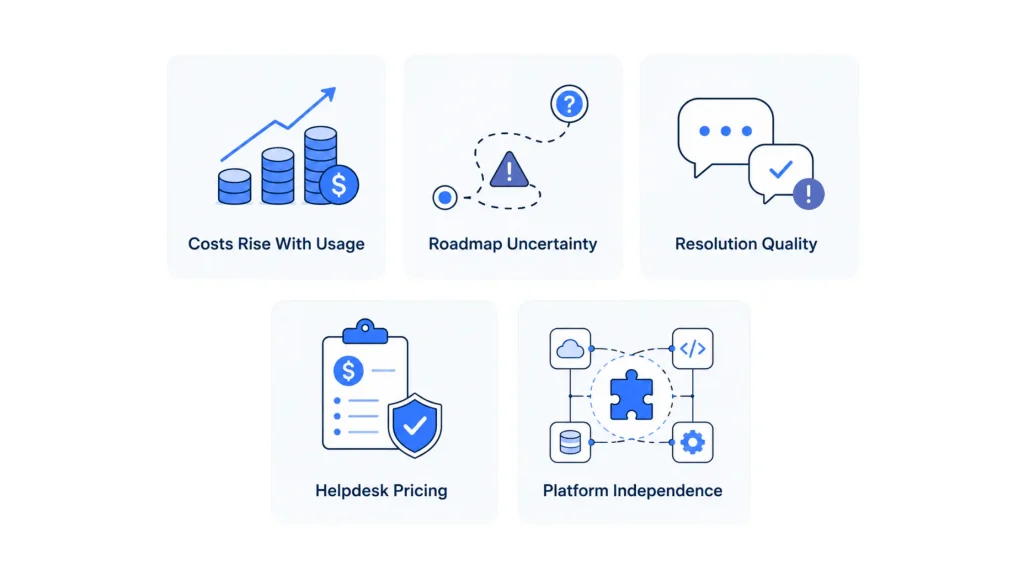
Customer support teams researching Fin in 2026 land on the same five friction points, whether they’ve used the platform for years or are just starting to evaluate it.
1. Costs Rise Exactly When the AI Gets Better Fin bills per outcome, and an outcome includes a customer who simply stops replying after Fin’s last message, not only a confirmed resolution. The better the agent performs, the more outcomes it logs, and the larger the monthly bill grows. The model has a 50-outcome monthly minimum but no ceiling.
2. The Acquisition Adds Roadmap Uncertainty Salesforce’s agreement to acquire Fin is signed but not closed, with completion expected toward the end of Salesforce’s 2027 fiscal year. Teams signing multi-year contracts today have no guarantee that pricing, product direction, or support quality stays the same once Fin folds into Agentforce.
3. Resolution Quality Doesn’t Always Match the Marketing Some teams report Fin marking conversations as resolved when the underlying problem wasn’t actually solved, alongside responses that read as scripted and complex issues that bounce back to a human agent anyway, according to one third-party comparison. Fin cites a 76% resolution rate, while independent estimates put the real figure closer to 42 to 50%.
4. The Best Pricing Requires Buying the Whole Helpdesk Fin’s flat $0.99-per-outcome rate applies with no seat cost when it runs on top of another company’s helpdesk. Pairing Fin with Intercom’s own helpdesk adds a per-seat charge on top of that per-outcome fee, so the pricing story gets more complicated for teams that want the AI and the ticketing system from the same vendor.
5. Standardizing on Intercom Isn’t Always the Goal Some teams evaluate alternatives simply because they don’t want their support stack tied to Intercom at all, whether for regulated-industry requirements, deeper action-taking needs, or general platform independence down the line.
| Platform | Best For |
|---|---|
| YourGPT | No-code AI agents for multichannel support, sales, and action-taking workflows with predictable pricing |
| Zendesk AI Agents | AI automation for teams already standardized on the Zendesk helpdesk |
| Salesforce Agentforce | Enterprise AI agents grounded in Salesforce CRM and Data Cloud |
| Tidio | Fast, self-serve live chat and AI support for ecommerce teams |
| Sierra | Enterprise-grade, brand-tuned AI agents across chat and voice |
| Freshworks Freddy AI | AI assistance and automated support inside Freshdesk and Freshservice |
| Gorgias | Shopify-focused support automation for orders, refunds, and shipping questions |
Ranked and reviewed on pricing transparency, helpdesk independence, and how much real action each AI agent can take beyond answering questions. The list spans platforms built for enterprise-scale deployments alongside ones designed to go live without a multi-month sales cycle. Each entry below covers what the platform actually does, who it fits best, and current pricing.
YourGPT is an AI-first platform designed to build and run autonomous AI agents across customer support, sales, and internal operations. The agents execute tasks and resolve requests directly inside the conversation. YourGPT states its agents resolve up to 90% of repeated queries on their own, with more closed end to end as integration with a company’s product and data deepens, according to YourGPT’s own comparison page.
Teams can launch simple knowledge bots using the no-code builder, then scale into advanced automation using AI Studio for structured workflows and system integrations.
Zendesk AI Agents is the AI layer built into Zendesk’s helpdesk suite, combining a lighter, always-included tier with a separate, more capable tier for scripted, action-taking automation. It runs entirely on top of Zendesk’s own ticketing, routing, and reporting system.
Teams can start with the bundled Essential tier for basic deflection, then move up to the Advanced tier once the AI needs to take real action inside a ticket beyond suggesting a reply.
Salesforce Agentforce is the platform Salesforce is folding Fin into once its pending acquisition closes, and it’s already a direct alternative for any team running Salesforce Service Cloud today. It’s a broader framework for building customer-facing, employee-facing, and voice agents grounded directly in Salesforce CRM data.
Pricing runs on three separate models at once (flat per-conversation, granular Flex Credits, and per-user licensing), which adds flexibility but also means most real deployments carry Data Cloud as a required, separately priced layer underneath the AI itself.
Tidio is a live chat and helpdesk platform built for small and mid-sized ecommerce teams, with an AI agent called Lyro layered on top. Unlike the enterprise-focused platforms elsewhere on this list, Tidio is designed for fast, self-serve setup with no sales-led deployment cycle.
The base plan covers live chat, a shared inbox, and basic ticketing. Lyro AI is a separate, additionally metered layer on top, which means a Tidio bill often has two quotas running in parallel: billable human conversations and Lyro AI conversations.
Sierra is an enterprise conversational AI platform founded by former Salesforce co-CEO Bret Taylor, built for large consumer brands that want a vendor-managed, brand-tuned AI agent across chat and voice. It’s sold through enterprise sales, with embedded engineers who tune the agent’s behavior after launch.
The platform emphasizes dialogue quality and brand consistency over raw automation volume, positioning it for companies where an inconsistent AI voice would carry real brand risk.
Freshworks Freddy AI is the AI layer inside Freshdesk, sold as separate Copilot and AI Agent add-ons on top of the base helpdesk price. It’s built for teams already running Freshdesk or Freshservice who want to add AI without switching their core ticketing system.
Freddy Copilot assists human agents inside the ticket, while the customer-facing AI Agent resolves conversations across email and chat on its own, billed by session, an engagement counted whether or not it ends in a resolution.
Gorgias is the Shopify-native helpdesk of choice for ecommerce brands, with a dedicated AI Agent add-on layered on top of its ticket-based helpdesk pricing. It connects directly to Shopify, WooCommerce, and Magento order data, so support conversations can pull real order, refund, and shipping details without leaving the chat.
Unlike per-seat helpdesks, Gorgias prices by ticket volume and allows unlimited users on every plan, though a fully AI-resolved conversation bills as both a ticket and an AI resolution on the same interaction.
| Platform | Pricing Model | Main Strength | AI Use Case | Platform Fit | Best Choice For |
|---|---|---|---|---|---|
| YourGPT | Flat plans with included AI credits | No-code AI agents that answer questions and execute workflows | Customer support, lead qualification, account updates, bookings, and internal automation | Standalone platform that connects with existing helpdesks, CRMs, and business tools | Teams that want multichannel AI automation without replacing their current support stack |
| Zendesk AI Agents | Per-agent subscription with automated-resolution usage | Native AI automation inside Zendesk’s ticketing and support environment | Ticket resolution, intelligent routing, agent assistance, and support deflection | Best suited to organizations standardized on Zendesk Suite | Support teams that need mature ticketing, reporting, macros, and AI in one system |
| Salesforce Agentforce | Per conversation, Flex Credits, or per-user licensing | AI agents grounded directly in Salesforce CRM data | Customer service, sales assistance, employee support, and CRM record actions | Strongest fit for businesses using Salesforce Service Cloud and related products | Enterprises that want AI agents deeply connected to Salesforce data and processes |
| Tidio | Tiered subscription with metered AI conversations | Fast, self-serve setup combining live chat, helpdesk, and Lyro AI | Product questions, order support, lead capture, and common customer inquiries | Good fit for Shopify, WooCommerce, and smaller online stores | Businesses that want live chat and basic AI support with quick deployment |
| Sierra | Custom enterprise pricing | Brand-tuned conversational AI across chat and voice | Multi-step customer service, account actions, and high-volume conversations | Standalone enterprise AI layer with vendor-supported implementation | Enterprises that prioritize brand-consistent conversations and managed deployment |
| Freshworks Freddy AI | Per-agent subscription with session-based AI usage | Native AI assistance and customer-facing automation inside Freshworks | Reply drafting, ticket summaries, automated answers, and support resolution | Best suited to teams already operating within the Freshworks ecosystem | Teams that want to add AI without replacing Freshdesk or Freshservice |
| Gorgias | Ticket-based plans with per-resolution AI charges | Deep access to ecommerce order, shipping, refund, and customer data | Order tracking, refund questions, product support, and shipping updates | Strong fit for Shopify, WooCommerce, and Magento stores | Ecommerce brands whose support volume mainly involves orders and post-purchase questions |
Every platform on this list connects an AI agent to systems that matter: order databases, CRM records, billing, and sometimes payment or refund processing. That access is the whole point, since an agent that can only answer questions can’t actually close a ticket. It’s also where the real risk sits.
Before granting any AI agent write access to customer or financial systems, confirm three things regardless of which vendor is under evaluation:
Sierra and Kustomer both build escalation paths into their core design for this reason. That path is worth testing specifically during any trial, beyond simply checking whether the bot answers well.
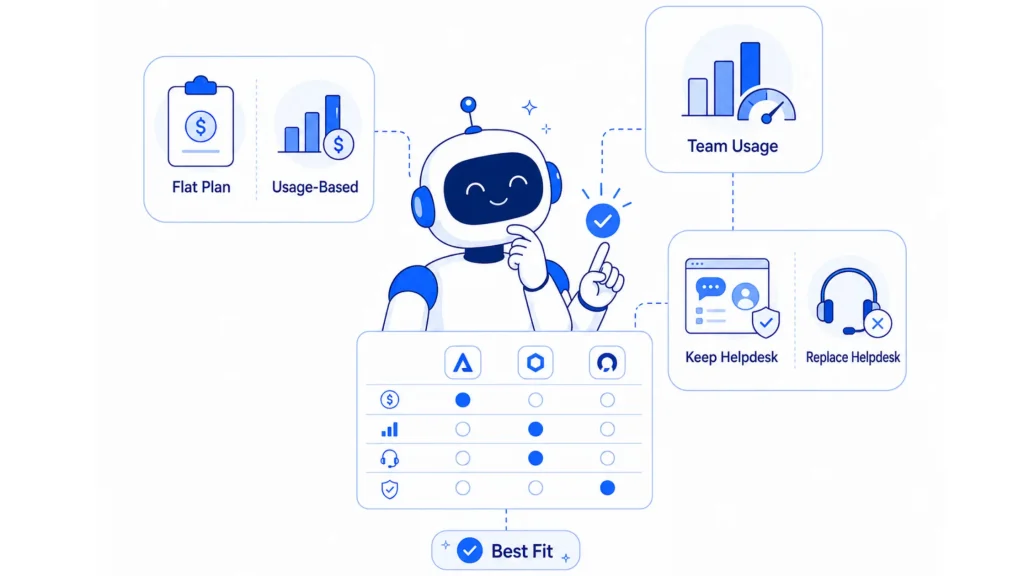
Four decisions narrow a seven-tool list down to two or three real candidates faster than any feature comparison:
Salesforce signed a definitive agreement to acquire Fin, formerly Intercom, on June 15, 2026, but the deal has not closed. Salesforce expects completion toward the end of its 2027 fiscal year, and Fin’s pricing and product remain unchanged in the meantime.
Per Fin’s own pricing page, a billable outcome includes a resolution, a procedure handoff, or a disqualification. A customer who simply stops replying after Fin’s last message also counts as a resolution.
Fin, Salesforce Agentforce, and YourGPT all publish exact rates on their own pricing pages. Tidio publishes most of its base tiers directly, though its Lyro AI add-on pricing needs cross-checking against third-party sources. Zendesk, Sierra, Kustomer, Freshworks, and Gorgias require piecing pricing together from secondary sources or a direct sales quote.
Tidio’s free and Starter tiers and YourGPT’s flat Essential plan both suit small teams well, since neither charges per resolution. A small team mostly answering repetitive questions can also come out ahead on Fin’s or Gorgias’ per-resolution pricing, as long as genuine automated volume stays low.
Sierra and YourGPT both run as a standalone AI layer independent of an existing ticketing system. Zendesk, Freshworks, Gorgias, Tidio, and Kustomer are built around their own native helpdesk or CRM, so adopting the AI means adopting the platform underneath it.
Per-resolution pricing, used by Fin, Zendesk, and Gorgias, charges for every successful outcome, so the bill grows in a straight line as the AI gets better at its job. Flat-plan pricing, used by YourGPT, charges a fixed monthly rate for a set usage pool, so automating more conversations does not raise the bill until that pool runs out.
It is disputed. Fin and Salesforce cite a 76% resolution rate in the acquisition announcement, while independent estimates put the figure closer to 42% to 50%. Part of the gap comes from Fin’s definition of a resolution, which includes conversations where the customer simply stopped responding.
Sierra, Salesforce Agentforce, and Kustomer all target larger support organizations with more complex requirements, though only Salesforce Agentforce publishes exact rates. Sierra and Kustomer both require a direct sales conversation to get real pricing.
Fin remains a reasonable default for customer service teams already running on Intercom who value transparent per-outcome pricing. The pending Salesforce acquisition and Fin’s own definition of a billable “resolution” are still worth weighing before signing a longer contract.
The real decision was never which platform has the longest feature list. It’s whether a billing model survives the AI actually getting good at raising customer satisfaction, since a per-resolution or per-session meter that looks cheap today can cost more than a flat plan within a year of real usage.
The four decisions above narrow that choice fast for any specific team, whether that lands on an enterprise platform like Sierra, a helpdesk-native tool already in place, or a flat-plan platform like YourGPT built to avoid the meter entirely. Running the actual math against current ticket volume before any contract gets signed is worth more than trusting the sticker price on a pricing page.

Compare six Yuma alternatives by ecommerce capabilities, helpdesk compatibility, pricing and human handoffs to choose a replacement for your support team.


Move from Gorgias with a verified ticket archive, tested AI workflows, human handoff and a channel cutover plan before ending your subscription.

TL;DR The Gorgias AI Agent is the automation layer inside the Gorgias helpdesk, split between a Shopping Assistant for pre-purchase conversations and a Support Agent for post-purchase support. A connected Shopify store is required, and Gorgias documentation rules out platforms such as BigCommerce, Magento, and WooCommerce for the AI Agent. Billing runs on two separate […]

TL;DR Gorgias is the closest Richpanel alternative for Shopify stores that need native order actions directly inside support tickets. YourGPT fits stores that want one AI agent handling requests across web, WhatsApp, Instagram, and email, while Tidio and Re:amaze suit smaller teams looking for lighter, lower-cost options. Richpanel’s AI pricing starts around $500/month for two […]

TL;DR Shopify Inbox is a good free option for stores that only need basic storefront chat and simple customer conversations. Stores usually look for alternatives when they need multichannel support, stronger team workflows, or automated order actions. YourGPT is strongest for cross-channel AI automation, Gorgias for Shopify-native order workflows, and Tidio for smaller stores that […]
TL;DR Tidio recently restructured its top paid plan, and many 2026 reviews still describe the old pricing model. Confirm current pricing directly on Tidio’s site before budgeting. Lyro, Tidio’s AI agent, runs on Anthropic’s Claude rather than ChatGPT. Only the Premium tier carries a guaranteed resolution rate, well below the average Tidio advertises elsewhere. Billing […]