Retail Customer Service in 2026: Where AI Fits (and Where It Doesn’t)

Shreya
November 16, 2026
TL;DR
Retail customer service is changing as businesses handle more online orders, returns, and customer questions across multiple channels. Shoppers expect quick answers, accurate information, and consistent support, whether they contact a retailer through its website, phone, or messaging apps. Meeting these expectations with human agents alone can be difficult, especially during peak shopping periods.
AI in retail customer service helps businesses manage repetitive requests such as order tracking, product availability, and standard returns. AI agents can also access connected systems and perform approved actions. However, not every interaction belongs in an automated workflow. Billing disputes, unusual refund requests, and sensitive complaints often require human judgment.
The challenge is deciding where automation adds value and where human support remains necessary. This blog examines the practical uses and limitations of AI in retail customer service in 2026, along with the workflows, safeguards, and evaluation criteria retailers should consider before adopting it.
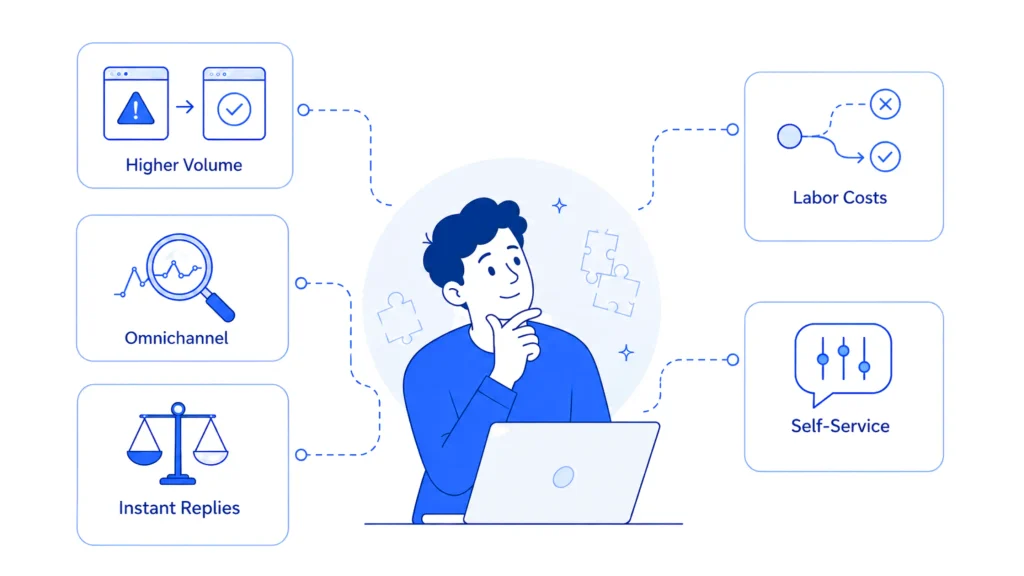
Retailers face growing pressure to respond faster, manage support costs, and provide consistent service across multiple channels. Five factors are driving these changes in 2026:
Together, these factors are changing how retailers organize support. AI can manage predictable, high-volume requests, allowing human agents to spend more time resolving issues that require investigation, judgment, or personal attention.
Retailers use different technologies to handle customer questions, automate routine tasks, and support human agents. While these tools are often grouped under AI customer service, their capabilities vary significantly.
The main difference lies in how each system understands requests, accesses information, and takes action. Rule-based tools follow predefined instructions, while AI-powered systems can interpret natural language and work with connected data.
Platforms such as YourGPT bring these capabilities together through AI chatbots, voice support, WhatsApp integration, knowledge management, and human handoff. However, the level of automation depends on the available integrations, data quality, and permissions configured by the retailer.
AI is most useful in retail workflows that involve frequent questions, reliable data, and clearly defined actions. When connected to order management systems, product catalogs, and customer records, AI agents can resolve many routine requests without human involvement.
Order-status questions, often called WISMO (Where Is My Order?) requests, are well suited to automation. An AI agent connected to order and shipping systems can retrieve tracking information, check delivery progress, and share estimated arrival dates.
However, lost packages, conflicting tracking updates, and delivery disputes may still require human investigation.
AI agents can check whether an order meets the return policy, explain eligibility, initiate approved returns, and provide shipping instructions. For straightforward cases, this reduces the steps customers need to complete.
Exceptions such as damaged products, expired return windows, or suspected fraud should follow predefined review and escalation rules rather than receive automatic approval.
AI can help shoppers find products by interpreting natural-language questions about size, features, compatibility, or availability. When connected to a current product catalog, it can compare options and suggest alternatives based on stated preferences.
Recommendations should rely on verified product information, particularly when compatibility or safety matters.
Customers frequently contact retailers to check reward balances, redeem points, or understand membership benefits. An authenticated AI agent can retrieve account-specific information and explain loyalty rules without requiring a support representative.
Sensitive actions, including account changes and disputed rewards, need appropriate identity verification and authorization controls.
AI assistants can answer questions about opening hours, store locations, pickup options, and product availability across branches. With access to current inventory data, they can also help shoppers locate products at nearby stores.
Stock information should reflect the latest available system records, as inventory can change before customers arrive.
AI assistants can respond to common retail questions in multiple languages, helping businesses serve shoppers across different regions without maintaining separate scripts for every language.
However, retailers should test language accuracy, regional terminology, and translated policies before relying on AI for refunds, payments, or other sensitive interactions.
The common requirement across these use cases is reliable access to business data. AI can handle routine requests effectively when information is accurate, actions are authorized, and exceptions have a clear path to human support.
AI can automate routine support tasks, but it cannot reliably handle every customer situation. Its effectiveness depends on data accuracy, system integrations, decision-making boundaries, and the complexity of each request. Retailers should understand these limitations before assigning AI greater responsibility.
AI can recognize signs of frustration and respond politely, but it cannot genuinely understand a customer’s emotions or circumstances. This becomes a limitation when handling repeated complaints, damaged purchases, or customers who have already experienced poor service.
Human agents can assess the situation, show empathy, and offer solutions that go beyond standard responses. Zendesk’s conversational AI guidelines also emphasize accounting for customer emotions and providing appropriate support options.
AI agents work best when requests follow clear policies and approved workflows. Unusual refund requests, disputed charges, and compensation decisions may involve circumstances that predefined rules do not cover.
Without appropriate controls, an agent could reject a valid exception or approve an action that creates financial risk. Such cases often require human judgment and authorization.
AI systems can produce convincing answers even when their information is incomplete, outdated, or contradictory. An old return policy or incorrect product specification can lead to misleading advice.
A well-known example is the 2024 Moffatt v. Air Canada case, in which a Canadian tribunal held the airline responsible for incorrect information provided by its chatbot. Although the case involved an airline, the same risk applies to retail policies, warranties, and refund conditions.
Regular knowledge-base updates and source verification reduce these errors, but cannot guarantee accuracy in every response. The NIST Generative AI Risk Management Profile provides further guidance on managing risks associated with generative AI.
An AI agent cannot reliably check an order, issue a refund, or confirm inventory without access to the relevant business systems. Missing integrations, delayed synchronization, or API failures can prevent it from completing a request.
For example, an agent may confirm that a refund was initiated but cannot verify whether the payment processor completed it. Without transaction confirmation, the customer may receive an inaccurate status update.
Retail AI agents may access customer addresses, order histories, loyalty accounts, and payment-related information. Poor authentication, excessive permissions, or insecure integrations can expose sensitive data or allow unauthorized actions.
The OWASP Top 10 for Large Language Model Applications identifies risks such as sensitive information disclosure, prompt injection, and excessive agency.
Retailers need identity verification, role-based permissions, transaction limits, and audit logs, particularly when agents can modify orders or process refunds.
AI may continue attempting to resolve a request even when it lacks sufficient information or authority. Repeated responses, failed actions, or transfers without conversation history can leave customers more frustrated than before.
Clear escalation rules should identify when an agent must stop, transfer the request, and provide the human representative with the relevant customer context. Zendesk’s documentation on AI-to-human handoffs explains how automated and human support can transition within a conversation.
These limitations do not make AI unsuitable for retail support. They show why automation needs clear boundaries. Retailers should use AI for tasks it can complete reliably and involve human agents when requests require discretion, sensitive decisions, or additional investigation.
The debate over whether AI or humans should run retail support misses the point. The retailers seeing the best results in 2026 route each request to whichever side handles it better, treating that routing decision as core infrastructure, not an afterthought.
AI handles:
Humans handle:
| Category | AI | Human |
|---|---|---|
| Handles | FAQs, tracking, returns, availability checks, routine requests | Escalations, emotional situations, complex problem solving, relationship management |
| Strength | Speed, consistency, availability | Judgment, empathy, flexibility |
| Best used for | Fact-based questions with a clear answer | Situations where the right answer depends on context |
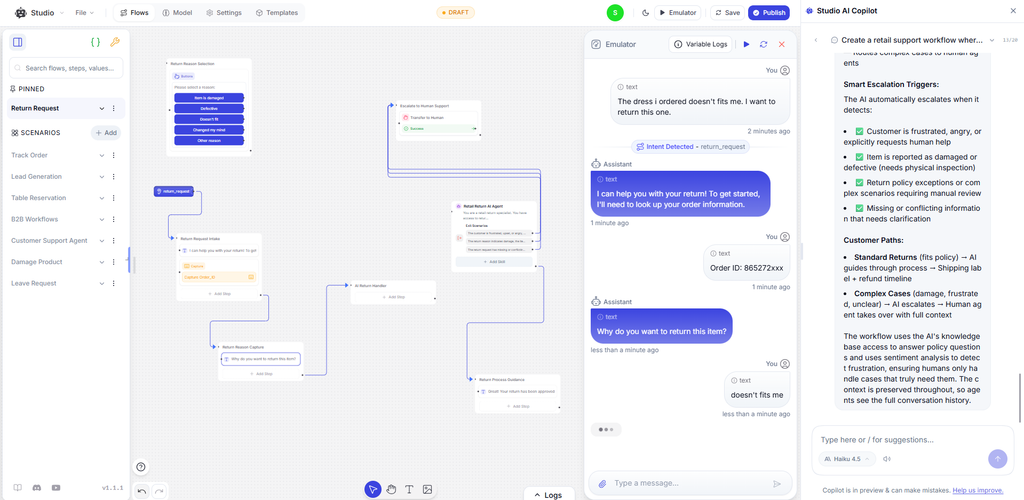
How YourGPT Handles This Split
YourGPT is a no-code AI agent platform, that retailers use to automate support, sales, and operations from one connected system, deployed by more than 10,000 teams. Inside a hybrid support model, it is built to handle both sides of the split:
Pricing:
Limitation
Answer quality still depends on how well the underlying data is organized, a limitation every retail AI platform shares, not just this one. RAG grounding, Studio rules, and knowledge-conflict detection reduce that risk, but they do not replace the work of fixing fragmented data first.
The fits-and-falls-short split above condenses into a single scannable reference below, useful for triaging a live queue instead of evaluating a platform.
| Interaction | Good Fit for AI | Needs a Person |
|---|---|---|
| Order status and tracking | Yes | Rarely |
| Inventory and store availability | Yes | Rarely |
| Standard return within policy | Yes | For exceptions |
| Damaged or wrong item received | Intake only | Yes, for resolution |
| Billing dispute or repeat complaint | No | Always |
| Price-match or policy exception | Intake only | Yes, for approval |
| Product questions from published specs | Yes | For nuanced comparisons |
| Angry or distressed customer | Acknowledge and route | Yes, immediately |
The dividing line is less about topic and more about whether the answer is a fact a system can check or a judgment call that carries real consequences for the customer.
Retail support agents routinely touch order history, payment-adjacent details, and personal contact information, and increasingly some carry the authority to approve refunds on their own. That combination deserves its own set of controls, not a footnote inside a features list.
Returns fraud is a real pressure on retailers leaning on automation. NRF’s 2025 Retail Returns Landscape report found US retailers expected $849.9 billion in returns, with 9% classified as fraudulent, and 85% already use AI to help catch it. The same automation that speeds up legitimate returns needs guardrails against fraudulent ones too.
A few controls matter more than the rest:
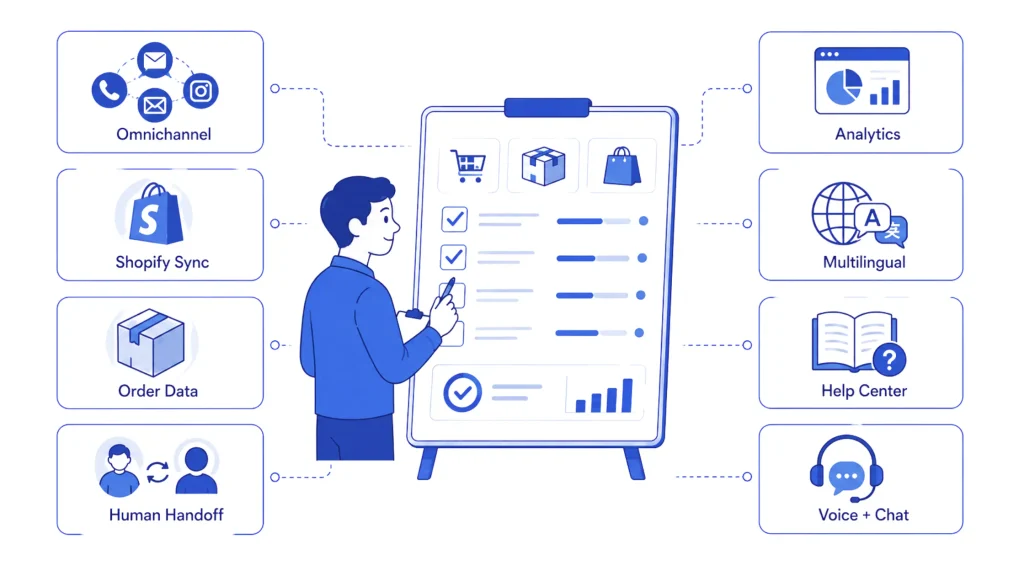
A platform may perform well in a demo but struggle with real orders, incomplete customer information, or unexpected requests. Before selecting an AI customer service solution, retailers should test its capabilities using their actual support workflows.
A useful vendor test should reveal more than whether the chatbot answers correctly. It should show whether the platform can complete approved tasks, recognize its limitations, and recover when something goes wrong.
AI in retail customer service is moving beyond answering questions toward completing tasks, anticipating customer needs, and connecting support across online and physical stores. While these capabilities are developing at different speeds, several trends are shaping how retailers plan their support operations.
Voice AI is becoming an option for handling common phone inquiries, including order updates, store hours, return policies, and appointment scheduling. More advanced systems can retrieve customer information and complete approved actions during a call.
However, retailers still need reliable speech recognition, identity verification, and human escalation for complicated or sensitive requests.
AI agents are moving beyond providing information to carrying out connected actions. For example, an agent could check return eligibility, create a return request, generate a shipping label, and update the customer within one conversation.
These workflows require secure integrations, clear permissions, and verification before important actions are completed.
Retail AI assistants can use product catalogs, purchase history, and customer preferences to provide more relevant assistance. A shopper asking about an unavailable product might receive suggestions for alternatives that match their preferred size, budget, or specifications.
Personalization can make support more useful, but retailers must balance it with customer consent and data privacy requirements.
Instead of waiting for customers to report problems, retailers can use AI and automated workflows to identify potential issues earlier.
For example, a system connected to shipping data could detect a delivery delay and notify the customer before they contact support. This approach depends on accurate event data and appropriate communication preferences.
Retailers are working toward support experiences where online conversations, store visits, and customer records remain connected.
A customer could begin a product inquiry through website chat and continue the conversation with an in-store associate who can access the relevant history. This approach reflects the principles of omnichannel customer service, where customer context and support information remain consistent across channels.
The next stage of retail AI will be measured less by the number of automated conversations and more by how successfully systems complete tasks across channels. Retailers that maintain accurate data, clear approval rules, and reliable human support will be better positioned to adopt these capabilities as they mature.
Not entirely. AI can handle routine requests such as order tracking, inventory checks, FAQs, and standard returns when connected to accurate business data. However, complex complaints, disputed charges, policy exceptions, and sensitive situations often require human judgment. A hybrid support model allows AI to manage predictable tasks while human agents handle cases that need additional attention.
A rule-based chatbot follows predefined scripts to answer common questions. An AI agent can interpret natural language, retrieve information from connected systems, and perform approved actions. For example, a basic chatbot might explain a return policy, while an AI agent connected to order data can check eligibility and initiate a return. Capabilities depend on the platform and its integrations.
Yes. AI agents connected to order and payment systems can check return eligibility, initiate approved returns, generate shipping instructions, and provide refund updates. However, high-value refunds, suspected fraud, and requests outside standard policies should follow predefined approval rules or be reviewed by a human representative.
Retail AI can handle sensitive information more safely when appropriate security controls are implemented. These include customer authentication, role-based access, encrypted data transmission, refund approval limits, and audit logs. Retailers should also verify vendor security documentation, data retention policies, and relevant compliance requirements before connecting payment or customer records.
Yes. Many AI customer service platforms support multilingual conversations, with some offering more than 100 languages. Retailers can answer product questions, explain policies, and provide order updates in different languages. However, language coverage and accuracy vary by platform, so businesses should test regional terminology, translations, and sensitive support scenarios before deployment.
Retailers should evaluate live integrations with ecommerce and order management systems, omnichannel support, knowledge accuracy, human handoff, security controls, and resolution analytics. Test each platform using real customer scenarios, including failed API calls and policy exceptions. Platforms such as YourGPT offer AI support, workflow automation, and human escalation, but businesses should verify that the available integrations match their specific requirements.
AI is likely to change retail support roles rather than eliminate the need for human agents. It can handle repetitive questions and approved transactions, allowing employees to focus on complex complaints, exceptions, and customer relationships. Some routine roles may require fewer staff hours, while human oversight and problem-solving remain important for reliable service.
Retail AI is moving toward voice assistants, multi-step agent workflows, proactive delivery notifications, personalized shopping assistance, and connected online and in-store support. These capabilities will depend on accurate customer data, secure integrations, clear approval rules, and reliable human escalation.
AI is changing retail customer service, but successful automation depends on knowing where it adds value and where human support remains necessary. Order tracking, inventory checks, and standard returns are strong candidates for AI, while complex disputes, policy exceptions, and sensitive complaints still benefit from human judgment. The goal is not to automate every interaction, but to resolve customer problems accurately without creating unnecessary friction.
Retailers should start by identifying repetitive requests, connecting AI to reliable data, and setting clear rules for human escalation. Measure actual resolution rates, customer satisfaction, and recurring failures rather than automated conversation counts alone. The strongest retail support model is one where customers receive the right help at the right time, whether it comes from AI or a person.
Build a GDPR-compliant chatbot with data minimization, consent checks, secure account lookups, retention and deletion across connected systems.

Create a YourGPT phone agent, add human transfers and callback bookings, connect Twilio, and test the complete caller experience before launch.
A practical platform benchmark with YourGPT production results, external field evidence, a complete scorecard and industry-specific acceptance tests.
Trace recurring questions to the step where customers get stuck, apply the right fix, and measure whether more customers finish.
Set up YourGPT AI agents to answer questions, complete support actions, and resolve requests with business knowledge and clear human-assistance rules.

A practical rollout plan for support teams covering scope, knowledge preparation, YourGPT setup, testing, launch gates, security, and honest ROI measurement.