How to Build a Sales Qualification Bot That Books Meetings Automatically

Rajni
November 24, 2026
Most businesses lose qualified leads because they respond too slowly, not because their product is weak.
A sales qualification bot engages visitors instantly, asks the right questions, evaluates fit automatically, and books meetings without human involvement.
Built on YourGPT, the bot can be trained on your business knowledge, connected to your calendar, and deployed across every channel your prospects use.
A prospect visits your website, checks your pricing, and decides to book a demo. But instead of choosing a meeting time, they fill out a form and wait for someone from sales to respond.
That delay can cost you a potential customer, especially when they’re comparing multiple solutions.
For sales teams, the challenge goes beyond capturing leads. Someone still needs to review each inquiry, check whether the prospect is a good fit, assign the right representative, and arrange a meeting. These manual steps can slow down the sales process.
A sales qualification bot handles these tasks through a conversation. It answers initial questions, collects relevant details, evaluates prospects against your qualification criteria, and books meetings based on calendar availability.
In this guide, you’ll learn how to build a sales qualification bot using YourGPT, set up qualification rules, connect scheduling tools, and automate the process from the first inquiry to a confirmed meeting.
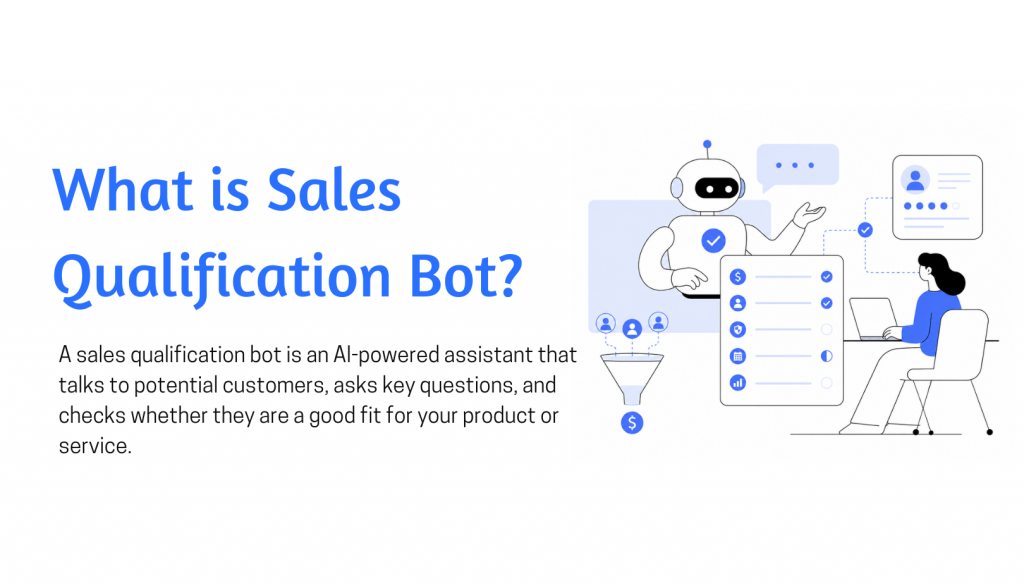
A sales qualification bot is an AI-powered conversational assistant that collects prospect information, evaluates buying intent, and identifies potential customers based on your sales team’s criteria.
Unlike a basic chatbot that primarily answers questions, a qualification bot helps determine what should happen next.
For example, when someone asks about your product, the bot can find out what they need, whether your solution fits their requirements, and when they plan to make a decision.
Based on their responses, it can:
Qualification criteria depend on your product, target customers, and sales process. A B2B software company might prioritize company size and implementation timeline, while an agency may focus on project budget and service requirements.
Common criteria include:
The bot doesn’t need to ask every question. It should collect only the information necessary to determine the next step.
Once it has enough details, it can apply predefined qualification rules to offer a meeting, request additional information, or direct the prospect to another suitable resource.
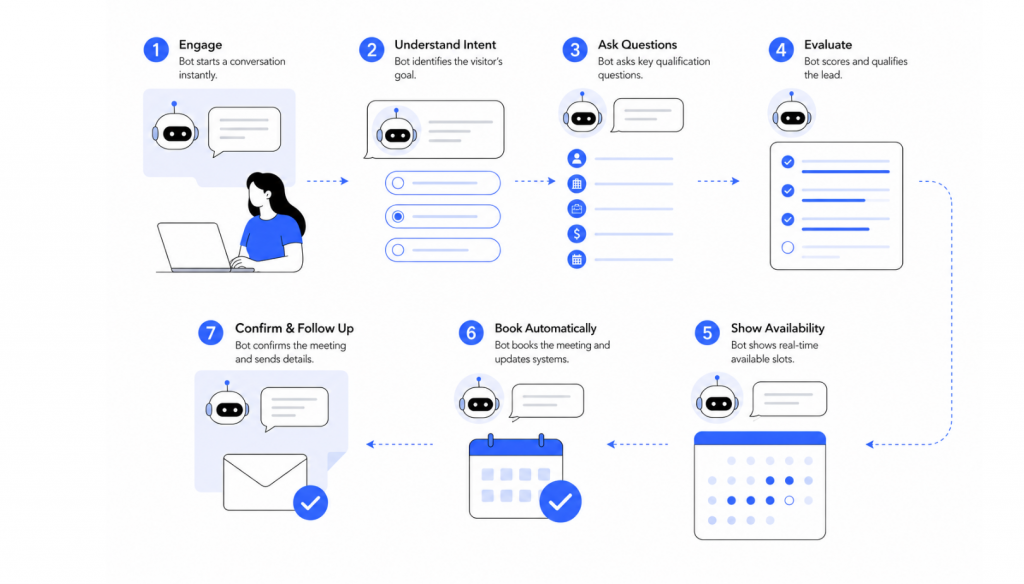
A sales qualification bot connects the first customer inquiry to a confirmed sales meeting. It follows a sequence of steps, using the prospect’s responses and your predefined rules to decide what happens next.
The bot welcomes visitors and offers help based on their questions or the page they’re viewing.
For example, a visitor exploring AI customer support might see:
“Looking to automate customer support? I can answer your questions or help you schedule a demo.”
Visitors can ask questions or express interest without filling out a separate form.
The bot determines whether someone wants pricing information, a product demonstration, integration details, or general assistance.
A visitor requesting a demo can move directly into qualification, while someone researching features can receive relevant information first.
The bot asks questions based on the prospect’s intent and the information already available.
For a B2B software company, it might collect:
If a prospect has already provided an answer, the bot should use it rather than asking again.
The bot evaluates responses using predefined qualification rules. For example, a company might use the following scoring model:
| Qualification criteria | Score |
|---|---|
| Company has 50+ employees | 25 |
| Director-level role or above | 25 |
| Budget meets requirements | 20 |
| Active project within 6 months | 20 |
| Product matches requirements | 10 |
| Total possible score | 100 |
A business could set a threshold of 70 points for direct meeting booking. Prospects below that threshold might receive additional information or be routed to a different follow-up process.
These scores are illustrative. Each business should define thresholds based on its own sales criteria.
When a prospect qualifies, the bot requests available meeting slots from the connected scheduling system.
It can present suitable times based on the assigned representative’s availability, meeting duration, and time zone.
After the prospect selects a time, the bot submits the booking through the connected calendar or scheduling tool.
Depending on the configured integrations, the workflow can also:
The booking should only be confirmed after the scheduling system returns a successful result.
Once the meeting is created, the prospect receives a confirmation with the scheduled date, time, and meeting details.
The sales representative can also receive the qualification summary, including the prospect’s requirements, budget, and timeline.
If booking fails or no suitable slots are available, the bot should offer another time or arrange human follow-up rather than claiming the meeting is confirmed.
This completes the process from the initial inquiry to a scheduled sales conversation, with the information needed for the sales team to prepare.
Building a sales qualification AI agent starts with one goal: help businesses qualify leads faster without losing control over routing, scheduling, or sales follow-up.
With YourGPT, you can create an AI sales qualification bot that answers prospect questions, collects key lead information, qualifies visitors based on your rules, and books meetings with the right team. The agent can be trained on your business knowledge, connected with scheduling tools, and deployed across multiple customer channels.
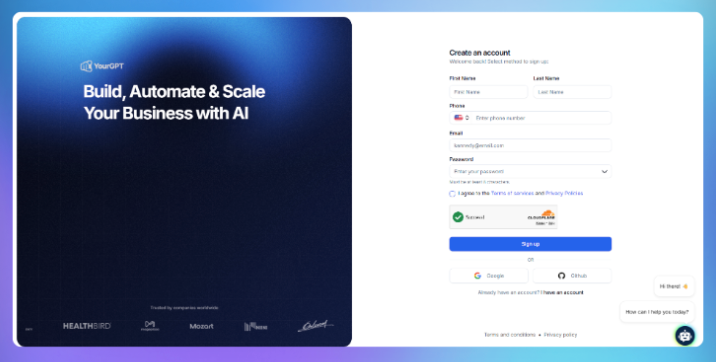
Sign in to YourGPT and create a new AI agent.
Before moving ahead, define what the bot should handle automatically and what should be routed to your sales team. Decide what makes a lead qualified, which questions the bot should ask, what information must be collected, and which team member should receive each type of booking.
This helps avoid poor lead routing, missed opportunities, and inconsistent qualification results.
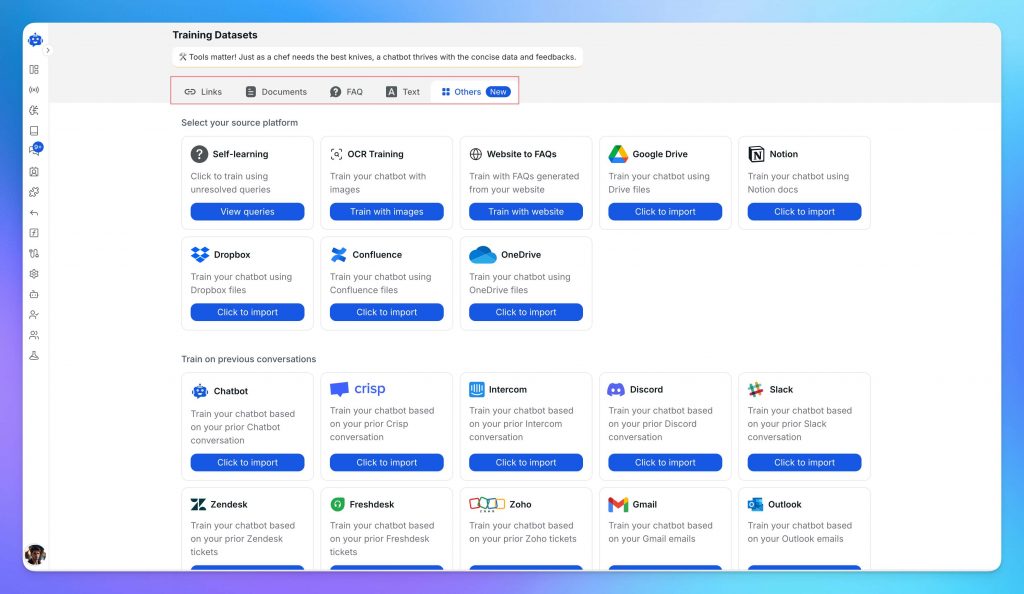
Train the agent using your real sales and business content, such as:
This allows the agent to answer common pre-sales questions based on your business instead of giving generic responses.
For example, if a prospect asks whether your product integrates with Salesforce, the bot can answer immediately instead of sending the question to a sales representative. You can also customise the AI agent persona based on your sales tone, such as professional, helpful, friendly, or consultative.
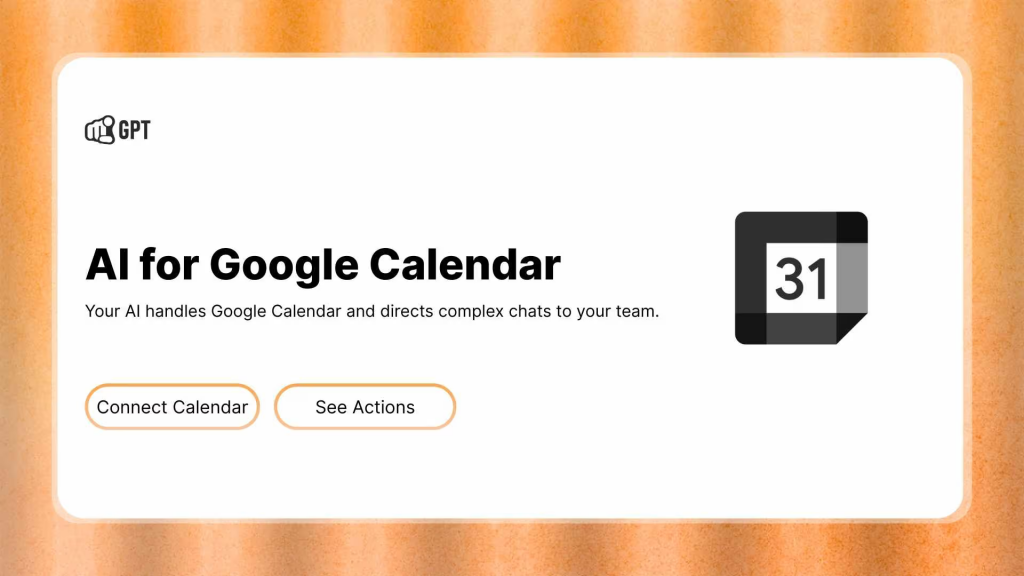
Connect the agent with your scheduling tools so qualified leads can book meetings directly from the conversation.
YourGPT supports scheduling integrations such as Calendly, Cal.com, and Google Calendar. This allows the bot to check availability, suggest meeting slots, and help prospects schedule calls without manual back-and-forth.
You can also configure routing rules, such as:
This ensures every prospect reaches the right person and reduces scheduling confusion.
Test the agent with real sales scenarios before going live.
Use examples such as a fully qualified lead, an unqualified visitor, an existing customer, a competitor inquiry, a job applicant, a support request, and a prospect asking pricing or integration questions.
Check whether the bot collects the right information, answers accurately, qualifies leads correctly, routes conversations properly, and books meetings without errors.
Also review edge cases like unclear budgets, missing contact details, wrong company size, existing customer accounts, or prospects who want urgent human help.
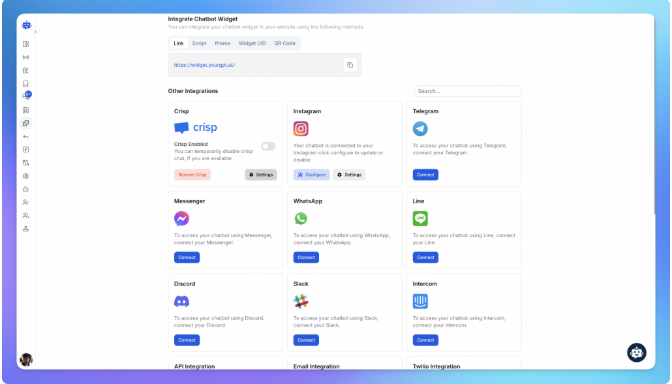
Once tested, deploy the AI agent across your customer-facing channels.
YourGPT supports deployment on website live chat, WhatsApp, Instagram, Slack, Facebook Messenger, CRM platforms, helpdesk tools, and e-commerce systems.
Start with lower-risk workflows such as answering FAQs, collecting lead details, and booking meetings. Expand to advanced routing, CRM updates, and automated follow-ups after reviewing performance.
For teams that need deeper workflow control, YourGPT AI Studio provides additional customisation without requiring a development team.
After launch, review conversations regularly.
Check which leads the bot qualifies, where prospects drop off, which questions are unanswered, and where human escalation is needed. Keep updating the knowledge base whenever pricing, product features, qualification rules, or sales processes change.
By following these steps, your business can create a sales qualification AI agent with YourGPT that improves response speed, captures better leads, reduces manual follow-up, and helps prospects book meetings with the right team.
Here are the examples of sales qualification bot :
A visitor exploring a SaaS customer support platform wants to know whether it can handle their team’s workload.
The bot asks about their team size, current tool, monthly ticket volume, budget, and timeline. If the visitor says they have 20+ agents, high ticket volume, and want to switch within 30 days, the bot marks them as a high-priority lead and offers to book a demo.
A business owner visits an agency website looking for help with lead generation.
The bot asks what services they need, their monthly ad budget, target location, industry, and when they want to start. If they have a strong budget and are ready to begin soon, the bot sends their details to the sales team.
A founder visits a development company’s website and wants to build a mobile app.
The bot asks whether they need Android, iOS, or both, whether designs are ready, their budget range, launch timeline, and who will approve the project. If the budget and timeline match the company’s services, the bot books a discovery call.
A buyer visits a real estate website looking for available properties.
The bot asks about property type, preferred area, budget, financing status, and purchase timeline. If the buyer has financing ready and plans to buy soon, the bot connects them with an agent.
A company visits an AI solutions website looking for a customer support chatbot.
The bot asks about monthly inquiry volume, support channels, current tools, budget, and decision timeline. If the company has high inquiry volume and is actively evaluating vendors, the bot marks them as an enterprise opportunity.
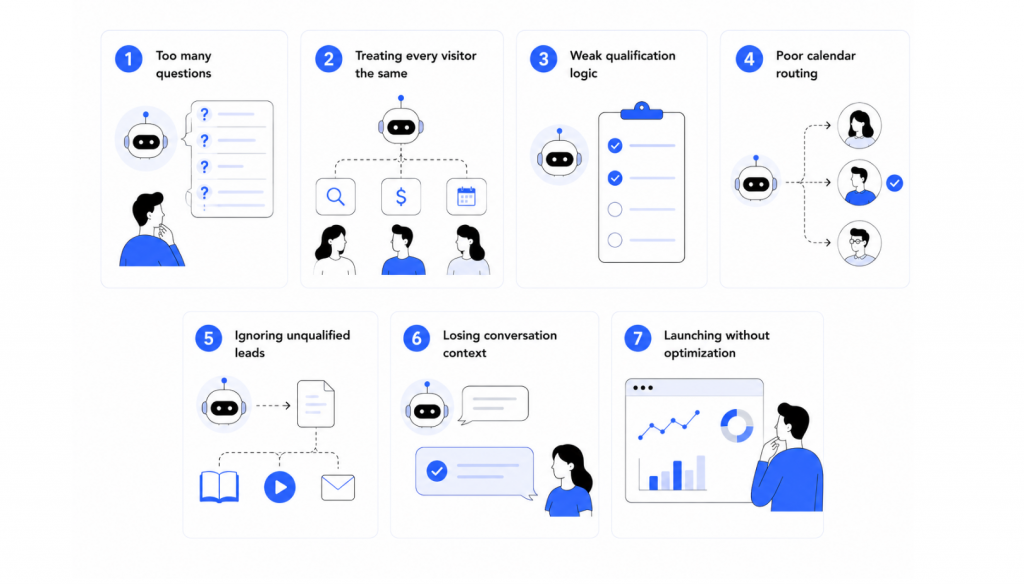
Even a well-configured qualification bot can underperform if certain principles are ignored.
A sales qualification bot typically collects a prospect’s name, business email, company size, requirements, budget, and purchase timeline. The exact questions depend on your sales process. Avoid collecting unnecessary information that could discourage visitors from completing the conversation.
Yes. A qualification bot connected to a scheduling tool can check available slots, let prospects select a time, and create calendar events automatically. Human assistance may still be needed for special requests, scheduling conflicts, or failed bookings.
Not necessarily. Platforms like YourGPT let you create AI agents, train them on business information, and define qualification instructions without coding. Custom integrations and more complex workflows may require additional technical setup.
The bot can offer relevant resources, recommend another service, or provide an optional follow-up. You can also configure different qualification paths for prospects who aren’t ready to purchase but may become suitable customers later.
Integration options depend on the platform. YourGPT provides scheduling templates for Calendly, Cal.com, and Google Calendar. CRM connections can be configured through supported integrations or APIs to save prospect details, qualification results, and meeting information.
Yes, if the platform supports those channels. YourGPT allows teams to deploy AI agents on websites, WhatsApp, and other messaging platforms. This lets prospects ask questions and complete qualification through their preferred communication channel. Automated booking requires a connected scheduling workflow.
Focus on qualified lead rate, meeting booking rate, meeting attendance, and sales acceptance rate. These show whether the bot is attracting suitable prospects and scheduling useful conversations. A high booking count alone doesn’t necessarily mean better sales results.
A successful sales qualification bot should do more than schedule meetings. It should identify prospects who match your business requirements and give sales representatives the context they need before a conversation begins.
With YourGPT, you can start with a no-code agent and expand into connected workflows as your sales process grows.
Before launching, test the complete process with real sales scenarios, including unqualified leads and failed bookings. Then measure meeting attendance and lead quality to see whether the bot is bringing the right opportunities to your team.
The real measure of success isn’t how many meetings your bot books, but how many turn into meaningful sales opportunities.
Build a no-code AI agent that qualifies prospects, answers sales questions, and schedules meetings automatically.
Ten AI customer service tools for beauty and skincare brands, with what a chat reply may legally claim, a product-page checklist, a 12-question trial and a priced Black Friday month.

A comparison of 10 AI customer service tools for jewelry and luxury brands, grouped by tool type, with a 10-ticket trial and a shortlist by store setup.
TL;DR Retail customer service is changing as businesses handle more online orders, returns, and customer questions across multiple channels. Shoppers expect quick answers, accurate information, and consistent support, whether they contact a retailer through its website, phone, or messaging apps. Meeting these expectations with human agents alone can be difficult, especially during peak shopping periods. […]
Build a GDPR-compliant chatbot with data minimization, consent checks, secure account lookups, retention and deletion across connected systems.
Create a YourGPT phone agent, add human transfers and callback bookings, connect Twilio, and test the complete caller experience before launch.
A practical platform benchmark with YourGPT production results, external field evidence, a complete scorecard and industry-specific acceptance tests.