Ada CX Review 2026: Pricing, Pros & Cons

Shreya Sharma
August 24, 2026
Ada CX is a no-code enterprise AI platform for automating support across chat, voice, email, and messaging.
Pricing is quote-only, with no public plans or self-serve signup.
Admin reviews are generally positive, while end-customer feedback is more mixed.
Ada supports SOC 2 Type II, GDPR, HIPAA, PCI DSS, and AIUC-1 certification.
Ada CX shows up in almost every enterprise AI customer service shortlist. Almost every one of those lists skips the same detail. What does the platform actually cost? That question is worth answering before booking a single demo call.
Ada, styled Ada CX or ada.cx, is a Toronto company that spent the past two years rebuilding itself around large language models under what it now calls the Agentic Customer Experience (ACX) Operating Model. The pitch is agents that reason through multi-step service requests instead of following a fixed decision tree, deployed across chat, voice, email, and messaging from one platform.
This review breaks down what Ada CX does in practice, what its own site says about cost and what it leaves out, how real users rate the experience, and where the platform’s limits start to show once the sales call ends.
Ada CX is an enterprise platform for building and managing AI agents that handle customer service across channels. Founded in 2016 by Mike Murchison and David Hariri, the company grew out of the founders’ own stint answering support tickets before they built software to automate the patterns they found there.
A few facts frame where Ada sits in the market today:
Status. Unpublished. Ada does not show plan names, tiers, or dollar figures on its official website. Its pricing URL redirects visitors directly to a demo request.
What that means in practice. Ada uses a sales-led buying process. Its main calls to action are to speak with an expert or book a demo rather than select a public pricing plan.
What’s actually unknown. Ada does not publish a starting price or specific conversation rate. Its content indicates that billing is generally based on conversations rather than resolutions, but actual costs remain private.
What to do about it. Request a demo from Ada to get pricing based on your conversation volume, channels, integrations, and support requirements.
Eight capabilities do most of the work here, spanning how the platform reasons through a request, where it can operate, and where its limits sit.
Ada does not publish plan names, tiers, or prices anywhere on its official website. Visiting ada.cx/pricing redirects straight to a demo-booking page, and no dollar figure, starting price, or plan comparison appears on the homepage, the platform pages, or any of the industry-specific pages either.
What Ada’s site does say. Ada’s own blog explains its general billing philosophy: the default model bills per conversation rather than per resolution, on the reasoning that a per-resolution model can end up charging more as an AI agent gets better at its job. That post lays out the logic behind the two models but stops short of stating an actual rate for either one.
What Ada’s site does not say. A starting price, a specific per-conversation or per-resolution rate, a minimum contract size, or anything resembling a public plan structure. There is also no self-serve signup flow anywhere on the site. Evaluating Ada CX means booking a demo first.
The closest thing to a public number. Ada’s own listing on the Salesforce AppExchange states a default plan starting at $30,000 USD per company per year, described as a consumption-based model with economies of scale at higher volume, discounts available for nonprofits, and a 14-day free trial through that specific integration path. Salesforce hosts the listing, but the number comes directly from Ada’s own account.
What third-party trackers report beyond that. Reported figures vary by source but converge on a consistent range across several independent trackers:
| Pricing Signal | Reported Range | Source Type |
|---|---|---|
| Entry-level annual contract | ~$30,000/year | Ada’s own Salesforce AppExchange listing |
| Median annual contract, 96 tracked purchases | ~$70,001/year | Secondary (Vendr procurement data, cited by CorePiper) |
| Contract range across that same sample | $33,700 to $273,500/year | Secondary (Vendr, same source) |
| High-volume enterprise deployments | $100,000 to $300,000+/year | Secondary (Featurebase, Fin.ai, corroborated by a widely cited operator account on Reddit) |
| Per-resolution rate, exception billing | $1.00 to $3.50 per resolution | Secondary (multiple trackers) |
None of these third-party figures are confirmed by Ada’s own site, so they belong in a planning spreadsheet rather than a budget line, best treated as a rough sense of scale until Ada’s sales team confirms an actual number.
What to do about it. Treat the gap between what Ada publishes and what third parties report as a genuine signal worth asking about directly. Book the conversation through Ada’s demo page, and ask specifically whether the quote is conversation-based or resolution-based, and how a billable conversation gets defined, before assuming either model applies by default.
These themes recur most often across verified G2 reviews from the admins and support teams who actually run Ada day to day.
These are the friction points that show up most often, both on Ada’s own site and in what reviewers report once they are actually running the platform.
Ada’s agents touch customer conversation data, connect to core business systems such as CRMs and helpdesks through APIs tools, and on voice deployments handle live phone conversations. That scope makes security a genuine evaluation item here, deserving real scrutiny.
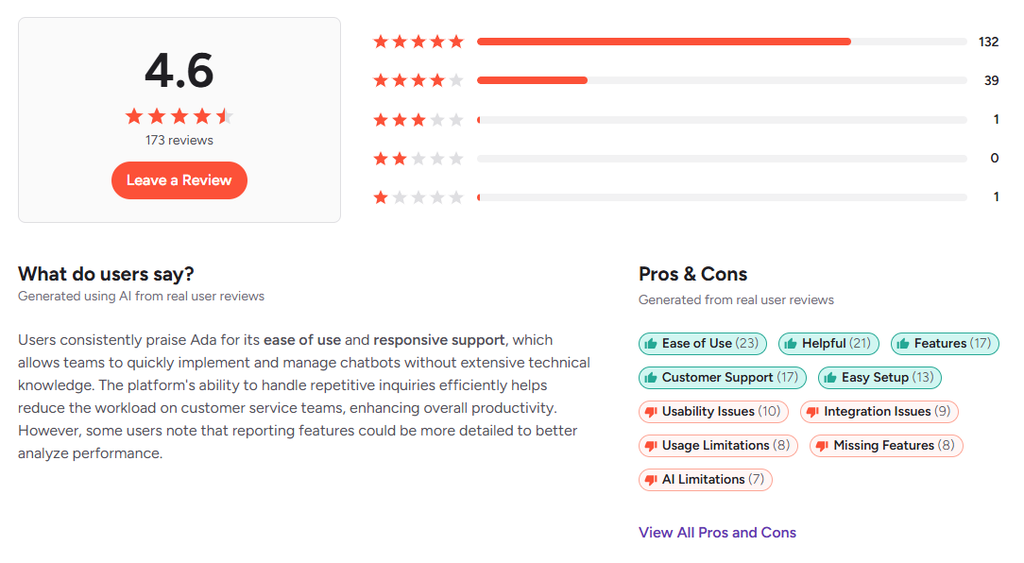
The rating gap between review platforms comes down to audience. On G2, Ada holds 4.6 out of 5 across 173 reviews as of August 2026, largely from the support ops managers and admins who configure and manage the platform day to day. Trustpilot tells a different story, sitting around 1.8 out of 5 from roughly 20 reviews as of mid-2026, mostly end customers who talked to an Ada-powered bot on someone else’s website, with lost context between turns and difficulty reaching a human as recurring complaints.
A support team handling high volumes of routine, well-scoped questions tends to land closer to the G2 experience. A team fielding complex, emotionally loaded conversations should weigh the Trustpilot pattern more heavily.
This review draws on Ada’s own live pages, G2’s aggregated review data, third-party procurement trackers, and Ada’s public press releases. Ada does not offer self-serve access, so no hands-on trial account factored into this evaluation.
No single weighted score gets assigned here. That would require a live account running real support traffic against the platform. Published documentation and aggregated review data cannot substitute for that kind of live testing.
Ada fits best for large enterprises with high, steady conversation volume, budget for a sales-led rollout measured in weeks, and a support operation already concentrated on Salesforce or Zendesk. Outside that profile, a few alternatives worth comparing come up often.
| If The Priority Is | Choose | Why |
|---|---|---|
| A self-serve start with published pricing and no sales call | YourGPT | Public pricing, a 7-day trial, multi-step AI Studio workflows, and native omnichannel deployment |
| Granular, hand-built control over conversation logic | Voiceflow | Visual canvas for deterministic flows plus autonomous reasoning across multiple LLM providers |
| Large-enterprise, LLM-first automation at Ada’s scale | Decagon or Sierra | Comparable enterprise automation scope and procurement profile for direct evaluation |
| An existing Zendesk or Salesforce investment with minimal new tooling | Ada CX | Deep native integrations with Zendesk and Salesforce make it a strong fit for those ecosystems |
Ada CX is a no-code enterprise agentic customer experience platform for automating support across chat, voice, email, and messaging. Its Reasoning Engine and Playbooks support multi-step customer service workflows.
Ada does not publish plans or pricing on its official website. Its Salesforce AppExchange listing shows a default plan starting at $30,000 per company per year, but an exact quote requires contacting Ada’s sales team.
Ada does not offer a general self-serve trial on its main website. A 14-day free trial appears on its Salesforce AppExchange listing specifically for that integration path.
Launched in February 2026, Ada’s Reasoning Engine is its intelligence layer across channels. It can answer simple requests immediately while processing longer, multi-step tasks in the background.
Ada holds SOC 2 Type II, HIPAA, GDPR, and PCI DSS certifications. It also earned AIUC-1 agentic AI safety certification and states that it uses Zero Data Retention agreements with its LLM providers.
Key limitations include unpublished pricing, a sales-led setup process, limited self-serve evaluation, and less flexible reporting. Knowledge integrations are also narrower than some competitors.
Ada is generally better suited to larger enterprises with high conversation volumes and resources for a guided rollout. Teams wanting published pricing and a self-serve start may prefer alternatives such as YourGPT.
Voiceflow is strong for granular conversation-flow control, while Decagon and Sierra compete at the enterprise level. YourGPT suits teams wanting multi-step AI workflows and omnichannel deployment with a self-serve buying process.
Ada CX earns its place among the best-known names in enterprise AI customer service. It genuinely handles complex, multi-step service work beyond simple FAQ answering, and the security stack (SOC 2 Type II, HIPAA, GDPR, PCI DSS, AIUC-1) gives regulated industries a documented answer.
The friction shows up early. Ada’s own site publishes no starting price, no billing model, and no self-serve way to try the product, so getting a number means booking a sales call first, setup runs weeks, and the gap between G2’s admin-side praise and Trustpilot’s end-customer complaints deserves real weight before signing anything.
Ada earns the sales conversation for a team already on Salesforce or Zendesk with steady volume and bandwidth for a multi-week rollout. Therefore, Everyone else should compare it against a self-serve alternative like YourGPT first.
Move from Gorgias with a verified ticket archive, tested AI workflows, human handoff and a channel cutover plan before ending your subscription.

TL;DR The Gorgias AI Agent is the automation layer inside the Gorgias helpdesk, split between a Shopping Assistant for pre-purchase conversations and a Support Agent for post-purchase support. A connected Shopify store is required, and Gorgias documentation rules out platforms such as BigCommerce, Magento, and WooCommerce for the AI Agent. Billing runs on two separate […]


TL;DR Gorgias is the closest Richpanel alternative for Shopify stores that need native order actions directly inside support tickets. YourGPT fits stores that want one AI agent handling requests across web, WhatsApp, Instagram, and email, while Tidio and Re:amaze suit smaller teams looking for lighter, lower-cost options. Richpanel’s AI pricing starts around $500/month for two […]

TL;DR Shopify Inbox is a good free option for stores that only need basic storefront chat and simple customer conversations. Stores usually look for alternatives when they need multichannel support, stronger team workflows, or automated order actions. YourGPT is strongest for cross-channel AI automation, Gorgias for Shopify-native order workflows, and Tidio for smaller stores that […]
TL;DR Tidio recently restructured its top paid plan, and many 2026 reviews still describe the old pricing model. Confirm current pricing directly on Tidio’s site before budgeting. Lyro, Tidio’s AI agent, runs on Anthropic’s Claude rather than ChatGPT. Only the Premium tier carries a guaranteed resolution rate, well below the average Tidio advertises elsewhere. Billing […]
TL;DR Drift’s situation goes well past “post-acquisition.” Clari and Salesloft announced a formal sunset after a major OAuth breach pushed Drift offline for weeks. Two of the other usual “alternatives” are getting bought too. Salesforce closed its acquisition of Qualified and signed a deal to acquire Intercom, now Fin. The real split is budget and […]