Tidio Review 2026: Pricing, Lyro Limits & Who It’s Actually For

Rajni
August 28, 2026
Tidio recently restructured its top paid plan, and many 2026 reviews still describe the old pricing model. Confirm current pricing directly on Tidio’s site before budgeting.
Lyro, Tidio’s AI agent, runs on Anthropic’s Claude rather than ChatGPT. Only the Premium tier carries a guaranteed resolution rate, well below the average Tidio advertises elsewhere.
Billing runs on three separate meters: billable conversations, Lyro AI conversations, and Flows visitors. Each carries its own quota and its own add-on cost.
Third-party reviews on G2 and Capterra are consistently strong, with pricing complexity as the most repeated complaint on both platforms.
Tidio fits small teams and e-commerce stores that want live chat plus a capable AI layer without enterprise procurement. Complex, multi-step support workflows tend to outgrow it fast.
Tidio has been the default answer to “cheap AI live chat” for small e-commerce stores for a few years now, and the reputation still mostly holds. What’s changed is the pricing underneath it. The platform quietly rebuilt its top self-serve tier sometime before March 2026, and a surprising number of 2026 reviews, some published within the last month, are still describing a plan structure that no longer exists.
That gap matters if a decision hinges on a specific number. This review works from Tidio’s own live pricing page rather than secondary aggregators, and it spends real time on the part most buyers skip past. That means what a Lyro conversation actually counts as, where the free tier runs out, and what happens to the bill once AI usage climbs past a demo.
The short version is that Tidio remains a better, low-friction pick for small teams. The complicated version is everything after this paragraph.
Tidio is a customer communication platform built around live chat, a shared inbox, and Lyro, its AI agent. Tytus Golas and Marcin Wiktor founded the company in 2013 in Szczecin, Poland, and it now serves 300,000-plus businesses, most of them running Shopify, WooCommerce, or BigCommerce stores. Tidio raised a $25M Series B in May 2022, led by PeakSpan Capital with participation from Inovo Venture Partners and InPost founder Rafal Brzoska. Company trackers put current headcount at roughly 150 to 200 people, though they disagree on whether Szczecin or San Francisco is the main headquarters today. Treat any specific number here as an estimate.
Tidio’s product has three main parts, sold together or on their own. Customer Service covers live chat, ticketing, and a shared inbox. Flows is a no-code builder for scripted, rule-based automations. Lyro is the AI agent. A visitor might land in live chat, get passed to a scripted Flow for a simple question, or get an answer straight from Lyro, all inside the same widget.
Model. Tidio confirms that Lyro runs on Anthropic’s Claude combined with its own in-house models. It does not use ChatGPT, which Tidio presents as a deliberate choice focused on safety and reliability.
Resolution rate. Tidio states that Lyro reaches a 67% average resolution rate, often higher. That figure is a company-wide marketing average rather than a guaranteed result. The Premium plan carries a specific 50% Lyro AI resolution-rate guarantee, which is lower than the broader 67% headline figure commonly cited in Tidio reviews and marketing.
What counts as a conversation. A Lyro conversation starts when a customer interaction receives at least one AI reply. Multiple Lyro responses within the same issue still count as one conversation, even if the customer leaves the chat and returns later. Usage only increases when a genuinely new interaction begins.
Smart Actions. Lyro Smart Actions extend beyond text-based answers by letting the AI trigger connected workflows such as order lookups and lead qualification through integrated tools.
Standalone use. Lyro Connect lets teams use Lyro inside existing helpdesks such as Zendesk or Salesforce without moving their entire support operation to Tidio’s inbox. It is available on Plus and Premium plans and is billed separately from $0.50 per conversation, making it a different pricing model from the bundled Lyro AI Agent add-on.
Beyond Lyro, a handful of features round out the platform and shape day-to-day use.
Prices verified directly against tidio.com/pricing and tidio.com/faq as of August 19, 2026. Tidio’s pricing page defaults to annual billing (with 2 months free), so the headline numbers below are the annual-billed monthly rate, with the equivalent monthly-billed rate noted alongside. Confirm the toggle state before quoting a figure to a client, since the two numbers differ by roughly 17%.
| Plan | Price | Billable Conversations | Notable Inclusions |
|---|---|---|---|
| Free | $0/mo | 50/mo | Live chat, ticketing, 10 seats, and 50 Lyro conversations as a one-time allowance that does not renew |
| Starter |
$24.17/mo annual $29/mo monthly |
100/mo | 50 Lyro AI conversations as a one-off allowance, 100 Flows visitors, and basic analytics |
| Growth |
From $49.17/mo annual From $59/mo monthly |
From 250/mo | Advanced analytics, live typing preview, automatic chat assignment, and macros |
| Plus | $300/mo base, plus usage | Custom | Discounted usage rates, dedicated success manager, custom branding, and OpenAPI |
| Premium | Custom, contact sales | Custom | From 3,000 Lyro AI conversations, guaranteed 50% Lyro resolution rate, SSO, and compliance features |
The number worth sitting with is the Plus row. As of this writing, most 2026 pricing roundups, including several published within the past month, still list Plus at a flat $749/mo. That was accurate for most of 2025 and part of 2026. It stopped being accurate once Tidio restructured Plus to a $300/mo base plus usage-based billing sometime before March 19, 2026 (confirmed independently by a third-party pricing audit dated that day). A team quoting the old $749 figure from a review article, even a recent one, is working from stale data.
Three quotas run independently of each other, which is why Tidio’s actual monthly cost rarely matches the plan price on the page:
Removing the “Powered by Tidio” branding costs an additional $16.67/mo annual ($20/mo monthly) on Growth, and comes included free starting on Plus.
A Starter-plan store that wants meaningful Lyro coverage is realistically paying $29 (Starter) plus $39 (Lyro, 50 conversations) before touching branding removal or Flows, which is the gap that shows up in G2’s “expensive” and “cost limitations” complaint categories (76 and 44 reviews respectively). None of this makes Tidio unusually costly against direct competitors. For teams comparing across the broader live chat and AI category, it’s simply a structure worth modeling against actual conversation volume rather than the sticker price alone.
Tidio earns its reputation for a specific, checkable set of reasons.
The complaints cluster around a few well-documented pain points, the kind that show up again and again in G2’s own category data.
Lyro AI Agent handles live customer conversations, and Lyro Smart Actions can now take actions in connected systems like order lookups, both of which put real customer and order data through the platform. That makes the compliance picture worth checking before support operations depend on it.
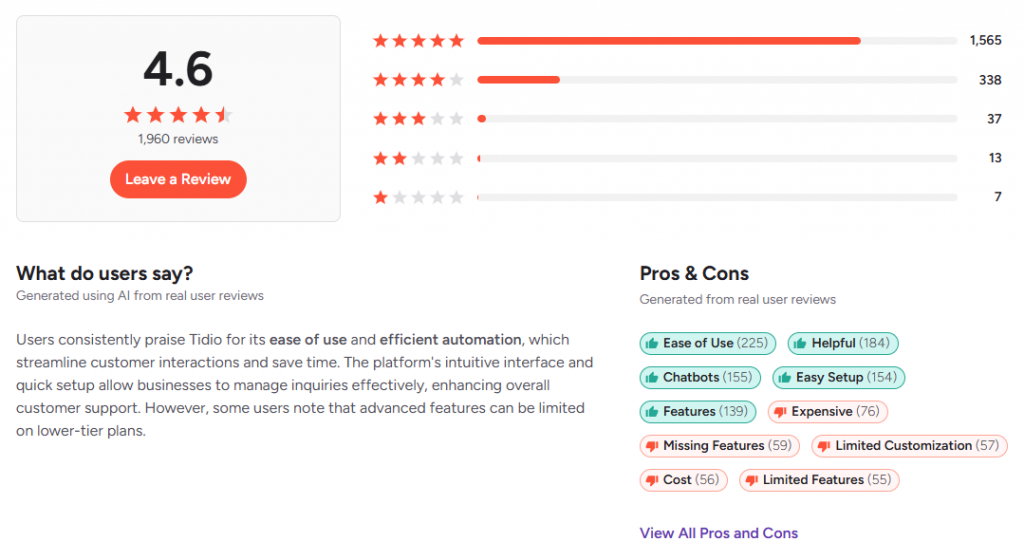
Tidio’s third-party scores are unusually consistent for a support platform, at least on the two review sites that matter most in a purchase decision.
G2 puts Tidio at 4.6 out of 5 across 1,959 reviews, as of August 13, 2026. Top praised categories: ease of use (225), support (184), AI chatbot quality (155), easy setup (154). Pricing dominates the complaints. “Expensive” appears in 76 reviews and “too expensive” in another 56, ahead of missing features (59) and limited customization (57).
Capterra shows a closely aligned 4.7 out of 5 from 590 reviews, updated August 3, 2026. Individual reviews echo the same pattern: praise for setup speed and Lyro’s handling of repetitive questions, complaints about the layered pricing and where the free plan’s limits sit.
Trustpilot tells a rougher story. Secondary aggregators place Tidio somewhere between 3.2 and 3.8 depending on the snapshot date, a spread wide enough to warrant reading a few recent reviews directly rather than trusting any single number, including this one.
This review draws on Tidio’s own live product and pricing pages, published G2 and Capterra review data, and cross-checked funding and company records. A hands-on trial account wasn’t part of this process.
We didn’t assign Tidio a single weighted score. That requires a live trial account run against real support volume, which desk research shouldn’t pretend to replace.
Tidio fits best for small teams and e-commerce stores that want live chat and a capable AI layer without an enterprise buying process. Outside that profile, a few alternatives come up consistently in the same comparisons.
| If Your Priority Is | Choose | Why |
|---|---|---|
| AI automation across support, sales, and operations, not just chat | YourGPT | Usage-based pricing with model choice across four providers and agentic workflows across departments |
| The lowest-friction entry into AI live chat for a small store | Tidio | Genuine free tier, fast no-code setup, and deep Shopify integration |
| AI that reasons through complex, multi-step support questions | Intercom (Fin) | Deeper CRM and product context, at a materially higher per-resolution cost |
| Predictable, flat pricing instead of multiple usage meters | Crisp | Per-workspace pricing avoids Tidio’s three separate billing quotas |
| Enterprise-scale ticketing and multi-brand routing | Zendesk | Built for larger support organizations than Tidio’s SMB-focused target market |
A broader roundup of Tidio alternatives covers more platforms if integration depth or a different pricing model is the deciding factor, and the wider customer service AI chatbot comparison is worth a look for teams still narrowing the category itself.
Tidio is a customer communication platform combining live chat, a shared inbox, and an AI agent called Lyro. Small businesses and e-commerce stores use it to answer customer questions, automate FAQ-style support, and manage conversations across channels like WhatsApp, Instagram, and email from one dashboard.
Tidio runs Free, Starter, Growth, Plus, and Premium plans. Starter begins around $29/mo billed monthly, Growth from $59/mo, and Plus now starts at $300/mo plus usage-based billing. Lyro AI and Flows are separate add-ons with their own pricing, so the actual monthly cost depends on conversation volume across all three meters. Check Tidio’s live pricing page for the current figures before budgeting.
The Free plan includes 50 Lyro AI conversations, but that allowance is a one-time grant rather than a monthly quota. Ongoing Lyro usage past those 50 conversations requires the paid AI Agent add-on, which starts at $39/mo monthly for 50 conversations.
Tidio targets small teams and e-commerce stores with a lower entry price and faster no-code setup. Intercom Fin targets larger support organizations that need deeper multi-step reasoning and CRM context, at a materially higher per-resolution cost.
Common alternatives include Intercom Fin for complex support reasoning, Zendesk for enterprise ticketing, Crisp for flat per-workspace pricing, and YourGPT for teams that want AI automation across support, sales, and operations with model choice across OpenAI, Anthropic, Google, and xAI.
Both platforms offer AI-powered live chat, but the scope differs. Tidio focuses on customer support, with deep Shopify integration and fast no-code setup built for small e-commerce stores. YourGPT spans support, sales, and operations from one no-code builder, with model choice across OpenAI, Anthropic, Google, and xAI, plus AI Studio for building multi-step agentic workflows. A side-by-side comparison of both platforms breaks down the differences in more depth.
For a small team or e-commerce store that wants live chat running the same day, Tidio still earns its reputation. The free tier is real, Shopify support runs deep, and Lyro running on Claude gives it a specific, checkable story most competitors can’t match.
The pricing story needs actual math beyond the sticker price. Three separate meters and a Plus tier that changed structure this year mean the page price is only a starting point. Model expected conversation volume before signing up, and re-check the live pricing page for the current figure.
Teams needing AI that reasons through multi-step problems or takes complex actions across systems are the ones most likely to hit Tidio’s ceiling first.

Compare six Yuma alternatives by ecommerce capabilities, helpdesk compatibility, pricing and human handoffs to choose a replacement for your support team.


Move from Gorgias with a verified ticket archive, tested AI workflows, human handoff and a channel cutover plan before ending your subscription.

TL;DR The Gorgias AI Agent is the automation layer inside the Gorgias helpdesk, split between a Shopping Assistant for pre-purchase conversations and a Support Agent for post-purchase support. A connected Shopify store is required, and Gorgias documentation rules out platforms such as BigCommerce, Magento, and WooCommerce for the AI Agent. Billing runs on two separate […]

TL;DR Gorgias is the closest Richpanel alternative for Shopify stores that need native order actions directly inside support tickets. YourGPT fits stores that want one AI agent handling requests across web, WhatsApp, Instagram, and email, while Tidio and Re:amaze suit smaller teams looking for lighter, lower-cost options. Richpanel’s AI pricing starts around $500/month for two […]

TL;DR Shopify Inbox is a good free option for stores that only need basic storefront chat and simple customer conversations. Stores usually look for alternatives when they need multichannel support, stronger team workflows, or automated order actions. YourGPT is strongest for cross-channel AI automation, Gorgias for Shopify-native order workflows, and Tidio for smaller stores that […]
TL;DR Drift’s situation goes well past “post-acquisition.” Clari and Salesloft announced a formal sunset after a major OAuth breach pushed Drift offline for weeks. Two of the other usual “alternatives” are getting bought too. Salesforce closed its acquisition of Qualified and signed a deal to acquire Intercom, now Fin. The real split is budget and […]