7 Best Shopify Inbox Alternatives in 2026

Rajni
September 3, 2026

Shopify Inbox is a good free option for stores that only need basic storefront chat and simple customer conversations.
Stores usually look for alternatives when they need multichannel support, stronger team workflows, or automated order actions.
YourGPT is strongest for cross-channel AI automation, Gorgias for Shopify-native order workflows, and Tidio for smaller stores that want a simpler live-chat setup.
Every Shopify store starts with Shopify Inbox open in a tab. It ships free inside the admin, takes minutes to turn on, and handles the first few dozen customer questions well enough. The tool a store outgrows first is rarely the tool a store replaces first, though, and Inbox tends to stay installed well past the point where its limits start showing. One channel. Suggested replies instead of resolutions. No real way for more than one person to work a shared queue without stepping on each other.
This piece compares seven Shopify Inbox alternatives that merchants and support teams are actually moving to in 2026: YourGPT, Gorgias, Tidio, Richpanel, Re:amaze, Kustomer, and Help Scout. Each entry covers what the tool does inside a live Shopify store, current pricing, and the specific trade-off worth knowing before switching.
| Rank | Platform | Best For | Quick Take |
|---|---|---|---|
| 1 | YourGPT | AI agent automation across every channel | Resolves requests and takes real action across channels, built for Shopify and going well beyond web chat |
| 2 | Gorgias | Shopify-native ecommerce helpdesk | The deepest order and refund actions built into the ticket workflow, billed per ticket |
| 3 | Tidio | Small stores, quick setup | Live chat and an AI chatbot on a genuine free tier, with a steep jump to the top plan |
| 4 | Richpanel | Migrating off Gorgias or Zendesk | Separates the agent helpdesk from a dedicated self-service portal |
| 5 | Re:amaze | Small teams wanting flat per-seat pricing | Predictable per-agent cost across email, chat, social, and SMS |
| 6 | Kustomer | Larger, CRM-style support teams | A unified customer timeline, built for teams of 8 or more agents with annual budgets |
| 7 | Help Scout | Email-first support | A clean shared inbox and knowledge base, lighter on Shopify-specific actions |
Shopify Inbox is Shopify’s free customer messaging tool for handling live conversations from an online store. It combines storefront chat, customer context, product recommendations, and AI-assisted replies inside Shopify Admin. The limitations become more noticeable when support expands across multiple channels, more agents join the team, or customers expect issues to be resolved directly inside a conversation.
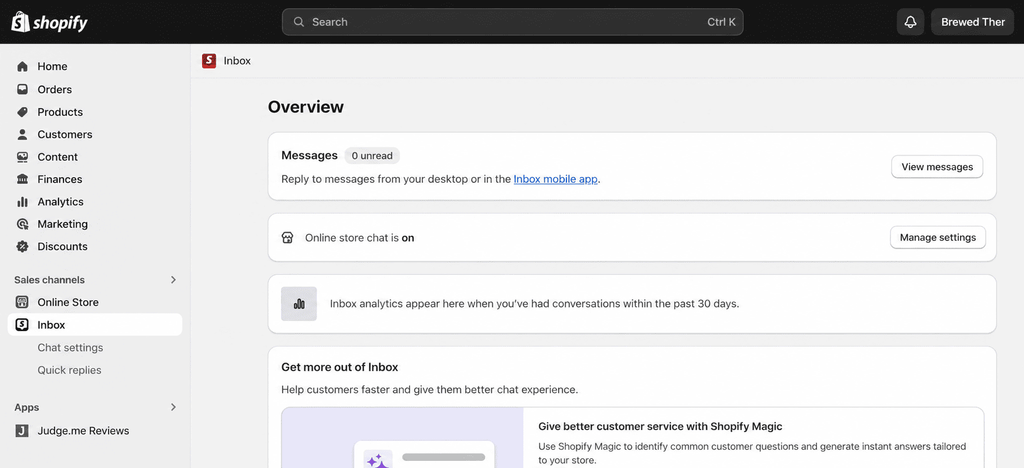
Shopify Inbox currently holds a 4.6 rating on the Shopify App Store, though recent reviews confirm the pattern. A Twist Of Date, a UK merchant on the app for three-plus years, left a 1-star review saying a September 2026 update broke the chat experience and dropped contact “close to zero.” Nextlaunch, a US merchant, left a 3-star review saying Inbox should connect to “Email, SMS, WhatsApp” instead of standing alone.
These limitations do not make Shopify Inbox a poor choice. For all stores that mainly need simple website chat, its free inclusion with Shopify makes it practical. Businesses usually begin considering alternatives when they need multichannel support, stronger team workflows, broader knowledge-base training, or AI that can move beyond suggesting replies and complete support actions directly.
The best Shopify Inbox alternatives differ in how deeply they handle automation, ecommerce actions, team workflows, and multichannel support. The seven platforms below are compared on features, limitations, pricing, and the type of Shopify store each one fits best.
YourGPT is a no-code AI platform that lets Shopify stores create agents using their product data, policies, and processes. The platform handles a critical problem for BFCM: customer conversations scattered across multiple channels. With omnichannel deployment, you run a single unified agent across web, WhatsApp, Slack, Instagram, Messenger, and other channels from one dashboard, ensuring consistent support no matter where customers reach out.
Unlike traditional chatbots that suggest replies for humans to review, YourGPT agents can resolve customer requests end-to-end, executing actions like order lookups, refunds, and account updates without additional steps. In production deployments, YourGPT’s Autonomous AI has achieved resolution rates above 90%, meaning the agent handles the majority of customer interactions without human escalation critical for managing BFCM traffic spikes without overwhelming your support team.
Best For: Stores that get customer messages across more than one channel and want the agent itself to resolve the request, all the way through, rather than hand a human a reply to review.
Gorgias is a customer experience platform built specifically for ecommerce, with native Shopify, BigCommerce, Magento, and WooCommerce integrations that pull order data straight into the ticket view. Support agents can issue refunds, edit orders, and apply discount codes without leaving a conversation, which is the single biggest functional gap between Gorgias and Shopify Inbox.
It bills per ticket rather than per seat, so adding team members costs nothing extra, though the AI Agent add-on is billed separately per resolution on top of the base ticket fee. Gorgias even publishes its own Shopify Inbox comparison page, a sign of how directly the two products compete for the same switching merchants.
Best For: Shopify-native brands with meaningful order volume that want refund and order actions built directly into the support workflow.
Tidio combines a live chat widget with the Lyro AI chatbot and a lightweight helpdesk, and it remains one of the faster tools to set up on a Shopify or WooCommerce store. The free plan is genuinely usable for very small stores, covering 50 conversations and up to 10 seats before a paid tier becomes necessary.
The catch shows up further up the ladder. Growth tops out around $59 a month, and the next plan up jumps to roughly $749 a month with no tier in between, a gap worth planning around before committing.
Best For: Small or early-stage stores that want a familiar live chat and chatbot combination without a steep learning curve.
Richpanel splits its product into two pieces sold separately: an agent-facing helpdesk and a customer-facing self-service portal that deflects tickets before they ever reach a human. That split is also its main complexity. Teams pay a per-agent fee for the helpdesk and a second, order-volume-based fee for the portal, plus additional costs for AI features and channel add-ons like WhatsApp or voice.
Richpanel actively markets itself to teams migrating off Gorgias or Zendesk, including contract buyout offers, which signals exactly which audience it is built to win over.
Best For: Teams already running Gorgias or Zendesk that want self-service deflection sold as its own dedicated product.
Re:amaze, owned by GoDaddy since 2021, brings email, live chat, social messaging, and SMS into one inbox with straightforward per-agent pricing. Three tiers scale by feature depth rather than conversation volume: Basic covers the core inbox, Pro adds multi-brand support plus SMS and voice through Twilio, and Plus adds department routing and staff performance reporting.
A flat-rate Starter plan also exists for teams that want unlimited seats but stay under 500 conversations a month, useful for stores where founders or warehouse staff need occasional inbox access without a full per-seat cost.
Best For: Small teams of two to five agents that want predictable per-seat cost across several channels without heavy automation depth.
Kustomer takes a different structural approach than every other tool on this list. Instead of a ticket queue, it builds a single Conversation Timeline per customer, pulling order history, past conversations, and account context into one continuous view.
That CRM-first design suits high-volume B2C operations well, but the pricing and structure make it a poor first stop for a store simply outgrowing Shopify Inbox. There is no published self-serve pricing, no monthly billing option, and an 8-seat minimum before a quote is even possible.
Best For: Larger, established B2C operations already running an 8-plus agent support team that want a CRM-style timeline built into daily work.
Help Scout is built around email-first support and a shared inbox, with a clean interface that consistently earns praise in reviews for being simple to learn. It pairs the inbox with Docs, a self-service knowledge base, and AI Answers, an add-on that resolves repetitive questions automatically. What it does not have is a native Shopify sidebar.
Order data, refunds, and product lookups have to come through third-party connectors rather than a built-in integration, which puts a ceiling on how much ecommerce-specific action can happen inside a single conversation.
Best For: Teams whose support volume is mostly email-driven and who value a simple shared inbox over deep ecommerce-specific order actions.
| Platform | AI Powered | Instagram / Social | Multilingual | Shopify / Ecommerce | Order Actions | Knowledge Base | Human Handoff | Team Collaboration | Automation / API Actions | Voice | ||
|---|---|---|---|---|---|---|---|---|---|---|---|---|
| YourGPT | ✓ AI agents + workflows | ✓ | ✓ | ✓ Instagram, Messenger & more | ✓ 100+ languages | ✓ Shopify + ecommerce integrations | ✓ Via APIs and AI Studio workflows | ✓ Websites, PDFs, docs, FAQs & more | ✓ Full context preserved | ✓ Shared inbox and agent handoff | ✓ No-code workflows, APIs, webhooks, JS & Python | ✓ Phone AI agents |
| Gorgias | ✓ AI Agent | ✓ | ✓ | ✓ Social messaging | ✓ | ✓ Strong Shopify focus | ✓ Refunds, cancellations and edits | ✓ Help center and support content | ✓ | ✓ Assignment, macros and rules | ✓ Rules, macros and ecommerce actions | Limited / add-on dependent |
| Tidio | ✓ Lyro AI | ✓ | Via integrations | ✓ Social channels | ✓ | ✓ Shopify & WooCommerce | Limited | ✓ AI knowledge sources | ✓ | ✓ Shared inbox and agent assignment | ✓ Visual automation flows | — |
| Richpanel | ✓ AI features | ✓ | ✓ Add-on | ✓ Social messaging | ✓ | ✓ Shopify & WooCommerce | ✓ Ecommerce support workflows | ✓ Self-service portal | ✓ | ✓ Routing, assignment and CSAT | ✓ Automation and self-service workflows | Available as add-on |
| Re:amaze | ✓ Chatbot + automation | ✓ | Via messaging integrations | ✓ Social messaging | ✓ | ✓ Shopify, WooCommerce & BigCommerce | ✓ Ecommerce workflows | ✓ FAQ and help content | ✓ | ✓ Shared inbox and team assignment | ✓ Workflow automation | ✓ Via Twilio on higher tiers |
| Kustomer | ✓ AI Agents | ✓ | ✓ | ✓ Messaging channels | ✓ | ✓ Ecommerce integrations | Integration dependent | ✓ Customer and support knowledge | ✓ | ✓ Routing and CRM-style collaboration | ✓ Workflow and CRM automation | ✓ |
| Help Scout | ✓ AI Answers | ✓ Strong focus | Integration dependent | Limited | ✓ | Via third-party Shopify connections | Limited / integration dependent | ✓ Docs knowledge base | ✓ | ✓ Shared inbox, notes and assignments | ✓ Workflows and integrations | — |
Start with YourGPT for stores that want automation to take real action, not just answer faster. Use Gorgias or Re:amaze for ecommerce-native ticketing, or match a niche pick above to a specific migration reason.
Replacing Shopify Inbox is less about finding the tool with the longest feature list and more about matching the billing model and channel coverage to how the store actually receives customer messages.
1. Match the billing model to the actual volume pattern. Ticket-based tools like Gorgias reward steady volume and punish spikes. Seat-based tools like Re:amaze and Kustomer reward small, stable teams and punish fast headcount growth. Knowing which pattern a store fits changes which pricing model saves money.
2. Confirm real order actions are included. Seeing a customer’s order inside a conversation is one thing. Being able to refund it, edit it, or cancel it without switching to the Shopify admin is a different capability entirely, and worth testing directly rather than assuming. Gorgias, Richpanel, and YourGPT all support real actions. Help Scout mostly does not without extra connectors.
3. Count the channels customers already use. A store fielding messages only through the storefront widget may not need to move off Inbox at all. One receiving WhatsApp, Instagram, and email inquiries alongside web chat needs a platform built for that from the start, which is where tools compared in this live chat roundup tend to separate from single-channel options.
4. Treat AI as a separate line item. Almost every tool on this list bills its AI feature (Lyro, AI Agent, AI Answers, AI Agents for Customers) apart from the base plan. Budgeting for the base plan alone consistently understates the real monthly cost once automation is switched on.
5. Check what a free trial actually requires. A 7-day trial with no credit card, like YourGPT’s, is a lower-commitment way to test real conversation quality on a live store than a sales-gated demo, which is the model Kustomer and Richpanel’s higher tiers use instead.
Teams weighing a broader platform switch, beyond a single point tool, especially ones already comparing suite-level options like Intercom alternatives or other customer engagement platforms, will find most of the same trade-offs apply. The billing model and channel coverage matter more than the logo on the pricing page.
Yes. Shopify Inbox ships with every Shopify plan at no extra cost, including AI-suggested replies drawn from store content. The real trade-off shows up in scope. It covers web chat only, with no native support for WhatsApp, Instagram, or a shared team queue.
Tidio and Re:amaze both fit small teams well, Tidio for its free tier and quick setup, and Re:amaze for predictable flat per-agent pricing. YourGPT is also a strong fit for small stores that specifically want AI handling more than basic replies, given its 7-day free trial with no credit card required.
YourGPT deploys the same AI agent across WhatsApp, Instagram, Messenger, Telegram, Slack, Line, email, and web chat from a single dashboard. Gorgias and Re:amaze also cover social channels, though with less automation depth on the messaging side than a dedicated AI agent platform.
Gorgias, Richpanel, Re:amaze, and YourGPT all support real order actions like refunds and order edits without leaving the conversation. Help Scout and Kustomer generally require a connected app or a separate step in the Shopify admin for the same actions.
It depends heavily on the billing model. A small team might spend as little as $29 to $59 a month on Tidio or Re:amaze’s entry tiers, while a higher-volume Shopify store running Gorgias or Kustomer with AI features switched on can realistically land in the hundreds to low thousands per month. Checking each vendor’s current pricing page against actual conversation volume before committing is worth the extra ten minutes.
YourGPT is built as a broader AI agent platform for support, sales, and operations rather than a helpdesk with an AI feature bolted on. The same agent that answers a Shopify order question can also qualify a lead or trigger an internal workflow using AI Studio’s conditional logic and API calls, which is a different scope than a ticket-focused tool like Gorgias or Help Scout is built to cover.
None of these seven tools is a strict upgrade over Shopify Inbox in every direction. Each one solves a specific reason merchants outgrow the free version: channel gaps, order-action depth, team size, or unpredictable per-seat costs. The tool worth trialing first depends on which of those four hit first.
For stores where the trigger was customers messaging on channels Inbox never covered, WhatsApp threads, Instagram DMs, emails that never made it into the chat widget, YourGPT is built specifically to close that gap with one agent that takes real action across every channel at once. The 7-day free trial requires no credit card, which makes it a low-friction way to connect a live Shopify store and test resolution quality before deciding on anything longer term.
Automate product questions, order updates, recommendations, and customer support across your Shopify store and multiple channels.


Compare six Yuma alternatives by ecommerce capabilities, helpdesk compatibility, pricing and human handoffs to choose a replacement for your support team.


Move from Gorgias with a verified ticket archive, tested AI workflows, human handoff and a channel cutover plan before ending your subscription.


TL;DR The Gorgias AI Agent is the automation layer inside the Gorgias helpdesk, split between a Shopping Assistant for pre-purchase conversations and a Support Agent for post-purchase support. A connected Shopify store is required, and Gorgias documentation rules out platforms such as BigCommerce, Magento, and WooCommerce for the AI Agent. Billing runs on two separate […]

TL;DR Gorgias is the closest Richpanel alternative for Shopify stores that need native order actions directly inside support tickets. YourGPT fits stores that want one AI agent handling requests across web, WhatsApp, Instagram, and email, while Tidio and Re:amaze suit smaller teams looking for lighter, lower-cost options. Richpanel’s AI pricing starts around $500/month for two […]

TL;DR Tidio recently restructured its top paid plan, and many 2026 reviews still describe the old pricing model. Confirm current pricing directly on Tidio’s site before budgeting. Lyro, Tidio’s AI agent, runs on Anthropic’s Claude rather than ChatGPT. Only the Premium tier carries a guaranteed resolution rate, well below the average Tidio advertises elsewhere. Billing […]
TL;DR Drift’s situation goes well past “post-acquisition.” Clari and Salesloft announced a formal sunset after a major OAuth breach pushed Drift offline for weeks. Two of the other usual “alternatives” are getting bought too. Salesforce closed its acquisition of Qualified and signed a deal to acquire Intercom, now Fin. The real split is budget and […]