Gorgias AI Agent Review 2026: Pricing, Pros & Cons

Rajni
September 7, 2026
The Gorgias AI Agent is the automation layer inside the Gorgias helpdesk, split between a Shopping Assistant for pre-purchase conversations and a Support Agent for post-purchase support.
A connected Shopify store is required, and Gorgias documentation rules out platforms such as BigCommerce, Magento, and WooCommerce for the AI Agent.
Billing runs on two separate meters, so a conversation resolved entirely by AI can carry both a ticket fee and an automated-interaction fee.
Gorgias markets a high automation ceiling, but the results shown in its own customer stories tend to sit below that maximum.
The Gorgias AI Agent is the AI built into the Gorgias helpdesk. It replies to customers on chat and email, and it can carry out order tasks on its own, like tracking a package, starting a return, cancelling an order, or changing a subscription. For a Shopify brand that is a genuine step up, because the agent reads live store data and completes the task instead of pointing at a help article and hoping.
The cost is where it gets complicated. Gorgias charges for the helpdesk and for the AI on two separate meters, and one kind of conversation gets billed on both. The automation rate deserves a second look too, because the figure in the marketing sits above the figures in Gorgias’ own customer stories.
This review covers all of it. What the agent does, what it really costs, how much it automates once live, and what verified reviewers report after the trial ends.
Gorgias is the ecommerce-native helpdesk that most Shopify brands consider first, and the AI Agent is the automation product that sits inside it. Gorgias positions it as an agent purpose-built for ecommerce, trained on commerce scenarios and not adapted from a general-purpose support bot.
It ships as two halves of one product.
The distinction matters for billing, because the two halves carry different overage rates.
Summer 2026 release. AI Agent 3.0 rebuilt Gorgias’ resolution engine and introduced several new capabilities that matter when evaluating the platform for customer support automation.
Gaia. Gaia is a coaching agent that audits the AI Agent’s setup, identifies knowledge gaps, flags contradictions across the knowledge base, and drafts corrections for approval. Gaia is free during its open beta, while post-beta pricing has not yet been announced.
Skills. Skills define how the AI Agent should respond, which actions it should take, and when it should hand a conversation to a human for each request type. This helps keep workflows such as returns and warranty claims consistent even when customers phrase the same request differently.
Messenger and Instagram DMs. AI Agent 3.0 extends automation into Messenger and Instagram direct messages, while carrying conversation context across email, chat, SMS, and supported social channels.
Vision. The agent can interpret photos shoppers send through chat and use that visual information to answer the request directly instead of automatically escalating it to a human agent.
Knowledge, actions, and guardrails are all configured in one place. The list below covers the pieces that decide how much the agent handles alone and when it steps back to a human.
Gorgias prices the helpdesk and the AI Agent as two line items on a single bill. The helpdesk bills per ticket and never per agent seat. The AI Agent adds a monthly fee that bundles a set number of automated interactions, with anything past that bundle billed per interaction.
Because this review is about the AI Agent, the table below shows the combined price with AI Agent switched on, which is what the pricing page displays when the Add AI Agent toggle is active. It covers the annual plans only.
| Plan | Price with AI Agent | Billed Annually | Tickets Included | Automated Interactions Included | Past the Limit |
|---|---|---|---|---|---|
| Basic | $77/mo | $924/year | 300 | 30 |
$0.40 per ticket $1.50 per automated interaction |
| Pro | $471/mo | $5,652/year | 2,000 | 190 |
$0.36 per ticket $1.50 per automated interaction |
| Advanced | $1,227/mo | $14,724/year | 5,000 | 530 |
$0.36 per ticket $1.50 per automated interaction |
One thing stands out in that table. The included interaction bundles are small against the ticket allowances they sit beside, landing near 10% on all three plans.
That gap deserves arithmetic. Pro includes 2,000 tickets and 190 automated interactions. Hitting the marketed 60% automation rate on that plan would mean 1,200 automated interactions, so 1,010 past the bundle at $1.50 each adds $1,515 a month. The marketing number and the bundle sizes point in opposite directions.
There are no seat fees, no per-message charges, and no token-based billing. That part of the model is clean.
The detail that catches teams out is this one, and it needs stating precisely because the marketing page and the billing docs read differently at a glance.
Gorgias’ billing documentation sets out three cases.
The double charge lands on exactly the outcome a brand is paying for. The better the automation performs, the more often both meters run. Gorgias’ AI Agent page says a handed-over conversation is not charged twice, which is true of case two only and reads like a blanket denial.
Two mechanics belong in any cost model. An interaction counts as automated only if no human is needed within 72 hours, so reporting settles on a delay. And accounts created before 28 May 2025 that never subscribed to AI Agent and upgraded to Shopping Assistant skills stay on legacy pricing, where a ticket counts toward one meter or the other, never both.
A worked example. Pro on annual billing costs $471 a month for 2,000 tickets and 190 automated interactions. At 3,000 billable conversations with 800 resolved by the agent, the 1,000 extra tickets add $360 and the 610 extra interactions add $915. The month lands near $1,746, close to four times the headline.
Gorgias earns its reputation for a specific, checkable set of reasons.
Most of the friction here is structural. The first three items decide whether Gorgias fits a business at all, before budget enters the conversation.
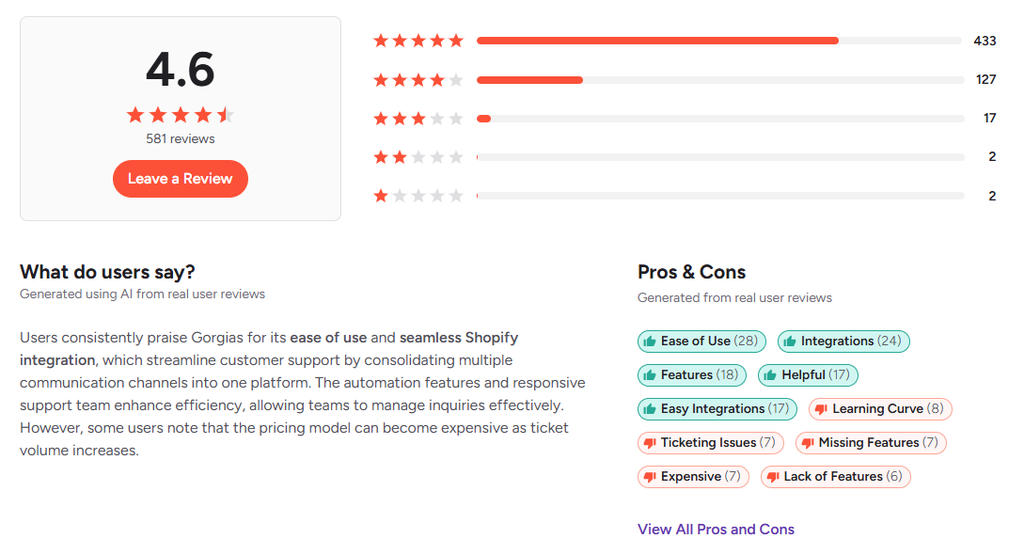
Gorgias holds 4.6 out of 5 on G2 and 4.6 out of 5 on Capterra across 135 reviews, with Ease of Use at 4.6 and the other categories at 4.5. The pool matters before generalizing. Capterra reports that 88% of reviewers come from small businesses, and many reviews are marked incentivized, so that score says more about small Shopify brands than enterprise or B2B deployments.
Praise concentrates on the Shopify integration, ticket-based pricing, and a short learning curve. The criticism is just as consistent. A March 2026 Capterra reviewer flagged that promoted features often turn out to be Shopify-only, and called the AI Agent’s email-per-store setup awkward for multi-store businesses. An August 2026 reviewer found AI suggestions helpful but frequently in need of edits before sending. Reporting depth and UI clutter recur across both years.
This review draws on Gorgias’ own live pricing page, help center, security FAQ, changelog, and published customer stories, cross-checked against recent independent pricing breakdowns. A hands-on trial account wasn’t part of this process.
The Gorgias AI Agent fits a specific profile well. A Shopify-native brand, with a ticket mix heavy on order actions, and someone available to own the configuration. Outside that profile, a few alternatives come up repeatedly.
| If Your Priority Is | Choose | Why |
|---|---|---|
| Running agents beyond Shopify, on one cost meter | YourGPT | No storefront lock-in, usage-based AI Credits with no seat fees or separate resolution meter, and voice agents that answer inbound calls |
| Deepest native Shopify actions inside the ticket | Gorgias | Order edits, refunds, and subscription changes run natively on live store data |
| Enterprise ticketing with deep customization and reporting | Zendesk | Mature automation and the largest integration marketplace in the category |
| Messaging-first support tied to product onboarding | Intercom Fin | In-app engagement built directly into the support layer |
| Shopify-native depth without Gorgias’ billing structure | Richpanel or Siena | Ecommerce-focused agents in the same lane, with simpler pricing structures |
| Area | Gorgias | YourGPT |
|---|---|---|
| Core approach | Ecommerce helpdesk + AI | AI agent platform |
| Best fit | Shopify-first support teams | Support, sales and operations |
| Shopify | Deep native focus | Deep native focus |
| WooCommerce | Helpdesk integration, AI Agent limitations noted in this review | Deep native focus |
| BigCommerce | Supported | Supported |
| Website | Yes | Yes |
| Yes | Yes | |
| Yes | Yes | |
| Voice | Voice support is separate from autonomous AI resolution | AI voice agents |
| Business systems | Strong ecommerce integrations | APIs, CRM, helpdesk, ecommerce and custom systems |
| AI models | Gorgias-managed model stack | Multiple model options |
| AI pricing | Subscription + outcome + seat | AI credits |
| Per-resolution fee | Yes, under the model described in this review | No separate per-resolution charge |
| Self-learning | Gaia focuses on improving AI setup and knowledge | Self-learning is part of the agent platform |
| Multi-agent workflows | No | Built around agent and workflow orchestration |
| Best reason to choose | Shopify support depth | Broader agent deployment and automation |
This comparison highlights how Gorgias and YourGPT differ across ecommerce depth, channels, pricing, and automation architecture but it’s just a snapshot. If you’re evaluating tools beyond these two, or want a broader look at where Gorgias falls short for different use cases, check out our full breakdown: Top 7 Gorgias Alternatives & Competitors
No. Gorgias documentation states the AI Agent requires a connected Shopify store and is not supported on BigCommerce, Magento, or WooCommerce. Merchants on those platforms can still use the Gorgias helpdesk with read-only store visibility, but the automation that Gorgias markets is unavailable to them.
The AI Agent is bundled into each helpdesk plan as a second line item. On annual billing, Basic runs $77 a month with 30 automated interactions included, Pro runs $471 with 190, and Advanced runs $1,227 with 530. Anything past the bundle bills at $1.50 per automated interaction, on top of per-ticket overage at $0.36 to $0.40. The plan price is rarely the real monthly cost once automation is switched on.
Gorgias runs two meters. When the AI Agent resolves a conversation with no human handover, it draws both a ticket fee and an automated-interaction fee on the same conversation. If the agent hands over to a person, only the ticket fee applies. The double charge lands on the exact outcome a brand is paying for, so it belongs in any cost model before signing.
Gorgias markets a 60% automation ceiling, but its own customer stories land lower. Orthofeet reached 56% of support tickets in under two months, while Psycho Bunny reported 26%, concentrated on straightforward FAQs. Planning on 25% to 30% in the first year, with room to climb, avoids the most common budgeting mistake.
Answers come only from connected knowledge sources, and the agent declines when it finds nothing relevant. Every draft passes through a second AI model that scores confidence and blocks anything below threshold. Exclusion and handover topics keep it away from medical, legal, or regulated subjects, and every sent answer is viewable alongside the sources it drew from. Gorgias states plainly that it cannot guarantee zero errors.
Gaia is a coaching agent built into Gorgias that audits the AI Agent’s setup, flags duplicated or missing knowledge, and drafts corrections for a human to approve. It is free during the open beta and available on every account. Post-beta pricing has not been announced.
YourGPT is the usual pick for teams running agents across more than one storefront platform or wanting cost on a single meter. It deploys on Shopify, WooCommerce, BigCommerce, and most site builders, plus WhatsApp, Instagram, Slack, and native mobile SDKs, with plans from $39 to $349 a month on annual billing and no per-message or separate resolution charges. Zendesk suits enterprise ticketing with dedicated ops staff, Intercom Fin suits messaging-first product teams, and Richpanel or Siena stay in the Shopify-native lane with simpler billing.
Yes, if you are enterprise Shopify-first and your main objective is to automate ecommerce support inside an existing helpdesk.
Gorgias has a real advantage when the work involves order data, returns, refunds, subscriptions, and other ecommerce workflows. Its AI Agent is not just an FAQ layer, and that makes it substantially more useful than a basic support chatbot.
But that is also the boundary of the product.
If you are building a broader AI automation strategy, the question becomes bigger than support. You may want one agent architecture across your website, WhatsApp, Instagram, email, voice, CRM, ecommerce platform, and internal systems.
That is where YourGPT takes a different approach. Instead of treating AI as an automation layer inside a helpdesk, it treats the AI agent as the automation layer itself.
Verdict: Gorgias is a strong Shopify-first AI helpdesk. YourGPT is the stronger fit when you want AI agents to move beyond support and actually operate across your business.
Choose Halloween ecommerce campaigns that fit your products, with AI agent workflows, offer worksheets, launch tests and order measurement.
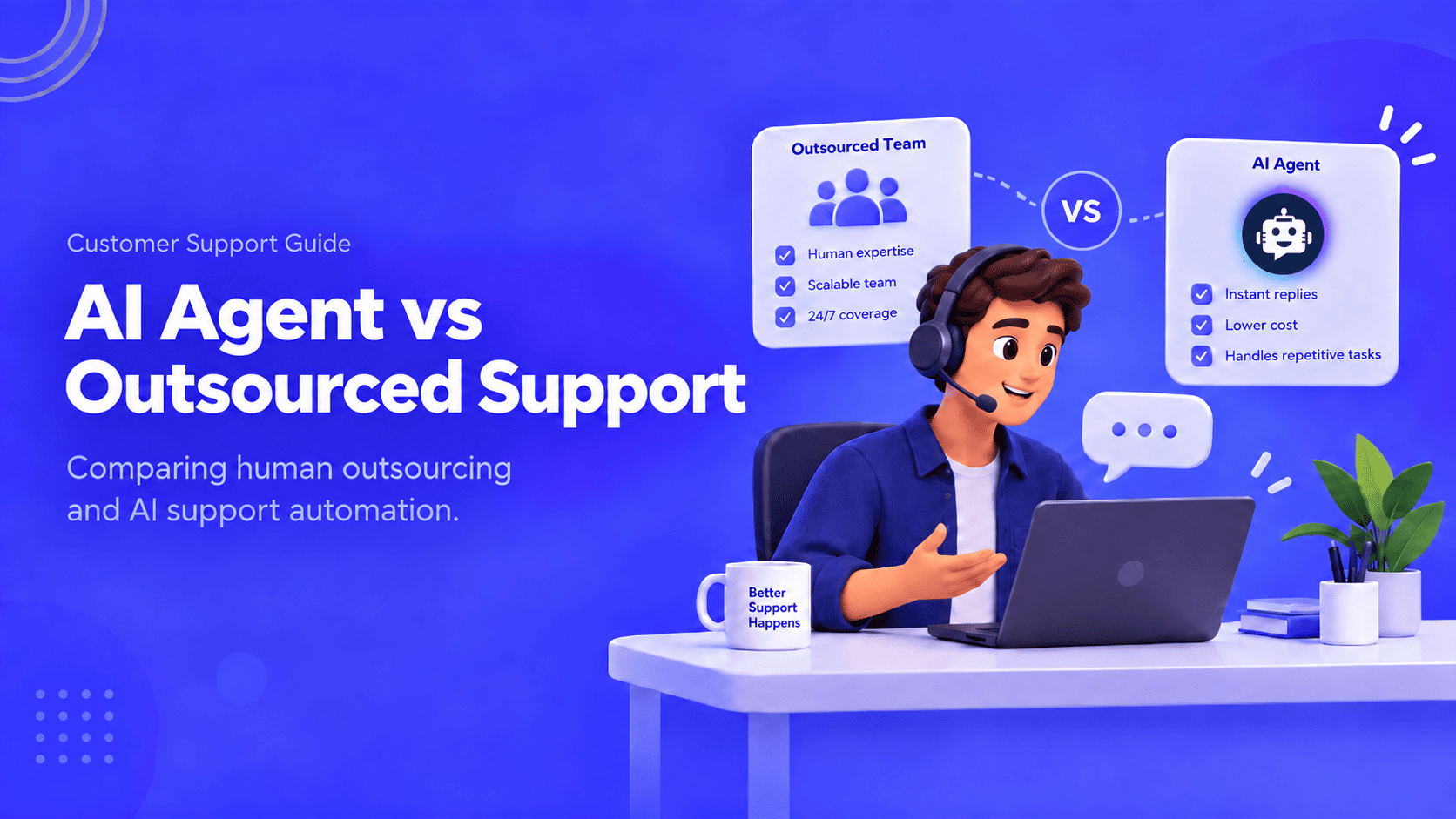
Compare outsourcing customer service with an AI agent using your own ticket mix, a cost model you fill in, and a clear rule for a hybrid split.
Export the Zendesk ticket archive, train an AI Agent on the help center, and test one real ticket before you stop the old queue.


Compare six Yuma alternatives by ecommerce capabilities, helpdesk compatibility, pricing and human handoffs to choose a replacement for your support team.


Move from Gorgias with a verified ticket archive, tested AI workflows, human handoff and a channel cutover plan before ending your subscription.

TL;DR Gorgias is the closest Richpanel alternative for Shopify stores that need native order actions directly inside support tickets. YourGPT fits stores that want one AI agent handling requests across web, WhatsApp, Instagram, and email, while Tidio and Re:amaze suit smaller teams looking for lighter, lower-cost options. Richpanel’s AI pricing starts around $500/month for two […]