Build vs Buy AI Agents: The Mistake That Costs Teams 6 Months

Rajni
Last updated on April 17, 2026
Two teams started building AI agents around the same time.
One spent months stitching together LangGraph, internal APIs, a vector database, and an evaluation pipeline. The prototype worked. Production exposed the gaps. Retries created duplicate records. Failures were hard to trace. The launch kept slipping.
The other shipped in weeks using a no-code agent platform connected to its CRM and Slack. It was simpler. It was live. It improved through real usage.
Same goal. Different outcome.
Most teams assume they need to build. That is where the delay starts.
In 2026, the question isn’t if a team can build an AI agent. Most can. What actually matters is how quickly they can get it to work reliably once it’s out in the real world.
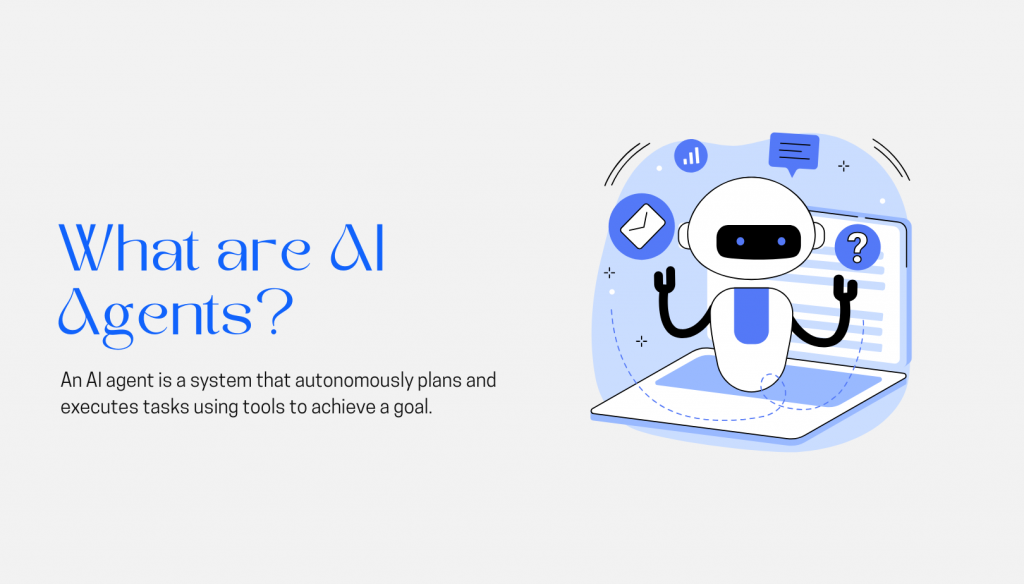
Before making a build vs buy decision, you need a clear picture of what you are actually building or buying.
An AI agent in 2026 is not a chatbot with a few API calls attached. It is a system that combines reasoning, memory, tools, and coordination capabilities. Each layer introduces real engineering complexity, and together they form the full agent stack.
The reasoning loop is the core of how an agent operates. The system receives a task, decides what action or tool to use, executes it, observes the result, and repeats until the task is completed or a stopping condition is reached. This is commonly referred to as a ReAct (Reasoning + Acting) loop.
Different frameworks implement this in different ways. LangGraph represents execution as a stateful graph where nodes are actions and edges define transitions, making control flow explicit but requiring upfront design. CrewAI organizes agents into roles that collaborate and delegate tasks, which works well for structured multi-step workflows. AutoGen uses a conversation-based model where agents exchange structured messages and dynamically assign responsibilities. Each approach trades off between control, flexibility, and debugging complexity.
Memory in agents operates at two levels. Working memory holds the immediate context of a single execution, including the task, tool outputs, and intermediate reasoning steps. Long-term memory stores information across sessions, usually using vector databases like Pinecone, Weaviate, or pgvector to retrieve relevant context.
Without both layers functioning correctly, agents tend to repeat actions, lose context mid-process, or generate outputs that contradict earlier steps.
Tools allow agents to interact with external systems such as APIs, databases, and internal services. In 2026, the Model Context Protocol (MCP), introduced by Anthropic in late 2024, has become a key standard for tool integration.
MCP defines a client-server model where agents (hosts) connect to tool servers that expose capabilities like APIs, data access, or prompts. The key advantage is reuse: once a tool server is built in an MCP-compatible format, it can be connected to multiple agents without rewriting integrations for each system. This reduces but does not eliminate integration work, especially for complex or legacy systems.
Multi-agent coordination is still evolving. The Agent-to-Agent (A2A) protocol introduced by Google in 2025 defines a standard for how agents can discover each other and delegate tasks across systems.
In practice, however, most production systems still rely on framework-native coordination rather than cross-framework communication. Tools like LangGraph and CrewAI handle multi-agent orchestration internally, which is currently more stable and predictable than relying on external agent-to-agent interoperability.
Evaluation is one of the most critical and often underbuilt parts of agent systems. In 2026, two main approaches are commonly used.
Trajectory evaluation focuses on the full execution path, not just the final output. It checks whether each step and tool call in the process was necessary and correct. This is important because a correct final answer can still come from an inefficient or incorrect sequence of actions.
LLM-as-judge uses a separate model to evaluate outputs at scale. It is useful for production monitoring, but requires careful calibration. Without alignment to human-reviewed examples, it can introduce bias toward longer or more confident responses rather than truly correct ones.
This stack is not simple. Each layer, reasoning, memory, tools, collaboration, and evaluation, introduces its own set of design choices and tradeoffs.
The real question is not whether it can be built, but whether it should be built given the time, cost, and operational complexity involved.
Most teams make the build vs buy call based on what they see in a demo or prototype. That’s misleading. Things change the moment you hit real traffic. The decision starts to depend less on what’s possible, and more on how fast you can get something working, what it costs to keep it running, and how much complexity your team can actually handle without slowing down.
In 2026, this is not a clean either-or decision. It sits on a spectrum. The comparison below breaks down how different approaches hold up when you move from demo to production.
This comparison reflects where complexity is handled across different approaches and how that impacts production behavior at scale.
Most teams underestimate the complexity of AI agents in production. A project that looks like a few days or weeks of work often stretches into months. The delay is rarely caused by the agent itself. The time is consumed by the infrastructure required to make it survive in production.
Here is why the timeline expands:
The reason timelines stretch to six months or more is not because one thing is hard. It is because all of these layers show up gradually, each one exposing gaps in the previous one. What starts as a simple build turns into ongoing system work across integrations, state, evaluation, and reliability.
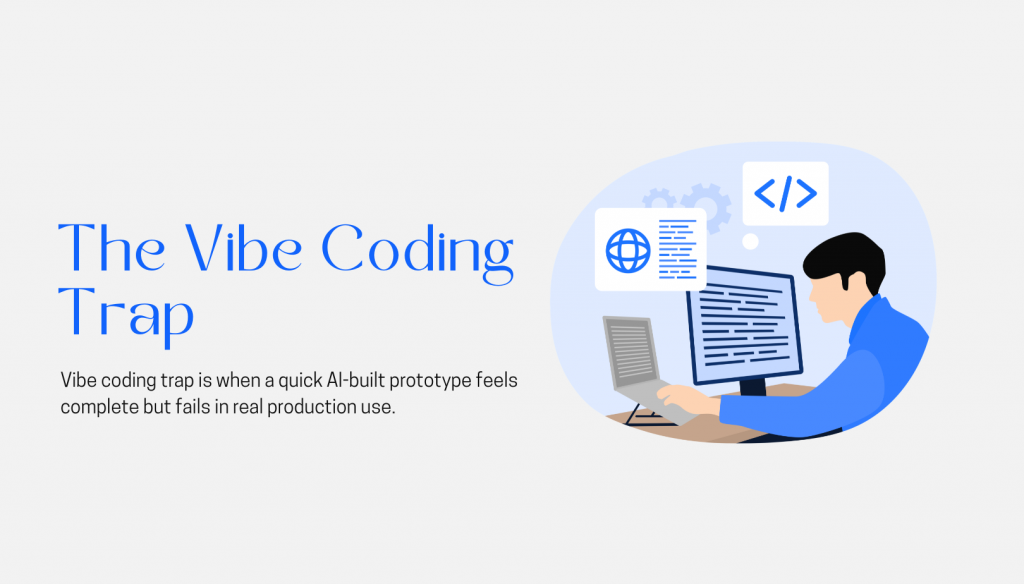
There is a specific moment where many teams make a critical mistake, often before writing a single line of production code.
A requirements prompt is dropped into Cursor or Claude Code. Within minutes, a working agent appears. Tool calls are connected, a basic loop runs, and the output looks reasonable. Someone says, “this is basically done.” That moment is where the six-month delay often begins.Vibe coding is useful, but only for rapid validation. It helps test whether a workflow makes sense, how tools interact, and where obvious model failures appear before real engineering effort begins. It turns ideas into working drafts quickly, which is valuable.
Production failure is not caused by model quality alone, but by the absence of system-level engineering around reliability, control, and visibility.
For most SMBs in 2026, the practical starting point is not building from scratch but adopting a buy or hybrid approach, especially when AI agents are not the core product. The goal is to reach production quickly and learn from real usage rather than committing early to a complex system design.
Overall, buy or hybrid works best as a starting point because it prioritizes real-world validation over upfront complexity, allowing teams to decide later where custom builds are actually justified.
Most teams don’t fail because they misunderstand the options. They fail because they commit to an approach before they have any real production evidence to base it on. The right call depends on how much complexity your team can realistically own, not just during the build but months after launch when things break in ways nobody anticipated.
Build when:
Buy when:
A Note on Fast Prototypes
How to Decide
Build when control over logic is a core part of your product and directly impacts outcomes. Buy when speed and reliability matter more than designing the system yourself. Hybrid works when you need both quick delivery and control over specific parts of the workflow. Most teams start with buy or hybrid and move to custom builds only where real usage shows clear need.
The build vs buy decision looks different in 2026 compared to even a year or two ago. A few changes in the ecosystem have reduced the need to build everything from scratch, while also making hybrid approaches more practical.
These shifts don’t remove the need to make tradeoffs. They change where those tradeoffs show up, and make it easier to avoid unnecessary complexity early on.
The six-month trap does not come from choosing the wrong framework. It comes from treating an architectural decision as final before you have production evidence to inform it.
In 2026, the no-code and hybrid options are capable enough for the majority of enterprise and SMB agent use cases. MCP standardization has reduced the integration work required to connect agents to business systems. Managed evaluation and observability tooling has removed some of the most time-consuming infrastructure work from the custom build path. The surface area where a full custom build is genuinely justified has narrowed.
Build when the agent’s reasoning or decision logic is a real competitive moat, when compliance requirements make third-party platforms non-viable, and when you have the engineering capacity to own the full stack over the long term. In every other case, start with a platform or a hybrid approach, get to production, and let real usage data tell you where custom logic is actually necessary.
The teams shipping reliable production agents in 2026 are not the ones who designed the most complete architecture upfront. They are the ones who got to real users first, measured what actually happened, and adjusted from there.
Tier 1 support handles first contact. See how Tiers 0 to 3 differ and what changes when an AI agent becomes your first line.
The 12 customer service metrics to track when an AI agent resolves tickets, with a formula for each and a baseline built from your own last month.

Calculate cost per ticket with one formula and a free calculator, then compare it with the cost of a conversation an AI agent resolves.
Omnichannel support means every channel answers from the same knowledge. Train one AI agent, pick your first channel, and test that answers match.
Self-learning AI agents log the questions they miss. Learn how human review turns those gaps into trained answers and how to run the weekly loop.
Train an AI agent on your return policy, connect the Shopify template in AI Studio to check real orders, and route exceptions to your team.