Best WordPress Chatbots in 2026: Top 7 AI Chatbot Plugins Compared

Rajni
Last updated on August 24, 2026
The best WordPress chatbot in 2026 depends on your needs. YourGPT is ideal for AI support, sales automation, WooCommerce assistance, omnichannel messaging, and human handoff.
Tidio and WPBot suit simpler chatbot setups, while Intercom and IBM Watson Assistant are better for larger teams and enterprise use cases.
Every WordPress site owner faces a common problem. You want to respond to visitors, answer their questions, and convert them into customers. But being available all the time is not realistic, and replying manually to every message soon becomes unmanageable.
WordPress chatbots have improved from basic tools with fixed replies to intelligent assistants that can understand context and guide users through real interactions. They can respond instantly, manage routine questions, and support sales or service operations without human involvement.
The real challenge appears when you search for the right one. There are hundreds of chatbot plugins claiming to improve engagement or automate support. Some provide advanced features but need technical setup. Others are easy to install but limited in capability. And pricing often varies between free plans with few functions and paid versions that cost more than expected.
This blog compares the 7 best WordPress chatbots in 2026 based on performance, setup, pricing, and suitability for different types of websites. Whether you run an online store, a membership site, or a SaaS product, this comparison will help you select the chatbot that fits your goals.
Before comparing the top plugins, it helps to understand what makes a chatbot effective. A well-built chatbot should not only respond to visitors but also fit into your broader business workflow.
Important features to consider:
A strong WordPress chatbot balances intelligence, usability, and reliability, creating consistent value for both users and teams.
Different WordPress sites need different chatbot setups. A blog does not need the same system as a WooCommerce store, and a small service website does not need the same platform as a support-heavy SaaS company.
| Plugin name | Best for | Starting price |
|---|---|---|
| YourGPT | AI support and sales automation, omnichannel messaging, and WooCommerce assistance. | Starts at $39/month, billed annually |
| Tidio | Small ecommerce stores that need live chat, chatbot templates, and simple automation. | Paid plans from around $24/month, billed annually |
| WPBot | Basic chatbot builder for WordPress site owners. | Free version available; paid plans from around $49/year |
| Intercom | Advanced customer messaging, AI support, product engagement, and larger support teams. | Starts around $29/seat/month, with Fin AI priced separately |
| Crisp | Live chat and customer communication management. | Free plan available; paid plans from around €45/month |
| WotNot | No-code chatbot building for lead generation, qualification, and guided conversations. | Paid plans from around $29/month |
| IBM Watson Assistant | Enterprise-grade AI assistant deployments with advanced control, security, and compliance needs. | Paid plans from around $140/month |
Pricing can change over time. Always check each vendor’s official pricing page before making a final decision.
If you only need a simple chat widget, start with a lightweight plugin. If your WordPress site needs customer support automation, WooCommerce support, lead routing, omnichannel messaging, or workflow-connected AI, choose a platform with stronger automation and handoff capabilities.
Now that you know what to look for, let’s compare the top WordPress chatbot plugins available in 2026.
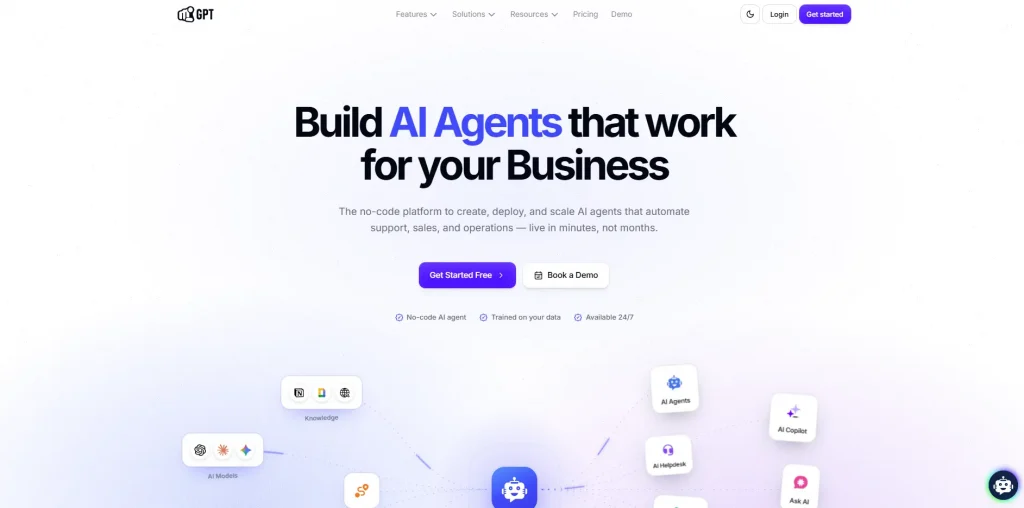
YourGPT is a no code AI platform designed for businesses that need to automate customer support, sales and business workflows. It brings together chat, voice capabilities, and workflow automation in a single system, helping online stores handle customer interactions more efficiently with AI first live chat without requiring technical expertise. It is trusted as top rated ecommerce chatbot.
YourGPT is best for WordPress businesses that want customer support & sales automation, omnichannel messaging, lead capture, and workflow-connected customer conversations. Suitable for online stores, D2C brand, agencies, service companies, and teams that manage customer conversations across several platforms.
Choose YourGPT if your chatbot needs to help resolve customer questions, support WooCommerce workflows, and connect conversations across multiple channels.
WordPress integration: Install the native WordPress plugin and connect your chatbot using the widget ID or website integration setup.
Pricing: Starting at $39/month (billed annually) | 7-day free trial
Discover how YourGPT AI chatbot can streamline your customer service

Tidio is a versatile WordPress chatbot plugin that blends AI automation with live chat capabilities, making it popular among small to medium-sized businesses. It’s particularly strong for businesses that want automation but still need human intervention for complex queries.
Small e-commerce stores using WooCommerce or Shopify, service-based businesses needing both automation and human chat, and budget-conscious businesses starting with chatbot automation.
Pricing: Free plan available | Paid plans from $19/month
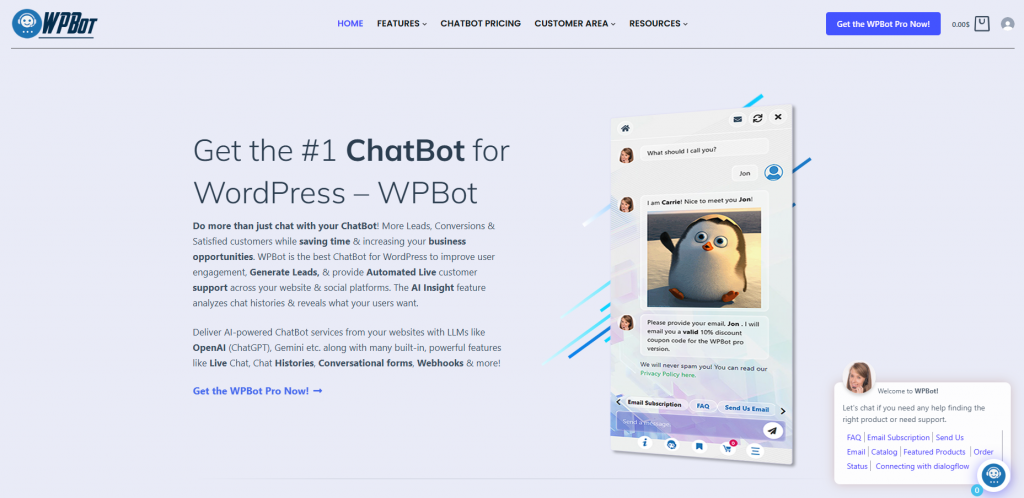
WPBot is a feature-rich AI chatbot designed specifically for WordPress with deep platform integration. It provides 24/7 automated support, lead generation, and data collection directly from your WordPress dashboard.
WordPress developers and agencies managing multiple client sites with lifetime licensing, budget-conscious site owners wanting a free solution with upgrade options, and businesses preferring WordPress-native tools over external platforms.
Pricing: Free version available | Pro plans from $49/year
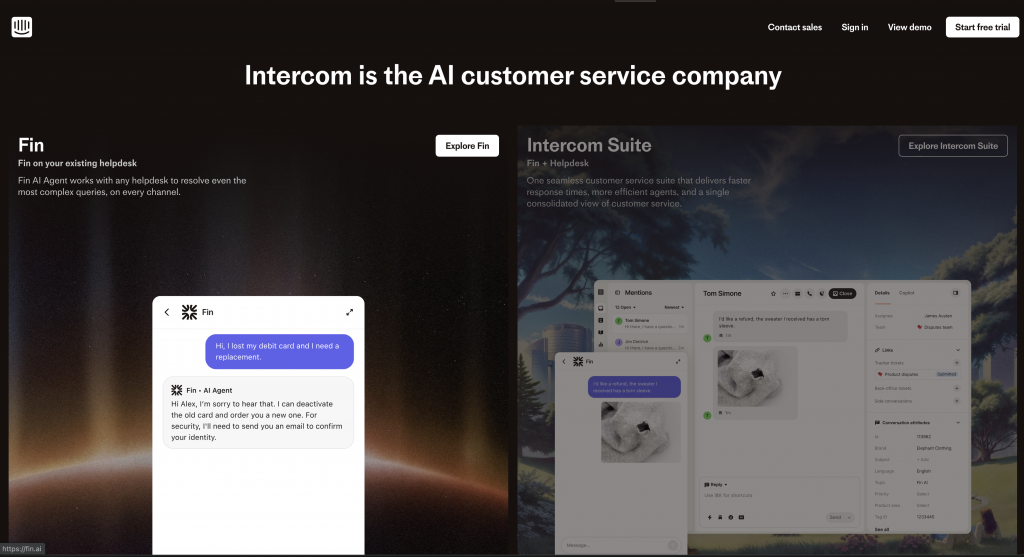
Intercom is an enterprise-grade customer service platform that combines AI-powered chatbots with live chat, help desk, and product tours. It’s designed for businesses that want a comprehensive customer messaging solution with powerful automation capabilities.
SaaS companies and product-led businesses needing sophisticated customer engagement, enterprises requiring advanced automation with CRM integration, and growing companies that want a platform to scale with their needs.
Pricing: Essential at $39/month | Advanced at $99/month | Expert at $139/month (Fin AI starts at $0.99 per resolution)
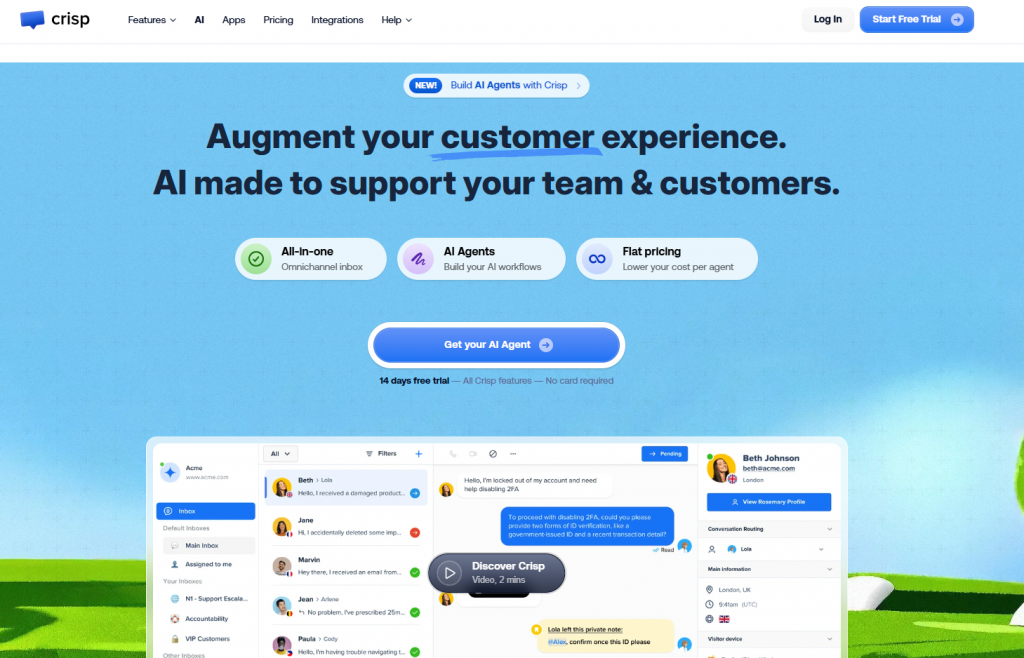
Crisp is an AI-powered business messaging platform that enhances customer experience by providing a complete communication hub rather than just a chatbot. It’s designed as a scalable customer support system for teams.
Customer support teams needing a complete communication platform, agencies managing multiple clients with multi-brand features, and European businesses prioritizing GDPR compliance.
Pricing: Free basic plan | Pro plans from €25/month (~$27)
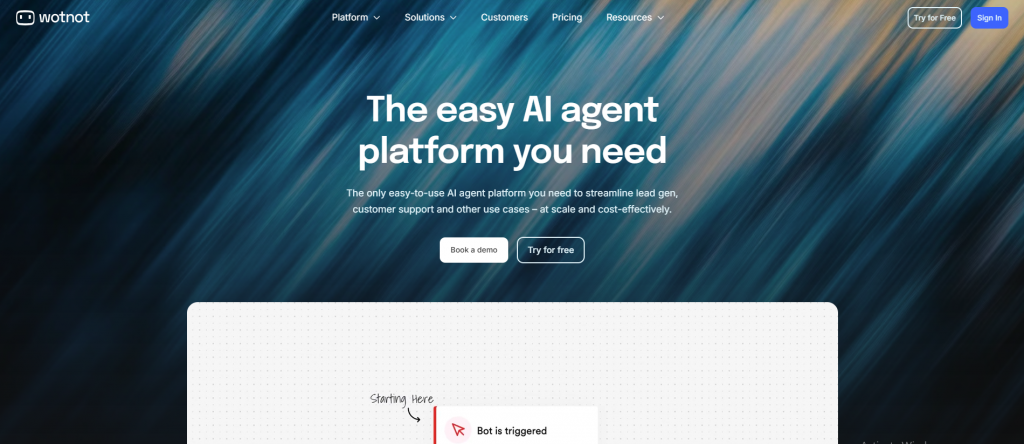
WotNot is described as the easiest platform to build both chatbots and AI agents, offering a super-simple no-code bot builder with complete flexibility. It bridges the gap between simple chatbots and sophisticated AI agents.
Marketing teams focused on lead generation and qualification, non-technical users needing managed services, and small to mid-sized companies wanting professional chatbot setup.
Pricing: Lite at $29/month | Starter at $99/month | Premium at $299/month
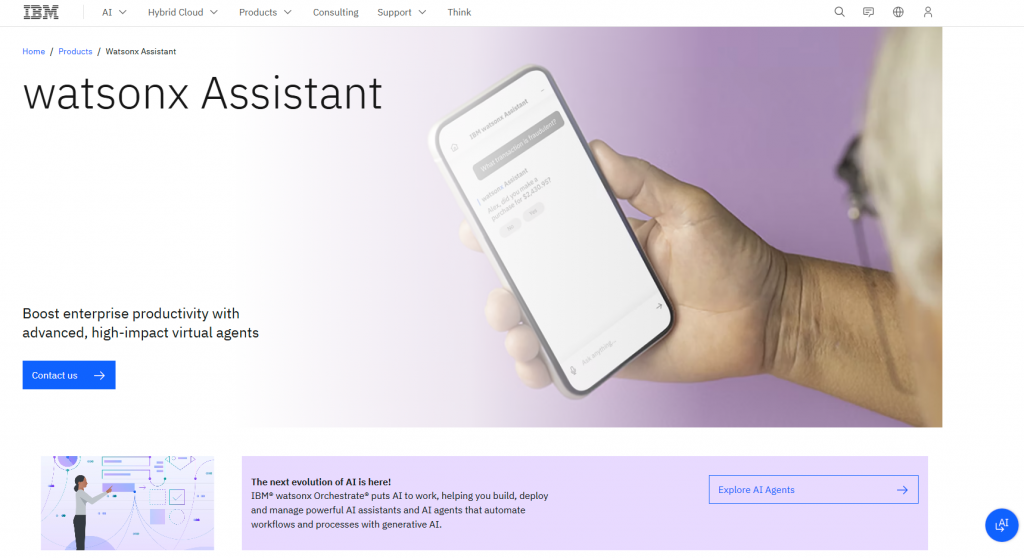
IBM Watson Assistant utilizes IBM’s Watson technology to create virtual assistants with enterprise-grade artificial intelligence and machine learning capabilities for WordPress chatbots.
Large enterprises requiring top-tier AI capabilities, developers building sophisticated conversational AI, regulated industries needing compliance certifications, and organizations already using IBM ecosystem.
Pricing: Free plan available | Plus plans from $140/month
Here’s a quick side-by-side comparison of the top WordPress chatbots:
| Plugin | Best For | Starting Price | Free Trial | No-Code Builder | Self-Learning | Voice Agents | Extensions / Add-ons | AI Platform Scope | Multi-Channel | Lead Capture | Enterprise Security |
|---|---|---|---|---|---|---|---|---|---|---|---|
| YourGPT | Advanced automation & omni-channel businesses | $49 per month | 7-day | ✓ | ✓ | ✓ (Voice AI) | ✓ | AI Agents / AI Studio / AI Helpdesk / AI Search | Website, WooCommerce, WhatsApp, Slack, Messenger | Advanced | SOC 2 Type 2, GDPR |
| Tidio | Small e-commerce and support teams | $24.17 per month billed annually | Free forever | ✓ | ✗ | ✗ | ✓ (Shopify, WordPress, Email) | Chat + Automation + CRM | Website, Messenger, Instagram | Good | Standard |
| WPBot | Agencies using native WordPress tools | $39 per year | Free version | ✓ | ✗ | ✗ | ✗ | Basic Chatbot only | Website | Basic | Standard |
| Intercom | Enterprise messaging & AI support | $29 per seat per month billed annually | 14-day | Limited (Setup needed) | ✓ (Self-training Fin AI) | ✓ (Voice Beta) | ✓ (App Store Integrations) | AI Support + CRM + Analytics | Website, Email, Mobile, Messenger | Advanced | SOC 2, GDPR |
| Crisp | Support teams & collaboration | $45 per month | 14-day | ✓ | ✗ | ✗ | Limited | Live Chat + Inbox | Website, Messenger, Telegram | Good | Standard |
| WotNot | No-code builders for lead generation | $23 per month billed annually | 14-day | ✓ | ✗ | ✗ | Limited | Lead Gen & Chat Automation | Website, WhatsApp, Email | Advanced | Standard |
| IBM Watson Assistant | Large enterprises with compliance needs | $140 per month | No free plan | Limited (complex setup) | ✗ | ✓ (Voice & IVR) | Limited | AI Assistant for Enterprise Workflows | Website, Voice, Mobile | Advanced | Enterprise grade |
A traditional WordPress chatbot usually helps with simple website tasks. It can answer FAQs, collect contact details, show predefined buttons, or route visitors to the right page.
An AI agent goes further. It can understand user intent, retrieve information from business knowledge, follow instructions, connect with tools, trigger workflows, and hand off to a human when a request needs judgment.
For a basic website, a chatbot may be enough. For a WooCommerce store, SaaS website, agency, or support-heavy business, an AI agent-style chatbot is more useful because it can support real customer workflows.
The difference matters because many WordPress chatbot plugins look similar on the surface. The real question is not only “Can it chat?” The better question is:
Can it help the visitor complete the next step?
That next step might be asking about a product, checking a policy, submitting a lead, getting support, booking a call, or continuing the conversation with a human team.
Choosing a chatbot for WordPress depends on what you want it to achieve and how much control you need over its setup. The right approach is to map your goals first and then match them with the chatbot’s capabilities.
When comparing WooCommerce chatbot tools, check whether they support:
– Product and policy questions
– Order-related support
– Return and refund questions
– Human handoff
– Website chat and messaging channels
– Training from store content
– Integration with ecommerce and support workflows
1. Define your goals
Begin with clarity on what you expect the chatbot to handle:
Knowing this helps filter unnecessary options early.
2. Assess technical comfort
Your setup and team skills decide how complex the chatbot can be.
3. Focus on essential capabilities
Evaluate the functions that make a real difference in performance:
4. Check compatibility with your environment
Integration should be smooth and reliable. The chatbot must work well with WordPress themes, plugins, and external systems such as WooCommerce, CRMs, or support tools. Compatibility ensures the chatbot adds value without affecting performance.
5. Evaluate security and scalability
When dealing with user data, compliance and reliability matter. Look for features such as GDPR or SOC 2 compliance, data encryption, and access control. Confirm that the chatbot can handle increased traffic without slowing your site.
6. Test before deployment
Always test in a live setting before full rollout.
Taking a structured approach makes it easier to choose a chatbot that fits naturally with your workflow, integrates cleanly with your systems, and grows with your business.
The best WooCommerce chatbot should reduce repetitive questions while keeping the customer experience clear, fast, and easy to manage.
A chatbot becomes useful only when it helps real people do real tasks. Setting it up is the easy part. Making it work smoothly is where most teams fall short.
1. Begin with what users actually need : Spend time understanding how visitors use your site. Look through common questions in your inbox or chat history. Identify patterns. If most visitors ask about pricing or order updates, design your chatbot around those first. The more specific you start, the faster it becomes helpful.
2. Train it with real conversations : Feed your chatbot with the same words customers use. Not summaries, but actual phrases from real messages or support tickets. Include incomplete sentences, short requests, and context clues. This helps the chatbot learn how people express intent rather than how your team documents it.
3. Keep conversations short and easy to follow : Every message should move the user forward. Ask one question at a time. Give clear options to choose from. If the user seems lost, offer a quick way to reach your team. A good chatbot should guide, not overwhelm.
4. Design for mobile first : Most users will talk to your chatbot on their phones. Make sure it loads fast, fits the screen well, and uses buttons large enough to tap comfortably. Avoid pop-ups or layouts that block content. A smooth mobile chat experience often makes the biggest difference.
5. Treat analytics as feedback : Numbers only matter if you read them with curiosity. Check where users drop off or repeat the same question. Those moments show what needs fixing. Update the chatbot regularly instead of treating it as a one-time setup.
6. Balance automation with a human touch : Automation should make your support faster, not colder. When the chatbot cannot help, transfer the user to a human who already knows the context. This keeps the conversation natural and saves everyone time.
WPBot and Tidio both offer robust free versions. WPBot provides more features in the free tier for WordPress-specific functionality, while Tidio offers better live chat integration. For advanced AI capabilities on a free plan, IBM Watson Assistant’s developer tier is worth considering.
No. Modern WordPress chatbot plugins like YourGPT, Tidio, and WotNot offer no-code visual builders that anyone can use. However, having development skills enables advanced customization with platforms like YourGPT’s AI Studio that support code execution.
Yes. YourGPT, Tidio, and WPBot all provide native WooCommerce integrations for product searches, cart recovery, order tracking, and customer support. YourGPT offers the most comprehensive e-commerce features with advanced product recommendation algorithms.
Pricing ranges from free (with limitations) to $500+/month for enterprise solutions. Most businesses find suitable options in the $50–$150/month range. YourGPT starts at $59/month, Tidio at $19/month, and WPBot offers lifetime licenses from $49/year.
Quality chatbot plugins like those reviewed here are optimized for performance and won’t noticeably affect site speed. They typically load asynchronously after your main content. Choose plugins with good performance reviews and CDN-hosted resources.
Yes. YourGPT supports 100+ languages with automatic detection, while other platforms like Tidio and WPBot offer multilingual capabilities. The sophistication of language support varies—AI-powered chatbots generally handle multiple languages better than rule-based systems.
Rule-based chatbots follow predetermined conversation paths using keywords and buttons. AI chatbots like YourGPT use natural language processing to understand intent and generate contextual responses. AI chatbots are more flexible but may require more training data for accuracy.
Absolutely. All modern WordPress chatbot plugins are mobile-responsive. Some, like YourGPT and Tidio, also offer dedicated mobile apps for managing conversations on the go. Mobile optimization is crucial since most website traffic comes from mobile devices.
Finding the best WordPress chatbot in 2026 starts with understanding what your website actually needs from chat.
A simple blog or service website may only need a chatbot that answers common questions and collects leads. A WooCommerce store may need help with product questions, order-related support, returns, and post-purchase conversations. A larger business may need a full customer messaging system with team inboxes, CRM connections, AI automation, and human handoff.
That is why there is no single chatbot that fits every WordPress site.
Tidio and WPBot are practical choices for simpler setups. Intercom and IBM Watson Assistant fits enterprise teams.
YourGPT is best suited for WordPress businesses that want to move beyond a basic chat widget. It is a stronger fit when your chatbot needs to support customers, assist WooCommerce shoppers, capture leads, connect across channels, and hand conversations to a human team when needed.
The right choice should come from your real customer conversations. Look at the questions visitors already ask, the channels they use, and the tasks your team repeats every day. Then choose the chatbot that can handle those interactions reliably, without making your workflow harder to manage.
Engage visitors, answer questions, and capture leads directly on your WordPress site. YourGPT’s chatbot works round the clock, connects with WooCommerce, and helps your team focus on what matters most.
Full access for 7 days · No credit card required · Cancel anytime
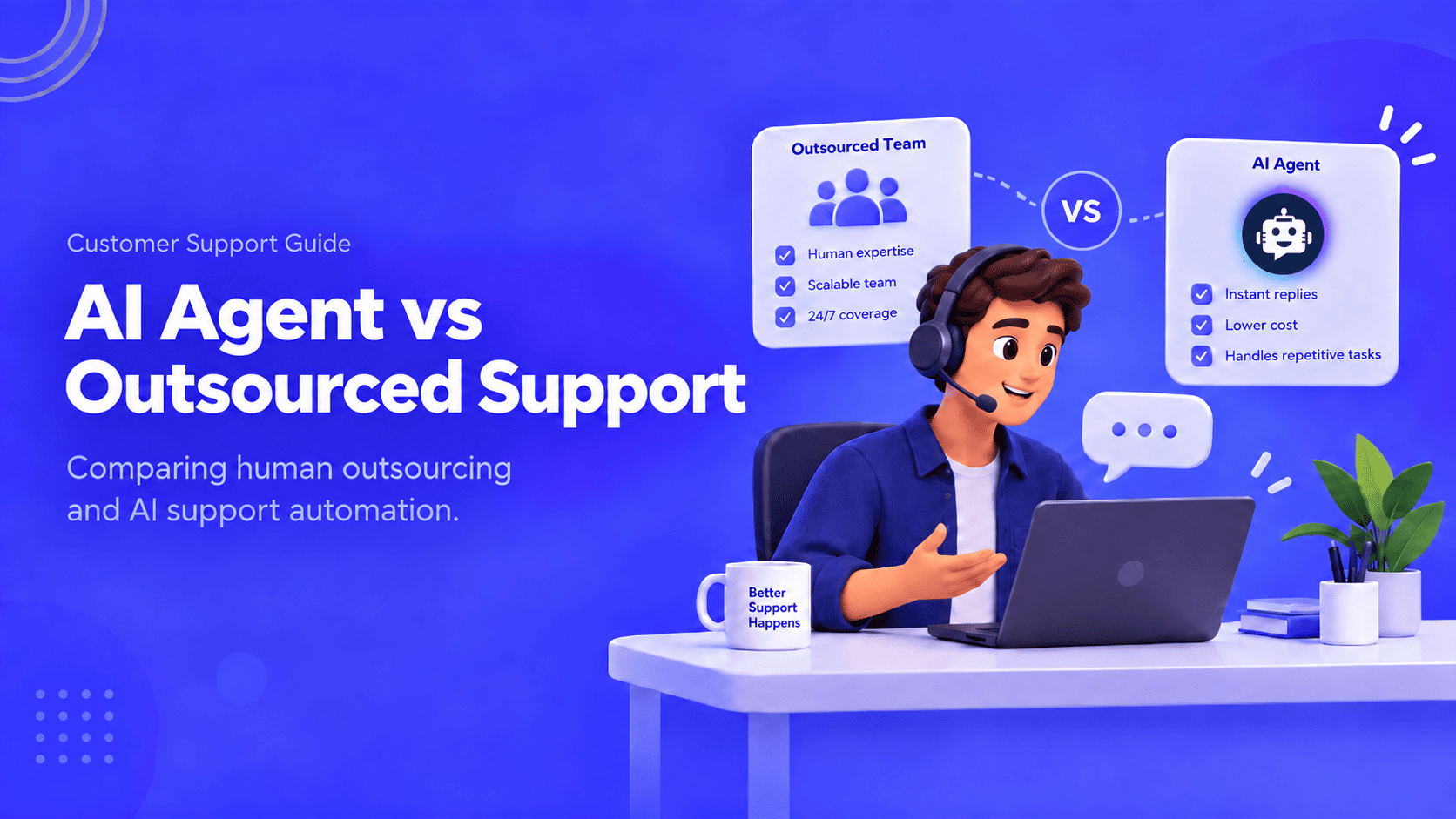
Compare outsourcing customer service with an AI agent using your own ticket mix, a cost model you fill in, and a clear rule for a hybrid split.
Export the Zendesk ticket archive, train an AI Agent on the help center, and test one real ticket before you stop the old queue.


Compare six Yuma alternatives by ecommerce capabilities, helpdesk compatibility, pricing and human handoffs to choose a replacement for your support team.


Move from Gorgias with a verified ticket archive, tested AI workflows, human handoff and a channel cutover plan before ending your subscription.
TL;DR The Gorgias AI Agent is the automation layer inside the Gorgias helpdesk, split between a Shopping Assistant for pre-purchase conversations and a Support Agent for post-purchase support. A connected Shopify store is required, and Gorgias documentation rules out platforms such as BigCommerce, Magento, and WooCommerce for the AI Agent. Billing runs on two separate […]

TL;DR Gorgias is the closest Richpanel alternative for Shopify stores that need native order actions directly inside support tickets. YourGPT fits stores that want one AI agent handling requests across web, WhatsApp, Instagram, and email, while Tidio and Re:amaze suit smaller teams looking for lighter, lower-cost options. Richpanel’s AI pricing starts around $500/month for two […]