11 Best AI Tools for Instagram That Actually Save You Time in 2026

Rajni
Last updated on August 12, 2026
Managing Instagram for a business involves much more than publishing posts.
You may need to plan content, design carousels, edit Reels, write captions, schedule posts, answer comments, respond to DMs, qualify leads, track performance, and decide what to create next.
AI automation in marketing can reduce repetitive work across content, engagement, and customer communication, but the useful tools are usually the ones built around a specific part of the Instagram workflow.
For example, a video editor will not solve an overflowing DM inbox. A chatbot will not design your next carousel. A scheduling platform will not automatically tell you why customers keep asking the same product question.
That is why this guide compares 11 AI tools based on what they actually help you do on Instagram.
We cover tools for:
The goal is not to automate Instagram completely. It is to identify where your team spends unnecessary time and choose a tool that reduces that workload.
| Tool | Best For |
|---|---|
| YourGPT | Automating Instagram DMs, comments, customer support, sales conversations, and lead qualification with AI |
| Canva AI | Creating Instagram posts, Stories, carousels, Reel covers, and branded visuals |
| Async | Turning long-form videos into short Instagram clips and Reels with AI |
| Zebracat | Creating Instagram Reels and short-form videos from prompts, scripts, or written content |
| Hootsuite | Scheduling Instagram content, managing engagement, and tracking social performance |
| Ritetag | Researching Instagram hashtags and identifying relevant tags for posts |
| Synthesia | Creating presenter-style Instagram videos and multilingual video content with AI avatars |
| Copy.ai | Writing Instagram captions, hooks, campaign copy, and ad variations |
| Brandwatch | Monitoring brand conversations, audience sentiment, trends, and competitor activity |
| Inflact | Instagram-focused content scheduling, audience research, analytics, and engagement tools |
| OpenArt | Generating custom images, illustrations, and creative assets for Instagram content |
The best AI tools for Instagram in 2026 designed to support content creation, analytics, automation, and audience growth for businesses. Here’s a Top 11 Best AI Tools for Instagram in 2026 list
YourGPT is an AI agent platform for customer support, sales, and business operations. Businesses can build AI agents on their own knowledge, connect them with business systems, and use them to answer questions, qualify leads, support customers, and carry out operational tasks. For teams using Instagram as a customer channel, the same agents can handle conversations across DMs and comments while staying connected to the wider customer journey.
On Instagram, YourGPT goes beyond simple auto-replies and predefined message flows. AI agents can understand open-ended questions, answer product and service inquiries, capture and qualify leads, assist with support requests, and guide customers toward the appropriate next step. They can also use business context during the conversation, which makes Instagram useful not only for engagement, but also for sales and customer service workflows.
Teams can train AI on websites, documents, FAQs, and other business knowledge, then connect agents with CRMs, helpdesks, ecommerce systems, calendars, APIs, and internal workflows. Agents can then connect with CRMs, helpdesks, ecommerce systems, calendars, APIs, and internal workflows to take actions when a conversation requires more than an answer. Depending on the setup, an agent can retrieve information, collect customer details, trigger a workflow, update a connected system, or involve a team member when human judgment is needed.
Instagram is one of several channels where these agents can operate. Businesses can deploy YourGPT across Instagram, websites, WhatsApp, Messenger, email, voice, and other supported channels while using shared knowledge, integrations, and workflows. Teams can start with no-code configuration, build more advanced automation through AI Studio, support multilingual conversations, and maintain human handoff when a customer or task requires direct team involvement.
Compatibility: Web, Instagram, WhatsApp, Messenger, email, voice, and other supported customer channels
See the potential of AI to transform your operations
No credit card required • 14-day free trial • Setup in minutes
Canva AI is a design-focused platform that helps creators and brands produce Instagram visuals quickly without requiring professional design skills. It is commonly used for creating posts, Stories, carousel graphics, and Reel covers with consistent branding.
For Instagram teams, Canva AI simplifies the content creation process by turning short prompts into layouts, graphics, and visual concepts. Instead of starting from a blank canvas, users can generate designs that already match Instagram’s dimensions and format requirements. This makes it easier to maintain posting consistency without spending hours on design work.
Canva AI works particularly well for teams that need to create content frequently. Brand Kits help keep colors, fonts, and styles consistent, while collaboration features allow multiple contributors to work on the same content calendar. While it is not a full automation or engagement tool, Canva AI plays a key role in speeding up visual production.
Canva AI is best suited for creators and teams that want to improve visual quality and posting frequency without relying on dedicated designers.
Compatibility: Web, iOS, Android
Async is an AI-powered content creation platform designed to help creators and teams turn long-form content into short, shareable video clips without manual editing. It’s commonly used for repurposing podcasts, interviews, webinars, and talking-head videos into clips optimized for platforms like Instagram, TikTok, YouTube Shorts, and LinkedIn.
For social media teams and creators, Async simplifies the clipping workflow by using an AI clip maker to automatically identify key moments, generate short-form videos, and format them for different platforms. Instead of scrubbing through timelines and cutting clips by hand, users can quickly produce multiple ready-to-publish videos from a single recording.
Async works particularly well for creators who publish consistently and need to scale their content output. Alongside clip generation, the platform offers AI-powered captions, subtitles, and voice enhancement tools, helping teams maintain quality while increasing volume. While it’s not built for social media scheduling or engagement management, Async plays a central role in speeding up post-production and content repurposing.
Async is best suited for creators, podcasters, and marketing teams who want to turn existing content into high-performing short videos using AI, without relying on complex editing software.
Compatibility: Web
Zebracat is an AI-powered video creation tool designed to help teams turn text-based content into short-form videos and Instagram Reels. It is commonly used by brands and creators who want to publish video content consistently without filming, editing software, or production teams.
For Instagram, Zebracat works by converting prompts, scripts, or blog content into videos using AI-generated visuals, stock footage, subtitles, and music. This allows teams to repurpose written content into Reels quickly, making it easier to stay active in video-heavy feeds without increasing production time.
Zebracat focuses on speed and simplicity rather than creative depth. While it does not offer full creative control like manual video editing tools, it removes the biggest barriers to video creation: time, skills, and resources. It fits well into workflows where volume and consistency matter more than highly customized visuals.
Zebracat is best suited for brands and marketers looking to scale Instagram Reels and video output with minimal effort.
Compatibility: Web
Hootsuite is a social media management platform designed to help teams manage Instagram alongside other social channels from a single dashboard. It is commonly used by brands, agencies, and enterprise teams that need structured scheduling, monitoring, and reporting rather than individual creator workflows.
For Instagram, Hootsuite supports post scheduling, comment management, and performance tracking. Its AI features assist with caption generation and posting time recommendations based on historical engagement data. This helps teams maintain consistent publishing schedules while reducing manual planning.
Hootsuite is particularly useful in team environments. Approval workflows, role-based access, and shared inboxes allow multiple people to collaborate without losing control over publishing. While it is not built specifically for Instagram-first automation, it provides reliable infrastructure for managing Instagram at scale.
Hootsuite is best suited for organizations that prioritize consistency, reporting, and coordination across multiple accounts or platforms.
Compatibility: Web, iOS, Android
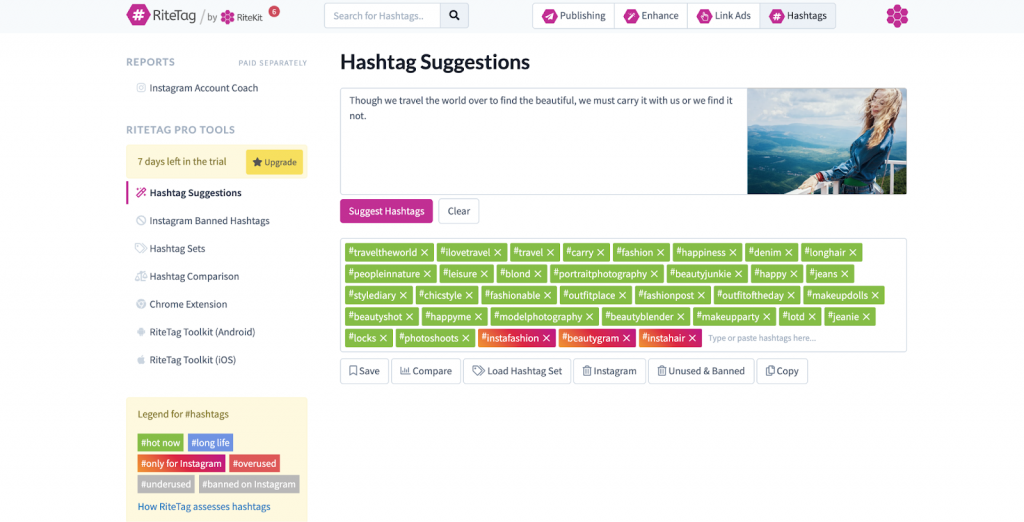
Ritetag is an AI-powered hashtag research tool focused on improving Instagram reach and discoverability. It is designed for creators and brands that want to make more informed decisions about which hashtags to use, rather than relying on guesswork or repeated tag sets.
For Instagram, Ritetag analyzes hashtag performance in real time and suggests combinations based on engagement potential and competition level. This helps users avoid hashtags that are either too competitive or too inactive. Instead of chasing trends blindly, teams can select hashtags that align with their content and audience size.
Ritetag works best as a supporting tool within a broader Instagram workflow. It does not handle content creation, scheduling, or engagement, but it plays a focused role in improving post visibility. For accounts where reach and growth depend heavily on hashtag strategy, Ritetag adds clarity and structure to an otherwise manual process.
Ritetag is best suited for influencers, content creators, and marketers who want consistent hashtag performance without spending hours on research.
Compatibility: Web, Browser Extension
Synthesia is an AI video generation platform that creates videos using realistic AI avatars and voiceovers. While it is widely used for training and internal communication, many brands now use it for Instagram videos such as product explainers, announcements, tutorials, and multilingual content.
For Instagram, Synthesia allows teams to turn scripts into polished videos without filming, cameras, or presenters. This is especially useful for brands that want consistent, professional-looking video content or need to communicate the same message across multiple languages. Videos can be adapted for short-form formats and used in Reels or feed posts.
Synthesia focuses on clarity and scale rather than creative experimentation. It works best for educational, informational, or product-focused content where a clear message matters more than lifestyle visuals. Brands using Synthesia often pair it with other tools for editing, captions, or scheduling.
Synthesia is best suited for businesses that want presenter-style Instagram videos without relying on real people or production teams.
Compatibility: Web
Copy.ai is an AI-powered content creation platform designed to help marketing, sales, and growth teams generate written content quickly and at scale. It focuses on automating copywriting tasks such as blog intros, ad copy, product descriptions, social media posts, and sales outreach rather than conversational customer engagement.
Copy.ai is most effective when teams need to accelerate content production without relying heavily on writers. Marketers use it to brainstorm ideas, draft variations, and optimize messaging across multiple channels. The platform’s prompt-based workflows and templates make it accessible to non-technical users while still offering flexibility for different content needs.
Copy.ai integrates with common marketing and productivity tools, allowing teams to streamline content workflows and reuse outputs across campaigns. While it excels at short- and mid-form copy generation, it is not designed for managing real-time conversations, customer support, or chatbot-driven workflows.
Copy.ai is best suited for teams focused on content velocity, campaign execution, and scaling written output rather than interactive automation or customer service.
Compatibility: Web
Brandwatch is a digital consumer intelligence and social media management platform that helps brands monitor conversations, analyze sentiment, and turn audience signals into inputs for a broader customer experience strategy.
Brandwatch is most effective when businesses need to understand how their brand is perceived, track competitor trends, or manage large-scale social media campaigns. Its powerful analytics engine, customizable dashboards, and AI-driven sentiment analysis enable teams to make informed strategic decisions based on real-time public opinion.
The platform also includes robust publishing and engagement tools via its social suite (formerly Falcon.io), making it a full-service solution for managing content calendars, responding to messages, and tracking campaign performance across platforms like Twitter/X, Facebook, Instagram, LinkedIn, and more.
While Brandwatch offers deep insights and strong engagement tools, it is not a chatbot platform and does not support interactive automation or scripted conversational flows.
Brandwatch is best suited for brands focused on reputation management, competitive analysis, and large-scale social media operations not for those seeking automated customer support or marketing chatbots.
Compatibility: Web, iOS, Android
Inflact is an Instagram marketing automation platform built to help brands grow their presence, engage followers, and streamline content management on Instagram. It focuses on automation tools for direct messaging, post scheduling, audience targeting, and analytics, primarily tailored for marketers, influencers, and e-commerce businesses.
Inflact is most effective for managing Instagram outreach at scale. Users rely on its automated DM system to engage new followers, promote offers, and maintain consistent communication. The platform also allows for hashtag tracking, smart targeting based on user behavior, and content scheduling, all designed to boost visibility and engagement without manual effort.
Its tools extend beyond basic automation, offering a media downloader, profile analyzer, and CRM-like features to manage conversations. However, Inflact is rule-based and lacks natural language processing, meaning it doesn’t support flexible, AI-powered conversations or deep customer service workflows.
Inflact is best suited for brands focused on audience growth, campaign automation, and content planning on Instagram, not for handling complex customer queries or running omnichannel chatbots.
Compatibility: Web
OpenArt is an AI art generation platform designed for creators, designers, and marketers who want to produce high-quality images using text prompts. It focuses on democratizing visual creativity by offering tools that generate artwork, illustrations, and designs powered by advanced generative AI models like Stable Diffusion.
OpenArt is most effective for users looking to quickly generate visual content for branding, social media, design inspiration, or creative projects. Its intuitive prompt-based interface, customizable image styles, and upscaling tools allow anyone, regardless of artistic skill, to create polished visuals. The platform also includes features like inpainting, image variations, and fine-tuning for more creative control.
OpenArt integrates with trending AI models and supports training of custom models, making it valuable for artists and teams with specific visual goals. However, it is not built for conversational AI or customer interaction. Its value lies in creative visual output, not communication workflows.
OpenArt is best suited for individuals and teams focused on visual content creation, art exploration, and AI-assisted design, not for chatbot development or customer engagement.
Compatibility: Web
The right tool depends on where Instagram is creating work for your team. Some tools help you produce content faster. Others help distribute it, understand performance, or manage the conversations that follow.
For content creation, the tools serve noticeably different purposes:
Once the content exists, Hootsuite becomes more relevant when the challenge is keeping publishing, engagement, analytics, and multiple social accounts organized. Inflact takes a more Instagram-focused approach to scheduling, profile research, audience tools, and engagement workflows. Ritetag has a narrower role, but it can be useful when hashtag research itself is consuming time.
The workflow changes once people start replying to posts, commenting on Reels, or sending DMs.
That is where YourGPT fits.
YourGPT is an AI agent platform for customer support, sales, and operations, with Instagram as one of the channels where those agents can work. Instead of treating every Instagram interaction as a social media task, businesses can use AI agents to answer open-ended questions, qualify leads, handle support requests, use business knowledge, connect with other systems, and move conversations toward the right next step.
This becomes particularly relevant when Instagram generates:
For a business already using Instagram to attract customers, this closes an important gap between getting engagement and actually handling what that engagement produces.
Individual comments and DMs tell you what one customer is saying. Brandwatch is more useful when you need to understand the broader conversation around your brand, market, or competitors through social listening, sentiment, trends, and audience intelligence.
Most teams will get more value from a few complementary tools than from trying to find one platform that does everything.
A business using Instagram across the customer journey might use:
Canva AI → Hootsuite → YourGPT
Canva helps create the content. Hootsuite manages publishing and social activity. YourGPT handles the customer conversations, sales inquiries, and support workflows that follow.
A video-led team could replace or supplement Canva with Async, Zebracat, or Synthesia, while a larger brand may add Brandwatch when broader audience intelligence becomes important.
The useful question is not “Which tool has the most AI?” It is “Which part of our Instagram workflow still requires too much manual work?” That answer usually makes the right tool much easier to identify.
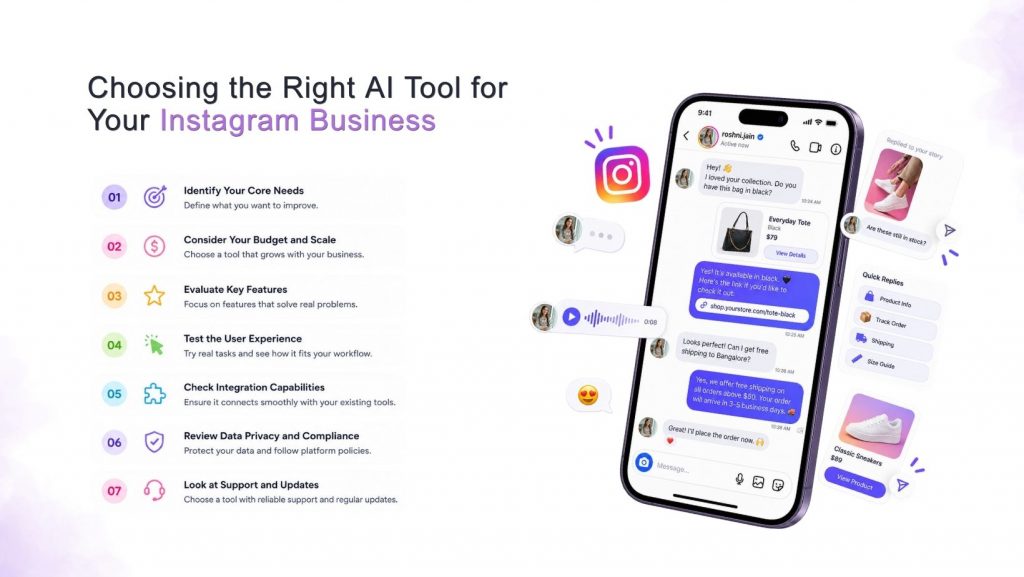
A long feature list tells you very little about whether a tool will improve your Instagram workflow. The better question is: what work will disappear, become faster, or become easier to manage after you add it?
For Instagram, that usually comes down to a few practical decisions.
Different teams lose time in different places.
A creator may spend hours editing Reels. A marketing team may struggle to maintain a publishing calendar. A business may already have enough content but lose leads because DMs and comments pile up.
Match the tool to that point of friction:
This is more useful than choosing the platform with the broadest feature set.
Two products can both claim to use AI while doing very different amounts of work.
A caption tool may give you a first draft. A video tool may turn a script into a finished clip. An AI agent may answer a question, retrieve business information, qualify the customer, and trigger the next workflow.
Ask where the automation stops.
Does it suggest, create, publish, respond, or actually complete the task?
That distinction has a direct impact on how much time the tool can save.
“Instagram integration” can mean anything from basic post scheduling to handling customer conversations.
Before choosing a platform, check whether it supports the parts of Instagram that matter to you, such as:
A tool can be useful for Instagram without covering every surface. What matters is whether it covers your workflow.
This matters most when Instagram generates leads, sales, or support requests.
If a customer asks about an order in a DM, does the workflow end with a generated reply? Or can the system retrieve the relevant information, capture customer details, connect with your CRM, trigger an action, or involve the right team member?
For businesses, the value of an Instagram AI tool often depends on what it can do beyond Instagram. Customer conversations are part of a wider customer experience that can span marketing, sales, support, ecommerce, and post-purchase operations.
Do not judge a tool from its homepage or an empty dashboard.
Give it something you already do every week.
Create an actual Reel. Schedule a real content batch. Give it one of your existing caption briefs. Run a typical customer question through the Instagram workflow. Test what happens when the AI does not know the answer.
Then look at the result:
Did it remove work, or did it simply move the work somewhere else?
That is a much more useful buying signal than the number of AI features included in the plan.
The entry price rarely tells the full story.
Depending on the product, costs may change with message volume, AI usage, team seats, social accounts, generated content, or higher automation limits. Consider what happens when your audience, publishing volume, or customer conversations grow.
The right Instagram AI tool should make an important part of your workflow easier to run without adding unnecessary complexity elsewhere.
Quick answers about using AI for Instagram content, conversations, automation, and customer engagement.
It depends on what you want to improve. Canva AI is useful for visual content, Async and Zebracat help with short-form video, and Hootsuite supports publishing and social management. For businesses using Instagram for customer support, sales, or lead generation, YourGPT can automate AI-powered conversations across DMs and comments.
Yes. AI platforms can help respond to DMs and comments, although the depth of automation varies. YourGPT can use business knowledge to handle open-ended questions, support requests, sales inquiries, and lead qualification instead of relying only on fixed response templates.
They can if the system relies on generic templates or has poor business context. AI agents that use your website, FAQs, product information, and conversation context can produce more relevant responses. Teams should still define clear instructions and review how the AI handles real customer conversations.
Yes. When someone comments on a post or starts a DM, AI can help answer questions, collect contact details, qualify intent, and guide the person toward the next step. Platforms such as YourGPT can also connect conversations with CRMs, calendars, APIs, and other business workflows when the use case requires it.
Yes, but different tools handle different parts of the process. Canva AI can help with posts, Stories, and carousels, Zebracat can turn scripts into short videos, Async can repurpose longer recordings into clips, and Copy.ai can assist with captions, hooks, and campaign copy.
Usually not. AI is more useful for reducing repetitive work such as editing, drafting, scheduling, reporting, and responding to common questions. People still make the decisions around positioning, creative direction, campaigns, customer judgment, and brand strategy.
Start with the workflow you want to improve. Check which Instagram surfaces the tool supports, how much of the task it can complete, how it integrates with your existing systems, and what happens when human input is needed. A useful tool should remove meaningful work rather than simply add another dashboard.
Instagram marketing in 2026 is less about doing more and more about doing the right things consistently. Content volume, response speed, and follow-through now matter as much as creative ideas. The tools covered in this guide exist to remove daily friction, whether that friction comes from unanswered DMs, inconsistent posting, slow content production, or lack of visibility into what’s working.
Each platform serves a different role. Tools like YourGPT help manage conversations and streamline operations through AI agents. Canva AI, Zebracat, Synthesia, and OpenArt focus on making visual and video content easier to produce at scale. Hootsuite brings structure to social planning, captions, and analytics, while Ritetag improves discoverability through smarter hashtag strategies. Copy AI supports fast, high-quality caption and ad copy creation, and Brandwatch delivers deep audience insights through AI-powered social listening. Inflact stands out for automating Instagram growth and engagement.
The most effective approach is to start small. Identify the one area that currently slows you down the most and test a tool that addresses it directly. Measure whether it actually saves time or improves engagement, then build from there. When used with intention and regular review, AI tools make Instagram more manageable without stripping away the human judgment and authenticity your audience still expects.
Compare six Yuma alternatives by ecommerce capabilities, helpdesk compatibility, pricing and human handoffs to choose a replacement for your support team.


Move from Gorgias with a verified ticket archive, tested AI workflows, human handoff and a channel cutover plan before ending your subscription.

TL;DR The Gorgias AI Agent is the automation layer inside the Gorgias helpdesk, split between a Shopping Assistant for pre-purchase conversations and a Support Agent for post-purchase support. A connected Shopify store is required, and Gorgias documentation rules out platforms such as BigCommerce, Magento, and WooCommerce for the AI Agent. Billing runs on two separate […]

TL;DR Gorgias is the closest Richpanel alternative for Shopify stores that need native order actions directly inside support tickets. YourGPT fits stores that want one AI agent handling requests across web, WhatsApp, Instagram, and email, while Tidio and Re:amaze suit smaller teams looking for lighter, lower-cost options. Richpanel’s AI pricing starts around $500/month for two […]
TL;DR Shopify Inbox is a good free option for stores that only need basic storefront chat and simple customer conversations. Stores usually look for alternatives when they need multichannel support, stronger team workflows, or automated order actions. YourGPT is strongest for cross-channel AI automation, Gorgias for Shopify-native order workflows, and Tidio for smaller stores that […]
TL;DR Tidio recently restructured its top paid plan, and many 2026 reviews still describe the old pricing model. Confirm current pricing directly on Tidio’s site before budgeting. Lyro, Tidio’s AI agent, runs on Anthropic’s Claude rather than ChatGPT. Only the Premium tier carries a guaranteed resolution rate, well below the average Tidio advertises elsewhere. Billing […]