Should You Outsource Customer Service or Use an AI Agent?

Rajni
October 1, 2026
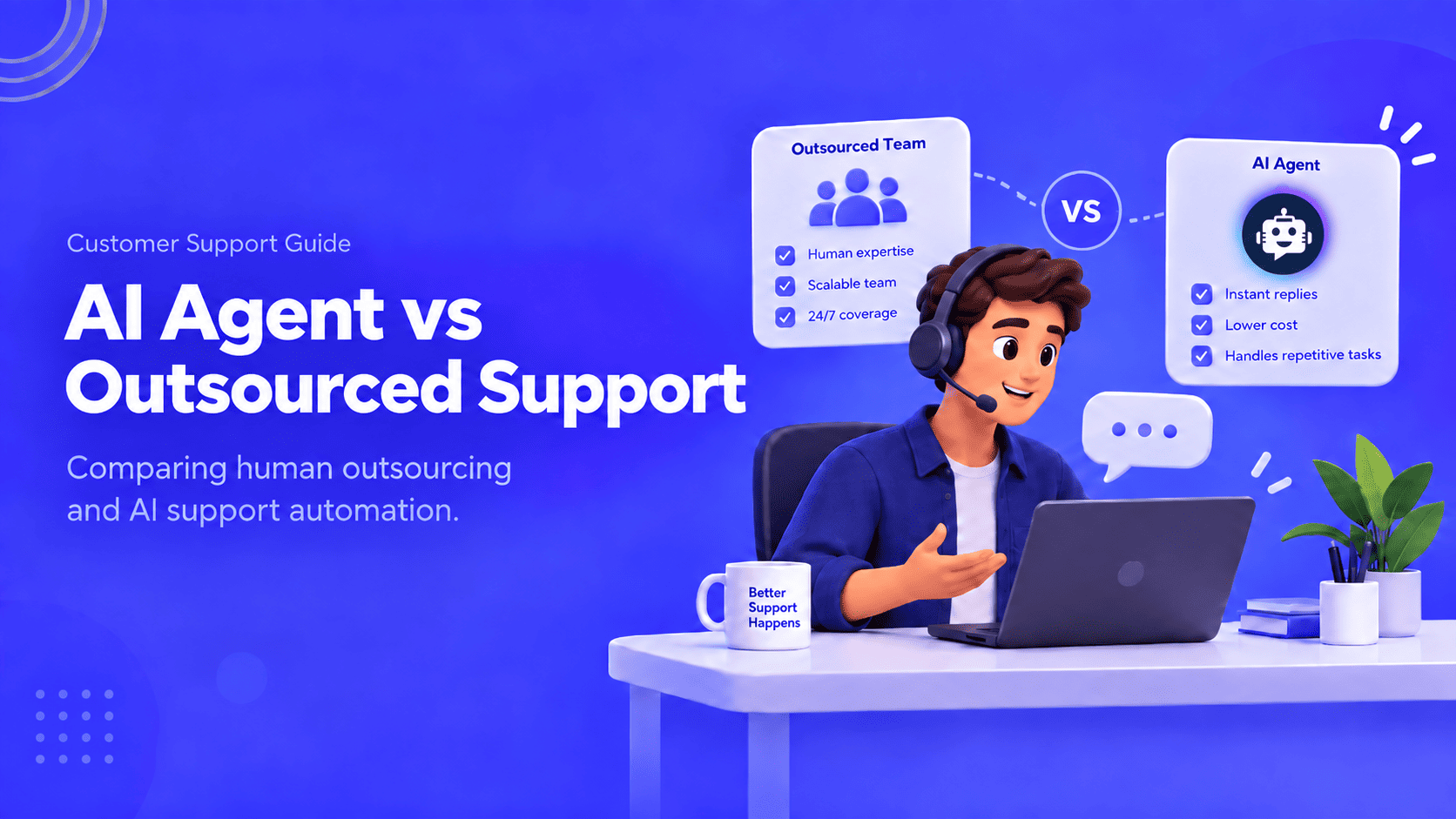
Give an AI agent the questions that repeat and can be answered from your own pages or systems, and pay people for the tickets that need a decision. Outsource when judgment calls dominate your queue or you need staffed coverage before your answers are written down. When repeated questions are a large share of the queue, run a hybrid split and size the human team for what the agent leaves behind.
An outsourcing quote and a software pricing page are not priced in the same unit. The outsourcing firm sells time from trained people, by the seat, the hour, or the handled ticket. The agent platform sells a plan plus usage. Putting the two headline numbers side by side tells you little about what either one will cost for your queue.
What settles the question is your ticket mix. A queue full of “where is my order” and “what is your return window” behaves differently from one full of damaged-item disputes and refund exceptions, and the same monthly volume can point to opposite answers.
There is a second stake that a quote does not show. Whoever answers your customers also builds up the knowledge of how to answer them. With an outsourced team, that knowledge collects in their people, macros, and notes. With an agent, it lives in the pages and documents you train it on.
This page takes you from last month’s tickets to a decision you can defend with your own numbers.
Every later number on this page depends on how much of your queue repeats. That one share decides everything else below . Export a full month of tickets from whatever inbox or help desk you use, and tag each one into a pile.
Pile two is where the difference between answering a question and resolving it shows up. An agent that replies “check your confirmation email” to an order-status question has answered it without resolving it. Count a pile two ticket as automatable only if the agent can reach the system that holds the answer.
Use a full month, and add a second one if you have a seasonal peak. A launch week or a quiet week is too small a sample, and it makes the repeated share look larger or smaller than it really is. The share of tickets in piles one and two is the number that decides this comparison. With the piles counted, you can price each model against the work it would actually do.
An outsourced team sells you people’s time. Before you compare quotes, find out which unit each vendor’s price uses. It might be a seat per month, an hour, or a handled ticket. Then ask about minimum commitments, coverage hours, languages, and which channels the team works.
The quote covers the people answering tickets. It does not cover the work that stays with you:
Fixed seats also shape what happens on a busy day. Little’s Law says the average number of open tickets equals the arrival rate times the average time each ticket stays open. If a sale doubles arrivals while the seat count stays flat, each ticket also stays open longer, so the backlog more than doubles. You either size the contract for your peak and pay for idle seats on quiet days, or size it for the average and accept longer waits on busy ones.
Outsourcing is strong where pile three is large. Disputes, emotional complaints, and calls that need a trained voice are human work, and a good vendor gives you that capacity without hiring. The weak point is knowledge: the macros and notes the team builds live on their side, so write them into the contract as deliverables you receive when it ends. An AI agent changes both the seat math and the knowledge question, since it has no seats to size and its answers come from pages you control.
An AI agent sells you a plan plus usage. YourGPT pricing, checked on 1 October 2026, lists Essential at $39 a month, Professional at $79, and Advanced at $349 when billed annually. Month-to-month prices are $59, $129, and $499, and Enterprise uses a custom yearly contract.
Usage is billed in AI Credits, not per resolution, and credit use depends on the model you select and the conversation workload. A pilot on real traffic gives you a truer number than any estimate. Since credits are spent on AI model calls, a keyword-triggered flow that answers from a fixed script without invoking the model costs nothing extra. Confirm the exact setting in your dashboard before you build a cost model around it.
The agent answers from the sources you train it on: your website, help center, PDFs, Notion, Google Drive, and FAQs. It handles pile two through Functions, REST APIs, webhooks, and AI Studio, which connect it to the systems that hold order and account records.
When set up correctly and maintained, YourGPT agents resolve up to 90% of repeated queries. That ceiling applies to piles one and two. Pile three still needs people.
YourGPT is not a native ticketing system with a full ticket lifecycle, and advanced workflows in AI Studio take configuration time. An answer is only as good as its source. A stale policy page produces a stale answer, which is one reason AI agents give wrong answers.
With both price structures in view, the table sets the two models next to the hybrid split on the points that change a decision.
| Question | Outsourced team | AI agent | Hybrid split |
|---|---|---|---|
| What you pay for | Seats, hours, or handled tickets | A plan plus AI Credits | A plan plus a smaller human team |
| What a spike does | Longer waits, or idle seats sized for peak | More credits used for the extra conversations | Agent absorbs repeats while people take the extra judgment calls |
| What a policy change needs | Every team member retrained | The source page updated and retrained | Source page for the agent and a note to the team |
| Where the knowledge lives | Vendor macros and notes unless the contract says otherwise | Your pages, documents, and trained FAQs | Mostly your sources |
| How quality is checked | Sampled conversation reviews | Your team reviews unresolved questions before training | Both, on smaller volumes |
| Weak spot | Cost stays fixed when volume drops | Cannot make judgment calls or run a ticket queue | Needs a clean handoff between the two |
The rows show the shape of each option. Your own numbers show which shape costs less, and that takes one short calculation.
The model needs four inputs you already have or can get this week. Write them down before you talk to any vendor, because the quote you ask for depends on them.
Then work out what the hybrid split leaves for people: all of pile three, plus the repeated tickets the agent does not close. Multiply T by R to get the repeated tickets, multiply that by the agent’s resolution rate, and subtract the result from T. Ask the vendor, or your own team, to price that smaller load, since a per-ticket rate can change when volume drops.
Now compare two monthly totals:
The same inputs let you calculate AI ROI if you need a return figure for approval.
Here is a hypothetical queue to show the arithmetic. It uses ticket counts only, because vendor prices vary too much to assume one.
| Hypothetical queue | At the 90% ceiling | At a 70% pilot rate |
|---|---|---|
| Total tickets (T) | 3,000 | 3,000 |
| Repeated tickets in piles one and two | 2,000 | 2,000 |
| Resolved by the agent | 1,800 | 1,400 |
| Left for people | 1,200 | 1,600 |
In this example, the human team is sized for 1,200 to 1,600 tickets instead of 3,000. Size the human team for the tickets the agent leaves behind, not for the whole queue. Use your pilot’s measured rate rather than the ceiling, and track it the way you would a deflection rate, so the plan survives a month where fewer questions repeat.
Add your own management time to both totals, since neither option runs without someone owning it. Once both numbers are in, the decision rule below tells you how to read them.
Automate what repeats and is written down, and pay people for what needs a decision. The table applies that rule to the situations this comparison usually comes down to.
| Your situation | Choose | Reason |
|---|---|---|
| Piles one and two are the larger share and the answers are written down | Hybrid split | The agent takes repeats and a smaller team takes decisions |
| Pile three is the larger share | Outsource or hire | People do the main work and an agent only trims the edges |
| One person runs support and questions wait outside their hours | AI agent with handoff to that person | The agent covers repeat questions outside that person’s hours |
| You need staffed coverage now and policies are not written anywhere | Outsource first | The agent has nothing to train on yet, so write sources while the contract runs |
| Answers involve legal, medical, or financial decisions | People own the decision | The agent answers only published facts and hands off the rest |
Unwritten policies hurt both models. An agent has nothing to answer from, and an outsourced team ends up improvising answers ticket by ticket. Write the policies down first, whichever model you choose.
The same rule keeps deciding who handles what between AI and human support as your queue changes. A hybrid only works if tickets move cleanly between the two sides, which is the last thing to set up.
A hybrid split fails at the seam, where the agent stops and a person starts. You can set up human handoff in three ways:
If an outsourced team takes the escalations, point the webhook or workflow at the channel they already staff, and price their contract on the escalated volume instead of the whole queue. The customer should never have to repeat the question after the handoff to a person.
Before launch, test with real tickets from piles one and two, pulled from the export, rather than invented questions. After launch, check your dashboard’s self-learning or unanswered-questions view to see what the agent could not resolve. Review each one, correct the answer, and submit it for training so it becomes part of the FAQ the agent answers from next time.
Reviewing unresolved questions weekly keeps a person in charge of what becomes trusted knowledge. It works like an outsourcing QA sample, except this human-in-the-loop check runs before the answer goes live. Once the split is running, a few practical questions usually come up.
Often, yes, because the decision depends on the repeated share and your coverage hours more than on volume. A small queue where most questions are about shipping and returns can run on an entry plan with handoff to the owner. It makes less sense if nearly every ticket needs a judgment call. In that case the agent has little to resolve, and a part-time person or an outsourced team fits better.
It should name the macros, scripts, and internal notes as deliverables you receive during the contract and when it ends. Without that clause, the answers your customers rely on can leave with the vendor. Ask for tagged ticket exports as well, since the tags tell you which pile each ticket belonged to. Those files later become training sources if you move repeated questions to an agent.
Yes, as long as they work in a channel the handoff can reach. The Request Human button can send a webhook to Slack, Discord, Zapier, or Pabbly, and AI Studio workflows can create a ticket or send an email when the agent cannot answer. Agree on which channel the vendor staffs before launch, then test one real escalation end to end so nothing sits unread.
Start with the model choice, since credit use depends on the model you select. Then move fixed-answer questions, such as a store address or a returns link, to Quick Replies, which do not consume AI Credits. Keep the model for questions that need retrieval or an action. Watch credit use during the pilot month and adjust before you commit to a plan tier.
The agent keeps giving the old answer until you update the source and retrain it. Edit the policy page or document first, then refresh that training source so the new wording replaces the old. Check any trained FAQ that quoted the old policy, because it will not update itself. One real question about the changed policy confirms the new answer before customers ask it.
Your ticket mix settles the choice between outsourcing and an AI agent, and the price tags only make sense once you know it. Count what repeats, price each model on the work it would actually do, and size people for what is left. When piles one and two make up the larger share, that points to a hybrid split: the agent takes the written, repeated questions, and people take the decisions.
Whichever way the numbers fall, keep the answers in pages you own. That one habit makes every later switch cheaper, whether you move work to an agent, to a vendor, or back in-house.
Train the agent on your repeated questions, then route everything else to people through handoff.
Export the Zendesk ticket archive, train an AI Agent on the help center, and test one real ticket before you stop the old queue.


Compare six Yuma alternatives by ecommerce capabilities, helpdesk compatibility, pricing and human handoffs to choose a replacement for your support team.


Move from Gorgias with a verified ticket archive, tested AI workflows, human handoff and a channel cutover plan before ending your subscription.

TL;DR The Gorgias AI Agent is the automation layer inside the Gorgias helpdesk, split between a Shopping Assistant for pre-purchase conversations and a Support Agent for post-purchase support. A connected Shopify store is required, and Gorgias documentation rules out platforms such as BigCommerce, Magento, and WooCommerce for the AI Agent. Billing runs on two separate […]

TL;DR Gorgias is the closest Richpanel alternative for Shopify stores that need native order actions directly inside support tickets. YourGPT fits stores that want one AI agent handling requests across web, WhatsApp, Instagram, and email, while Tidio and Re:amaze suit smaller teams looking for lighter, lower-cost options. Richpanel’s AI pricing starts around $500/month for two […]

TL;DR Shopify Inbox is a good free option for stores that only need basic storefront chat and simple customer conversations. Stores usually look for alternatives when they need multichannel support, stronger team workflows, or automated order actions. YourGPT is strongest for cross-channel AI automation, Gorgias for Shopify-native order workflows, and Tidio for smaller stores that […]