Yellow.ai Review 2026: Pricing, Pros & Cons

Shreya
October 27, 2026
TL;DR
Yellow.ai has spent a decade building an enterprise conversational AI platform out of Bangalore, and in 2026 it is asking Wall Street to value it at half a billion dollars while cutting a third of its staff and rebuilding its core product around a new “agentic interface” called Nexus. Both moves showed up in filings and press releases this year, and both matter more to a buyer than another walkthrough of the drag-and-drop bot builder.
This review covers what Yellow.ai actually costs past the “contact sales” wall, what independent reviewers say happens after signing, and where implementation timelines tend to slip. It draws on Yellow.ai’s own pricing, trust center, and case study pages, its AWS Marketplace listing, G2’s review data, and reporting on the SPAC filing and layoffs, gathered without a hands-on trial account.
Namma Metro in Bengaluru runs its WhatsApp ticketing on this platform. So does Hyundai Motor India’s vehicle-configuration flow. If your evaluation includes deployments across India, Southeast Asia, or the Middle East, that regional depth is one of the few things about Yellow.ai that isn’t in dispute.
Yellow.ai is a no-code platform for building AI agents that handle customer and employee conversations across chat and voice, built on a decade of work in enterprise conversational AI out of Bangalore.
Buyers researching this platform in 2026 need to hold two facts side by side that most vendor pages won’t put on the same slide.
Underneath the marketing language, this is what actually differentiates the platform on a feature-by-feature basis.
Yellow.ai publishes one free plan and, through AWS Marketplace, two annual contracts. Every other price is a quote.
| Option | What is Included | Price |
|---|---|---|
| Free | 1 AI agent. 500 chat sessions a month, then $0.99 per resolution. No credit card to start. | $0 |
| AWS Marketplace Basic | 1 use case, tiered conversation limits, 12-month contract. | $10,000 |
| AWS Marketplace Standard | 4 use cases, tiered conversation limits, 12-month contract. | $25,000 |
| Enterprise, direct | Unlimited agents and all 35-plus channels. | Custom quote |
Sources: Yellow.ai pricing page and AWS Marketplace listing. The AWS listing was opened on October 27, 2026. Third-party directories sometimes list a middle “Basic” tier, but an observer who reviewed the pricing page on October 5, 2026 found only two columns, Free and Contact us (Macha).
Three details change what these numbers mean:
No public source shows what a full Enterprise contract costs. One rough check uses Yellow.ai’s own investor figures: if enterprise accounts are about 70% of $34 million in revenue, spread across 650 enterprise clients, the average is roughly $37,000 per client. That is an illustration, not a price. It assumes total revenue approximates recurring revenue, and averages hide very large and very small accounts.
Forrester’s Q2 2026 evaluation of conversational AI vendors scored them on pricing flexibility and transparency. Only one vendor scored above 3 out of 5, and it was Rasa, not Yellow.ai (CX Foundation summary).hout running two sales processes in parallel.
These strengths hold up against Yellow.ai’s own claims and against what customers and reviewers actually report.
These are the recurring complaints and risk factors worth weighing before signing, drawn from reviewer patterns rather than a single bad experience.
Yellow.ai’s certifications are listed on its trust center, but the audit reports themselves are available only on request after signing an NDA, so a buyer cannot verify them from public pages.
| Area | What Yellow.ai States | What to Ask |
|---|---|---|
| Certifications | ISO/IEC 27001:2022 and ISO/IEC 27701:2019 certified, SOC 2 Type II attested, PCI DSS service provider compliance renewed (Trust Center). | The certificates and the full SOC 2 report, under NDA. |
| SOC 2 Period | December 1, 2024 to November 30, 2025. | A bridge letter or newer report. This window ended before the December 2025 layoffs and before Nexus (February 2026) and Nexus Vox (May 2026) shipped. |
| Privacy Law | Says it complies with applicable data protection laws as both processor and controller. | The data processing agreement and sub-processor list. GDPR is a law, not a certificate, and ISO 27701 is a privacy-management standard, not proof of GDPR compliance. |
| Health Data | HIPAA listed on its security page. | Whether your use case is covered and what agreement applies. |
| Data Hosting | US, EU, Singapore, India, Indonesia, and UAE. | Which region holds your conversation data, including voice recordings. |
| Access Control | Platform SSO through Google, Microsoft, ADFS, and Azure AD. Bot-level AD, LDAP, SAML, and OAuth2. | Role permissions for your administrators. |
| Disclosure | A vulnerability disclosure program. | Recent incident history and notification terms. |
If you plan to use Nexus Vox voice cloning, confirm consent and disclosure requirements in each country where callers are located before launch.
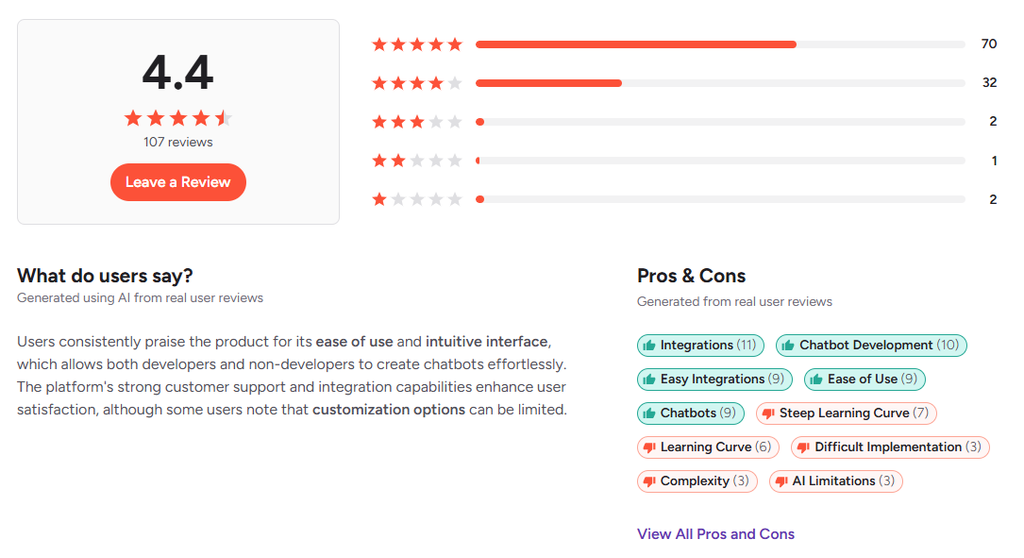
On G2, Yellow.ai holds a 4.4 out of 5 rating across roughly 106 reviews, skewed heavily positive at around two-thirds five-star. Reviewers most often praise the no-code builder and channel breadth, while the recurring negative pattern centers on support responsiveness and account-team turnover rather than the core automation technology.
Trustpilot tells a rougher story from a much smaller sample, including one reviewer who described scripted support responses and no clear path to a human supervisor. That lines up with similar complaints on G2 and in Gartner Peer Insights feedback, which strengthens the pattern despite the thin sample size. A complaint about a five-month stalled rollout also lands differently depending on deployment size, worth weighing against a single-use-case pilot versus a multi-department enterprise rollout.
This review draws on published sources rather than a hands-on trial account, so here’s specifically what informed each judgment.
We didn’t assign Yellow.ai a single weighted score across these categories. Doing that credibly would need a live enterprise trial running real traffic through a specific use case. Published documentation and aggregated reviews can’t substitute for that kind of test.
Yellow.ai fits best for large, multi-region enterprises, particularly those with an India, Southeast Asia, or Middle East footprint, that have the budget and internal resources to manage a sales-negotiated contract and a dedicated bot administrator. Outside that profile, a few alternatives come up often.
| If Your Priority Is | Choose | Why |
|---|---|---|
| Transparent, published pricing and a usage-based model instead of a sales-negotiated contract | YourGPT | Published annual tiers and a 7-day free trial, no sales call required to see a number. |
| Best-in-class natural language understanding accuracy | Kore.ai | Leads Yellow.ai on G2’s NLU and support sub-scores. |
| In-app engagement and support bundled for a smaller SaaS team | Intercom | Built for product-led teams under roughly 20 agents. |
| Full code-level control and self-hosting | Botpress | Open-source, developer-owned, at the cost of a steeper build. |
| Maximum channel and language breadth with deep APAC and Middle East deployment history | Yellow.ai | Best fit for large, multi-region enterprises with budget for a negotiated contract. |
A broader look at Yellow.ai alternatives and a wider roundup of enterprise chatbot platforms are worth reading if scale and channel count matter more than any single feature here. For teams still scoping what an enterprise-grade platform needs to deliver before shortlisting vendors, this guide to enterprise AI agent builders applies just as well to a Yellow.ai evaluation as to any competitor.
It costs nothing and doesn’t require a credit card to start. It includes 1 AI agent and 500 chat sessions a month, then $0.99 per resolution past that cap, and most enterprise features stay marked “Limited” until a paid plan.
Yellow.ai doesn’t publish a self-serve number above Free. The only real public figures come from its AWS Marketplace listing, which prices a Basic plan at $10,000 for 12 months and a Standard plan at $25,000 for 12 months. A genuine Enterprise deployment runs on a custom quote well past that.
Treat it as a due-diligence flag rather than an automatic disqualifier. Yellow.ai cut roughly 30% of its workforce in December 2025 and is now moving toward a public listing through a SPAC merger with Bluerock Acquisition Corp. Ask directly about support staffing continuity and contract terms before signing.
Yes. Yellow.ai holds ISO/IEC 27001:2022, ISO/IEC 27701:2019, and SOC 2 Type II certification covering December 2024 through November 2025, all confirmed on its own trust center. It also maintains PCI DSS Service Provider compliance for payment data.
Prebuilt templates can go live in days. A full production deployment with custom integrations more commonly takes 4 to 8 weeks, stretching to 2 to 4 months for complex multi-department rollouts. One customer reported a six-week launch, while a separate G2 reviewer described a project that ran past five months without shipping.
Support responsiveness and account-team turnover are the most recurring complaints across G2, Trustpilot, and Gartner Peer Insights. Several reviewers also flagged pricing opacity and occasional context loss during longer conversations.
YourGPT publishes its pricing directly on its site, starting at $39 a month for Essential and $79 for Professional on annual billing, so a team can see real numbers without a sales call. It also includes a visual AI Studio workflow builder, native connections, and a choice of models across OpenAI, Anthropic, Google, and xAI, though its channel list is narrower than Yellow.ai’s 35-plus channels.
Yes. YourGPT’s AI Studio is a visual, drag-and-drop workflow builder comparable in spirit to Yellow.ai’s no-code approach, and it comes with a 7-day free trial and no credit card required. It’s a reasonable starting point for teams that want to test agentic workflows before committing to an enterprise-scale platform like Yellow.ai.
Yellow.ai belongs on the shortlist of a large enterprise with a WhatsApp, voice, or Asia and Middle East footprint, a budget for a negotiated contract, and staff to run it. The channel reach, the legacy-system integration, and the India deployments are documented, even if the proof is mostly vendor-published.
The risks are about timing and verification more than the core technology. Ownership may change, the newest products are less than a year old, the latest SOC 2 report predates them, and no public price exists above $25,000 a year. Any one of these is manageable. Together they argue for a shorter first term, a written support commitment, milestone-based implementation terms, and a bridge letter, before committing to multiple years.
If you want the strongest analyst standing, compare the three Forrester Leaders. If you need published pricing or full deployment control, compare Rasa. If you only need to test an idea, the free plan is a low-risk way to try the builder.
Create an AI agent with YourGPT and evaluate its answers during a 7-day free trial.

Prepare a replacement support agent, test real requests and human handoff, then switch the storefront while keeping ownership of unfinished conversations.


The reader can shortlist one or two platforms by primary job, existing stack, action depth, handoff, governance, and billing unit.

A practical breakdown of Gorgias Helpdesk and AI Agent pricing, including what counts toward each allowance, how to compare plans and how to budget with your own volumes.
Choose Halloween ecommerce campaigns that fit your products, with AI agent workflows, offer worksheets, launch tests and order measurement.
Compare outsourcing customer service with an AI agent using your own ticket mix, a cost model you fill in, and a clear rule for a hybrid split.
Export the Zendesk ticket archive, train an AI Agent on the help center, and test one real ticket before you stop the old queue.
