What Is Bot as a Service (BaaS)? A Practical Guide for Businesses in 2026

Rajni
Last updated on February 25, 2026
Automation defines how modern enterprises execute, respond, and grow. Customer conversations are handled by AI. Transactions move through automated workflows. Approvals route across departments without manual follow-ups. In high-performing organizations, intelligent systems are embedded directly into revenue operations, service delivery, finance, and internal support.
Investment trends confirm this shift. The global conversational AI market surpassed USD 11 billion in 2024 and continues expanding in 2026 as organizations scale customer service and operational automation. Businesses expect to do more than just answer questions. It must complete work across core systems.
Deploying a chatbot can be done quickly. Sustaining automation across teams, tools, and compliance requirements is where complexity emerges. Internal builds demand infrastructure ownership, secure integrations, workflow orchestration, monitoring, access controls, and ongoing optimization. A focused conversational AI initiative often grows into a cross-functional operational responsibility.
To manage this without slowing execution, businesses are adopting Bot as a Service (BaaS). Rather than stitching together fragmented components, they use managed platforms that combine conversational intelligence, workflow execution, and enterprise integrations within a secure, scalable environment.
This blog covers how BaaS functions across organizations of all sizes, from scaling startups to global enterprises. It explains where automation creates measurable value, how modern platforms execute real workflows across systems, and what leaders should evaluate when adopting automation as foundational business infrastructure in 2026 and beyond.
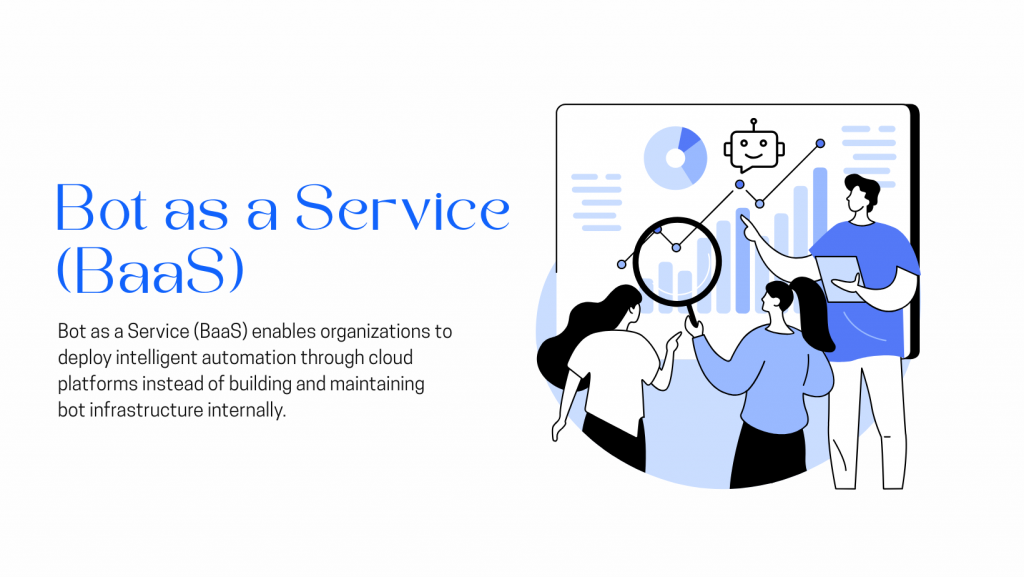
Bot as a Service (BaaS) is a cloud-based model that lets businesses deploy intelligent, AI bots through a managed platform, without building or maintaining the underlying infrastructure themselves.
Think of it like electricity. You do not build a power plant to run your office. You plug in and use what you need. BaaS works the same way for automation. You configure the workflows, define the rules, and the platform handles everything else: servers, scaling, uptime, security, and updates.
The biggest misconception about BaaS is that it is just a chatbot. It is not. A chatbot answers questions. BaaS executes business processes. There is a significant difference between a bot that says “your order is being processed” and one that actually processes the order, updates your inventory system, triggers a fulfillment workflow, and notifies your logistics team, all without a human involved.
Modern BaaS platforms connect directly with the systems businesses already run:
This means bots deployed through BaaS are not answering questions on the side. They are embedded in the actual operations of a business, handling refunds, routing approvals, scheduling appointments, updating records, and resolving service requests from start to finish.
For business decision makers, the value is straightforward: automation that previously required dedicated engineering teams and months of development can now be deployed in days, with costs tied to usage rather than infrastructure.
For technical buyers, what matters is how the platform is built. A production-grade BaaS platform delivers:
Together, these capabilities make bots function as controlled digital operators inside a business, not as standalone tools that handle one narrow task and hand off to a human for everything else.
Building intelligent bots internally is harder than it looks. It requires specialized engineering talent, long development cycles, ongoing model maintenance, and security architecture that most teams are not staffed to handle. The result is that most internal automation efforts never scale beyond a limited pilot.
BaaS removes that ceiling. Instead of treating automation as a technical project that lives in the engineering backlog, organizations can deploy it as a managed operating layer that runs alongside their existing systems from day one.
The business case is straightforward. Companies adopting BaaS are seeing measurable impact across several areas:
What makes this particularly valuable at the enterprise level is the visibility it creates. When bots are handling customer interactions, approvals, and service requests through a centralized platform, leaders get a clear picture of where processes are working and where they are breaking down. That operational intelligence is hard to get when work is scattered across people, inboxes, and spreadsheets.
The shift BaaS enables is not just operational. It is structural. Organizations stop treating bot deployments as isolated tools and start running them as core business infrastructure, the same way they treat their CRM or their payment stack. That is what turns efficiency gains into long-term competitive agility.
Most people assume BaaS is a smarter chatbot. It is not. It is an execution environment. The difference matters because one answers questions and the other completes work.
When a customer submits a refund request at midnight, a properly deployed BaaS platform does not create a ticket for someone to handle in the morning. It verifies the order, checks the policy, processes the refund, updates the record, and sends a confirmation before the customer closes the tab. That entire sequence happens across multiple systems, with no human involved, because the platform is built in layers that each have a distinct job.
1. The interaction layer is where the process begins. Customers and employees reach organizations through different surfaces: web, mobile, voice, messaging apps, internal service desks.
A production-grade BaaS platform maintains consistent execution across all of them. The channel someone uses does not change the quality or capability of what they get.
2. The intelligence layer is what separates a useful bot from a frustrating one. Real conversations are not clean. People phrase the same request ten different ways, switch topics mid-sentence, and carry context from previous interactions. This layer handles that complexity through intent recognition, session context tracking, live data retrieval, and business rule application. It is what allows a bot to tell the difference between a customer asking about a refund and one demanding one, and respond accordingly.
3. The execution layer is where BaaS creates actual business value. This is the part most organizations underestimate before they deploy it. Bots at this layer do not hand work to a human. They complete it:
4. The integration layer determines how far that execution can reach. A bot is only as capable as the systems it can access and act on. Enterprise BaaS platforms connect deeply with CRMs, ERPs, payment processors, identity services, helpdesk platforms, and internal databases. These are not read-only connections. Bots read data, write updates, and trigger downstream actions across an organization’s entire software stack.
5. The governance layer is what makes enterprise-scale deployment sustainable. Access controls, encryption, audit trails, compliance tracking, and automated escalation paths are not optional features.
They are the reason leadership can trust that automation running at scale stays within the boundaries the business sets. As bot usage grows, this layer ensures control grows with it, not against it.
Each layer depends on the one before it. Remove any one of them and what remains is either a limited tool, an uncontrolled system, or an expensive experiment that never reaches production scale. Together, they are what allow a bot to function as a reliable, governed, always-on operator inside a real business.
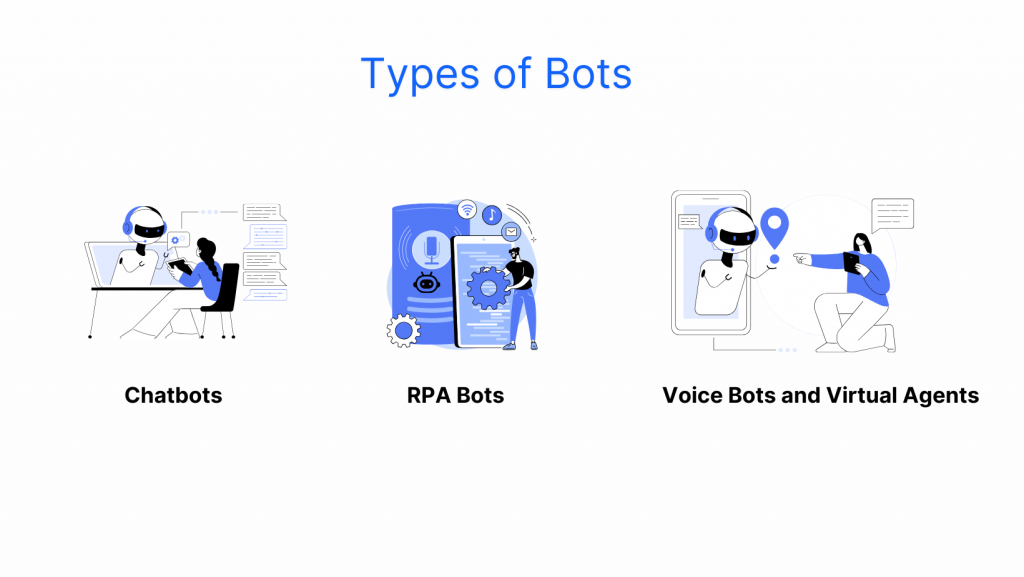
Not every business problem needs the same kind of bot. A company handling thousands of daily support requests has different requirements than a bank processing loan applications or a logistics firm managing order exceptions. Here is what each bot type actually does and where it belongs.
When most people think of a bot, they think of something that sits on a website, answers questions, and passes the conversation to a human when things get complicated. AI agents work differently.
The gap is not in how they talk. It is in what they do after. A chatbot answers. An AI agent gets the work done. It understands what someone needs, figures out the steps to resolve it, connects to the right systems, and completes the task. It can also be trained on your business data, internal policies, and processes, so it becomes more reliable the longer it runs.
What AI agents handle in practice:
RPA bots do not think or converse. They follow a fixed sequence of steps across systems, in the right order, every time. The point is not intelligence. It is that a defined process runs exactly as it should, without anyone having to trigger or watch it.
This is workflow automation in the most practical sense. A few examples of what it looks like:
Where AI agents handle the unpredictable, RPA bots handle the repetitive. Both have a clear place in a BaaS environment.
Phone support is one of the most expensive channels a business operates. Wait times grow with volume. Quality varies with staffing. Coverage collapses outside business hours. Voice bots address all three without requiring a parallel expansion in headcount.
They are not phone trees with better marketing. They understand natural spoken language and handle real transactions:
IT teams spend a disproportionate amount of time on requests that require no real judgment: password resets, access requests, software installs, basic troubleshooting. The same is true in HR, where a large share of daily queries are policy questions, leave requests, and onboarding steps that follow a known path every time.
Internal bots take that load off entirely. The people who used to handle those requests get their time back. The people making the requests get faster responses. It is one of the quieter BaaS deployments and consistently one of the most appreciated internally.
The strongest BaaS implementations do not rely on a single bot type. They run several together, each doing a different job, all sitting under one platform with consistent oversight. That is what makes the difference between deploying a bot and actually scaling operations.
The use cases where BaaS creates the clearest return share three characteristics: the work arrives in high volume, the process is already defined, and the cost of slow or inconsistent execution is directly measurable. These are not areas where businesses are experimenting. They are areas where the operational pressure was already real before any bot was deployed.
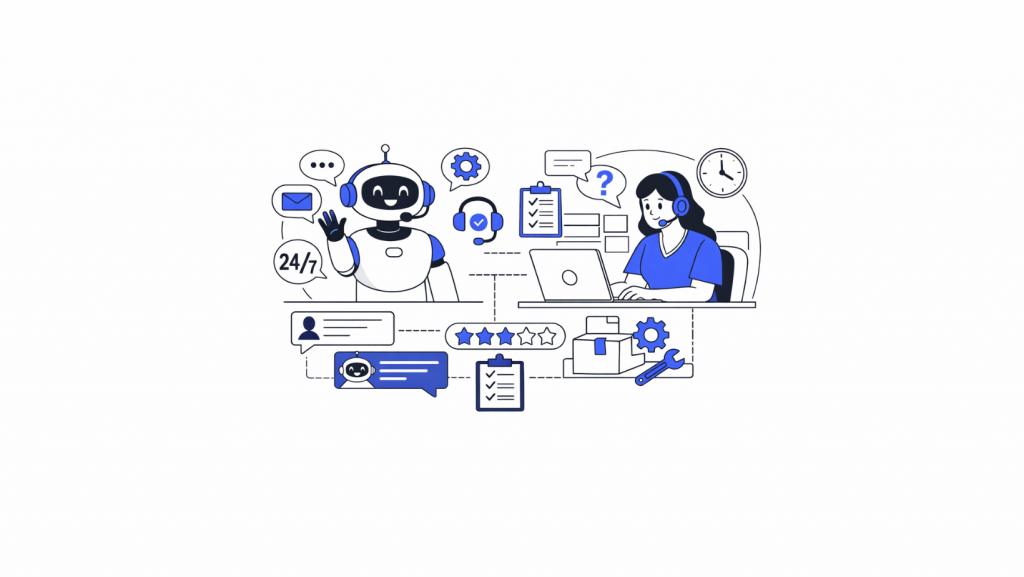
Support volume has a structural problem that hiring alone cannot solve. As a business grows, the number of repetitive, low-complexity requests grows with it, often faster than the team does. Order status inquiries, return requests, account updates, password resets: these categories represent a significant share of total ticket volume in most organizations, and none of them require human judgment to resolve.
When BaaS handles that share, the impact is not just speed. The nature of the support team’s work changes. Agents stop spending the majority of their day on requests that should never have reached them. The cases that do reach them arrive with full context already captured, so the conversation starts at the point of the actual problem rather than five minutes of information gathering.
Organizations that have deployed BaaS in customer support consistently report two outcomes: resolution times drop, and agent satisfaction improves. Both happen for the same reason: the work that was creating the most friction was never the right work for a human to be doing in the first place.
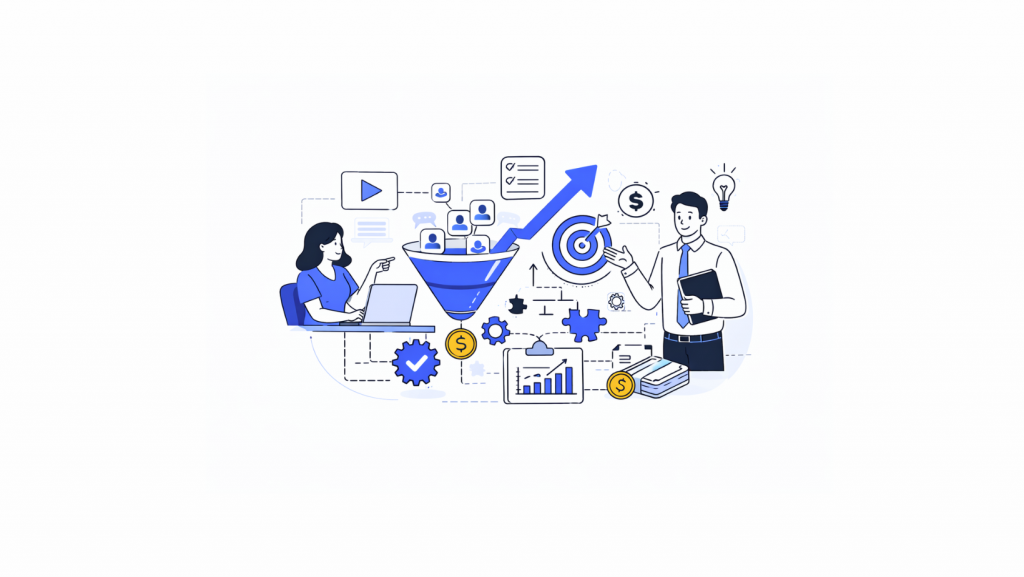
The gap between high-performing and underperforming sales teams is rarely about talent. It is almost always about time allocation. Studies consistently show that sales representatives spend less than 35% of their working hours actually selling. The rest goes to administrative work: updating CRM records, qualifying cold leads, scheduling meetings, sending manual follow-ups.
BaaS reclaims that time at the operational level. Inbound leads get qualified automatically based on behavior and data before a human gets involved. Meetings schedule themselves. CRM records update during the conversation (not an hour after it, when the rep finally has a moment to log it). Follow-up sequences run on defined triggers without anyone managing them individually.
The result is not that the team works harder. It is that a larger proportion of their working hours goes to the conversations that actually move revenue.
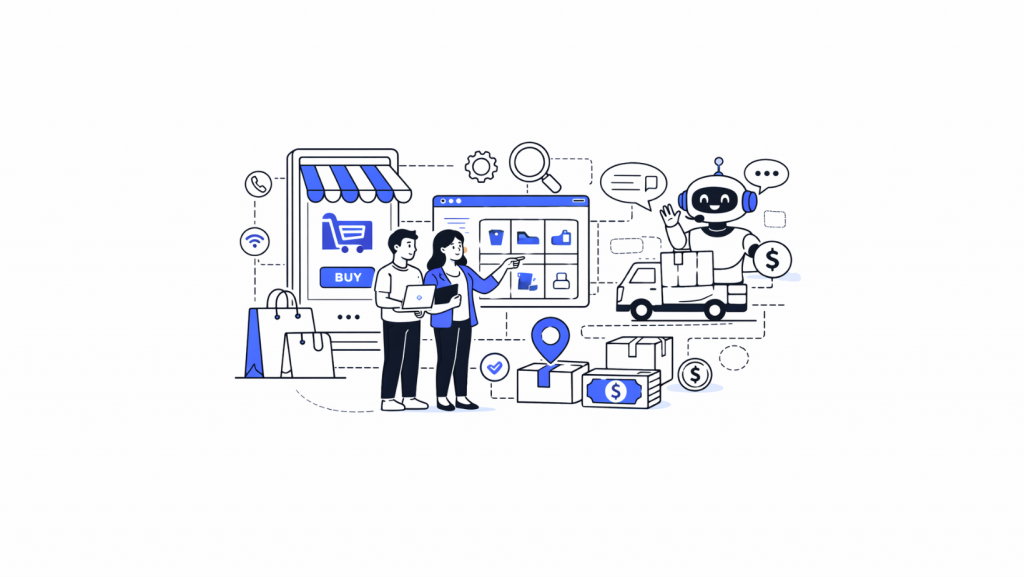
In online retail, support volume does not scale linearly with growth. A doubling of order volume typically produces more than double the support contacts, because more transactions means more delivery exceptions, more return requests, more billing questions, arriving around the clock from customers who expect a response in minutes.
BaaS connects the question directly to the data source during the conversation itself. A return gets initiated, validated against the return policy, and confirmed in a single exchange. A billing dispute gets resolved without a ticket being opened. The customer notices that it was fast and accurate. They do not need to know anything about what made it that way.
These automations reduce support load while creating smoother, faster customer experiences.
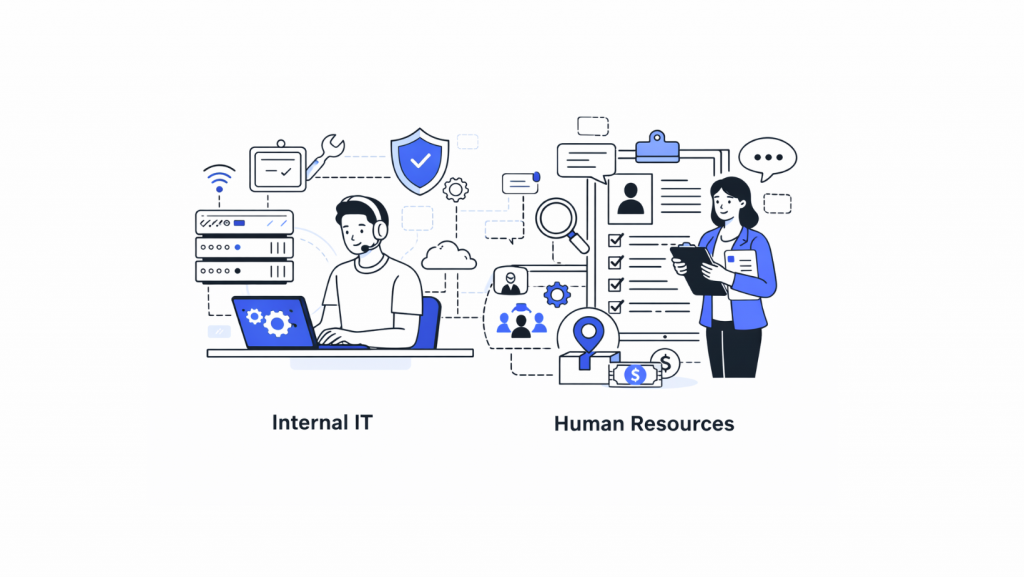
The IT helpdesk in most organizations carries a disproportionate volume of requests that require almost no judgment: password resets, access provisioning, account lockouts, software installation. HR teams field the same onboarding questions and policy clarifications on a recurring basis.
In both cases, the real cost is not just the time spent on individual requests. It is the cumulative drain on teams whose expertise is needed elsewhere. BaaS handles this work immediately and at any hour. The teams managing these requests recover meaningful capacity. The employees making them stop experiencing the delay that comes with human-dependent queues.
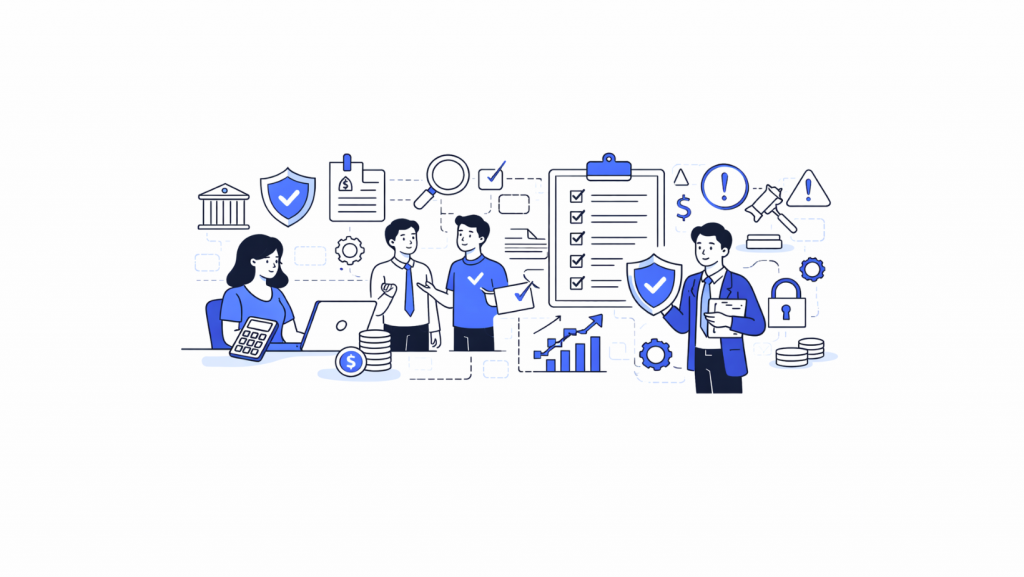
Finance has a low tolerance for error and a high requirement for documentation. Invoice matching, payment approvals, expense reconciliation, and regulatory reporting all carry real consequences when they are delayed or handled incorrectly, which is what makes them a strong fit for BaaS.
Invoices get validated and routed for approval without manual handling. Payment workflows move through the right approvers in the right sequence without anyone chasing them through email. Compliance reports get generated and filed on schedule rather than assembled manually under deadline pressure.
The finance team is not removed from the process. They are just no longer spending time on the parts that never required a finance professional to begin with.
Across all these areas, BaaS enables organizations to automate entire workflows rather than isolated tasks, creating measurable efficiency gains while maintaining service quality and operational control.
Most BaaS deployments that underdeliver do not fail because the technology did not work. They fail because of decisions made before the first bot went live. Understanding where the real friction comes from is more useful than a generic list of risks.
This is the challenge most vendors understate during the sales process. BaaS platforms come with pre-built connectors, and those connectors work well when the systems on the other end were built in the last decade. Many enterprise environments were not.
Legacy systems often have no APIs, or APIs that were bolted on later and behave inconsistently. Data structures differ between platforms in ways that are only discovered during testing. A field called “customer ID” in one system maps to something else entirely in another. Workflows that seemed straightforward on a whiteboard reveal dependencies nobody documented because nobody needed to document them until now.
None of this is insurmountable, but it takes longer than most organizations plan for. The integrations that look simple in a demo are sometimes the ones that consume the most time in production.
A bot that can read and write across your CRM, payment platform, HR system, and customer database is genuinely useful. It is also a significant attack surface if the governance around it is not thought through carefully.
The specific risk is not that BaaS platforms are insecure. Most enterprise-grade platforms have strong security architecture. The risk is in how they are configured. Bots granted broader access than they need, audit trails that are not reviewed, data passed through integrations without encryption at every point in the chain. These are configuration decisions, not platform failures, and they tend to happen when security is treated as something to handle after deployment rather than before it.
Organizations operating under GDPR, HIPAA, or financial compliance frameworks have an additional layer of complexity here, because the bot becomes part of the compliance perimeter whether it was designed to be or not.
There is a version of this that surprises almost every organization at some point. A bot is deployed, performs well in testing, goes live, and then six months later starts giving wrong answers. Not because it broke. Because the business changed and nobody updated it.
A pricing structure changed. A return policy was amended. A new product launched with different support requirements. Bots do not read internal memos. They operate on what they were trained on, and when the underlying reality shifts, their responses drift from accurate to confidently incorrect.
This is the maintenance reality that rarely gets discussed in implementation conversations. BaaS is not a deployment. It is an ongoing program. The organizations that treat it that way, with a defined process for reviewing and updating bot behavior when business processes change, consistently outperform the ones that treat go-live as the finish line.
When a bot takes over a workflow that a person used to own, that person does not automatically redirect their energy to something more valuable. In practice, they often feel uncertain about their role, protective of the process they managed, or simply unsure what they are supposed to be doing now.
This is not a technology problem and it cannot be solved with a training session. It requires honest communication about why the change is happening, what it means for individual roles, and who owns the automation program going forward. Teams that were not involved in the deployment decision are the least likely to trust or effectively use what was built for them.
The organizations that handle this well bring the relevant people in early, define clear ownership over bot performance, and treat adoption as an outcome to be managed rather than a natural consequence of going live. The ones that skip this step often find themselves with a functional bot that nobody uses the way it was intended.
The common thread across all of these is timing. Every one of these challenges becomes significantly harder to address after deployment than before it. The businesses that get the most out of BaaS are the ones that treat the hard questions as part of the implementation, not as problems to solve once something goes wrong.
The platform decision shapes everything that follows: how fast deployment happens, how deep integrations go, and whether automation scales without breaking. Six areas worth evaluating carefully before committing.
Most platforms start with simple question-and-answer flows. Real enterprise automation needs complete workflows across tools, built-in logic for conditions and approvals, and the ability to trigger actual actions from within a conversation. That is what separates a capable platform from a glorified FAQ tool.
Pre-built connectors matter, but the real question is how the platform behaves when it encounters something outside the standard list, which in most enterprise environments is inevitable. This is where the gap between vendor demos and production reality tends to show up first.
A bot connecting to your CRM, payment platform, and HR system is part of your security perimeter whether you designed it that way or not. The question to ask vendors is not whether they have compliance features. It is whether compliance is part of the default architecture.
A platform that handles a hundred daily conversations well but struggles at ten thousand is not a problem you want to discover six months in. Reliable uptime, automatic load handling, and real performance dashboards separate platforms that grow with the business from ones that need constant engineering attention as usage increases.
Resolution rates, failure points, and cost impact are the metrics that matter. Analytics showing where conversations break down are often more actionable than aggregate success numbers. If a platform’s reporting mostly shows uptime and message counts, that is a signal worth paying attention to.
Business processes change constantly. If every update requires a development ticket and a two-week cycle, the bot falls behind the business it is supposed to serve. Visual builders and low-code tools determine whether the team responsible for automation can actually own it, or remains permanently dependent on engineering.
Selecting a BaaS platform is not purely a technical decision. It determines how quickly teams adopt automation, how confidently the business can scale it, and whether it remains maintainable two years after the initial deployment. Platforms that look identical in a demo often diverge significantly in production.
The businesses that will look back on this period and say automation genuinely changed how they operate are not the ones that moved fastest. They are the ones that were honest about what they were solving before they deployed anything.
BaaS has matured to the point where the technology is rarely the limiting factor. The platforms available today can handle complex workflows, connect deeply with enterprise systems, serve customers across every channel, and improve over time. What separates organizations that extract real value from those that end up with an underused bot is not the platform they chose. It is whether they started with a real operational problem or started with the desire to have automation on the roadmap.
The companies seeing measurable returns treated BaaS the same way they treat any serious infrastructure decision: clear ownership, defined outcomes, honest measurement, and a process for improving what is not working. The ones who did not have something to show for it six months later usually skipped one of those steps.
What has also become clear is that isolated deployments have a ceiling. A bot that handles one workflow in one department delivers limited value. The same platform running across customer support, internal operations, sales, and finance, all connected to the same systems, all visible through the same governance layer, delivers something categorically different. That is when automation stops being a feature and starts being how the business runs.
YourGPT was built for that second category. Not as an entry point into automation, but as the platform organizations graduate to when they have outgrown point solutions and need something that scales with the complexity of a real business.
The operational advantage in the years ahead will not belong to the companies with the most bots. It will belong to the ones that built automation into how they actually work, and had the discipline to keep improving it.
TL;DR A Messenger AI agent helps businesses respond to Facebook Page DMs faster, answer customer questions using business data, and guide visitors toward the next step. With YourGPT AI for Messenger, businesses can enable 24/7 auto-replies, rich messages, multilingual support, human handoff, an omnichannel inbox, and no-code workflow automation. Facebook Page DMs are often where […]
Proactive AI is not a new category. It is just a shift in how you use the systems you already have. Instead of waiting for a customer to ask for help, you step in earlier, when the signal is there, but the request has not happened yet. Most teams are still reacting. A ticket comes […]
TL;DR An AI agent for gyms helps fitness businesses capture website leads, answer routine member questions, support trial bookings, guide class enquiries, and hand complex conversations to staff with context. The best setup uses approved business knowledge, clear escalation rules, CRM or workflow connections, and safe human handoff so gyms can reduce missed enquiries, improve […]
TL;DR Building a WooCommerce AI chatbot takes about 10 minutes and requires no coding. With YourGPT, you can train the chatbot on your store data, connect WooCommerce using REST API and webhooks, answer product and order questions, capture leads, support cart recovery, and extend the same AI assistant across your website, WhatsApp, Instagram, and other […]
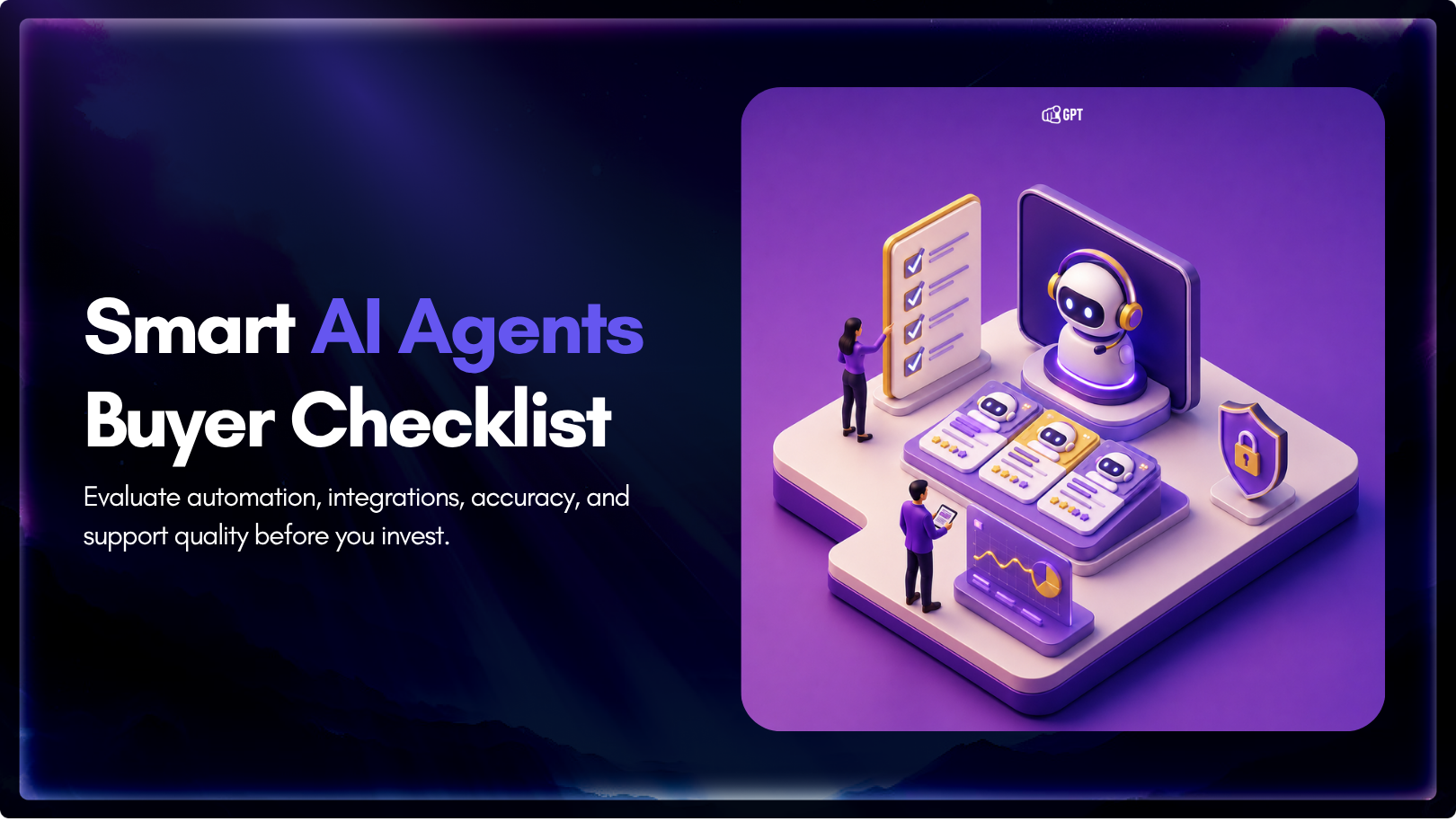
TL;DR AI agents are becoming part of everyday business operations across customer support, sales, onboarding, and internal workflows. In customer support, they are commonly used to answer questions, automate billing support, track orders, handle repetitive requests, collect information, route conversations, and assist human agents with context and actions. Some platforms focus mainly on conversational replies, […]
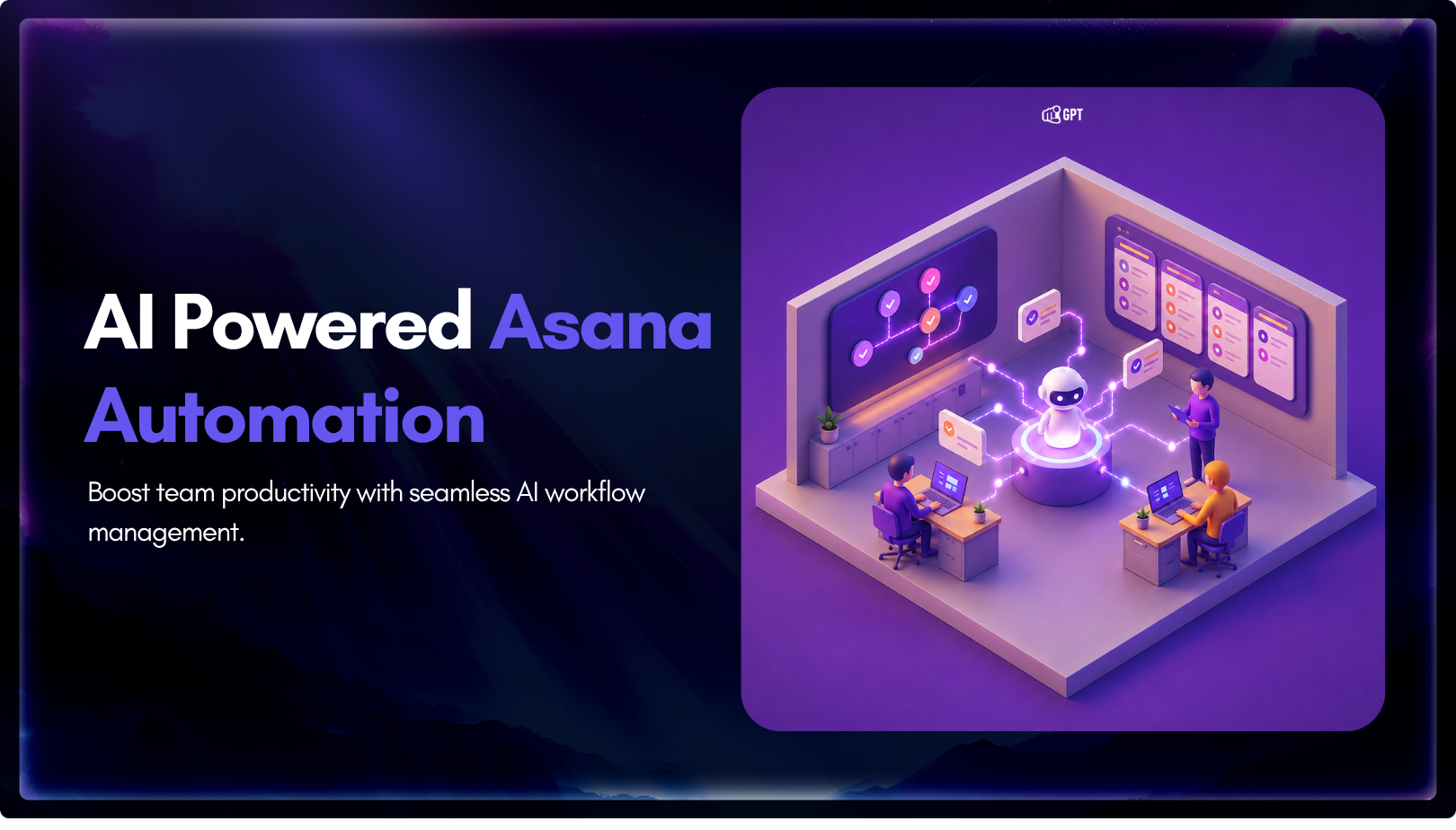
TL;DR YourGPT and Asana work best together when conversations can turn into structured tasks without manual handoff between support, ops, or project teams. You can connect them through Asana MCP, YourGPT AI Studio, or viaSocket, depending on whether you need agentic control, custom workflow logic, or a fast no-code setup. Start simple: use one clear […]