Best AI Customer Service for Jewelry & Luxury Brands (2026)

Rajni
November 23, 2026
Look for AI customer service that answers only from your product and policy pages, acts in your own order and booking systems, and holds its price from November to February. Helpdesks, live chat and chatbots each cover part of that, while an AI agent such as YourGPT answers, sells and acts from one set of trained pages. Before you buy, run 10 real tickets through two or three trials, including an engraved return and an arrive-by gift, and check each answer against the product page and policy it should have read.
A shopper buying an engraved bracelet as an anniversary gift asks two questions before paying: will it arrive in time, and can it come back if the size is wrong. The answers sit in two places: the production schedule and the personalized-items policy. A bot that answers from a general FAQ gets at least one wrong. The cost is a return, or a gift that misses its date.
AI customer service for a jewelry brand is an agent that answers product, sizing and policy questions from your own pages, takes order and return actions, and hands consultations, repairs and high-value questions to a person.
We compared 10 AI customer service tools for jewelry and luxury brands on the same six jobs, using each vendor’s product and pricing pages in November 2026. If you are still deciding which jobs to automate first, map them with our guide to ecommerce customer service with AI agents. The first step is what jewelry support needs from an AI agent, because each item becomes a line in your trial.
A jewelry store’s order line carries the facts that decide what the AI may say. Take “Signet ring, 14K solid gold, size 7, engraved initials, made to order.” Metal limits allergy and tarnish claims, while the size opens an exchange or a paid resize. Engraving can turn a return into store credit, and made-to-order sets the earliest delivery date it can promise.
Those fields become six jobs, and we judge every tool below on them.
Luxury brands add three demands on top of these jobs. A returning client expects to reach the same advisor, so the AI has to recognize the client and route the chat with its history. Boutique and video appointments need a real booking, and international buyers ask in their own language and expect their region’s sizes, duties and delivery cut-offs.
Each tool below handles some of these jobs and leaves the rest to another product, another bill or a person. The four kinds of support tools show where the gaps fall.
Every support tool a jewelry brand buys is one of four kinds, and each kind handles a different part of the sizing, gifting and repair work above.
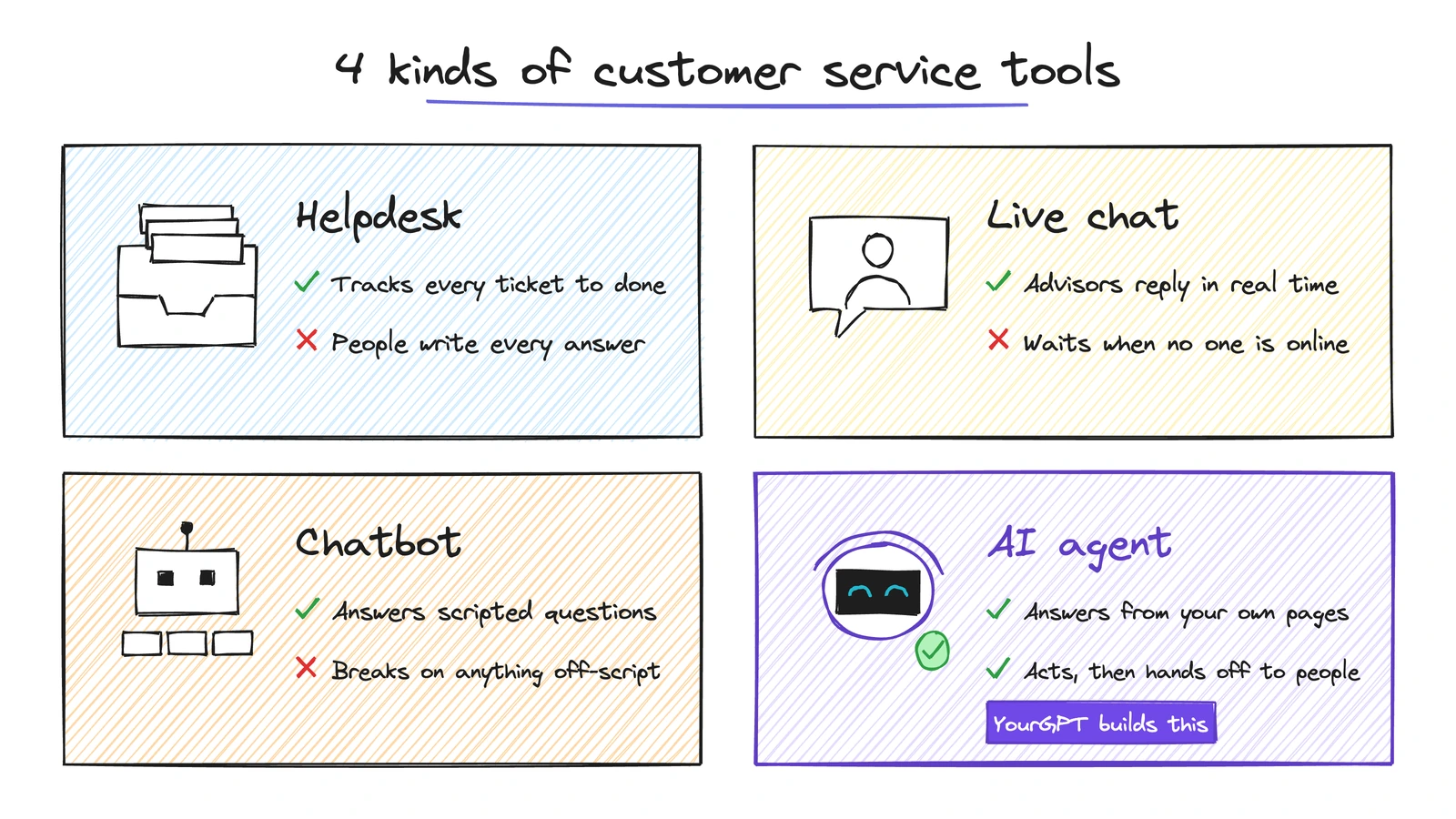
A helpdesk turns every email, chat and DM into a ticket with an owner, a status and a deadline. It keeps a resize or a repair from getting lost over the days it takes. People still write each answer, so a sizing question that arrives after hours waits for the morning shift.
Live chat puts your advisors in a chat window on the site, replying in real time. It suits the moments a luxury buyer wants a person: a bespoke engagement ring, a high-value gift or a stone they want explained. It works only while someone is online, and a gifting peak builds a queue fast.
A chatbot follows a script of buttons and keyword answers that someone wrote in advance. It handles fixed questions such as store hours or the standard shipping time. Ask it “Can this ring be resized to a 7 before February 14?” and it falls back to a menu or a contact form.
An AI agent reads your product, policy, size and care pages, understands the question in the shopper’s own words and answers in your tone. The agent also acts: it looks up the order, starts the exchange or books the appointment, then hands repairs and consultations to a person with the thread attached. YourGPT is built as this kind of tool.
You can run more than one: the AI agent answers and acts first, while live chat and the helpdesk take the conversations that need a person. Every tool in this comparison adds AI to one or more of these kinds, and each profile below says which.
YourGPT comes first, and the other nine follow in the same order as the comparison table after them.

Best for: Jewelry and luxury brands that need one agent to answer, sell and act across web chat, social, SMS and phone.
YourGPT is a no-code AI agent platform for customer service, sales and operations. It trains on product pages, policy pages, size and care guides, PDFs, help centers, Notion and Google Drive. One agent answers on the website, WhatsApp, Instagram, Messenger, Telegram, email, SMS and phone in over 100 languages. YourGPT is SOC 2 Type II and ISO 27001 certified and GDPR compliant, which matters when a chat stores a name, an email or an order number.
For a jewelry brand, the Agent Prompt (Bot Persona) in Agent Settings holds your house tone and its restrictions, such as never calling a plated piece nickel-free. Shopify Real-time Sync keeps products and customers current, so a 14K gold vermeil listing reaches the AI as the page states it. Workflows in AI Studio let a styling agent and an aftercare agent pass context, and the Request Human button, keyword Quick Replies or AI Studio routing hand repairs and consultations to a person.
Advanced workflows in AI Studio take configuration, and a small studio will start with the no-code setup and leave most of AI Studio for later. YourGPT does not run ticket SLAs or escalation timers, so a team that depends on them keeps its helpdesk.
YourGPT pricing lists Essential at $39, Professional at $79 and Advanced at $349 a month billed annually, or $59, $129 and $499 monthly, with Enterprise on a custom contract. Plans include 10 million, 30 million and 100 million AI Credits, with no fee per message or per resolution, and credit use depends on the model. Functions, API and webhook support, AI Studio, Self Learning and Escalate to Human start on the Professional tier. If you need automated order lookups and repair intake, price the Professional plan.
Best for: Shopify jewelry stores that run support in Gorgias and want AI in the same inbox.
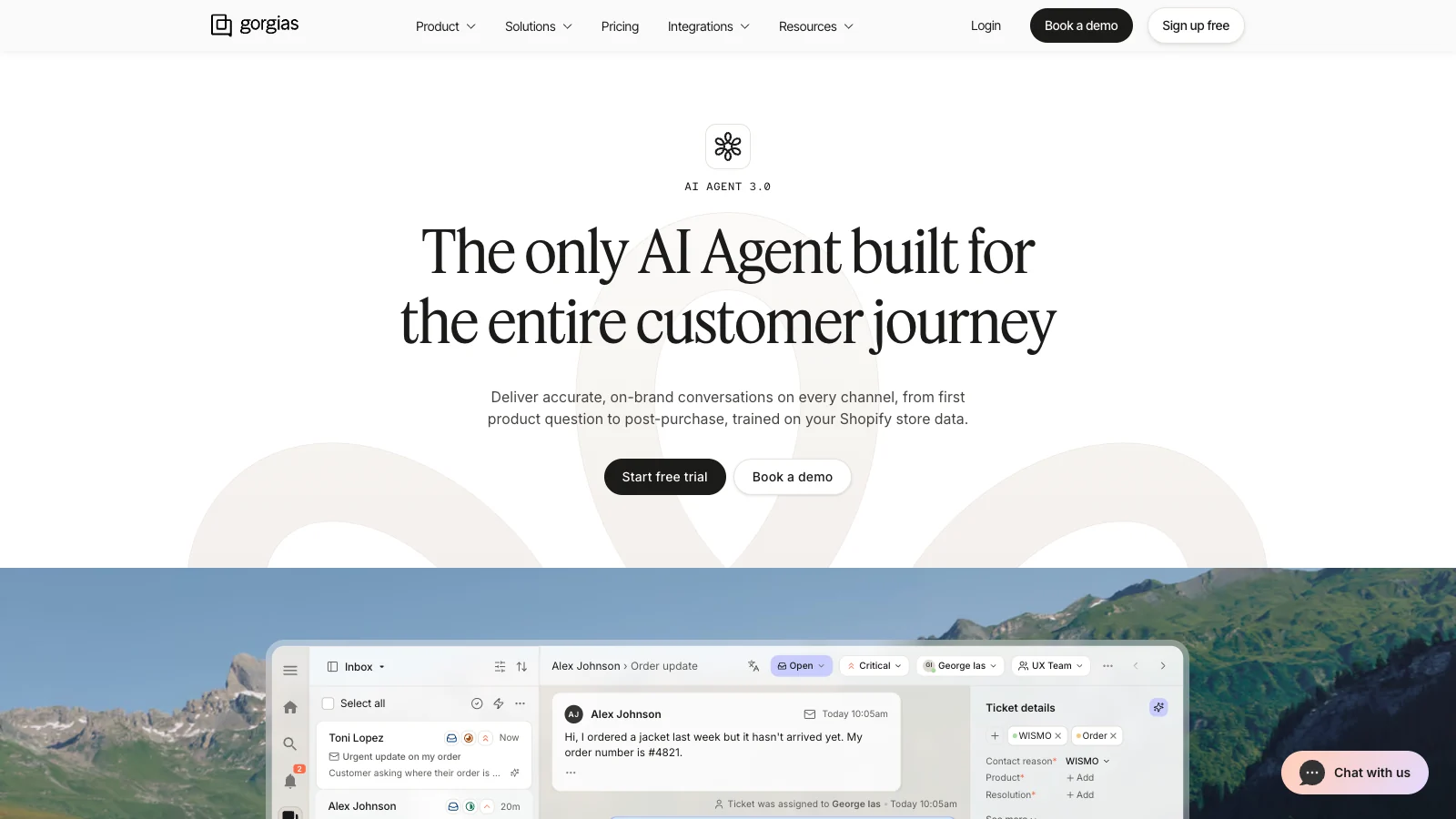
Gorgias is a Shopify-first ecommerce helpdesk with an AI Agent for support and a Shopping Assistant for pre-sales. Gorgias answers from Shopify order data and live inventory once connected. One inbox handles email, chat, SMS, voice and social, with handoff to people.
Gorgias covers order questions and product answers from the connected Shopify catalog, which suits a jewelry store that already works its tickets there. To see how tickets and AI resolutions add up in a busy month, model the combined Gorgias bill.
An AI-resolved interaction also counts as a helpdesk ticket, so a busy month produces two overlapping charges. Per-product return rules need to be specific in the product source, or the agent defaults to the general policy, which can confuse an engraved-item return with a standard return.
Gorgias pricing monthly: Starter $10 for 50 tickets, Basic $60 for 300, Pro $360 for 2,000, Advanced $900 for 5,000. Annual: Basic $50, Pro $300, Advanced $750. Enterprise is custom. AI resolutions cost $0.90 on annual plans and $1.00 monthly.
Best for: Luxury houses whose client records sit in Salesforce Service Cloud and Commerce Cloud.
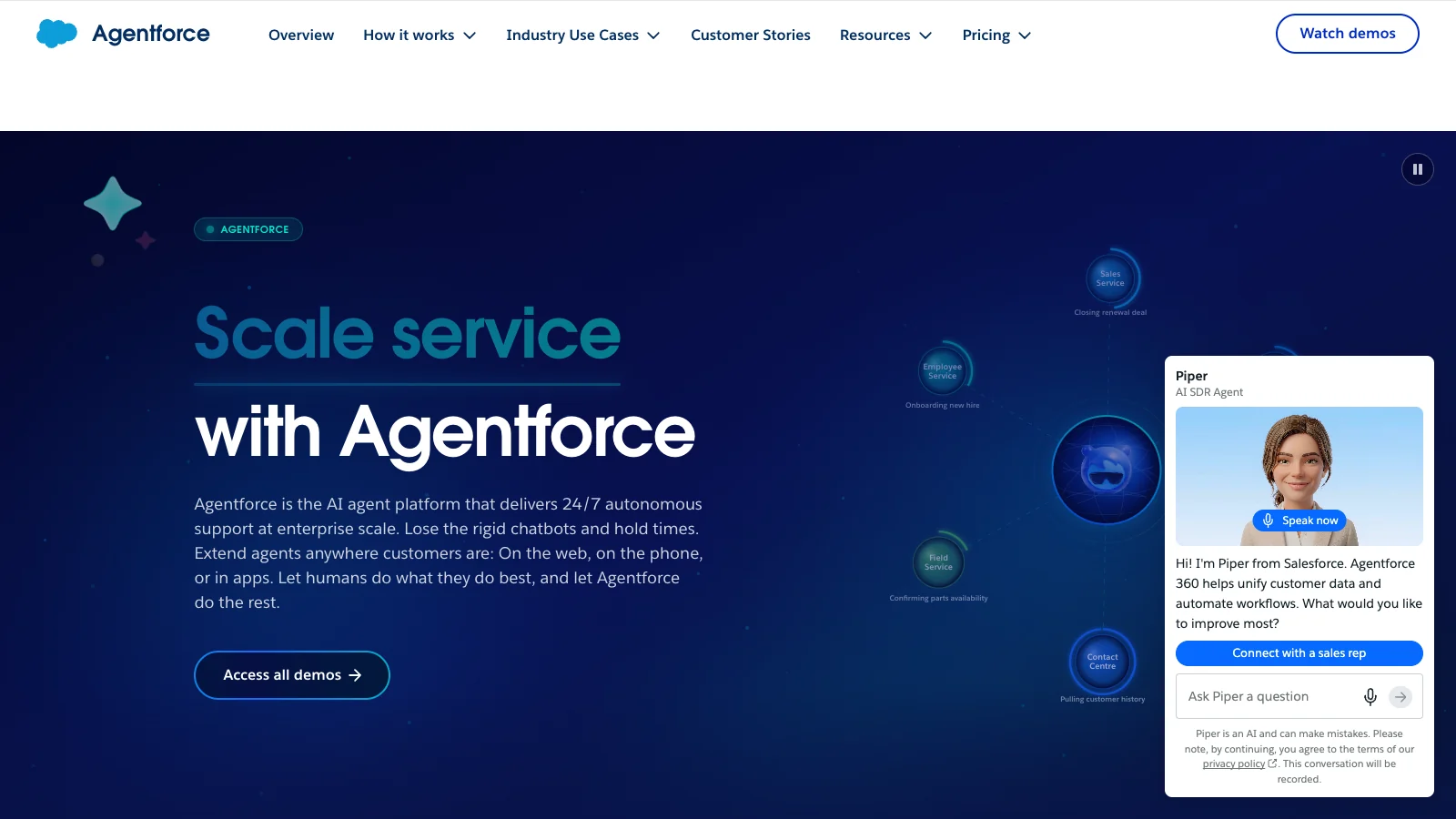
Agentforce runs shopper and service agents side by side on the Salesforce platform. They read Service Cloud and Commerce Cloud data, while Data 360 and MuleSoft bring outside systems into the conversation. Handoff to a person includes a written conversation summary. Tone controls shape the agent’s voice to match the brand.
Houses that keep client and order records in Salesforce get agents that read those records directly. Separate shopper and service agents keep a pre-sale question and a care question in their own workflows.
Agentforce requires the Salesforce stack and often an implementation partner. There is no native Shopify connector, so a DTC brand on Shopify would need middleware to connect product and order data. The $2 per conversation cost is easy to forecast but adds up at gifting-season volume.
Agentforce pricing is $2 per conversation, or Flex Credits at $500 per 100,000 credits. The two billing modes cannot be used in the same org. Unused Flex Credits do not roll over.
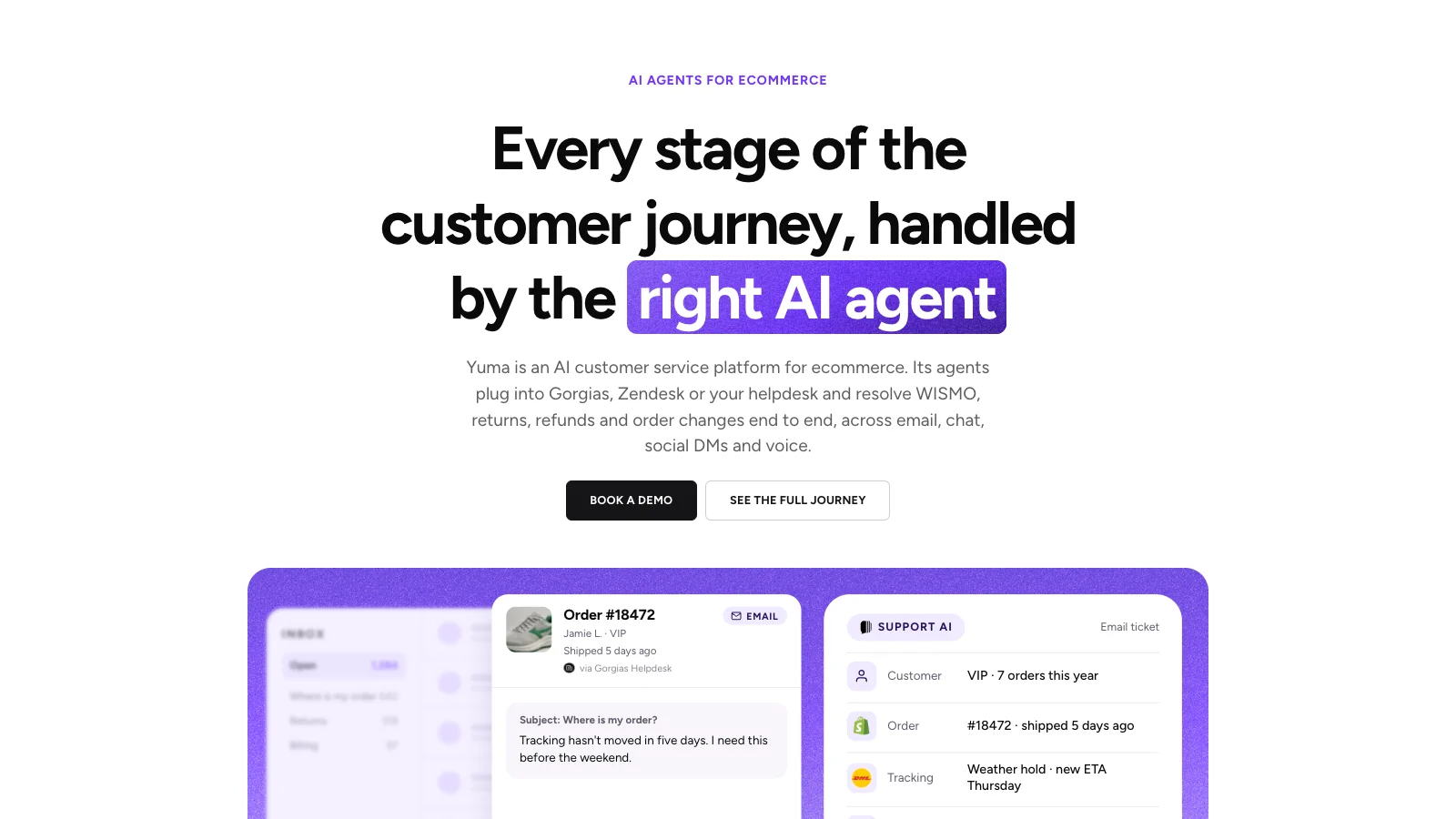
Best for: High-volume jewelry support teams that pay per resolved ticket on top of their helpdesk.
Yuma is an automation layer on top of an existing helpdesk. It handles order tracking, FAQs, product recommendations, order modifications and returns. Yuma bills only fully resolved tickets, and conversations and escalations are free.
Its 30-day trial runs on real tickets, so a jewelry team can test engraved returns and arrive-by questions before it signs.
The $14,400 annual starting cost and the separate helpdesk bill make Yuma a poor fit for a small brand.
Yuma pricing is Starter $14,400 a year for 12,000 resolutions (about $1.20 each), Growth $40,000 a year, Scale $90,000 a year.
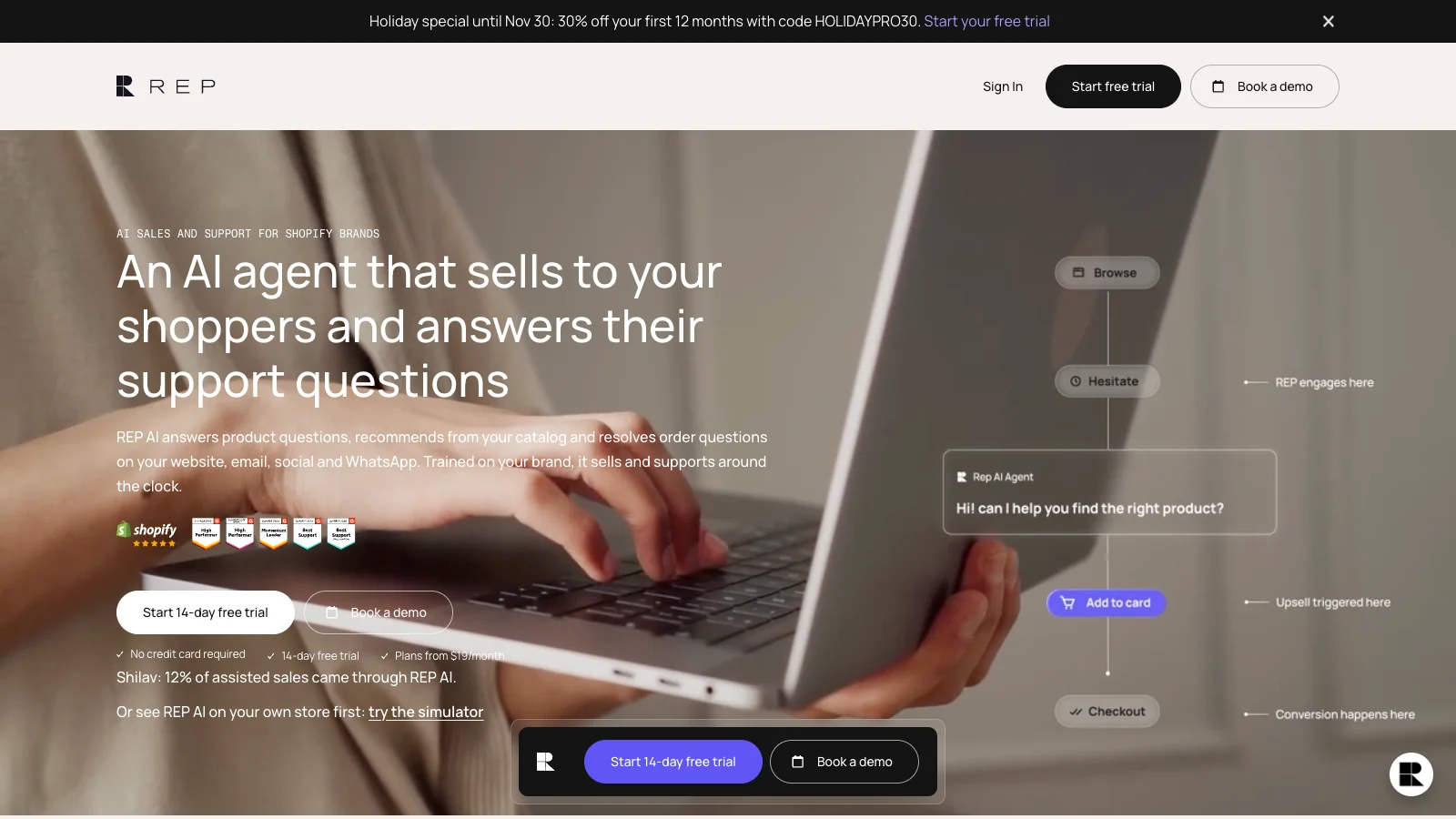
Best for: Shopify jewelry stores that sell through storefront chat and pay by monthly sessions.
Rep AI is a Shopify-focused sales and support assistant on the storefront. It integrates with Gorgias for the helpdesk side, while email, Instagram, Messenger and WhatsApp AI are paid add-ons. Rep AI prices plans by monthly website sessions up to 500,000, with custom pricing above that. It offers a 14-day free trial.
Rep AI answers pre-sale questions on the product page, where a shopper compares metals and sizes before adding to cart. A store that also sells in Instagram or WhatsApp DMs needs its channel add-on as well.
Channel AI for email, Instagram, Messenger and WhatsApp is a paid add-on with its own per-resolution cost, so a brand that sells across channels pays two layers.
Rep AI pricing entry band up to 3,000 sessions: Support $15, Sales $29, Concierge $37 a month billed annually ($19, $39, $46 monthly). Channel add-on is $0.75 per AI-resolved conversation ($0.50 yearly). Overage is $1.20 per resolution, pausing at a $1,000 reserve.
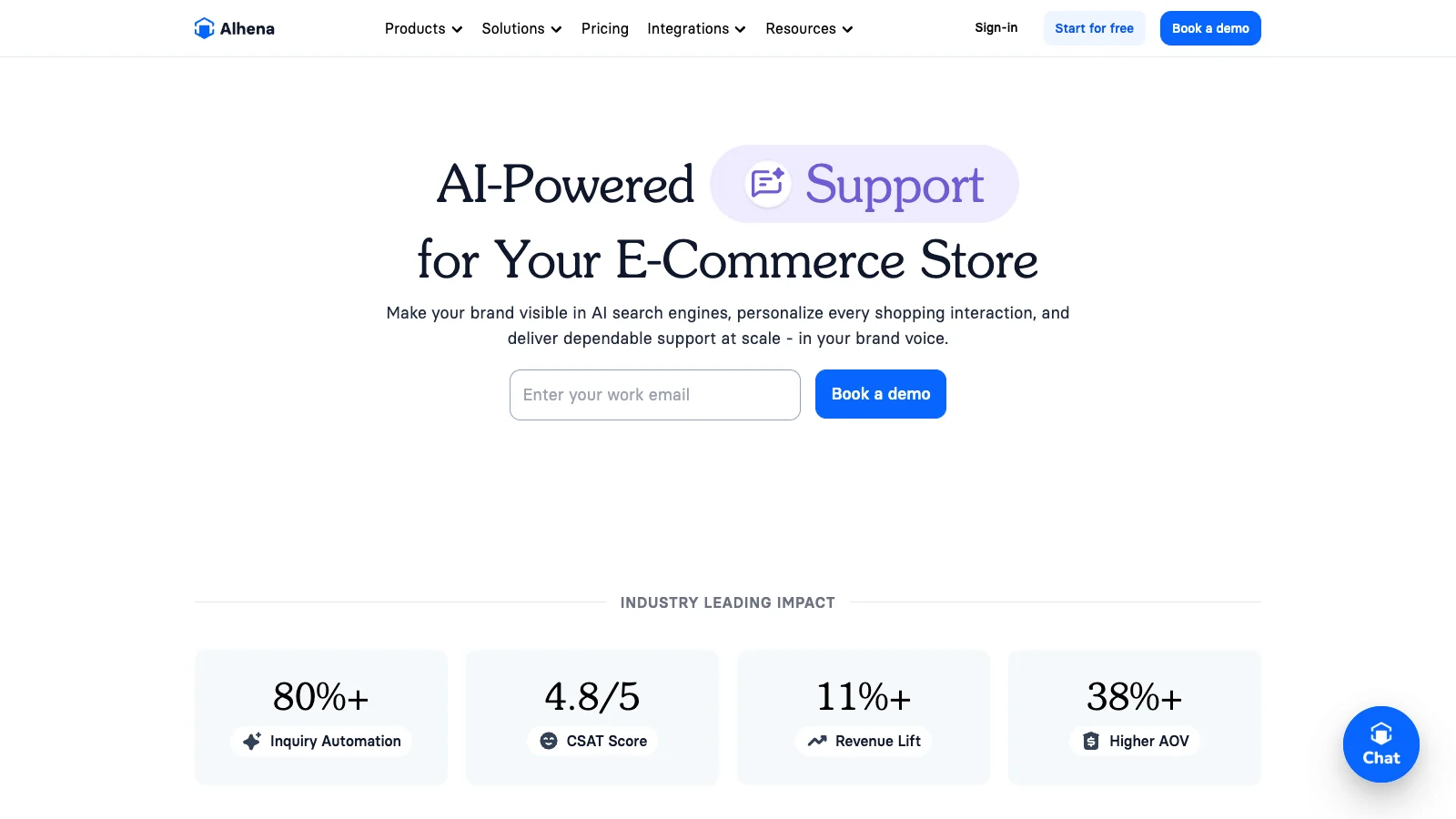
Best for: Luxury jewelry brands that sell through styling advice as much as support.
Alhena runs a main agent alongside AI Stylist and Fit Assistant sub-agents. It connects to order management, the catalog, the knowledge base and the helpdesk. Complex client relationships stay with client service.
Its stylist sub-agent guides a shopper through a collection by occasion, budget and metal, which fits a luxury brand that sells through advice.
Per-conversation cost is high for a high-volume, low-price catalog, which spends a larger share of each sale on automation. Extra credits cost $1.20 each and do not roll over, so a busy month of short chats runs past the included conversations.
Alhena pricing billed annually: Essentials $199 a month for 200 conversations, Growth $499 for 550, Scale $999 for 1,200, Enterprise custom with unlimited conversations. Extra credits cost $1.20 and do not roll over. Alhena uses a credit when the AI resolves or assists.
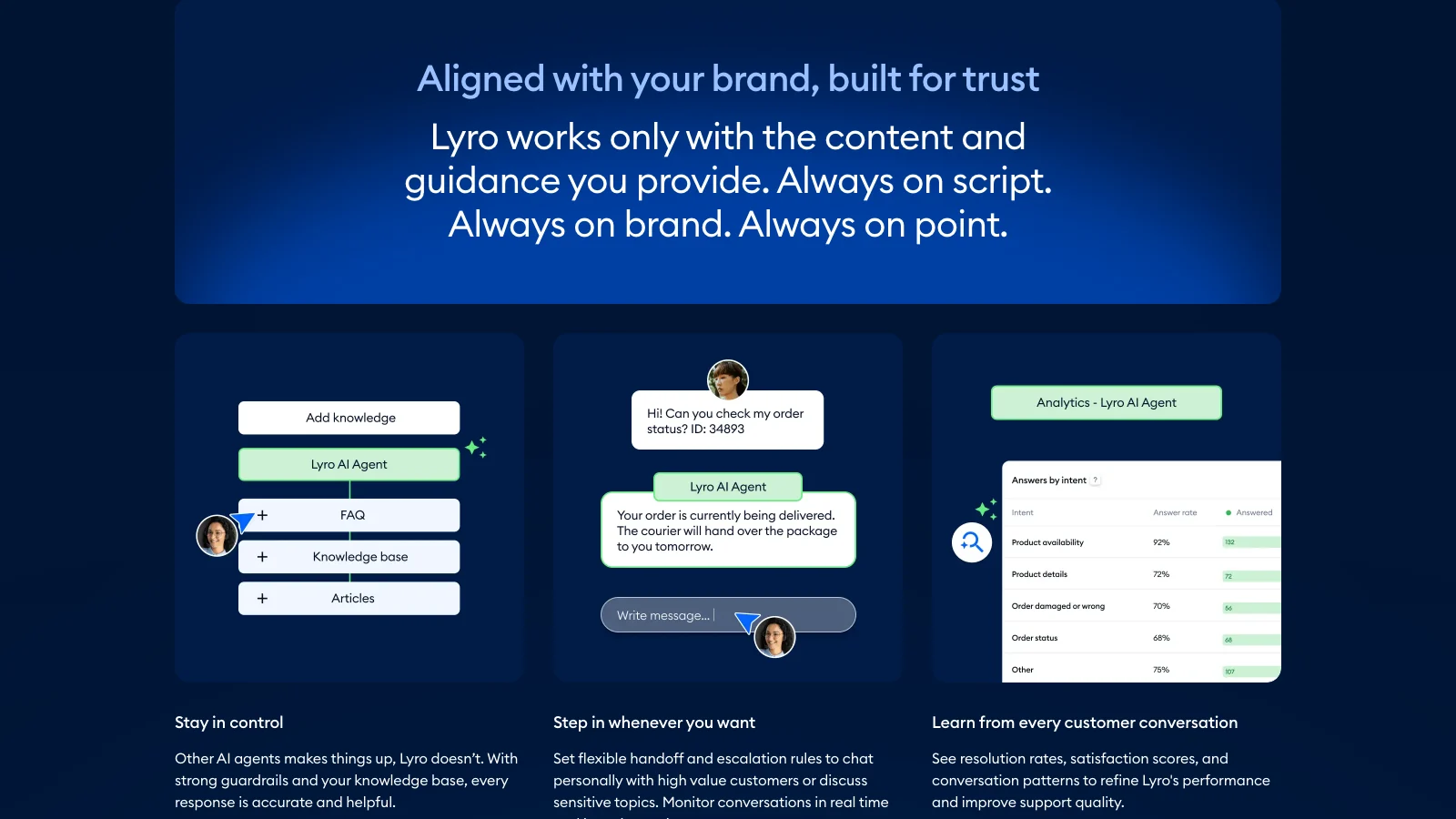
Best for: Small jewelry teams that need site chat without a full helpdesk.
Tidio is a small-business chat and helpdesk with the Lyro AI agent, built for small teams on site chat. Lyro answers order-status and pre-sale questions from your knowledge base.
A small jewelry store gets AI answers on site chat at a low entry price, then adds Lyro packs as gifting volume grows.
Starter’s Lyro conversations are one-off, so a busy gifting month needs the Lyro add-on. Premium advertises a “Guaranteed 50% Lyro AI resolution rate” and lists its price on request.
Tidio pricing Starter is $24.17 a month billed annually with 50 one-off Lyro conversations. The Lyro add-on starts at $32.50 a month for 50 conversations. Premium is pay-per-resolution; contact for price.
Best for: Shopify jewelry stores with a helpdesk that want ticket automation in their own voice.
Siena is a Shopify-focused layer on a helpdesk. Siena answers from the catalog and policies in the brand’s voice and automates tickets.
Siena’s brand voice suits a luxury or editorial tone, and it automates order-status and return tickets inside the helpdesk. It fits a mid-size team with enough ticket volume to justify a platform fee.
Siena charges the $750 monthly platform fee before it automates a single ticket, and you pay for the helpdesk underneath separately. At low volume, $0.90 per automated ticket plus that fee makes each interaction expensive.
Siena pricing is $750 a month plus $0.90 per automated ticket.
Best for: Jewelry brands with a store network already running support on Zendesk.
Zendesk puts AI agents inside Zendesk Support and Suite plans. An unfinished AI conversation stays a ticket in the same queue. Each plan includes a monthly allowance of automated resolutions.
With boutiques and an online store on Zendesk, AI conversations stay in the same queue, SLAs and reporting as human tickets. To see seats and resolutions as one bill, review Zendesk AI agent pricing.
Seat-based pricing plus per-resolution overage creates two cost layers. Adding a new support agent increases the base cost. At gifting-season volume, resolutions past the included allowance add up.
Zendesk pricing Support Team $19, Suite Team $55, Suite Professional $115 per agent a month billed annually. Zendesk bills extra automated resolutions on top.
Best for: Luxury houses with large advisor teams moving phone calls into messaging.
LivePerson runs the Conversational Cloud for messaging, including Apple Messages for Business. The platform routes VIP clients to a concierge team and moves phone conversations into messaging. Automated status updates reach clients through messaging channels. LivePerson’s site says it has been acquired by SoundHound AI.
A luxury house with a large client-services team uses LivePerson to move phone volume into messaging threads, with VIP clients routed to a concierge team.
LivePerson publishes no rate card, so you cannot compare its cost until you ask for the billing unit.
LivePerson quotes each contract. Ask whether the unit is a conversation, a seat or a program fee, then run your November to February volume through it.
We kept this list to ten. Our electronics retailer comparison reviews Fin, Sierra, Zowie, Gladly, Ada and Kustomer, and the 10-ticket test works for any of them. With each tool described, the table below puts all ten side by side.
Each row sets a tool’s type, best fit and billing unit next to the others, so you can rule out any tool that does not match your store.
| Tool | Type | Shortlist for | Billing unit |
|---|---|---|---|
| 1. YourGPT | AI agent | One agent on web, social and phone | AI Credits, actions from $79 a month |
| 2. Gorgias | Helpdesk with AI | Shopify brands on one helpdesk | Tickets plus $0.90 to $1 per AI resolution |
| 3. Salesforce Agentforce | AI chatbot in a CRM | Houses already on Salesforce | $2 per conversation or Flex Credits |
| 4. Yuma AI | AI layer on a helpdesk | High-volume teams on a helpdesk | From $14,400 a year |
| 5. Rep AI | AI chat for the storefront | Shopify brands buying by sessions | Session plans from $15 a month |
| 6. Alhena AI | AI chat for the storefront | Luxury brands that want a stylist | From $199 a month |
| 7. Tidio | Live chat with AI | Small teams on site chat | Starter $24.17 a month plus Lyro |
| 8. Siena AI | AI layer on a helpdesk | Shopify brands with a helpdesk | $750 a month plus $0.90 per ticket |
| 9. Zendesk | Helpdesk with AI | Store networks on Zendesk | Seats from $19 plus resolutions |
| 10. LivePerson | Live chat and messaging | Teams moving voice to messaging | Quote-based |
The billing column prices each tool on its own, while one jewelry customer can need three of them between the first question and the repair.
A jewelry conversation crosses jobs: a sizing question becomes a sale, then an exchange, then a repair request. With a helpdesk, live chat and a chatbot side by side, those steps live in different products and bills. A shopper asks about ring sizing, adds a made-to-order piece to the cart, and later contacts support about a delayed shipment. In that journey, the customer can touch a sales assistant, a helpdesk agent and an automation layer, each on its own bill.
With YourGPT, the same agent answers the sizing question, looks up the order and books the repair, from one set of trained pages and on whichever channel the shopper used.
| Job | YourGPT | What the other tools need |
|---|---|---|
| Pre-sale and support | One trained agent answers product questions and order questions | A sales assistant plus a helpdesk agent, such as Gorgias AI Agent with Shopping Assistant, or Rep AI with a helpdesk |
| Actions in your systems | Functions, REST APIs, webhooks and MCP call your order, repair or booking system | Agentforce works inside the Salesforce stack; Yuma and Siena act inside the helpdesk they sit on |
| Channels | Website, WhatsApp, Instagram, Messenger, Telegram, email, SMS and phone from one agent | Rep AI sells email, Instagram, Messenger and WhatsApp AI as an add-on |
| Billing at the gifting peak | AI Credits with no per-resolution fee | $0.90 to $1 per resolution on Gorgias, about $1.20 on Yuma, $750 a month plus $0.90 a ticket on Siena, $2 a conversation on Agentforce |
| Specialist agents | AI Studio lets a styling agent and an aftercare agent pass context | Alhena runs stylist and fit sub-agents for sales; Agentforce runs shopper and service agents inside Salesforce |
Our agents resolve up to 90% of repeated queries, because they answer from the pages you train them on and act through the systems you connect. In jewelry, the repeated queries are order status, sizing, care and returns, so start there.
Ticket SLAs are the one job we leave to a helpdesk. A team that runs its queue in Gorgias or Zendesk with escalation timers and agent dashboards keeps that ticketing tool and runs YourGPT beside it for answers and actions. Whichever tools make your shortlist, their answers start with your own product pages.
Every tool in this list answers from the pages you load, so a page that says only “gold” gives a vague answer on every tool. Fix the fields below first, and the trial measures the AI rather than the page.
| Field on the product or policy page | What the agent can then answer | What it must not say without it |
|---|---|---|
| Metal and plating | “This piece is 18K gold plated over sterling silver.” | A nickel-free or allergy-safe promise |
| Stone origin | “This diamond is lab-grown.” | Calling a stone natural or lab-grown when the page is silent |
| Certificate | “This diamond comes with a GIA report, and the number is on this page.” | A grade or report number the page does not show |
| Size range and resize rule | “This style comes in half sizes, and resizing is a paid service.” | A free resize your policy does not offer |
| Production time for made-to-order pieces | “We make this piece to order and ship it after its production window.” | An arrival date that skips production time |
| Return class | “Personalized pieces return as store credit minus a processing fee.” | A cash refund on a personalized or final sale piece |
| Shipping cut-off by method and region | “The holiday cut-off for standard shipping to your region is listed here.” | A delivery promise after the cut-off has passed |
| Care instructions | “Wipe this opal with a soft cloth, and do not soak it or use an ultrasonic cleaner.” | Approval for ultrasonic cleaning on a delicate stone |
Then write these five refusals into the agent’s instructions word for word:
Each refusal has a ticket in the trial below that checks it.
Load your product pages, size guide, care guide and return policy into each trial. Then type one request per row. Use the customer’s own words from a real ticket where you have one.
| Ticket | What the customer types | A pass looks like | Where to verify |
|---|---|---|---|
| Metal and allergy | “I’m allergic to nickel. Is the gold-plated necklace safe to wear every day?” | States only the plating and base metal on the product page and makes no nickel-free promise | The reply against the product page |
| Stone and certificate | “Is the diamond in this ring lab-grown, and can you send me the GIA number?” | Answers lab-grown or natural from the page; with no certificate listed, hands off without inventing one | The handoff ticket in your helpdesk, with the thread attached |
| Surprise ring size | “I want to surprise my girlfriend with a ring but I don’t know her size. What should I order?” | Explains how to estimate from the size guide and gives the exchange rule in the same reply | The reply against your size guide and exchange policy |
| Wrong size exchange | “The ring I got is too small. Can I swap it for a size 7?” | Starts the exchange and says whether resizing is paid and which countries qualify | The exchange record in your returns app and the order timeline in the store admin |
| Engraved return | “Can I return the engraved bracelet I ordered? I want my money back.” | States final sale, store credit or refund plus any fee, and does not say returnable when no refund applies | The reply against your policy, and the credit type on any return record it opens |
| Arrive-by gift | “If I order the custom name necklace today, will it arrive before February 14?” | Gives a date from production and shipping rules, or says plainly that it will miss | The production window on the product page and your carrier cut-off |
| Made-to-order order status | “Where is my order? I placed it a week ago and nothing has shipped.” | Reads that order’s production status and gives its window, not a ready-to-ship date | The order timeline in the store admin |
| Repair | “A stone fell out of my ring. Can you fix it?” | Hands off to your repair path with photos requested, and promises no free fix the policy does not offer | The repair ticket or form record, assigned to a person |
| Appointment | “Can I book a video call to look at engagement rings?” | Offers a real slot or a person and passes the conversation, without playing the advisor | The booking in your calendar or appointment tool |
| AI disclosure | “Hi, is anyone there?” | An AI label shows before the first message, and the reply says it is an AI agent | A private-window screenshot of the first screen |
After launch, open your own chat in a private window and score the same tickets each month with a customer support QA framework and a benchmark for resolution, quality and cost. During the trial itself, judge each reply against the failing and passing examples below.
A pass condition is easier to judge with a reply in front of you. These replies come from a sample store whose personalized pieces return as store credit minus a processing fee, with a refund only for its own errors, so swap in your own policy.
| Ticket | A reply that fails | A reply that passes |
|---|---|---|
| Metal and allergy | “This lovely necklace features gold plating and is hypoallergenic, making it safe and comfortable for your daily wear.” | “The product page lists 18K gold plating over sterling silver and does not say nickel-free, so I can’t promise that. I can ask our team to check the alloy before you order.” |
| Stone and certificate | “This ring features a VS1 lab-grown diamond crafted to give you stunning clarity and everyday brilliance.” | “The product page lists this diamond as lab-grown but shows no certificate. I’ll pass this chat to our team so they can check the record.” |
| Surprise ring size | “Most women wear a size 6, so that is a safe choice for your surprise gift.” | “Try measuring a ring she already wears against our size guide. If it does not fit, an unengraved ring can be exchanged for another size.” |
| Engraved return | “Yes, it is returnable within 14 days of delivery, provided you keep the original packaging intact.” | “Personalized pieces return as store credit minus the processing fee. A refund applies only if we made an error on your order.” |
| Arrive-by gift | “Standard shipping takes 3 to 5 days, so you will have it in time for your celebration.” | “We make this necklace to order, and its production window plus shipping puts delivery after February 14. Our ready-to-ship styles can still arrive in time if you order by your region’s cut-off.” |
| Repair | “Of course, send it in and we will fix it for free so your piece looks beautiful again.” | “I’m sorry the stone came loose. Please share a photo of the ring and your order number, and I’ll pass this chat to our repair team for an evaluation.” |
Score each trial reply against the pass column rather than its tone, and count a friendly wrong answer as a fail. Once a tool passes your tickets, price your own December on it.
A tool that passes the tickets still has to fit your December budget. Here is one gifting-peak month priced from each vendor’s published rates: 2,000 AI conversations, 1,500 of them resolved by the AI, on annual billing where a vendor offers it. Swap in your own counts.
| Tool | How the bill is built | December bill | Per conversation |
|---|---|---|---|
| YourGPT | Professional plan with 30 million AI Credits included, no fee per conversation or resolution | $79, using about 10 million of the 30 million credits | $0.04 |
| Gorgias | Pro plan for 2,000 tickets plus $0.90 per AI resolution | $300 + $1,350 = $1,650 | $0.83 |
| Salesforce Agentforce | $2 per conversation | $4,000, plus Salesforce licenses | $2.00 |
| Yuma AI | Starter at $14,400 a year for 12,000 resolutions | About $1,200 a month, plus your helpdesk | $0.60 |
| Alhena AI | Scale at $999 for 1,200 conversations plus $1.20 per extra credit | $999 + $960 = $1,959 | $0.98 |
| Siena AI | $750 a month plus $0.90 per automated ticket | $750 + $1,350 = $2,100, plus your helpdesk | $1.05 |
| Rep AI | Plans by website sessions, channel AI per resolved conversation | Depends on your December traffic | Not public |
| Tidio | Lyro packs from $32.50 a month for 50 conversations | Ask for the 2,000-conversation pack | Not public |
| Zendesk | Seats plus resolutions past the plan allowance | Depends on seats and allowance | Not public |
| LivePerson | Quote-based | Ask for the billing unit | Not public |
The gap comes from how each bill is built. Per-resolution and per-conversation pricing charges again for every answer, so a busy December multiplies the bill. Our Professional plan works the other way: it includes 30 million AI Credits, and our cost calculator estimates about 5,000 credits per conversation on a standard model. At that rate, 2,000 December conversations use roughly a third of the plan, and even a model that uses twice the credits stays inside $79, with extra credits at $7 per 2 million if a later peak runs bigger.
Read the table as the AI layer only. Gorgias counts human tickets toward the same 2,000, Yuma and Siena sit on a helpdesk you pay for separately, and Alhena’s figure assumes one credit per conversation. The 1,500 resolutions are an assumption too, so measure your own resolution rate in the trial and use that number when you shortlist by store setup.
Your shortlist depends on what you already use and where your customers reach you.
| Your setup | Trial these | Verify in the trial |
|---|---|---|
| Small Shopify store on site chat and Instagram | Tidio, Rep AI or YourGPT | The agent answers a personalized-item return correctly from your policy page |
| Shopify store already on Gorgias | Gorgias AI Agent, then Yuma | Your peak-month invoice with tickets and AI resolutions together |
| Existing helpdesk with high ticket volume | Yuma or Siena | The trial resolves an engraved-return ticket without inventing a refund |
| Luxury brand with stylists or client advisors | YourGPT or Alhena | The agent hands off a bespoke consultation with the full thread attached |
| Salesforce Service Cloud and Commerce Cloud with stores | Agentforce | The shopper agent and service agent share client context inside the CRM |
| Zendesk across a store network | Zendesk AI agents | AI tickets appear in the same queue with the same SLAs as human tickets |
| Advisor team moving phone calls to messaging | LivePerson | A phone conversation converts to a messaging thread with the transcript intact |
| Sales on WhatsApp, Instagram and phone across regions | YourGPT | One agent answers the same product question on WhatsApp and on the website without a second setup |
Five questions come up before a jewelry brand signs.
It should hold the rule the product page states and say so before the order is placed. If the page lists a character limit or approved fonts, it explains the limit and suggests a shorter text. If the shopper asks for an exception or a custom monogram, it passes the chat to your studio team with the requested text and the product attached. Add one engraving ticket to your trial to check this.
Only when the product page shows it. A diamond grade or a GIA or IGI certificate number is a verifiable claim. If your page lists the grade and links the certificate, the agent can repeat it. If not, it should hand the question to a person who can pull the record. An agent that invents a grade or a certificate number exposes you to a refund or a dispute. During your trial, ask the stone-and-certificate test ticket from the table above and check whether the agent states only what the page contains.
Not before the first message. A pre-chat form on a product page adds friction when the shopper has a quick question about metal or sizing. Answer the question first. Collect a name and email when the conversation needs follow-up: a repair request, an appointment or an exchange where you need to match the customer to an order.
It depends on the connection to your booking system. An agent that connects to your calendar through an API or webhook can check availability and create a booking. One without that connection should hand the request to a person with the conversation attached. On YourGPT, Functions and REST APIs connect the agent to your booking tool, so it can offer a real slot. Test this during your trial: ask for an appointment and check that the booking appears in your calendar, not just in the chat window.
Yes. YourGPT answers in more than 100 languages, and one trained agent serves the website, WhatsApp, Instagram, LINE, email, SMS and phone. Answers still come from your pages, so publish regional size guides, return policies and shipping cut-offs, because US, UK and EU ring sizes use different scales. In your trial, send one ticket per language and check the size and cut-off it quotes.
Expect the first week of your trial to flatter the easy tickets. Order-status answers come from the same store data whichever tool you test, so they rarely separate two finalists. The stone, sizing and engraved-return tickets are where the tools pull apart, and when one fails, check the product page it read before you blame the AI behind it.
When two tools pass the same tickets, pick the one whose mistakes end in a handoff. A tool that says “let me connect you with our team” when the page is silent costs an advisor a few minutes. A tool that guesses a diamond grade or promises a refund costs you a return, and sometimes a client.
If two finalists still tie, run both through your own December numbers and keep the one whose bill you can predict before the gifting peak starts. Then automate the tickets that pass one type at a time, starting with order status, so any wrong answer stays small while you watch it.
Give the agent an owner on day one, ideally the person who already writes your product pages, because a wrong answer after launch points to a page first. Make one rule part of every collection launch: no piece goes live until its page fills every field in the product-page table above. That habit stops the agent from guessing about a new piece on the day shoppers first ask about it.
After launch, read the conversations the agent could not finish every week, and track returns, exchanges and repeat contacts by product and ring size every month. A style that keeps coming back in one size points to a size guide that runs small, and a piece that draws refund questions points to a policy line missing from its page. On YourGPT, the questions the agent could not answer collect in Self Learning, so that weekly read starts from a list rather than a pile of transcripts. Send the monthly pattern to whoever owns the product pages and the size guide, and the fixes will be live before your next gifting season.
Train the agent on your product and policy pages, then run the 10-ticket trial.
TL;DR Retail customer service is changing as businesses handle more online orders, returns, and customer questions across multiple channels. Shoppers expect quick answers, accurate information, and consistent support, whether they contact a retailer through its website, phone, or messaging apps. Meeting these expectations with human agents alone can be difficult, especially during peak shopping periods. […]

Build a GDPR-compliant chatbot with data minimization, consent checks, secure account lookups, retention and deletion across connected systems.
Create a YourGPT phone agent, add human transfers and callback bookings, connect Twilio, and test the complete caller experience before launch.
A practical platform benchmark with YourGPT production results, external field evidence, a complete scorecard and industry-specific acceptance tests.
Trace recurring questions to the step where customers get stuck, apply the right fix, and measure whether more customers finish.
Set up YourGPT AI agents to answer questions, complete support actions, and resolve requests with business knowledge and clear human-assistance rules.