GPT-5.6 in Microsoft 365 Copilot and the Case for a Dedicated AI Support Agent in 2026

Shreya Sharma
July 20, 2026
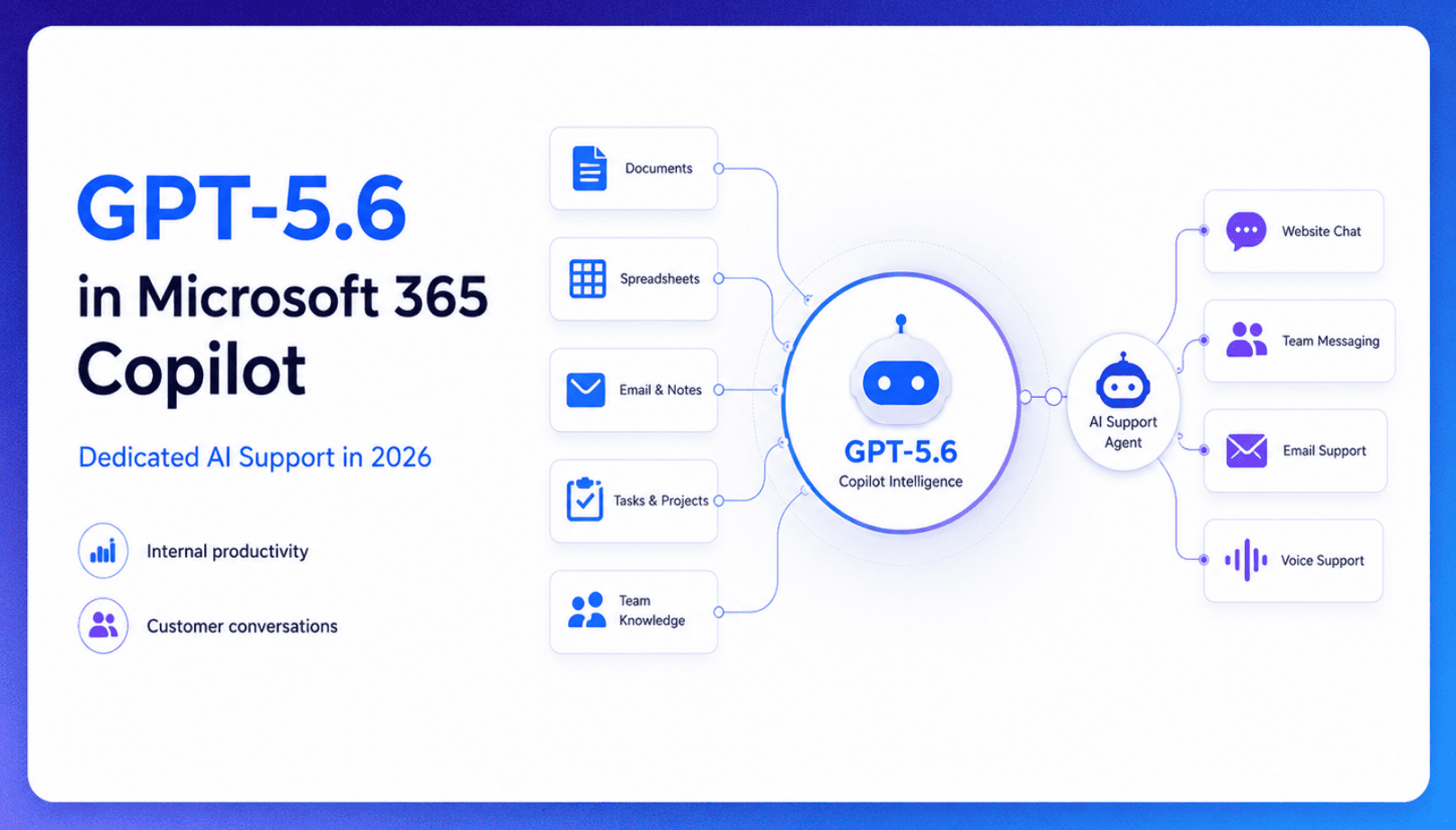
Microsoft made GPT-5.6 the preferred model across Word, Excel, PowerPoint, Copilot Chat, and Cowork on July 9, 2026, focusing on internal workplace productivity rather than customer-facing support.
Dynamics 365 Service Agent also reached general availability, but it mainly helps human support representatives manage cases within Microsoft’s existing permission structure and requires separate licensing.
A dedicated AI support agent serves a different role, handling public conversations across websites and messaging channels with separate customer knowledge, multi-model choice, and support-specific guardrails. Many teams may use both systems for different parts of the support workflow.
Microsoft made GPT-5.6 the preferred model across Word, Excel, PowerPoint, Copilot Chat, and Cowork, the productivity suite nearly every company already runs. For support leaders, the update raises an immediate question. If Copilot just got measurably smarter, does a business still need a separate AI support agent for customers, or does Copilot now cover that ground too?
Model announcements move fast, and it’s tempting to assume a stronger model inside a familiar tool changes what that tool actually does. A model upgrade and a product upgrade are not the same thing. Copilot’s July update, paired with a second Microsoft release that landed the same month, draws a sharper line between internal productivity work and customer-facing support than existed before GPT-5.6 arrived.
This piece breaks down what changed inside Copilot, what the platform is designed to do, and where a dedicated AI support agent still earns its place in the support stack, including the cases where the two run side by side. For the technical model-tier breakdown, see the Sol, Terra, and Luna comparison for support bots.
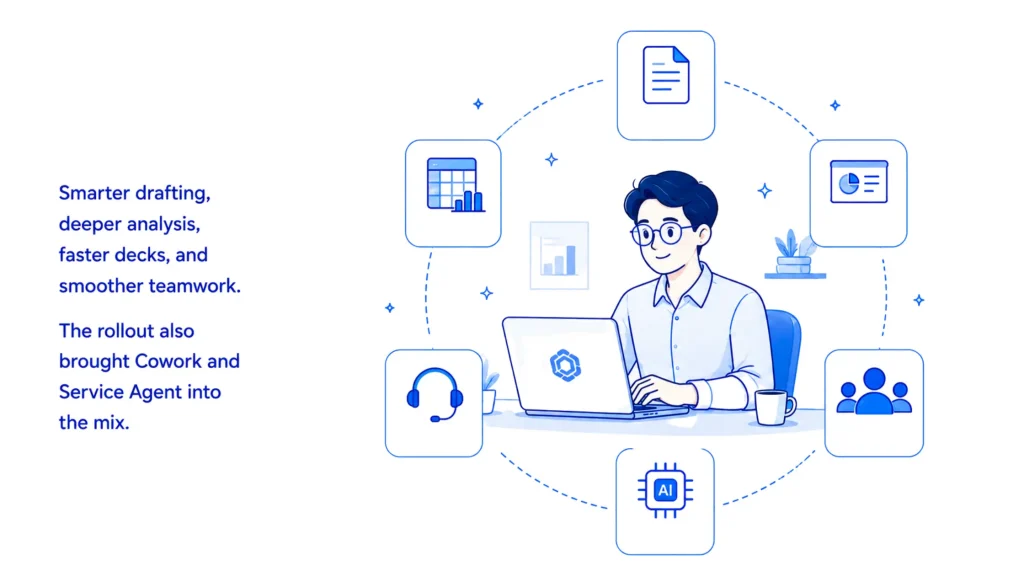
The update reached Microsoft 365 customers both natively and through the OpenAI API, per OpenAI’s own announcement. Microsoft’s framing centered on drafting documents with fewer prompting rounds, deeper spreadsheet analysis, faster presentation building, and smoother cross-functional work inside Cowork. Every example Microsoft and OpenAI gave in that announcement was an internal productivity task.
GPT-5.6 itself launched as a three-tier family, Sol, Terra, and Luna, after a limited preview to roughly 20 partner organizations on June 26, 2026, before reaching broader availability, including the Copilot rollout, on July 9. Teams evaluating which tier fits a support workload specifically, rather than a Word or Excel task, can find that breakdown in the Sol versus Terra versus Luna comparison.
The model upgrade didn’t arrive alone. Two other Microsoft releases landed in the same window:
Cowork lives inside Outlook, Teams, and Word. Service Agent lives inside a case queue. Neither lives in a customer’s inbox.
Cowork is an agentic task layer inside Microsoft 365 Copilot that runs entirely inside a company’s own Microsoft 365 tenant, grounded by Work IQ, Microsoft’s layer for pulling context from a company’s internal emails, files, and chat history. It handles:
Microsoft has also said the underlying platform that powers Cowork also powers Claude Cowork, a related but separate product from Anthropic. None of it touches a customer conversation. Cowork drafts an internal email or builds an internal spreadsheet. It doesn’t answer a website chat widget or a WhatsApp message from someone outside the company.
Service Agent follows the same pattern, one step closer to the support floor. Grounded in both Dataverse and Microsoft Graph data, it gives Dynamics 365 Customer Service reps:
Northern Trust’s AI engineering lead described the value as starting the day with context already surfaced instead of searching for it. Turning it on requires a Dynamics 365 Customer Service license on top of the Microsoft 365 Copilot license, and the system explicitly respects the access permissions a company’s IT department already has in place.
By Microsoft’s own description, Service Agent is a tool for the person on the support team. The system talking to the customer is a separate job entirely.
That distinction sounds abstract until it hits a resolution rate.
| Dimension | Internal Copilot | Dedicated Support Agent |
|---|---|---|
| Who reviews the output | An employee, before it reaches anyone | No one, by default |
| Where it runs | Inside company tools | Inside the customer conversation |
| Channels reached | Word, Excel, Teams, and internal chat | Website widget, WhatsApp, Instagram, and phone |
However capable the underlying model, an internal copilot was never meant to operate without that review step. A support agent has to.
That gap shows up in the resolution numbers. Gartner projects that agentic AI will autonomously resolve 80 percent of common customer service issues without human intervention by 2029, a projection built on agents designed to act inside support systems rather than general assistants that draft a reply for someone else to send. Today, actual self-service resolution sits far lower, around 14 percent per Lorikeet’s 2026 tracking, and the same research found that 64 percent of customers say they wish companies would stop layering AI into support that doesn’t actually resolve their problem.
Independent research on agent-assist tools backs the narrower claim Microsoft is making. The NBER working paper on generative AI at work found a 14 percent average increase in issues resolved per hour among support agents using an AI assistant, rising to roughly 34 percent for newer agents, a well-evidenced gain and exactly the kind of gain Copilot and Service Agent are built to deliver. It is a productivity boost for the person doing the work, not a substitute for the agent doing the work.
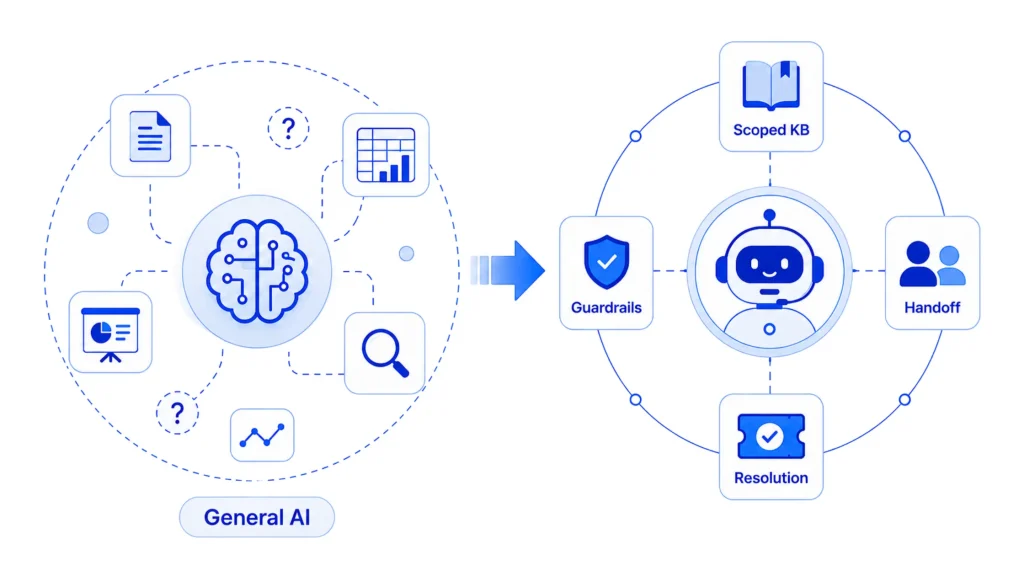
The reason has less to do with GPT-5.6’s capability than with what a model upgrade can’t fix by itself.
MIT’s Project NANDA studied enterprise AI deployments broadly and reached a relevant conclusion. Its lead researcher told Fortune that flexible general-purpose tools succeed at individual productivity precisely because they adapt to whatever the person needs in the moment, and that same flexibility becomes a liability in enterprise workflows that need consistent, workflow-specific behavior. A stronger model behind Copilot makes Copilot better at being Copilot, sharper at drafting, summarizing, and reasoning across a company’s own internal tools. None of that reach was ever aimed at a public conversation.
A dedicated support agent is built for that consistency from the outset, with a scoped knowledge base, defined escalation rules, and guardrails tuned for resolving a ticket rather than drafting a slide deck one minute and answering a refund question the next. Swapping in a stronger model doesn’t close that gap. Building the product around the job does.
Microsoft isn’t alone in separating the assistant that helps an employee from the agent that talks to a customer. Salesforce and Google are each drawing a version of the same line, though not identically.
| Vendor | Employee-Facing Agent | Customer-Facing Agent | Structure |
|---|---|---|---|
| Microsoft | Copilot, Cowork, Service Agent | None by design | Two products, two licenses |
| Salesforce | Agentforce by default, successor to Einstein Copilot | Agentforce customer agents, $2 per completed conversation | Two products, two prices |
| Gemini Enterprise Agent Platform | Gemini Enterprise Agent Platform | One platform, two configurations |
Salesforce sells these as two different products with two different meters, one for the employee’s inbox and one for the customer’s conversation.
Google tells a messier story, worth being honest about. Its platform is pitched as one console for building both kinds of agents under one governance layer, a genuinely different bet from Microsoft or Salesforce. Even so, Google’s own materials keep the two categories named separately inside that unified platform. The distinction between who an agent is built to face survives. It just gets absorbed into one product’s plumbing instead of living across two separate licenses.
The pattern across all three vendors points the same direction. Whether the split shows up as two licenses, two prices, or two configurations inside one platform, none of the major platforms currently ship a single agent equally suited to drafting an internal email and closing a customer’s support ticket.
None of this makes Copilot and a dedicated AI support agent rivals for the same budget line. In practice, the two often sit on opposite ends of the same workflow.
A customer-facing agent handles the conversation directly, resolving what it can and escalating what it can’t. When a case does need a human, the quality of that handoff matters more than almost anything else in the workflow. A well-built support agent, like YourGPT passes the full conversation history and context to the human rep who picks it up. From there, that same rep is exactly who Service Agent and Cowork exist to help, with case summaries, suggested next actions, and drafted replies grounded in the company’s internal systems, so the rep spends less time reconstructing what already happened and more time actually resolving the case.
Framed that way, the two products cover different halves of the same handoff. The customer never sees Copilot, and the internal case tools never touch a customer’s channel of choice directly. A support stack built around both, rather than one instead of the other, is a coherent and complementary setup.
Neither Microsoft nor a support-agent vendor markets the two working together this way. It’s an inference from how each product is built and licensed rather than a documented integration, worth testing on a live ticket queue before it goes into anyone’s roadmap slide.
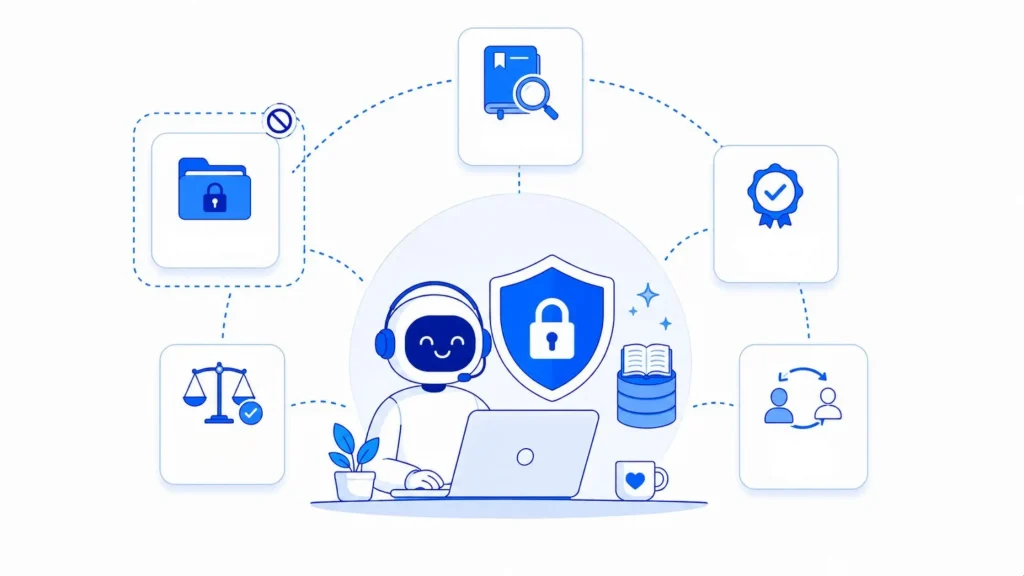
Pointing an internally grounded copilot at a customer conversation is riskier than it sounds, and the risk isn’t hypothetical.
Copilot tools inherit whatever permission structure already exists inside a company’s Microsoft 365 tenant, a sensible default for internal work. It means a copilot can only be as well-governed as the underlying file and folder permissions it was handed, and most companies’ internal permissions were never built with a public-facing conversation in mind. Security researchers have flagged this pattern directly. One Concentric AI data risk report found that Copilot deployments accessed close to three million sensitive records on average across the organizations sampled, not through a security flaw but through pre-existing over-sharing the AI simply made searchable. Separately, Microsoft’s own Data Security Index reported that 40 percent of enterprise data security incidents were linked to AI systems and tools, up from 27 percent the year before.
A dedicated support agent avoids that exposure by design:
The dollar figures rarely show up next to each other, so here they are.
| Product | Cost | What It Covers |
|---|---|---|
| M365 Copilot, add-on only | $30/user/month | Requires a separate qualifying M365 base plan |
| M365 Copilot, all-in with E3 or E5 | $66–$90/user/month | Total cost including the required base plan |
| Cowork | $0.01/credit, or $200 per 25,000-credit pack/month | Metered on top of the Copilot seat, with light tasks costing $1–$3 and heavy tasks costing $7 or more |
| Service Agent, Dynamics 365 Enterprise | $105/user/month | Stacked on top of the Copilot seat that activates it |
| Service Agent, Dynamics 365 Premium | $195/user/month | Stacked on top of the Copilot seat that activates it |
| YourGPT Professional | $79/month on annual billing, or $129/month billed monthly | 5 chatbots, 100 documents, 30M AI Credits, and 5 team members |
Matching the tool to the job beats assuming a smarter Copilot means dropping the support agent.
A team likely gets real value from Copilot’s GPT-5.6 upgrade alone if internal work, drafting, spreadsheet analysis, meeting prep, and case research for human reps, is the bottleneck, and customer conversations are already well handled elsewhere.
A dedicated AI support agent earns its place when:
The model-dependency point deserves scrutiny on its own. Betting an entire support stack on whichever model a single vendor prefers this quarter carries its own risk, and enterprise buyers have started naming this concern directly. A 2026 Zapier survey found that 81 percent of enterprise leaders are concerned about dependency on a specific AI vendor, with close to a third calling themselves very concerned. A separate report on CIO decision-making for 2026 argued that the platforms built to last are the ones that abstract the model layer from application logic, so switching or adding a model doesn’t force a rebuild of the workflows sitting on top of it. YourGPT works this way by design, letting a team pick between OpenAI, Anthropic, Google, and xAI models in a single configuration setting, so a support workflow doesn’t get rebuilt every time one lab’s flagship model changes.
For a support team already running on Microsoft 365 that matches any of the points above, the cost breakdown earlier in this piece already answers the pricing question. What it doesn’t show is what the decision looks like in practice. Talkmore, one of the companies running first-line support this way, reports that most routine questions now resolve without a human touching them, leaving its support team to focus on the harder cases.
No. Copilot, Cowork, and Service Agent are built for internal, employee-facing work inside a company’s own Microsoft 365 tenant. None of them hold an independent conversation with a customer on a website, WhatsApp, or a phone call, which is the specific job a dedicated AI support agent handles.
Cowork handles general internal tasks such as drafting documents and managing email, available to any Microsoft 365 Copilot user. Service Agent is narrower, built specifically for Dynamics 365 Customer Service reps, giving them case summaries and suggested actions. Both stay inside a company’s internal tools rather than facing a customer directly.
Not by design. Copilot’s tools inherit a company’s internal Microsoft 365 permissions and are reviewed by an employee before anything reaches a customer. A support agent meant to talk directly with customers is a separate category of product entirely.
Not exactly. Copilot is designed for internal productivity work, while YourGPT is made for customer-facing conversations across channels like WhatsApp, Instagram, and a website widget. Most teams end up running something like both rather than choosing one over the other.
YourGPT’s Professional plan runs $79 a month on annual billing, covering the whole support team as a flat platform fee. Microsoft’s side scales per employee seat instead, so a single support rep on Copilot plus Service Agent’s Enterprise tier alone can run well past that same figure before Cowork usage is even counted.
To some extent. Copilot Chat added Claude as a selectable model in June 2026, and admins can now enable Anthropic and xAI models for specific users and groups. That choice stays curated by Microsoft and gated at the admin level, rather than routed per workflow the way a dedicated support platform can be configured.
A dedicated support agent typically handles customers directly on a website widget, WhatsApp, Instagram, and by phone. Copilot’s tools work inside Word, Excel, Teams, and internal chat, and were never designed to hold a conversation on any customer-facing channel.
Yes, and many support teams end up running both. A dedicated agent can handle the customer conversation directly and hand off complex cases to a human rep, who can then use Copilot and Service Agent internally to resolve the case faster.
Three Microsoft releases landed in five weeks this summer, GPT-5.6, Cowork, and Service Agent, each one sharpening Copilot at the internal work it already does. None of them moved Copilot any closer to holding a conversation with a customer. That pattern is consistent enough to plan around. Whatever ships next inside Copilot will most likely make employees faster rather than put Copilot in front of a customer.
The one piece of this comparison that could shift fastest is model access. Copilot Chat added Claude as a selectable model in June, with Anthropic and xAI now available to admins who opt in, narrowing the model-choice gap on Copilot’s internal side. It’s still a curated, admin-gated choice rather than the per-workflow routing a platform like YourGPT builds around, and it doesn’t touch the customer-facing side of the comparison either way. Worth a second look in six months regardless, since model access is the fastest-moving part of this whole comparison.
TL;DR Cheap frontier models now compete for the same high-volume support workloads, with DeepSeek V4 remaining the lowest-cost option in this comparison. Kimi K2.6 and GLM-5.2 are open-weight and self-hostable, while Qwen 3.7 Plus is proprietary and available only through an API. Claude Haiku 4.5 is the only model here that its developer explicitly recommends […]
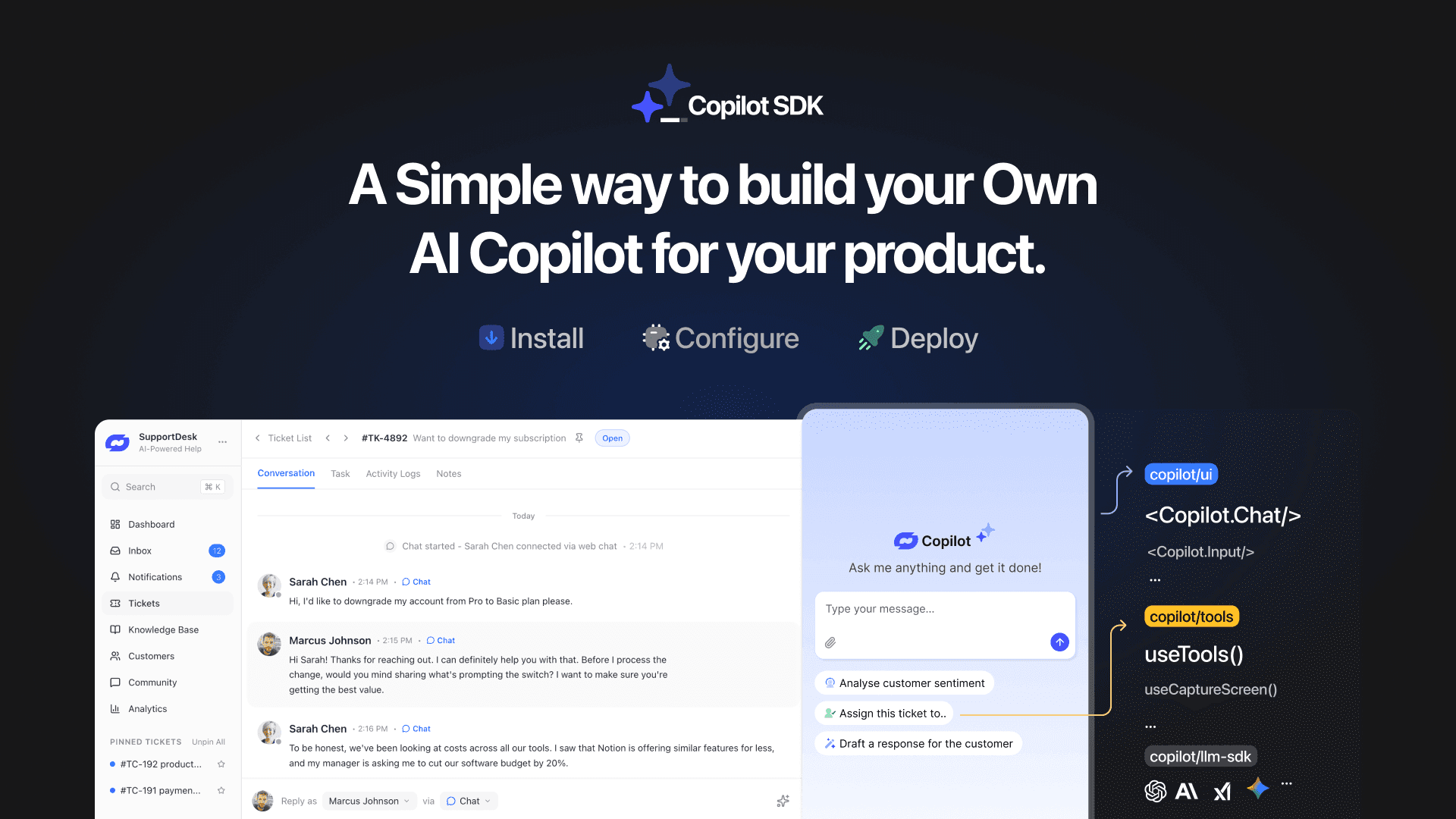
TL;DR YourGPT Copilot SDK is an open-source SDK for building AI agents that understand your application state, user context, and what is happening inside your product. Instead of working like isolated chat widgets, these agents connect directly with your product and can take real actions within existing workflows. This helps teams build contextual AI experiences […]

TL;DR YourGPT 2.0 adds AI Studio for building, testing, and debugging automated workflows. It includes native MCP integration for more than 100 tools, upgraded voice agents, and native SDKs for iOS and Android applications. With shared context across web, WhatsApp, Instagram, Telegram, and mobile, YourGPT turns conversations into real actions across support, sales, and operations. […]

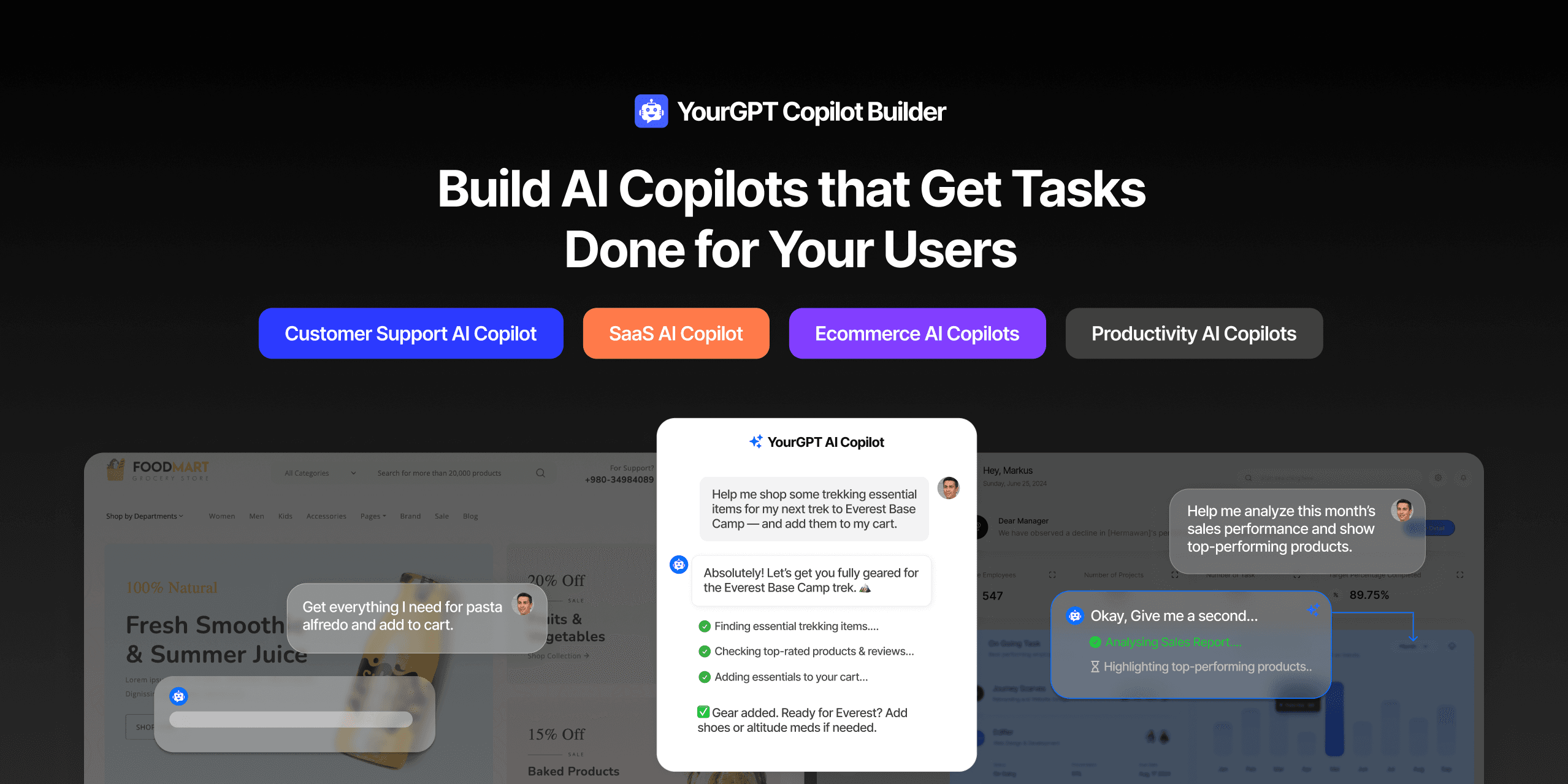
TL;DR Most AI tools provide answers but still leave users to complete the task through search results, settings pages, or checkout flows. AI Copilot Builder closes that gap by executing registered actions directly inside the product instead of only explaining what to do. Search, cart updates, account changes, and multi-step bookings can all happen within […]
TL;DR Building an AI-powered Telegram bot does not require custom development. BotFather provides the Telegram bot token, while a no-code platform like YourGPT handles AI training, free-form conversations, and the Telegram connection. This guide covers the full setup, from creating the bot in BotFather to connecting it with YourGPT and taking it live. Most Telegram […]

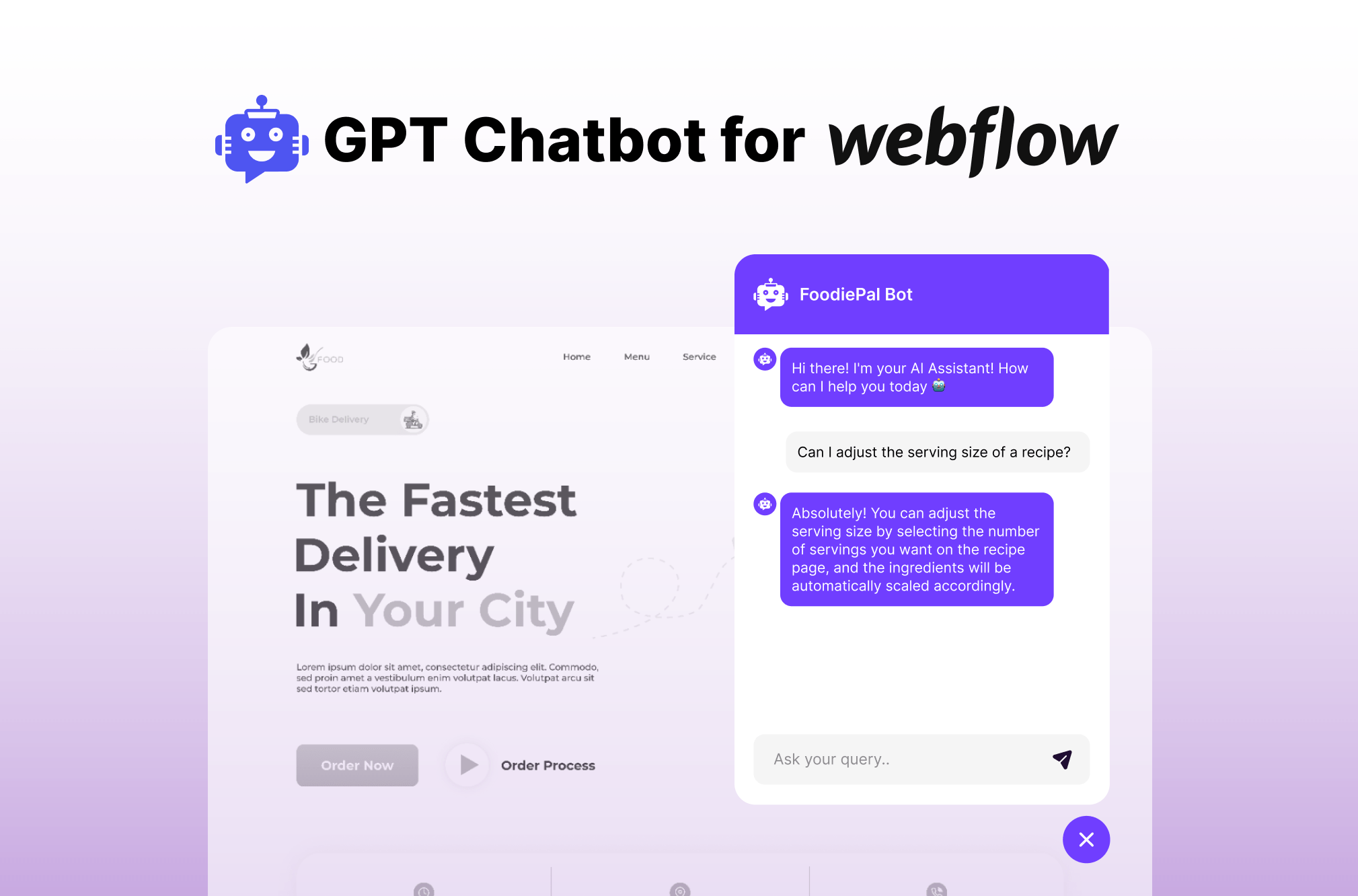
TL;DR Installing an AI chatbot on a Webflow site no longer requires custom code. YourGPT connects through the Webflow Marketplace, trains on your business data, supports multiple languages, and transfers conversations to a human when needed. This guide covers how to install, train, and customize your YourGPT chatbot after adding it to your Webflow site. […]