Claude Fable 5 for Customer Support: Is It Worth It, and Can You Even Use It?

Rajni
Last updated on July 13, 2026

Claude Fable 5 launched on June 9, 2026, was pulled offline three days later under a US export control order, and returned on July 1 after the order was lifted.
For support teams, Fable 5 is best suited for long-horizon tickets across billing, CRM, shipping, and documents not basic FAQ deflection.
Its biggest support advantages are the 1M token context window and document vision, but it costs double Claude Opus 4.8 at $10 input and $50 output per million tokens.
Fable 5 also requires mandatory 30-day data retention, with no zero-data-retention option, making it important to review before routing customer PII.
The real lesson is vendor resilience: support platforms that can switch models across providers are less likely to go dark when one AI vendor is disrupted.
Claude Fable 5 launched June 9, 2026, as Anthropic’s most capable model ever released to the public, built for the long, multi-step work that customer support teams increasingly hand to AI. Three days later, a US export control order took it offline for every user on Earth. It stayed dark for nineteen days.
That timeline barely appears in existing coverage of this model, because almost all of it published before the suspension happened, or before Anthropic restored access on July 1. For a support team evaluating Claude Fable 5 today, availability matters as much as capability. A workflow built on this model has to survive a repeat of what just happened, not just handle a hard ticket well.
Nineteen days without a flagship model is the single fact that should shape how support teams evaluate Claude Fable 5, more than any benchmark score.
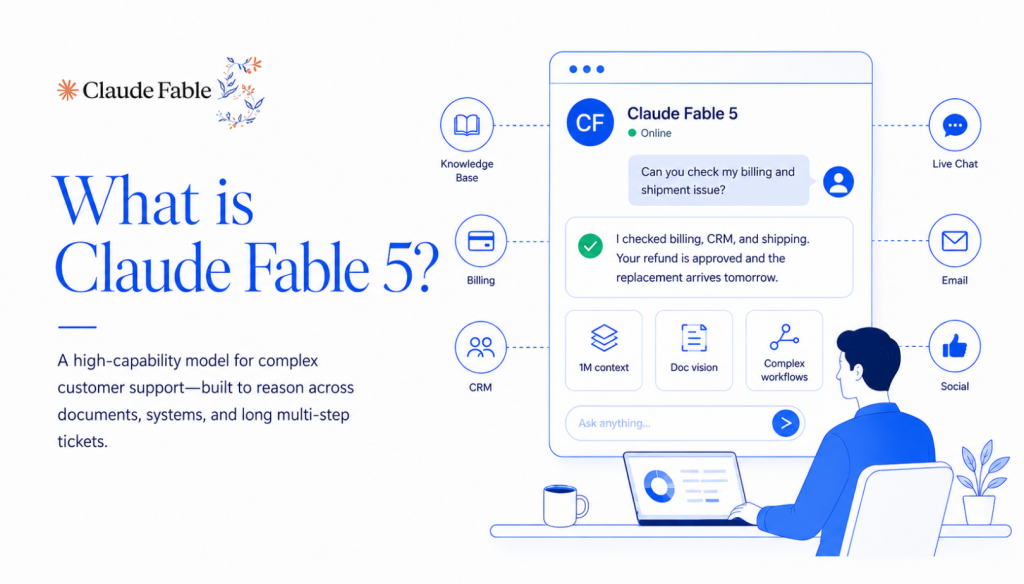
Claude Fable 5 is Anthropic’s newest flagship, announced June 9, 2026 as what the company called its most capable widely released model to date. It sits above Claude Opus 4.8 on Anthropic’s capability ladder. Anthropic shipped it alongside a sibling model, Claude Mythos 5, which shares the same underlying weights but skips the safety classifiers Fable 5 carries. Mythos 5 stays limited to vetted cybersecurity and biology research partners through a program called Project Glasswing. Fable 5 is the version anyone with a Claude plan or API access can use, similar to how GPT-5 became OpenAI’s generally available flagship earlier this year.
The API model ID is claude-fable-5. It runs on Amazon Bedrock, Google Cloud, and Microsoft Foundry, and it’s reachable through the Claude Platform, Claude.ai, Claude Code, and Claude Cowork. Anthropic built it for days-long, asynchronous work. It plans across stages, delegates to sub-agents, and checks its own output before handing back a result, rather than answering one prompt and stopping. For a wider view of how this generation of models compares, see our breakdown of the best large language models in 2026.
Most existing reviews of Fable 5 skip this part entirely, because most were written before it happened.
Fable 5 launched June 9. On June 12, the US government sent Anthropic a directive ordering it to suspend all access to Fable 5 and Mythos 5, citing national security authorities and a report that a researcher had found a way to bypass Fable 5’s safeguards. Anthropic received the notice at 5:21pm ET. Because the order applied to any foreign national anywhere and there was no way to verify nationality in real time, Anthropic pulled the model for every user, everywhere, the same day.
Anthropic’s own account of what triggered the order is worth knowing before trusting the model going forward. The underlying finding came from Amazon researchers, who showed a prompting technique that got Fable 5 to identify a small number of already known software vulnerabilities. When Anthropic tested whether other models could do the same thing, Claude Opus 4.8, GPT-5.5, and Kimi K2.7 all reproduced the finding, and every model Anthropic tested, including older Claude versions, could reproduce the exploit demonstration for the single vulnerability in question. The capability was not unique to Fable 5. The government acted on it anyway.
The suspension held until June 30, when the export controls were lifted. Anthropic began redeploying Fable 5 the next day, July 1, across the Claude Platform, Claude.ai, Claude Code, and Claude Cowork, with AWS, Google Cloud, and Microsoft Foundry following as each platform re-enabled it. Alongside the relaunch, Anthropic shipped a new safety classifier targeting the reported bypass technique, which the company says now blocks it in over 99% of cases.
As of today, July 3, Fable 5 is back and generally available. That answers half the question in this article’s title. The other half, whether the model can be trusted to stay available, has no clean answer yet, which is exactly why the rest of this article treats availability as a real factor and not a footnote.
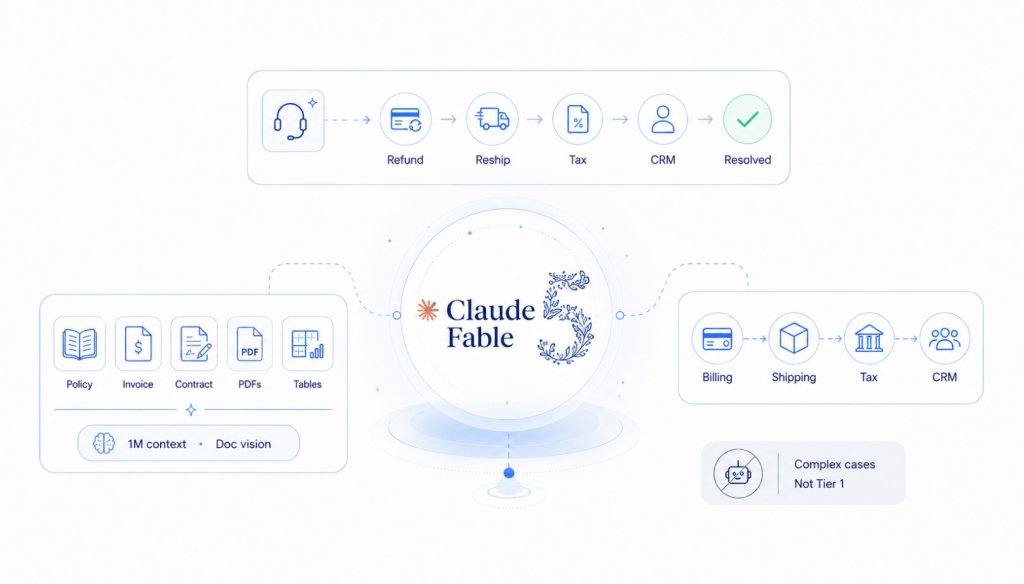
Judged on capability alone, and the outage set aside, two things matter most for support work.
The first is long, multi-step resolution. A ticket that spans a refund, a reship, and a tax adjustment usually bounces between three systems and lands back with a human halfway through, because most models lose the thread across that many steps. Fable 5’s sub-agent delegation and self-checking loop are built for exactly that kind of chain. Stripe has reportedly pointed Fable 5 at a 50-million-line Ruby codebase and run a full migration in a day. That’s a coding example, not a support one, but it demonstrates the same underlying capability, sustained multi-step reasoning without losing state.
The second is document handling. Fable 5’s 1M token context window lets it hold a full policy manual, a long ticket history, and a contract in the same conversation without chunking. Anthropic specifically calls out its ability to read diagrams, charts, and tables nested inside PDFs, which matters for support tickets that arrive with a screenshot, an invoice, or a spec sheet attached instead of plain text.
Tier 1 volume is the wrong job for it. A routine order-status question doesn’t need days-long planning or a million tokens of context, and paying Fable 5 rates for it is the wrong default.
Both models now carry the full 1M token context window at standard pricing, according to Anthropic’s current pricing page. The rate card is where they diverge.
| Metric | Claude Fable 5 | Claude Opus 4.8 |
|---|---|---|
| Input per million tokens | $10 | $5 |
| Output per million tokens | $50 | $25 |
| Context window | 1M tokens | 1M tokens |
| Max output tokens | 128,000 | 128,000 |
| Data retention | 30 days, mandatory | Per-account, ZDR available |
| Public access | Yes, with safety classifiers | Yes |
Fable 5 costs exactly twice what Opus 4.8 costs, on both input and output. The gap gets concrete fast once real ticket volume enters the picture. As an illustration built from these published rates rather than a benchmark, a short reply drawing on roughly 2,000 output tokens costs about $0.10 on Fable 5 and about $0.05 on Opus 4.8, a difference nobody notices. A long, multi-step resolution built from a 40,000-token reasoning and tool-call trace costs roughly $2.00 on Fable 5 against about $1.00 on Opus 4.8. At real support volume, that gap compounds fast if Fable 5 is answering every ticket instead of the hard ones. Routing the complex, multi-system tickets to Fable 5 and leaving routine tickets on a cheaper model or on deflection keeps the cost proportional to the value delivered.
This section matters more for support teams than for most Fable 5 use cases, because support conversations routinely carry customer PII, order details, and sometimes payment information.
Fable 5 and Mythos 5 are both designated “Covered Models” under Anthropic’s current policy. That means a mandatory 30-day data retention period, with no zero-data-retention option, unlike Opus 4.8, where ZDR is available depending on the account. A support team whose data handling requires zero retention as a contractual or compliance baseline needs to check this before routing production ticket data through Fable 5, not after.
The second thing worth knowing is how the safety classifiers behave. Fable 5 routes certain categories of prompt (cybersecurity, biology, chemistry, and a few adjacent areas) to Claude Opus 4.8 automatically when its classifiers flag a request, rather than answering directly. Most consumer support conversations never trigger this. B2B support touching regulated domains (healthcare, security products, lab equipment, chemical handling) can trigger it on entirely legitimate questions. Anthropic’s refusals-and-fallback API option exists specifically so a developer gets a structured signal when this happens, instead of a silent, unexplained shift in answer quality mid-conversation. Enabling that option from day one is worth doing before anything user-facing ships on the raw Fable 5 API.
The takeaway here is operational. Fable 5 works fine for support as long as the team handling it understands these constraints before go-live, which is also why securing autonomous AI agents against operational risk deserves its own review before any new model reaches production support traffic.
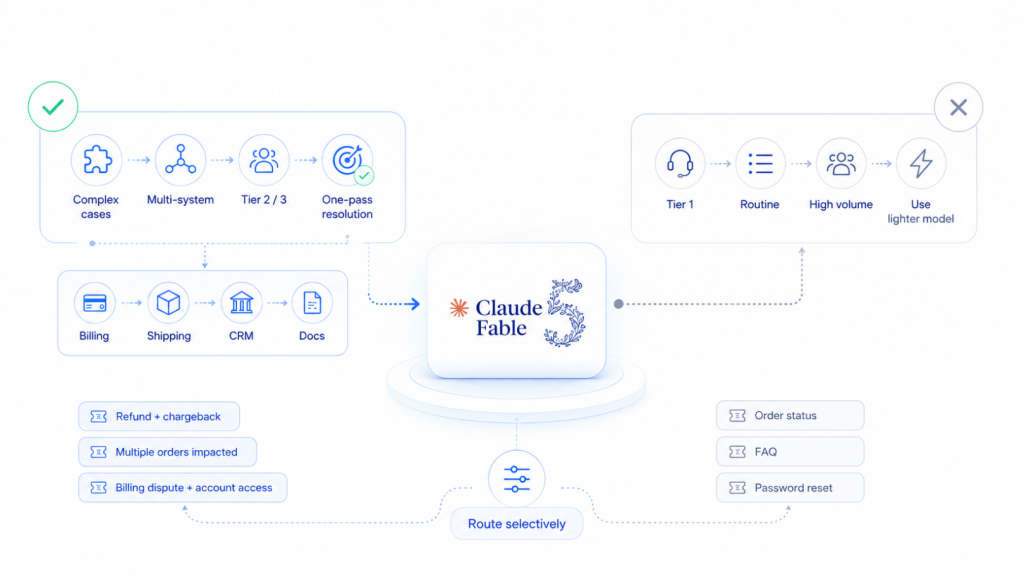
For the narrow slice of tickets it’s built for, long-running, multi-system, high-value resolutions, yes. The sub-agent planning and 1M token context solve a real problem. Tickets that currently bounce between three queues and land back with a human anyway can get resolved in a single pass. A team that already tracks a meaningful volume of Tier 2 and Tier 3 tickets in that shape should test Fable 5 against a defined slice of that queue.
For the rest of a typical support queue, the routine, high-volume, low-stakes tickets that make up most of what a support team actually answers, it’s the wrong default. The cost multiplier over Opus 4.8 buys nothing on a question a cheaper model already answers correctly. Gartner projects that 80% of common customer service issues will be resolved autonomously by 2029, and most of that volume is exactly the kind of routine query where model choice matters less than good retrieval and clean escalation rules.
Fable 5 earns its price tag on a defined subset of a support queue and nowhere else. Treat it as a specialist tool routed to specific tickets, not a wholesale model swap. Anyone building that evaluation from scratch should start with a full checklist for what to verify before adopting any support AI agent, since the same questions, cost per resolution, data handling, and failure modes apply well beyond this one model.
Yes, as of today. Access returned July 1 across the Claude Platform, Claude.ai, Claude Code, and Claude Cowork. Anthropic is including Fable 5 in up to 50% of weekly usage limits through July 7 for Pro, Max, Team, and select Enterprise plans, after which it shifts to usage credits. API access is live under the model ID claude-fable-5, with Amazon Bedrock, Google Cloud, and Microsoft Foundry re-enabling access as each platform catches up to Anthropic’s own rollout.
Two practical steps come before shipping anything against the API for a production support workflow. Confirm the account’s data retention settings against the 30-day mandatory minimum described above. Turn on the refusals-and-fallback option so a classifier trigger shows up as a structured event in the logs instead of a silent behavior change agents have to notice on their own.
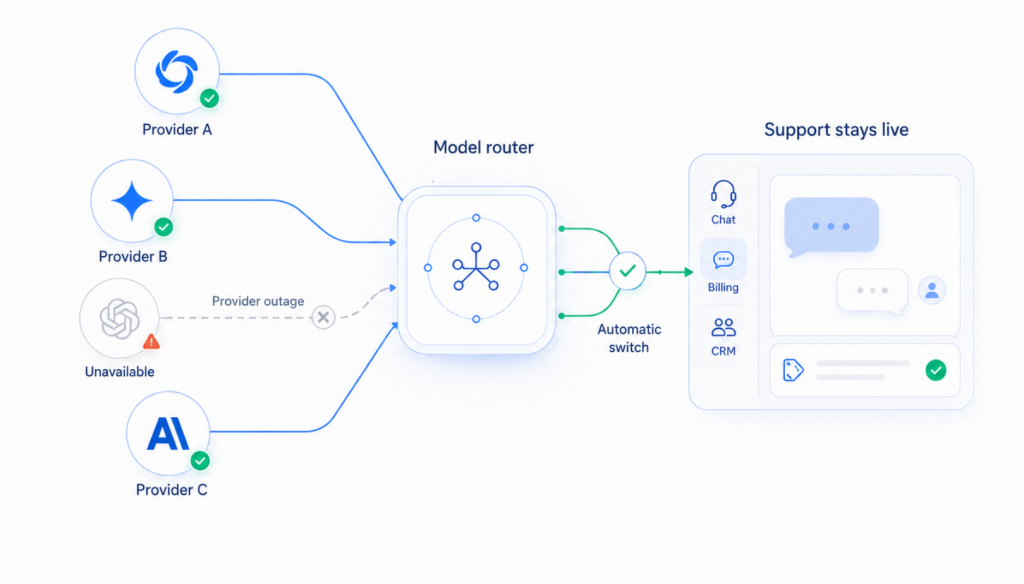
Strip away the specific jailbreak report and the specific export control order, and a pattern remains worth planning around regardless of which model triggers it next. A single government letter took Anthropic’s flagship model offline for every user on Earth, with no notice period, for nineteen days. Anthropic’s response was fast by the standard of any regulatory action. The real cost sits elsewhere, in what single-model dependency costs a business when a decision made outside the company determines whether its AI is available at all.
A support stack built directly on one model’s API has no answer to that scenario beyond waiting. A support platform built to switch across model providers (OpenAI, Anthropic, Google, and xAI, in YourGPT’s case) treats a provider-level suspension as a configuration change rather than an outage. If Fable 5 goes dark again for any reason, regulatory or otherwise, a team running support through a platform with model choice built in can shift the workload to Opus 4.8, Gemini, or GPT-5.5 without rebuilding a prompt library or waiting on a government decision. Fable 5 stays exactly as capable either way. What changes is what depending on it actually means for a team that has other options on standby.
Yes. Access returned July 1, 2026, after a US export control order suspended the model from June 12 to June 30. It’s live again on the Claude Platform, Claude.ai, Claude Code, Claude Cowork, and the API under the model ID claude-fable-5, with Amazon Bedrock, Google Cloud, and Microsoft Foundry re-enabling access as each platform catches up.
Fable 5 costs exactly double Opus 4.8, $10 input and $50 output per million tokens versus Opus 4.8’s $5 and $25. Both models carry a full 1M token context window and 128,000 max output tokens, so the price gap comes entirely from the rate card, not the specs.
It can be, with two things checked first. Fable 5 carries a mandatory 30-day data retention period with no zero-retention option, which matters if a compliance baseline requires zero retention. Its safety classifiers also route certain prompt categories, including cybersecurity, biology, chemistry, and adjacent areas, to Opus 4.8 automatically, which can occasionally fire on legitimate B2B questions in regulated industries.
The US government ordered Anthropic to suspend Fable 5 and Mythos 5 on June 12, citing a report that a researcher had bypassed Fable 5’s safeguards to identify known software vulnerabilities. Anthropic’s own testing later showed other models, including Opus 4.8 and GPT-5.5, could reproduce the same finding, and the controls were lifted June 30.
No. Fable 5 is built for long, multi-system tickets that need sustained reasoning to close, not the routine, high-volume questions a cheaper model already answers correctly. The cost multiplier over Opus 4.8 only pays off on the complex slice of a queue, so routing everything to Fable 5 is the fastest way to overspend on it.
On a stack built directly on one model’s API, the agent just stops working until access returns. On a platform like YourGPT, where teams pick from models across OpenAI, Anthropic, Google, and xAI, a provider-level suspension becomes a configuration change instead of an outage, since the workload can shift to another model without rebuilding the agent.
Claude Fable 5 is a genuinely capable model for the specific kind of support ticket that spans multiple systems and needs sustained reasoning to close. It isn’t the right default for a whole queue, it costs twice as much as Opus 4.8 for a reason, and it just proved, in public, that even Anthropic’s best model can disappear for nineteen days over a decision made outside the company entirely.
Use it selectively. Verify data retention settings before routing customer data through it. Build a support stack so that no single model’s availability is a single point of failure. The nineteen days between June 12 and July 1 make that argument better than anything written on purpose could.
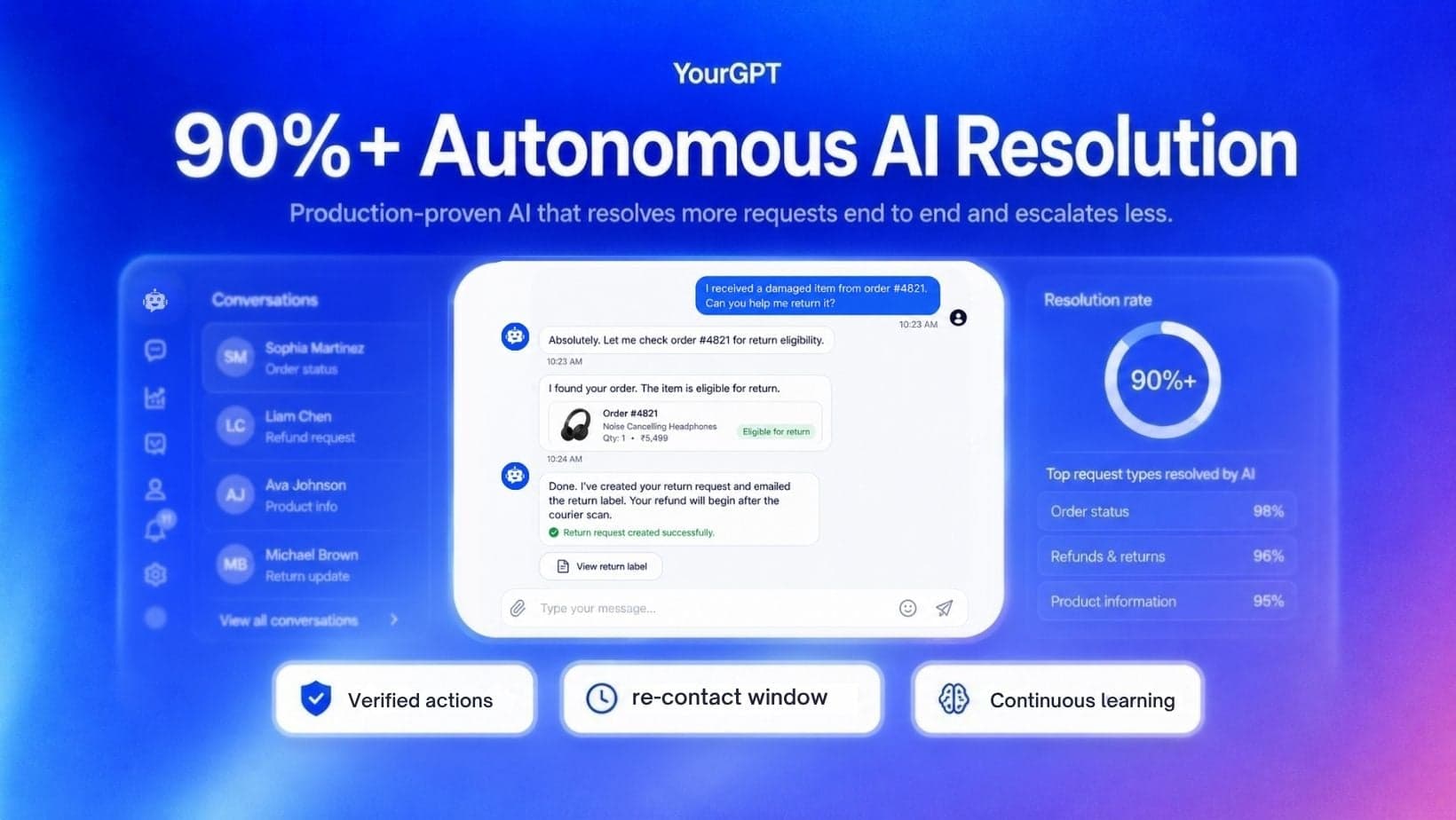
YourGPT has progressed from production deployments reaching around 80% AI resolution to 90%+ on eligible repeated requests in maintained deployments. Here is what changed, how we measure resolution, and how we apply that work with organizations that want to raise their own rates.

At YourGPT, we’ve always believed businesses need one platform for customer support, sales, and engagement. These are not separate parts of the customer journey. They shape how businesses communicate, build relationships, and move conversations forward. That belief continues to guide how we evolve YourGPT, building toward a more connected way for teams to manage communication, […]
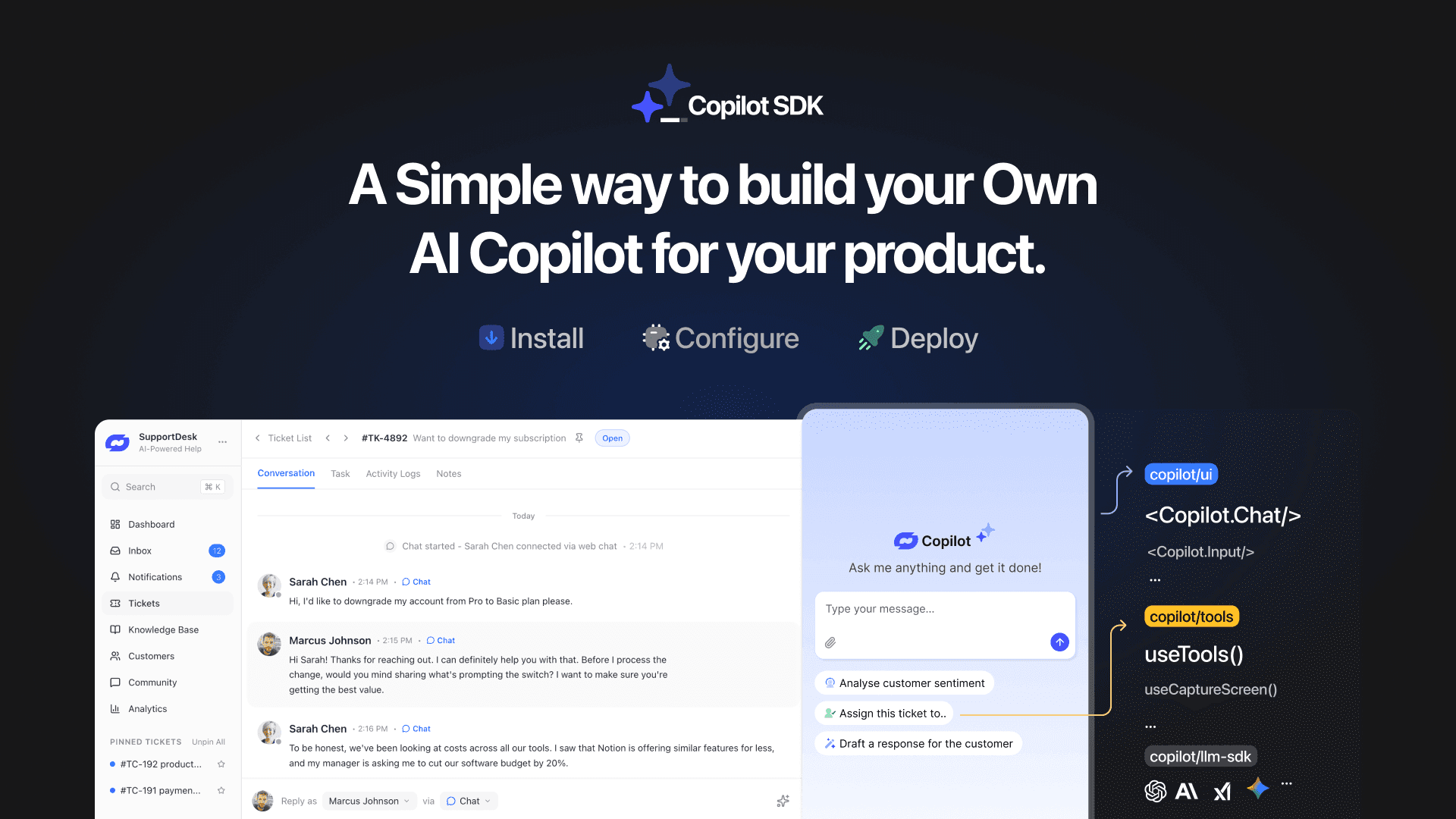
TL;DR YourGPT Copilot SDK is an open-source SDK for building AI agents that understand your application state, user context, and what is happening inside your product. Instead of working like isolated chat widgets, these agents connect directly with your product and can take real actions within existing workflows. This helps teams build contextual AI experiences […]

Happy New Year! We hope 2026 brings you closer to everything you’re working toward. Throughout 2025, you’ve seen the platform evolve. We shipped the AI Copilot Builder so your AI could execute actions on both frontend and backend, not just answer questions. We added AI assistance inside Studio to help you generate workflows without starting […]
Grok 4 is xAI’s most advanced large language model, representing a step change from Grok 3. With a 130K+ context window, built-in coding support, and multimodal capabilities, Grok 4 is designed for users who demand both reasoning and performance. If you’re wondering what Grok 4 offers, how it differs from previous versions, and how you […]
OpenAI officially launched GPT-5 on August 7, 2025 during a livestream event, marking one of the most significant AI releases since GPT-4. This unified system combines advanced reasoning capabilities with multimodal processing and introduces a companion family of open-weight models called GPT-OSS. If you are evaluating GPT-5 for your business, comparing it to GPT-4.1, or […]
