9 Best AI Receptionist for Small Business in 2026 (Compared)
Shreya Sharma
August 3, 2026
Summarize this post with AI
TL;DR
An AI receptionist answers calls, qualifies leads, and books appointments without a live agent, helping businesses reduce missed calls and cover after-hours demand.
Pricing can be based on calls, minutes, monthly plans, or human staffing, and lower-priced plans may exclude essential features such as appointment booking and call transfers.
This guide compares pricing, features, and tradeoffs based on call volume, industry requirements, and the level of human judgment each business needs.
Small businesses have more AI receptionist options than ever, but comparing them by starting price alone can be misleading. Some tools charge by the minute, others bill per call, and a few use flat monthly pricing. The features included also vary widely, especially for appointment booking, call transfers, lead qualification, and after-hours coverage.
This blog compares nine AI receptionist tools by pricing, billing model, core features, limitations, and best-fit use case. It also estimates the real monthly cost at different call volumes, helping you see how each platform scales before you commit.
The comparison highlights important differences that pricing pages often hide. NextPhone uses a flat monthly model, Ruby provides fully human-staffed reception at a premium price, and YourGPT works as a broader AI agent platform that can support reception, customer service, sales, and business workflows from one system.
By the end, you will be able to identify which tool fits your call volume, industry requirements, and automation needs, without choosing a plan that looks affordable but becomes expensive or restrictive in daily use.
What Is an AI Receptionist?
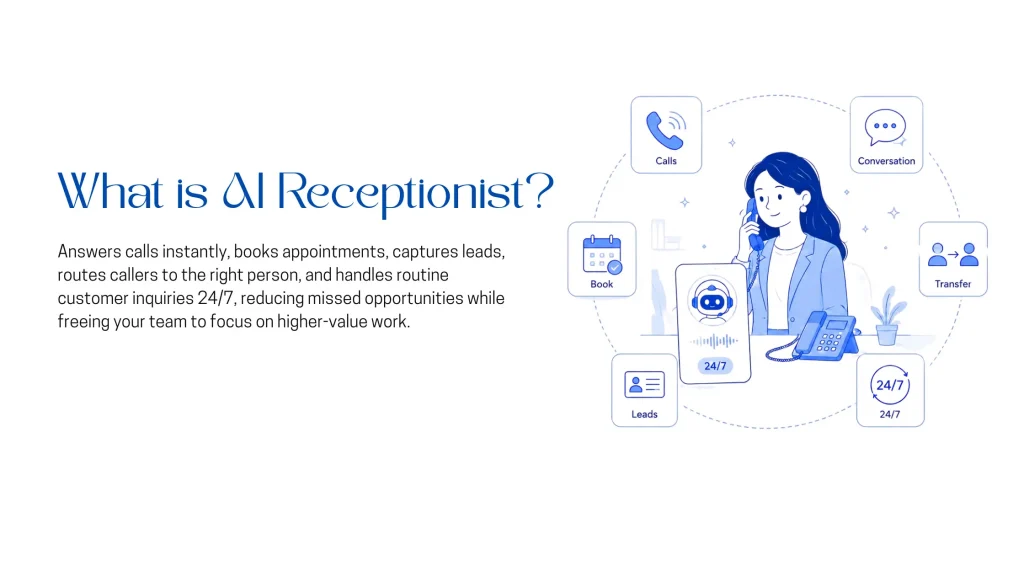
An AI receptionist is a virtual receptionist powered by an AI model rather than a human operator, answering the business phone line directly instead of routing every call to a person.
Most AI receptionists on the market, including the nine covered in this comparison, handle a consistent set of core tasks:
Answers incoming phone calls automatically, with no hold time
Understands natural language, so a caller can speak normally instead of navigating a phone tree
Transfers calls to a live person or a specific department when a conversation needs one
Books appointments directly into a connected calendar
Collects lead information such as name, contact details, and reason for calling
Answers frequently asked questions using information pulled from the business’s own website, hours, or policies
Works 24/7, including nights, weekends, and holidays
Not every tool handles each of these equally well, and the gap between the marketing page and what a specific plan tier delivers is most of what the rest of this guide covers.
Why Small Businesses Choose AI Receptionists
Adoption reasons tend to repeat across industries, and most map to a specific business outcome rather than general interest in AI.
Fewer Missed Calls : A call that goes to voicemail during a job site visit, a procedure, or after 5pm is a caller who often never calls back. An AI receptionist answers on the first ring, at any hour, rather than routing to a hold queue or letting the call ring out.
Lower Operating Costs : The plans covered in this comparison range from about $25 a month to several hundred, well below the cost of adding a full-time or even part-time hire, and without the payroll tax, benefits, or scheduling overhead that comes with a human employee.
Complete Call Resolution : At the right plan tier, covered vendor by vendor below since this is exactly where several entry-tier plans fall short, an AI receptionist can book an appointment, ask the qualifying questions a business would normally ask itself, and route the call to the right department, all inside the same conversation rather than taking a message for someone to follow up on later.
CRM Integration : Call details, transcripts, and lead information can sync into the CRM a business already uses, rather than living in a separate answering-service dashboard.
Multilingual Support: Several tools in this comparison handle dozens of languages automatically, letting a small business serve callers it couldn’t otherwise support without hiring bilingual staff.
Types of AI Receptionist Tools
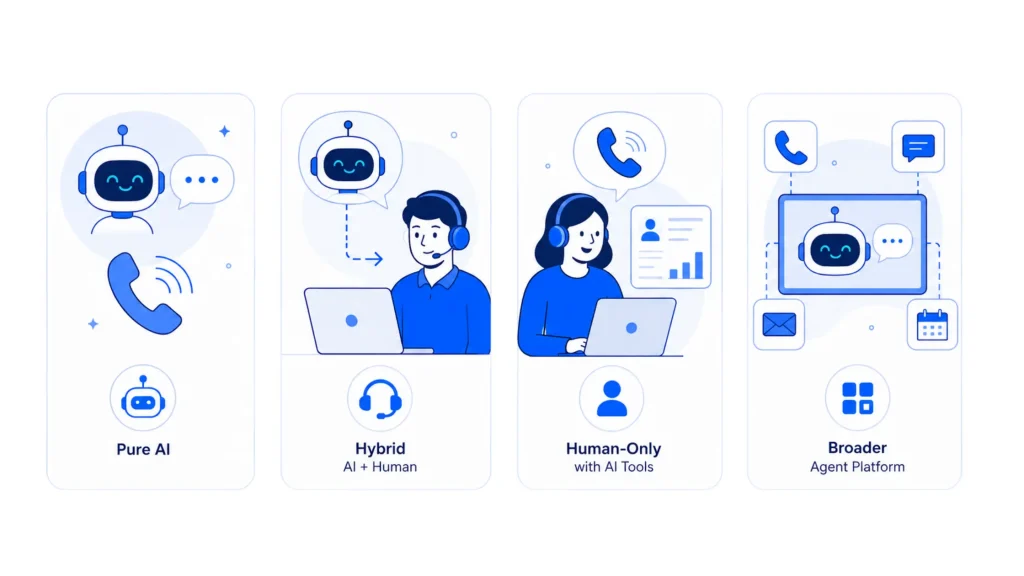
The category is messier than the marketing suggests. Under the same search term, buyers find four genuinely different products.
1. Pure AI
How it works. A voice model answers every call. A human only joins if the call is explicitly transferred.
Example tools. Rosie, Trillet, NextPhone, Goodcall, Upfirst, Frontdesk
Best for. Straightforward calls that don’t need much judgment
2. Hybrid AI Plus Human
How it works. Routine calls go to AI. Complex calls escalate to a live agent, usually for an extra per-call or per-transfer fee.
Example tools. Smith.ai
Best for. Calls that sometimes need real judgment, at extra cost
3. Human-Only With AI Tools
How it works. Trained people staff every call. AI supports internal tooling rather than answering the phone.
Example tools. Ruby
Best for. A live human voice on every call, regardless of cost
4. Broader Agent Platform
How it works. Phone answering is one channel inside a wider support, sales, and operations platform, priced as part of the whole system rather than a standalone per-call product.
Example tools. YourGPT
Best for. A business that already runs chat and support on one platform None of these is automatically the wrong choice. The right pick depends on knowing which category fits, since the pricing math and reliability tradeoffs differ for each.
Quick Glance
Platform
Best For
YourGPT
No-code AI agents across phone, chat, WhatsApp, and customer support
Rosie
AI reception for plumbers, electricians, and home service businesses
Trillet
Agencies and enterprises deploying AI receptionists at scale
NextPhone
Businesses that want unlimited calls at a flat monthly rate
Goodcall
Businesses with frequent repeat callers and customer relationships
Smith.ai
Teams choosing between AI-first and human-first receptionist services
Ruby
Businesses that prefer premium human-staffed call answering
Upfirst
Small businesses that want simple per-call pricing without minute tracking
Frontdesk
Businesses that want voice, chat, SMS, and CRM in one plan
Best AI Receptionist Tools Compared
Each entry below follows the same format, covering what the tool does, where it falls short, what it actually costs, and who it fits best. Pricing reflects the lowest published tier unless noted otherwise, and every gotcha found during research gets called out directly instead of left for a business to discover after signing up.
1. YourGPT
YourGPT is a no-code AI agent platform built for support, sales, and operations across chat, WhatsApp, and phone, with PhoneAI handling the voice side of that same system rather than running as a separate, single-purpose tool. One analytics dashboard tracks sentiment, resolution rate, and CSAT across every channel rather than just the phone. A human-in-the-loop handoff preserves full context when a call needs to reach a person rather than starting the conversation over.
Features
PhoneAI handles inbound calls, appointment scheduling, and lead qualification inside the same conversation flow
AI Studio connects calls to broader workflows like CRM updates and conditional routing rather than a fixed script
Choice of underlying model across OpenAI, Anthropic, Google, and xAI
Native CRM integrations including Salesforce, HubSpot, and Pipedrive
Native integrations through YourGPT’s companion tool marketplace, connecting agents to 100+ tools through one configuration instead of building a custom integration for each.
Pros
Phone line runs on the same platform as chat, WhatsApp, and support rather than living in a separate tool
Choice of underlying model across OpenAI, Anthropic, Google, and xAI rather than being locked to one provider
Native CRM integrations shared across every channel, so call data and chat data land in the same place
Cons
No dedicated, publicly verifiable receptionist-specific pricing tier, call-resolution rate, or concurrency figure for PhoneAI the way Rosie or Trillet publish
Setting up a phone workflow means configuring it in AI Studio rather than picking a preset template, so it takes longer to get a first call answered
Pricing
Billed as platform access instead of a per-call fee, so these numbers are not directly comparable to the rest of this list
Essential. $39/month annual billing
Professional. $79/month annual billing
Advanced. Around $349/month annual billing
Enterprise. Custom
Best for. A business that already runs chat and support on one platform and wants the phone line on that same system instead of a separate tool.
2. Rosie
Rosie targets home services businesses specifically, with a setup flow that scans the business website to build its own knowledge base. It answers 24/7 and handles multiple calls at once, so a second caller never hits a busy signal. A 7-day free trial is available before committing to a paid plan. Native iOS and Android apps let a business monitor calls from a phone instead of only a browser dashboard, and setup includes picking a dedicated area code and one of 10+ agent voices.
Features
Spam filtering on every plan
Bilingual English/Spanish handling
Call recording and transcription
Zapier integration connecting to 1,000+ apps
Pros
Built specifically for home services, with a setup flow that scans the business website to build its own knowledge base
Spam filtering included on every plan, even the cheapest one
Zapier connectivity to 1,000+ apps rather than a short, fixed integrations list
Cons
The $49/month Professional plan sends callers an SMS booking link rather than completing an actual appointment booking during the call, a real gotcha at the entry tier
Real calendar booking and warm transfers only become available on the $149/month Scale plan
Overage billing is disputed across sources, some describing an automatic tier upgrade and others citing $0.25/minute, with no public clarification found from Rosie directly
Pricing
Professional. $49/month (around 250 minutes, no real booking)
Scale. $149/month (1,000 minutes, booking and transfers included)
Best for. Trades businesses that specifically want the Scale tier’s booking and transfer features rather than just the $49 headline price.
3. Trillet
Trillet has repositioned since this comparison was first researched. The company now markets itself primarily as “the voice operating layer” for agencies and enterprise deployments, with a single-business AI receptionist plan still available but pushed to a secondary page rather than the main pricing page. The plan includes a 28-day money-back guarantee, longer than the trial window most competitors offer.
Features
24/7 call handling, calendar booking, and call summaries by email on the single-business plan
Learns the business from its website and reviews rather than a manual setup form
SMS and WhatsApp messaging is confirmed included on the agency-tier plans (Studio and Agency), unclear whether the $49 single-business plan includes it, since that plan sits on a separate page from the tier comparison table that lists it
A white-label option for agencies reselling to clients
Pros
Keeps the business’s existing phone number, callers never see a change
Learns from the business website and reviews automatically, less manual setup than a form-based competitor
White-label option available for agencies that want to resell the service to clients
Cons
At 150 included minutes, the entry plan covers roughly 60 calls at the 2.5-minute average used in this comparison
Per-minute overage adds up quickly for a business with longer calls
The company’s homepage and main pricing page are now built around agency and enterprise deployment, so a small business shopping directly has to know to look for the separate /agent page rather than the pricing page most visitors land on first
Best for. A solo business or trades operator that finds the direct signup page, since the core product still works the way it always did.
4. NextPhone
NextPhone’s pitch is unlimited-call pricing on every tier, aimed at contractors and trades businesses with unpredictable seasonal call spikes. It’s tiered by feature depth rather than by call volume, all three plans include unlimited calls. 26+ AI voices are available to match a business’s brand, and complex calls route to a team member immediately through instant transfer rather than looping the caller through AI first.
Features
Emergency-keyword detection that routes phrases like “pipe burst” or “no heat” directly to the business owner’s phone instead of trying to handle them with AI
Unlimited calls and users on every tier, with call recording, transcription, and calendar booking to Google or Outlook built in
10+ languages including Spanish, French, and Mandarin
Integrations with Clio, MyCase, HubSpot, ServiceTitan, Housecall Pro, Zapier, and 100+ other tools (integration depth varies by tier, see Cons)
No per-minute or per-call metering at any tier
Pros
Unlimited calls on every plan removes the risk of a surprise overage bill regardless of tier
Emergency-keyword detection routes urgent calls straight to the owner’s phone instead of letting AI attempt them
No per-minute or per-call tracking to monitor month to month
Cons
The specific performance statistics NextPhone publishes, a 98% resolution rate and a claim of serving 5,000+ small businesses, come from NextPhone’s own site with no independent audit found
These figures should be read as vendor-reported rather than verified, and they have already changed from the figures NextPhone published when this comparison was first researched
The CRM integrations (Clio, GoHighLevel, ServiceTitan, HubSpot) that most small businesses will actually want sit behind the $299/month Growth tier instead of the $199 entry plan
Scale. $599/month (adds custom-tuned onboarding, extra numbers, custom routing, SLA)
Best for. A contractor or trades business with high or spiky call volume, though CRM sync means budgeting for Growth at $299 instead of the $199 headline.
5. Goodcall
Goodcall bills by unique caller rather than by call count or minutes, which changes the math in a way worth understanding before signing up. A 14-day free trial is available before committing to a paid plan. There’s no limit on how many separate agents a business can build, useful for a multi-location operation that wants a distinct agent per site.
Features
Unlimited minutes and AI tokens on every plan
Configurable “skills” and “flows” for call logic
Google Voice integration
Pros
Unlimited minutes and AI tokens on every plan, so call length never triggers overage
Configurable “skills” and “flows” for tailoring call logic to the business
Google Voice integration included as standard
Cons
A “unique customer” is counted by phone number for the month, so a marketing push that brings in a wave of new numbers costs more even if total call volume barely changed
The existing business number cannot be ported directly, only reached through conditional call forwarding
Pricing is per agent, so a business running a separate agent for each location multiplies the monthly cost rather than paying one flat fee across locations
Pricing
Starter. $79/month per agent (100 customers), $66/month annual
Growth. $129/month per agent (250 customers), $108/month annual
Scale. $249/month per agent (500 customers), $208/month annual
$0.50 per customer over the plan cap
Enterprise. Custom
Best for. A business with a stable base of repeat callers, since the unique-caller model rewards loyalty over new-lead volume.
6. Smith.ai
Smith.ai now runs two separate product tracks with their own full pricing ladders, AI-first and Human-first, plus a third “Hybrid” option. This is a bigger structural change than a price update, the AI-first track now includes a genuine free tier with real call volume rather than a time-limited trial. Human-first agents are based in North America rather than an overseas call center, a detail some competitors don’t make as clear.
Features
AI-first: 24/7 AI call answering, recording, transcription, and summaries, lead qualification and call routing, AI scheduling, native integrations (Clio, Zapier, and more)
Human-first: live North America-based agents, lead screening and qualification, a dedicated phone number, first CRM integration free
Warm transfer from AI to a live agent is its own separate “Hybrid” product rather than a feature bundled into the AI-first plan
Pros
AI-first has a real free tier, 25 calls a month at $0 rather than just a limited-time trial
Human-first’s per-call rate drops as volume grows, from $11.50/call on the smallest plan down to $8.50/call on the largest
First CRM connection (Clio, HubSpot, Salesforce, and others) is free on both tracks
Cons
Human-first’s add-on list is long and priced per call: appointment booking $1.50, SMS or Slack notifications $0.50, call recording and transcription $0.25, a dedicated Spanish line $1.00, and more, so the real monthly bill routinely runs well above the base plan price
AI-first’s cheapest paid tier jumps straight to $150/month once the 25 free calls run out, there is no small paid step in between
Three separate tracks (AI-first, Hybrid, Human-first) each with their own tiers means picking a track comes before picking a plan, adding a decision step the single-tier competitors in this list don’t have
Pricing
AI-first:
Free. $0/month, 25 calls included, $3.00/call after that
Pro. $150/month (75 calls included), $2.00/call, with 150- and 300-call options at a discount
Enterprise. $500/month (300 calls included), $1.67/call, with 500- and 1,000+-call options
Best for. A law firm or medical practice that wants a live human safety net on the Human-first or Hybrid track, budgeted for the real per-call cost.
7. Ruby
Ruby shows up in nearly every “AI receptionist” search result despite being a human-staffed answering service at its core. The “AI enhancements” in its marketing are add-ons layered onto that human staff. They don’t replace it. Ruby also sells live chat as a separate product, plus a bundled plan combining chat and phone answering under one bill. The company advertises 5,000+ integrations, though most businesses will only ever connect the handful relevant to their own CRM and calendar.
Features
100% US-based live receptionists with roughly 120 hours of training
24/7 availability including holidays
Bilingual English/Spanish handling on every plan
Integrations with Clio, Salesforce, and HubSpot
Pros
100% US-based live receptionists with roughly 120 hours of training, real human judgment on every call
24/7 availability including holidays, with no AI escalation delay
Bilingual English/Spanish handling included on every plan rather than gated to a higher tier
Cons
Billing is per-minute, rounded up to the nearest 30 seconds
Every type of call counts against the minute allotment, including spam that gets through and after-call note-taking time
Overage rates cited across independent reviews range from roughly $2.79 to over $5 per minute depending on plan tier
Pricing
Startup. $250/month (50 minutes)
One-person business. $395/month (100 minutes)
Small business. $720/month (200 minutes, most popular)
Growing business. $1,725/month (500 minutes)
Larger volume available by custom quote
Best for. A business that wants a live human voice on every call and has the budget to match.
8. Upfirst
Upfirst runs a straightforward per-call billing model, backed by a 14-day trial and no minute tracking to manage. No credit card is required to start the trial, and most customers are live within 15 minutes of signing up. There’s no contract, so canceling anytime doesn’t require a notice period. The same setup connects directly to whatever CRM and calendar the business already runs, so switching tools isn’t required to get started.
Features
Per-call billing with no minute tracking
A 14-day trial
Annual billing that saves roughly 20 percent
CRM and calendar integrations including HubSpot, Salesforce, Pipedrive, GoHighLevel, Google Calendar, Outlook, and 195+ others via native or Zapier connections
35+ languages with automatic switching, plus memory that recognizes returning callers
Pros
Per-call billing with no minute tracking to worry about
14-day trial to test the service before committing
Annual billing saves roughly 20 percent over the monthly rate
Broad CRM and calendar connectivity out of the box rather than a short native list
Cons
No vertical-specific tailoring the way Rosie (trades) or NextPhone (law firms) are built around one industry’s tools and workflows, the integrations are broad but generic
Per-call overage rates drop as the plan tier goes up ($1.50/call on Starter down to $0.70/call on Scale), so underestimating volume on a lower tier costs more per call than picking the right tier upfront
Best for. A solo operator who wants simple per-call pricing and a short trial before committing.
9. Frontdesk
Frontdesk, formerly known as My AI Front Desk, bundles voice, web chat, SMS, and an AI-native CRM into one plan built for small businesses that want more than just a phone answered. The company positions the platform as a replacement for the separate tools many small businesses already pay for, HubSpot for CRM, Intercom for chat, Calendly for booking, combined into one AI-run system instead. Outbound calling for reminders and follow-ups is capped rather than unlimited, worth checking against actual call volume before assuming it covers every use case.
Features
Voice, web chat, SMS, and a basic AI-assisted CRM in one bundled plan
20+ languages supported
Capped outbound calling for reminders and follow-ups
A free tier with limited usage and no credit card required, to test before paying
Pros
Bundles CRM, SMS, and chat into the same plan a receptionist-only tool would charge extra for
Free tier lets a business test real usage before committing to a paid plan
Fast, non-technical setup with no scripting required
Cons
There is no longer an ongoing free plan. The cheapest tier, Basic at $20/month, includes 0 voice minutes, so it works for testing chat and SMS but not for actually answering calls
The 200 voice minutes on the $99 plan work out to about 7 minutes of calls a day, so any business over roughly 40 calls a month will likely see real costs climb past the $99 headline
No HIPAA or SOC 2 support confirmed, a real gap for healthcare or other regulated callers
Support is email-only on the entry tiers, with response times reported at 24 to 48 hours
Pricing
Basic. $20/month ($16/month annual). Chat and SMS only, 0 voice minutes included
Business-in-a-Box. $99/month ($79/month annual). 200 voice minutes included, $0.25/minute overage, most popular
Partner/Enterprise. Custom, includes volume pricing (voice from $0.07/minute), API access, and white-glove onboarding
Best for. A small, low-call-volume business that wants voice, chat, SMS, and CRM bundled into one plan instead of paying separately for each.
Side by Side Comparison
Tool
Best For
Starting Price
Billing Model
YourGPT
Businesses already managing chat, customer support, and phone conversations on one platform
$39/month, billed annually
Flat platform plan
Rosie
Trades businesses that need the Scale tier’s appointment booking and call transfers
$49/month
Per minute
Frontdesk
Low-volume businesses that want CRM, SMS, chat, and voice bundled together
$20/month for Basic with no voice minutes, or $99/month for Business with 200 voice minutes
Bundled plan with minute overages
Trillet
Solo businesses or trades operators using the direct signup plan
$49/month
Per minute
NextPhone
Contractors and service businesses with high or unpredictable call volume
$199/month, with tiers up to $599 for CRM and custom routing
Flat rate per tier
Goodcall
Businesses with a stable customer base and frequent repeat callers
$79/month per agent
Per unique caller
Smith.ai
Law firms, medical practices, and businesses choosing between AI-first and human-first reception
$0/month for the AI-first free tier to $300/month for the Human-first Starter plan
Per call across two separate product tracks
Ruby
Businesses that want a live human receptionist answering every call
$250/month
Tiered per-minute pricing
Upfirst
Solo operators and small businesses that prefer straightforward per-call pricing
$24.95/month
Per call
Industry-Specific Considerations
AI Receptionist for Dental Practices
Dental offices deal with a specific pattern. Call volume runs high during business hours, a wave of after-hours calls comes in from patients booking around their own work schedules, and callers often need an actual appointment slot checked against a practice management system rather than just a message taken. Rosie’s Scale tier covers the basic case, and several other tools in this list offer similar calendar integration at their higher tiers. For a deeper look at automating the appointment side specifically rather than just call answering, see this guide to AI appointment booking for dental clinics. Practices considering a broader automation layer beyond the phone line, including patient intake forms and follow-up messaging, can also look at this guide to AI agents for dental practices.
AI Receptionist for Law Firms
Legal intake calls carry more weight per call than most other verticals. A missed call from a prospective client with a real case can mean a lost client, which carries more weight than an ordinary lost sale. This is part of why Smith.ai’s hybrid model, with a live human backup for complex intake, shows up so often in legal-specific recommendations, and why several of Smith.ai’s CRM integrations (Clio, MyCase) are built specifically for legal practice management rather than left generic. Ruby makes the same pitch from the fully-human side. Firms evaluating a broader AI deployment across intake, document review, and client communication, beyond just the phone line, can see this guide to AI agents for law firms.
AI Receptionist for Medical Offices
Medical practices have the narrowest margin for error here, largely because of HIPAA. Notably, almost none of the pure-AI tools in this comparison make an explicit, plan-wide HIPAA claim. Ruby states it offers HIPAA-compliant handling for medical practices specifically, and several dedicated healthcare-focused AI receptionist vendors exist outside this list (Arini is one frequently cited as a dental-specific benchmark, for example) that were built around compliance requirements from the start instead of adding them on later. Any practice evaluating a general-purpose AI receptionist for patient-facing calls should get a direct, written answer on HIPAA and a signed Business Associate Agreement before forwarding a patient line. A marketing page’s general security language isn’t a substitute.
Security and Call Recording Compliance
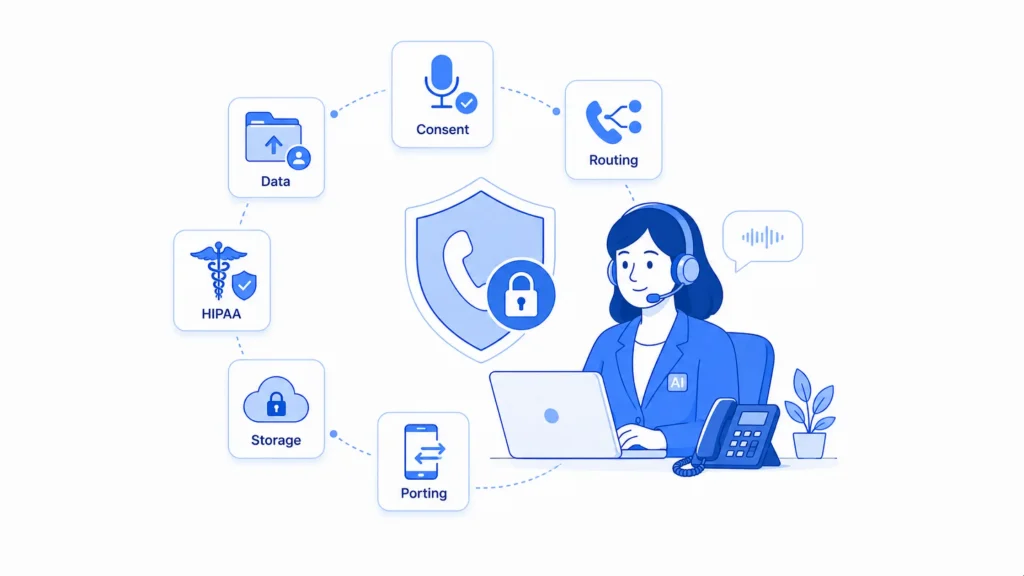
Forwarding a business phone line to a third party means that party is recording, transcribing, and in most cases storing every conversation, including whatever a caller says about their health, their legal situation, or their payment details. A few things are worth checking directly with any provider before signing up, regardless of which one gets chosen.
Call recording consent. Several US states require all parties on a call to consent to recording rather than just one. Every AI receptionist tool in this comparison records calls by default. Confirm how the provider handles consent disclosure for the states where the business operates, rather than assuming it’s handled automatically.
Data ownership on cancellation. It’s common for call transcripts, caller history, and lead data to live entirely inside the provider’s system. Ask directly what happens to that data, and whether it can be exported, if the business ever switches providers. This is rarely spelled out clearly on public pricing pages.
HIPAA and industry-specific compliance. As covered above, most pure-AI receptionist tools in this list do not make a plan-wide HIPAA claim. A general security page mentioning encryption is not the same as a signed Business Associate Agreement. Medical and mental health practices specifically should ask for the BAA before onboarding.
Number porting versus forwarding. Some tools issue a new number and rely on conditional call forwarding from the existing line (Goodcall works this way, for instance), which is a different setup than services that can take over an existing number directly. This affects what happens to the caller experience and to any existing marketing material listing the old number.
How to Choose the Right AI Receptionist
Start with call volume before features. A business under 50 calls a month is paying for headroom it doesn’t need with a flat-rate tool like NextPhone, and is well served by Upfirst’s entry tier or Frontdesk’s free tier. A business consistently over 200 to 300 calls a month should run the numbers on a flat-rate option before committing to per-call or per-minute billing, since the math flips hard at volume.
Then check whether the entry-tier price includes what’s needed. Rosie’s $49 plan is real, but it leaves out real appointment booking and call transfers that most businesses will need within the first month. Read the feature list at the price point being paid rather than the feature list printed at the top of the page.
Then decide whether a single-purpose tool or a broader platform fits the actual setup. A business that only wants its phone answered, with nothing else connected, is generally better served by one of the eight dedicated tools covered earlier in this list. A business that already runs, or is about to run, a broader AI agent for chat and support is the more realistic case for looking at YourGPT’s entry instead, since the phone line plugs into infrastructure that already exists rather than becoming a separate system to maintain.
Finally, match the model to the calls themselves. A business whose calls are short and transactional (hours, pricing, simple bookings) is well served by any of the pure-AI tools. A business whose calls regularly need judgment, negotiation, or genuine empathy (legal intake, a difficult patient conversation) should weigh Smith.ai’s hybrid model or Ruby’s human-only service against the higher cost, rather than assume AI alone will hold up on every call.
The right answer here isn’t the tool with the best marketing page. It’s the plan that matches actual call volume and actual call complexity, checked against what’s really included at that price rather than the headline number.
FAQ
How much does an AI receptionist cost for a small business?▼
Pricing across the market ranges from about $25 per month for a low-volume, per-call plan to several hundred dollars per month for a human-staffed service such as Ruby or Smith.ai’s Virtual Receptionist tier. Most dedicated AI-only tools cost between $25 and $200 per month, depending on call volume and included features.
Is Ruby actually an AI receptionist?▼
Not really. Ruby is a human-staffed answering service with optional AI features layered on top, rather than an AI-first tool like Rosie or Upfirst. It frequently appears in AI receptionist comparisons, but businesses should understand that its core service relies on live human receptionists.
Can an AI receptionist actually book appointments during a call?▼
Some can, but appointment booking may not be included in the entry-level plan. Rosie’s lowest-priced plan sends callers a booking link by text instead of completing the booking during the call. Live calendar booking becomes available on a higher tier, so businesses should check the exact plan before choosing a provider.
Do AI receptionists work with an existing business phone number?▼
Most AI receptionist services work through call forwarding rather than a complete number transfer. Goodcall, for example, provides its own phone number and uses conditional forwarding from the business’s existing line. Confirm the setup process with the vendor before assuming an existing number can be transferred automatically.
Are AI receptionists HIPAA compliant?▼
Not automatically. Most AI-only tools in this comparison do not make a plan-wide HIPAA compliance claim. Ruby states that it offers HIPAA-compliant handling for medical practices. Any healthcare business should confirm the vendor’s compliance terms and obtain a signed Business Associate Agreement before forwarding patient calls.
What is the difference between an AI receptionist and a broader AI agent platform like YourGPT?▼
A dedicated AI receptionist such as Rosie or NextPhone focuses primarily on answering phone calls. YourGPT is a broader no-code AI agent platform for chat, WhatsApp, customer support, and business workflows, with PhoneAI available as one connected channel. The right choice depends on whether a business only needs phone coverage or wants one system across multiple customer-facing channels.
What is MCP360, and does it matter when choosing an AI receptionist?▼
MCP360 is YourGPT’s companion tool marketplace. It allows an AI agent to connect with more than 100 external tools through one configuration instead of requiring a separate custom integration for each tool. It matters most for businesses building broader workflows inside YourGPT. A dedicated receptionist setup may only require calendar and CRM integrations.
Should a small business just pick the cheapest AI receptionist plan?▼
Not without checking what the plan includes. A low starting price may exclude appointment booking, call transfers, CRM access, or enough usage for the business’s monthly call volume. Rosie, for example, reserves live appointment booking and call transfers for a higher tier. Compare the features included at the exact price being paid, not only the headline price.
Conclusion
None of the nine tools compared here is a universal right answer. The right pick comes down to call volume, what a specific plan tier actually includes over its headline price, and how much judgment a typical call requires. That might mean NextPhone’s flat rate for a contractor with spiky call volume, or Ruby and Smith.ai’s human backup for sensitive legal or medical intake.
Or it might mean Upfirst for a solo operator who just wants to stop missing calls, or YourGPT for a business that already runs its chat and support on one platform and wants the phone line on that same system. Whatever gets picked, read the plan at the price actually being paid instead of the plan on the marketing page, and check it against real call volume before committing.
Create Your No Code AI Chatbot in minutes
Take your business to the next level with a powerful AI chatbot, just like ChatGPT
Compare six Yuma alternatives by ecommerce capabilities, helpdesk compatibility, pricing and human handoffs to choose a replacement for your support team.
TL;DR The Gorgias AI Agent is the automation layer inside the Gorgias helpdesk, split between a Shopping Assistant for pre-purchase conversations and a Support Agent for post-purchase support. A connected Shopify store is required, and Gorgias documentation rules out platforms such as BigCommerce, Magento, and WooCommerce for the AI Agent. Billing runs on two separate […]
TL;DR Gorgias is the closest Richpanel alternative for Shopify stores that need native order actions directly inside support tickets. YourGPT fits stores that want one AI agent handling requests across web, WhatsApp, Instagram, and email, while Tidio and Re:amaze suit smaller teams looking for lighter, lower-cost options. Richpanel’s AI pricing starts around $500/month for two […]