Best AI models for AI Customer Support in 2026: GPT-5.5 vs Claude Opus 4.8 vs Gemini 3.5

Rajni
Last updated on July 13, 2026
For AI customer support, the three frontier models that are actually deployable today are GPT-5.5, Claude Opus 4.8, and Gemini 3.5 Flash.
Newer models like GPT-5.6, Claude Fable 5, Mythos 5, and Gemini 3.5 Pro are not yet practical choices because access is gated or full release is still pending.
Claude Opus 4.8 leads on intelligence benchmarks, GPT-5.5 follows closely, while Gemini 3.5 Flash stands out for lower pricing at scale.
For support teams, the bigger factor is not just the model, but whether your platform lets you switch models easily without rebuilding your customer support workflow.
Three companies shipped new flagship models within six weeks this spring. Then, within days of each other in June, two of the three got their next release pulled behind a government-approved partner list. For anyone choosing a model for AI customer support, that gating pattern is the real story, not the launch dates.
Most “GPT-5.5 vs Claude vs Gemini” content treats this as a benchmark leaderboard problem: run the evals, read the scores, pick a winner. That’s a reasonable exercise for a coding assistant. It’s the wrong one for AI customer support, because none of the benchmarks anyone publishes (SWE-bench, Terminal-Bench, Humanity’s Last Exam) measure what a support bot actually has to do: read a confused customer’s message, stay inside your refund policy, and know when to hand off.
This piece covers what actually changed, which of these models you can deploy right now versus which ones are still theoretical for your team, and why the model is the smaller half of the decision.
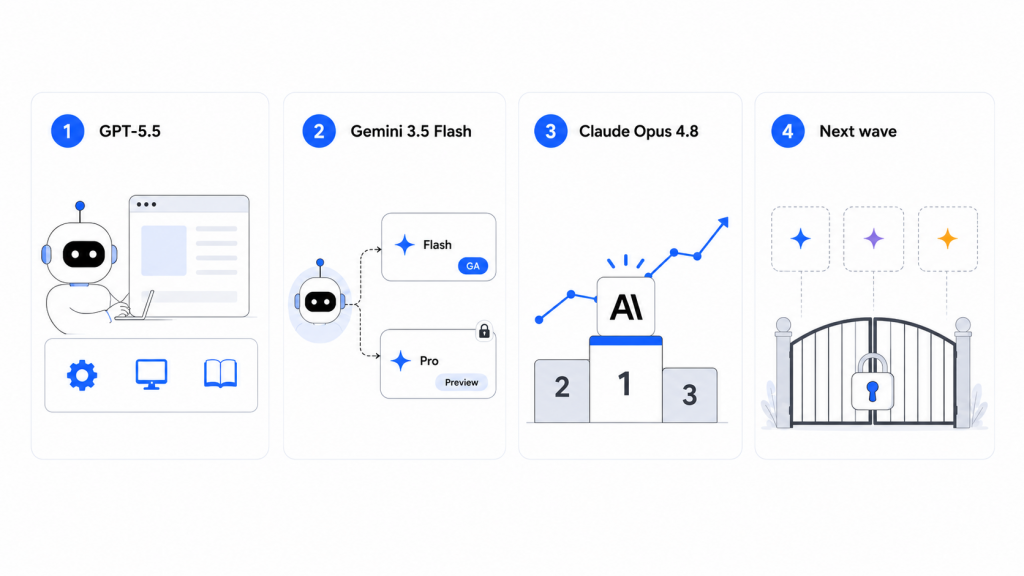
Three separate launches, three separate timelines:
That’s the visible reshuffle. The less visible one happened in June, when the next wave from two of the three labs got restricted before most teams could touch it.
| Header label | GPT-5.5 | Claude Opus 4.8 | Gemini 3.5 Flash |
|---|---|---|---|
| Vendor | OpenAI | Anthropic | |
| Released | April 23, 2026 | May 28, 2026 | May 19, 2026 |
| Availability | ChatGPT/Codex (Plus, Pro, Business, Enterprise), API | claude.ai, Claude Code, API, everywhere at launch | Gemini app, AI Studio, Vertex AI, API |
| API pricing (per 1M tokens) |
$5 input / $30 output (source) | $5 input / $25 output (source) | $1.50 input / $9 output (source) |
| Context window | 1M tokens | 1M tokens | 1M tokens |
| Where it leads | Agentic tool use, computer use tasks | #1 on the Artificial Analysis Intelligence Index at 61.4, ahead of GPT-5.5’s 60.2 (source) | Frontier-level intelligence at a fraction of flagship cost |
GPT-5.5 is OpenAI’s bet on long-horizon, tool-using tasks, the kind where a model has to plan, check its own work, and keep going without hand-holding. For AI customer support, that translates to multi-step resolution flows, an agent that looks up an order, checks a policy, and issues a refund in one pass, rather than a single-turn answer.
Claude Opus 4.8 is currently the most independently validated flagship on the market. Anthropic didn’t market it as a generational leap, and the benchmark gap over its own predecessor is genuinely small. What did change is reliability under agentic conditions: better tool-calling consistency, fewer silent failures, and a second-place finish on Artificial Analysis’s hallucination-adjacent AA-Omniscience index, behind only Gemini 3.1 Pro. For support, where a confidently wrong answer costs more than a slow one, that reliability delta matters more than the 1.2-point Intelligence Index gap over GPT-5.5.
Gemini 3.5 Flash is the pragmatic choice on paper. At $1.50 input and $9 output per 1M tokens, it costs roughly a third of GPT-5.5 or Opus 4.8 while running near frontier-level intelligence. High-volume, latency-sensitive workloads, a fair description of most support queues, are exactly what Google built it for.
Here’s the part most model comparisons skip. The newest generation from every lab in this race is currently gated, delayed, or both.
GPT-5.6 (Sol, Terra, Luna) previewed on June 26, 2026, and immediately went to roughly 20 partner organizations after OpenAI coordinated the release with the U.S. government. There’s no ChatGPT access during the preview, and OpenAI hasn’t announced a general-availability date. Terra is positioned as GPT-5.5-competitive at about half the cost, which is the tier most support teams would actually want, but you can’t request access as an unaffiliated business today.
Claude Fable 5 and Claude Mythos 5 launched June 9, 2026, and were pulled offline June 12 to comply with U.S. Department of Commerce export controls before being restored July 1. Even restored, reporting points to continued partner-list conditions narrower than the standard Claude lineup. Treat “restored” as “restored for some customers,” not “back to normal availability,” until you’ve confirmed your own account’s access.
Gemini 3.5 Pro hasn’t shipped at all. It’s been sitting in limited Vertex AI enterprise preview since its May 19 announcement, built around a 2-million-token context window and a Deep Think reasoning mode that would meaningfully change how much documentation you could hand it in a single call. Google has pointed to a July target without confirming a date. None of that helps a Q3 support rollout planned around a model that isn’t shipping yet.
The pattern across all three is the same. Frontier-tier availability turned into a policy and rollout variable this year, not just a commercial one. If your procurement plan says “wait for the best model,” you’re waiting on three separate, independent timelines that nobody, including the labs shipping them, has fully locked down.
Every one of these three models will hallucinate sometimes. Every one will occasionally misread an ambiguous instruction. That’s true of GPT-5.5, Opus 4.8, and Gemini 3.5 Flash alike, and it will still be true of whatever ships next quarter.
A support deployment succeeds or fails on the system built around the model, not on leaderboard position. Confidence thresholds route uncertain answers to a human instead of guessing. Retrieval grounds responses in your actual policy documents instead of the model’s training data. Automatic conflict detection catches contradictions across your knowledge base before a customer sees two different answers to the same question, a specific failure mode YourGPT’s Knowledge Conflict Detection is built to catch. That protective layer lives in the platform wrapped around the model, not in the model itself.
This is also the practical argument against marrying your support stack to one vendor’s roadmap. Sol, Terra, Fable 5, Mythos 5, and Gemini 3.5 Pro all prove the same point this year: the newest model and the model you can actually use are frequently different things. YourGPT’s AI Studio runs on models from OpenAI, Anthropic, Google, and xAI, and its Agent Playground lets you test the same agent against several of them side by side before you commit to one. A shift in which lab’s model is actually available becomes a setting you change, not a project you staff.
Choosing a frontier model for AI customer support is a data-handling and access decision as much as a capability one, and it deserves scrutiny separate from benchmark scores.
Every one of these three models is accessed through a vendor API, which means customer messages, order details, and account information leave your infrastructure and enter someone else’s, governed by whatever data-retention terms that vendor publishes at the time. Anthropic, OpenAI, and Google all publish privacy-first configurations for enterprise API traffic. The details are worth re-reading at the point you sign a contract, not assumed from a blog post written months earlier: retention windows, whether your data trains future models, and where it’s hosted regionally.
The access-gating pattern above compounds this risk. If your support platform is hard-wired to a single model, and that model’s newer tier gets restricted for export-control or safety reasons, as happened to two of the three labs in this piece within the same month, you’re stuck on the older tier with no fallback. A human-in-the-loop layer that catches low-confidence answers before they reach a customer, and a platform built to route between vendors rather than lock into one, are both mitigations for the same underlying risk. You don’t control your model vendor’s regulatory exposure, and 2026 has made that concrete rather than theoretical.
Skip the leaderboard and work through this instead:
There is no single best model for every support team. GPT-5.5 is strong for multi-step workflows, Claude Opus 4.8 is strong for reliability, and Gemini 3.5 Flash is practical for high-volume support because of its lower cost.
Choose based on your support needs. Use GPT-5.5 if your AI agent needs to complete actions, Claude Opus 4.8 if accuracy and reliability matter most, and Gemini 3.5 Flash if you need affordable scaling.
Claude Opus 4.8 leads on intelligence benchmarks, but that does not automatically make it better for every support use case. GPT-5.5 may be stronger when your support agent needs tool use and multi-step task completion.
Yes. Gemini 3.5 Flash is a strong option for high-volume, cost-sensitive support teams. It offers near-frontier performance at a lower price than GPT-5.5 and Claude Opus 4.8.
Not if you need to deploy now. These newer models are still gated, delayed, or limited in availability, so they are not practical choices for most customer support teams today.
Not completely. Most public benchmarks measure coding, reasoning, or tool use, not real support tasks like following refund policies, handling confused customers, or knowing when to hand off to a human.
YourGPT helps teams test and deploy AI customer support across multiple models, including OpenAI, Anthropic, and Google models. It lets you compare model performance, connect your knowledge base, add human handoff, and switch models without rebuilding your workflow.
The honest answer to “GPT-5.5 vs Claude Opus 4.8 vs Gemini 3.5” for AI customer support is that all three are usable today, each pulls ahead on a different axis (reliability, agentic depth, or price), and none of them is a stable long-term bet, because the newest tier from every lab in this comparison is currently gated, delayed, or both. Pick based on your failure mode and your ticket volume. Test against your own tickets before committing. Build your support stack so the model underneath it is a setting, not a foundation.

Compare six Yuma alternatives by ecommerce capabilities, helpdesk compatibility, pricing and human handoffs to choose a replacement for your support team.


Move from Gorgias with a verified ticket archive, tested AI workflows, human handoff and a channel cutover plan before ending your subscription.

TL;DR The Gorgias AI Agent is the automation layer inside the Gorgias helpdesk, split between a Shopping Assistant for pre-purchase conversations and a Support Agent for post-purchase support. A connected Shopify store is required, and Gorgias documentation rules out platforms such as BigCommerce, Magento, and WooCommerce for the AI Agent. Billing runs on two separate […]

TL;DR Gorgias is the closest Richpanel alternative for Shopify stores that need native order actions directly inside support tickets. YourGPT fits stores that want one AI agent handling requests across web, WhatsApp, Instagram, and email, while Tidio and Re:amaze suit smaller teams looking for lighter, lower-cost options. Richpanel’s AI pricing starts around $500/month for two […]

TL;DR Shopify Inbox is a good free option for stores that only need basic storefront chat and simple customer conversations. Stores usually look for alternatives when they need multichannel support, stronger team workflows, or automated order actions. YourGPT is strongest for cross-channel AI automation, Gorgias for Shopify-native order workflows, and Tidio for smaller stores that […]

TL;DR Tidio recently restructured its top paid plan, and many 2026 reviews still describe the old pricing model. Confirm current pricing directly on Tidio’s site before budgeting. Lyro, Tidio’s AI agent, runs on Anthropic’s Claude rather than ChatGPT. Only the Premium tier carries a guaranteed resolution rate, well below the average Tidio advertises elsewhere. Billing […]