Chatbase Review 2026: Pricing, Pros & Cons

Rajni
Last updated on July 14, 2026
Chatbase is a no-code AI agent builder trained on your own content, with plans at $0, $32, $120, and $400 per month on annual billing, plus a custom Enterprise tier.
Every self-serve plan includes exactly one AI agent. Extra agents cost $300 per agent per year, and removing the “Powered by Chatbase” badge costs $1,188 per year.
Billing runs on message credits that vary by AI model, so one reply can use 1 to 6 credits. The agent stops responding once credits run out unless auto-recharge is enabled at $40 per 1,000 credits.
Review platforms show a split picture: Capterra lists 4.3/5 and G2 lists 4.8/5 from a smaller review base, while Trustpilot has stayed near 2 stars due to billing and support complaints.
In 2026, Chatbase expanded beyond a simple website Q&A widget with voice agents, telephony, outbound WhatsApp campaigns, and a helpdesk module.
Chatbase built its reputation on one promise. Upload your docs, paste your website URL, and get a working support bot in about ten minutes. That promise still holds in 2026, and it explains the 10,000+ businesses on the platform, including names like IHG, Miele, and National Grid.
The harder questions start after setup. Message credits drain at different rates depending on the AI model you pick. The bot goes silent when they run out. A single AI agent is included on every plan, even the $400 one. And the gap between Chatbase’s software-review ratings and its Trustpilot score is wide enough to deserve its own section.
This Chatbase review breaks down the 2026 pricing structure, the features that actually shipped this year, where the platform delivers, and where teams tend to hit its ceiling.
Chatbase is a no-code platform for building AI customer support agents trained on your own business content. You feed it website URLs, PDFs, Notion pages, or raw text, pick an AI model, and deploy the agent to your website widget, WhatsApp, Messenger, Instagram, Slack, or email. Founded in 2023 by Yasser Elsaid, the company grew as a bootstrapped one-founder project to roughly $8 million in annual recurring revenue by late 2025 with a team of about 18 people, without venture funding.
The product has moved well past its “ChatGPT for your PDFs” origins. In 2026 alone, the changelog shows voice AI agents launched in April, outbound WhatsApp campaigns in May, HIPAA-eligible workspaces for Enterprise customers, and a steady stream of new models, including Claude Opus 4.8 and Gemini 3.5 Flash. Chatbase now positions itself as a complete AI customer support platform rather than a chat widget.
Status. Independent and bootstrapped. Chatbase has taken no venture funding and faces no acquisition, running at roughly $8 million ARR with a team of about 18 people as of late 2025.
What that buys you. No acquirer-driven roadmap shifts or migration deadlines of the kind Intercom Fin customers are currently navigating. The changelog shows near-weekly releases, so the small team is shipping, not stalling.
What’s actually unknown. How stable your plan terms are over time. AppSumo lifetime-deal buyers report being migrated to plans with fewer features than they purchased, and Chatbase’s own reply to a long-term customer on Trustpilot confirms pricing has been updated as the platform expanded.
What to do about it. Run the 7-day trial before any annual prepay, keep a record of the plan terms you signed up under, and treat multi-year commitments with the same caution you would apply to a vendor mid-acquisition.
Chatbase sells four public plans plus Enterprise. The prices below are the annual-billing rates verified against chatbase.co/pricing as of July 2026. Monthly billing removes the 20% yearly discount, which puts the monthly rates at roughly $40, $150, and $500 per third-party pricing trackers.
| Plan | Price Annual Billing | Message Credits/mo | AI Actions per Agent | Training Content | Seats |
|---|---|---|---|---|---|
| Free | $0 | 50 | 0 | 1 MB | 1 |
| Hobby | $32/mo | 500 | 5 | 10 MB | 2 |
| Standard | $120/mo | 4,000 | 8 | 20 MB | 3 |
| Pro | $400/mo | 15,000 | 12 | 40 MB | 5 |
| Enterprise | Custom | Custom | Custom | Custom | Custom |
Every self-serve plan includes one AI agent. The Standard tier is the step-up that matters, adding the helpdesk module, voice, telephony, outbound campaigns, API access, and auto-retraining. Enterprise adds SSO, white-labeling, custom roles, audit logs, SLAs, and HIPAA eligibility. Paid plans come with a 7-day free trial, and free-plan agents are deleted after 14 days of inactivity.
Credits are the layer that turns a simple price list into a budgeting exercise. Every AI reply consumes credits, and the rate depends on the model. Economy models cost 1 credit per response, while premium models like Claude Opus burn around 5 credits per reply, with third-party testing putting the realistic range at 2 to 6 credits. A Standard plan running a premium model delivers closer to 800 replies a month, well short of the 4,000 the headline suggests.
Unused credits expire monthly. When the balance hits zero, the agent stops responding entirely unless auto-recharge is on, which bills $40 per 1,000 extra credits.
Three add-ons routinely change the real monthly cost:
Here is a realistic scenario. A small support team on Standard wants a second agent for a separate product line and no vendor branding in front of customers. That stack runs $120 + $25 + $99, or $244 a month before any credit overages, roughly double the advertised plan price. Teams that outgrow Standard’s credit allowance face a jump straight to $400, since there is no tier in between.
Chatbase agents ingest company documentation and, through AI Actions, can touch billing systems, order data, and CRM records. That makes the security layer a first-order evaluation item rather than a footnote.
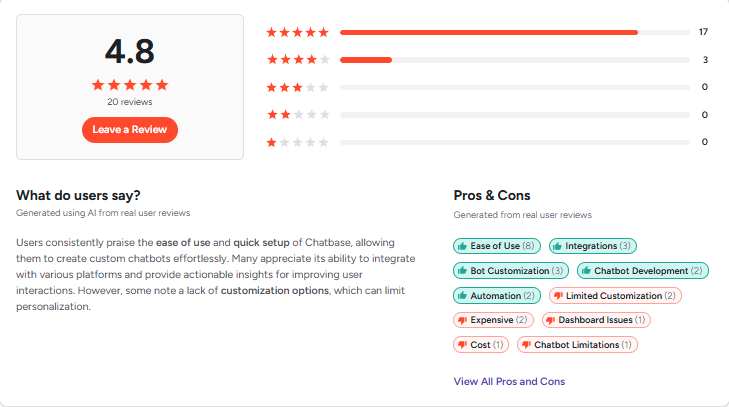
The rating spread on Chatbase is unusually wide, and reading it correctly matters more than the averages.
On software-comparison platforms, the picture is positive. Capterra shows 4.3 out of 5 across 73 reviews, with ease of use at 4.6 and value for money rated well, but customer service down at 3.8. G2 shows 4.8 out of 5, though from a small base of around 19 reviews, so treat it as directional. Praise clusters around setup speed, model flexibility, and lead qualification results.
Trustpilot tells a rougher story. The score has hovered near 2 stars across roughly 43 reviews, and the negative reviews concentrate on billing, refunds, disappearing training data, and slow support rather than core bot quality. The gap between platforms follows a familiar pattern. Buyers evaluating features review on G2 and Capterra, while existing customers reacting to a billing or support incident head to Trustpilot.
The practical takeaway is to test the specific failure modes reviewers describe before committing. Run the free trial with your real documentation, deliberately ask questions your docs answer poorly, and watch whether the bot admits uncertainty or invents something. Then check how fast support responds to a real ticket during the trial window.
This Chatbase review draws on published sources rather than a hands-on trial account, so here is exactly what informed each judgment:
We did not assign a single weighted score. That would require a live test account running against real support traffic, and a desk-research review should not pretend otherwise.
Chatbase fits best for small and mid-sized teams that want a docs-trained support agent live this week, can tolerate credit-based billing, and mostly need answers plus a handful of actions. Outside that profile, these alternatives come up most often:
The list above explains where each tool performs best. This table is designed for quicker decision-making, matching your main priority with the platform that fits it best.
| If Your Priority Is | Choose | Why |
|---|---|---|
| Multi-step workflows, multiple agents included, and voice plus chat in one platform | YourGPT | Visual AI Studio with code-level flexibility, 2 to 10 chatbots included per plan, and PhoneAI voice agents built in |
| Deterministic flow control and developer-grade customization | Botpress | Visual flow builder plus full API control for complex conversation logic |
| Live chat with human agents alongside the bot | Tidio | Built for SMB support teams working the inbox themselves |
| A full helpdesk suite with premium AI resolution | Intercom Fin | Deep ticketing and inbox maturity, billed per seat plus per AI outcome |
| The fastest possible docs-to-bot path with minimal configuration | Chatbase | Best-in-class setup speed if credit billing and single-agent plans fit your model |
For a wider field, the roundup of 10 Chatbase alternatives compares options across pricing, escalation, and workflow depth, and this buyer’s checklist for support AI agents covers what to verify in any platform before going live.
Yes. Chatbase has a free plan that includes 50 message credits per month, one AI agent, 1 MB of training content, and no AI Actions. Treat it as a sandbox rather than a production bot, because agents on the free plan are deleted after 14 days of inactivity. Paid plans also include a 7-day free trial.
Chatbase costs $32 per month for Hobby, $120 per month for Standard, and $400 per month for Pro on annual billing. Monthly billing is about 25% higher, at roughly $40, $150, and $500. Real deployments can cost more once add-ons stack up, including branding removal at $1,188 per year and extra AI agents at $300 per year each.
When message credits run out, the Chatbase agent stops responding to customers until credits renew or you top up. Auto-recharge, billed at $40 per 1,000 credits, automatically adds credits when your balance falls below a threshold you set. If the bot is customer-facing, enable auto-recharge from day one and treat the threshold as a production setting.
Chatbase holds SOC 2 Type II certification, is GDPR compliant, and states that customer data is never used to train AI models. Enterprise customers can sign a BAA for HIPAA-eligible workspaces with zero data retention. Data is hosted on AWS in the United States, which teams with EU data-residency requirements should factor into their evaluation.
Yes. Since April 2026, Chatbase Voice can route inbound calls through a Twilio integration into the same agent that handles chat. It uses the same knowledge base, AI Actions, and escalation rules, with real-time conversations in 95+ languages. Voice and telephony features start on the Standard plan at $120 per month.
Chatbase is a weaker fit if you need deterministic conversation flows, because it does not include a visual flow builder. It can also be limiting for teams running multiple products or clients, since every plan includes a single agent. For high-volume teams that need predictable billing, credit-based pricing can become harder to manage as traffic and model usage increase. Workflow-first platforms like YourGPT or Botpress may fit those cases better.
For a small team whose support questions live in reasonably clean documentation, Chatbase remains one of the fastest routes from nothing to a working AI agent, and the 2026 additions of voice, telephony, and a helpdesk module make the platform meaningfully more complete than it was a year ago. The $32 Hobby tier is a low-risk way to prove the concept.
The evaluation gets harder as usage grows. Credit-based billing rewards low traffic and punishes success, every plan includes a single agent, and the add-ons that make a deployment look professional can double the advertised price. Before committing to an annual plan, run the 7-day trial against your real content, calculate your credit burn with the model you actually intend to use, and price the full stack including branding removal and any extra agents. If the total starts approaching what a workflow-capable platform charges, compare the head-to-head with YourGPT before signing, because at that budget the single-agent, answers-first model stops being the obvious choice.
[IMAGE: Chatbase pricing page screenshot showing the four self-serve plans, no visible text overlay needed] [IMAGE: Illustration of message credits draining at different rates for economy vs premium AI models] [IMAGE: Side-by-side rating comparison graphic, Capterra 4.3 and G2 4.8 vs Trustpilot near 2 stars]

Compare six Yuma alternatives by ecommerce capabilities, helpdesk compatibility, pricing and human handoffs to choose a replacement for your support team.


Move from Gorgias with a verified ticket archive, tested AI workflows, human handoff and a channel cutover plan before ending your subscription.

TL;DR The Gorgias AI Agent is the automation layer inside the Gorgias helpdesk, split between a Shopping Assistant for pre-purchase conversations and a Support Agent for post-purchase support. A connected Shopify store is required, and Gorgias documentation rules out platforms such as BigCommerce, Magento, and WooCommerce for the AI Agent. Billing runs on two separate […]

TL;DR Gorgias is the closest Richpanel alternative for Shopify stores that need native order actions directly inside support tickets. YourGPT fits stores that want one AI agent handling requests across web, WhatsApp, Instagram, and email, while Tidio and Re:amaze suit smaller teams looking for lighter, lower-cost options. Richpanel’s AI pricing starts around $500/month for two […]

TL;DR Shopify Inbox is a good free option for stores that only need basic storefront chat and simple customer conversations. Stores usually look for alternatives when they need multichannel support, stronger team workflows, or automated order actions. YourGPT is strongest for cross-channel AI automation, Gorgias for Shopify-native order workflows, and Tidio for smaller stores that […]
TL;DR Tidio recently restructured its top paid plan, and many 2026 reviews still describe the old pricing model. Confirm current pricing directly on Tidio’s site before budgeting. Lyro, Tidio’s AI agent, runs on Anthropic’s Claude rather than ChatGPT. Only the Premium tier carries a guaranteed resolution rate, well below the average Tidio advertises elsewhere. Billing […]