Manychat Review 2026: Pricing, Pros & Cons

Rajni
Last updated on July 14, 2026
Manychat changed its pricing on March 2, 2026, introducing five Active Contact-based plans and reducing the Free plan limit from 1,000 contacts to just 25.
Plans now range from $0 for Free to $139 per month for Advanced, with additional overage charges when your contact volume exceeds the amount included in your plan.
Manychat remains a strong option for Instagram comment-to-DM automation and offers recognized security compliance, but its AI is primarily guided and rule-based, while customer support is limited to email.
Reviews are generally positive on G2 and Capterra, although its lower Trustpilot rating highlights recurring concerns about billing, cancellation, and account management.
Social media searches for DM automation tend to lead to the same place. Manychat has been the default pick for Instagram- and social-DM-driven growth for years, and it earned that reputation before the current AI wave even started. Comment on a Reel, get a DM back with a link or discount code, convert a follower into a lead. That single mechanic, built on Meta’s official APIs, is still what most Manychat accounts are running today.
Three things shifted in 2026: pricing, AI, and the field of tools competing for the same budget. A pricing overhaul in March replaced the old two-tier structure with a five-plan ladder billed by “Active Contacts,” and gutted the free plan in the process. Manychat also folded AI further into the product, but that AI still behaves closer to a scripted flow with an AI-shaped step bolted on than a system that reasons across an open conversation. Meanwhile, the tools sitting next to Manychat on a shortlist have gotten sharper, especially anywhere the actual need has moved past comment-to-DM into something closer to real conversation.
This Manychat review breaks down what the platform actually costs in 2026, what it does well, where the flow-builder approach runs into real limits, and where it now stands against the competition it didn’t have a year ago.
Manychat is a chat marketing platform that automates conversations across Instagram, Facebook Messenger, WhatsApp, TikTok, Telegram, SMS, and email. Founded in 2015 by Mike Yan, it built its reputation on Facebook Messenger bots before becoming best known for Instagram comment-to-DM automation: a follower comments a keyword on a post or Reel, and Manychat fires back an automatic DM with a link, a discount code, or a lead magnet.
The company backs that reputation with real scale. Manychat is used by more than 1 million businesses across 170-plus countries, and it raised a $140 million Series B in April 2025 to expand further into AI agents, backed by Bessemer Venture Partners and Summit Partners. It’s an official Meta Business Partner and a TikTok partner, which matters more than it sounds: unofficial automation tools risk account bans, and Manychat’s pricing page notes it’s one of the few companies with both partnerships at once.
Status. Live. Manychat rolled out the new pricing structure on March 2, 2026. As of July 2026, its five-tier model—Free, Essential, Pro, Business, and Advanced—is the default structure shown on Manychat’s pricing page.
What stays the same. Your automations, content, and contacts are not deleted when your plan changes. Manychat introduced the new plans to new signups first, followed by a gradual rollout to existing accounts. If you cancel features included with Pro, your flows remain saved but stop running until you resubscribe.
What’s actually unknown. Manychat has not confirmed whether every legacy account has moved to the new pricing structure or whether some customers remain grandfathered on older terms. Its Billing FAQ also mentions an “Elite” plan with dedicated Customer Success Manager support, even though Elite does not appear on the current five-tier pricing page. It is unclear whether it still exists separately or has been folded into Advanced.
What to do about it. Check Settings > Billing > Subscription inside your Manychat account instead of assuming the public pricing page reflects your current terms, especially if you signed up before March 2026.
Manychat introduced a major pricing overhaul in March 2026, replacing its old plan structure with five tiers based on Active Contacts.
The new pricing ranges from a limited Free plan for 25 contacts to an Advanced plan for larger businesses, with overage fees applied when contact limits are exceeded.
| Plan | Seat Price Annual | Seat Price Monthly | Notable Inclusions |
|---|---|---|---|
| Essential | $29/seat/mo ($19 promo as of July 2026) | $39/seat/mo | Fin AI Agent, shared inbox, messenger, basic reporting |
| Advanced | $85/seat/mo | $99/seat/mo | Multiple inboxes, workflow automation, 20 free Lite seats |
| Expert | $132/seat/mo | $139/seat/mo | SSO, HIPAA support, SLAs, multibrand messenger, 50 free Lite seats |
Prices verified against manychat.com/pricing as of July 10, 2026. The headline monthly price shown for each paid tier is paired with an annual-billing total on the live page, which suggests it already reflects the annual-commitment rate. Manychat’s pricing calculator, which shows a separate month-to-month (no annual commitment) rate, is JavaScript-rendered and didn’t appear in a static page fetch, so confirm the true pay-monthly rate directly on the live page before quoting it.
Here’s a real-world example. A creator running a comment-to-DM campaign that pulls in 10,000 active contacts in a month sits above the Business plan’s 7,500 included, so 2,500 contacts hit overage pricing. On monthly billing, that’s $69 base plus 2,500 × $0.025, or $131.50 for the month, a figure that lines up closely with an independent calculation from SetSmart using the same rates. On annual billing, the same overage costs $45 instead of $62.50, bringing the effective monthly total closer to $114.
WhatsApp and SMS carry their own per-message costs on top of the plan price, set by Meta’s WhatsApp Business Platform rather than by Manychat, and they vary by country and message category. Budget for this separately if WhatsApp is a core channel, and confirm current per-conversation rates directly with Meta’s own pricing before committing to volume.
One inconsistency is worth flagging before you budget. Manychat’s pricing page lists AI as an included feature of the $29/mo Pro plan and above, but the separate Manychat AI product page’s FAQ states “Manychat AI is an add-on to Manychat Pro, and costs $29/month,” as if it’s a charge on top of Pro rather than bundled into it. The two pages don’t agree, and this review can’t resolve which one is current. Confirm with Manychat directly, or check your own account’s billing settings, before assuming AI is free once you’re on Pro.
Manychat requires OAuth-level access to your Instagram, Facebook, or WhatsApp Business accounts to function, and it stores customer message data and, through integrations like Shopify and Stripe, references to order and payment activity. That combination makes its certification posture and platform-partner status worth checking directly rather than taking on faith.
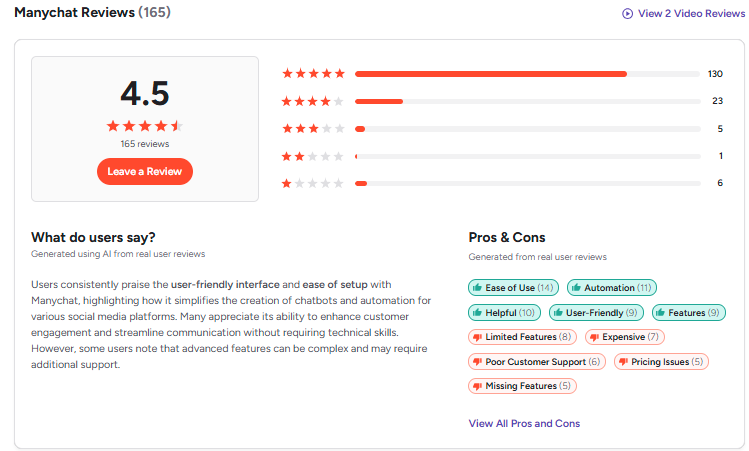
Rating platforms don’t fully agree here. On G2, Manychat sits around 4.5 out of 5 across roughly 150 to 165 reviews depending on when the snapshot was taken, with ease of use, automation depth, and template variety as the most repeated praise. Capterra shows a close 4.6 out of 5 from 72 reviews, with ease of use scoring 4.4 and customer service scoring a noticeably lower 4.0, a gap that’s consistent with the support complaints elsewhere in this review.
Trustpilot tells a rougher story. Reading directly through dozens of reviews on trustpilot.com/review/manychat.com, the recurring themes are billing charges continuing after cancellation, active-contact counting that users feel doesn’t match their actual usage, and slow or automated-feeling support responses. One reviewer on the page describes the visible average as roughly 3.8 out of 5, a figure this review can’t independently confirm since Trustpilot blocks automated access, so treat it as directionally useful rather than exact.
The gap between platforms tracks a pattern seen across most SaaS review aggregation. G2 and Capterra skew toward people evaluating features during a purchase decision, while Trustpilot skews toward existing customers writing in reaction to a specific billing or support incident. If you’re deciding based on these scores, it’s worth filtering for reviewers who match your own use case, since a billing complaint from a business running 20,000 active contacts on Business tier doesn’t necessarily predict what a solo creator on Essential will experience.
This review draws on Manychat’s own pricing, product, and security pages, verified review platforms, and a dated community forum example, rather than a hands-on trial account. That’s worth being explicit about.
We didn’t assign Manychat a single weighted score. That would need a live test account tracking real automation performance over time, not published documentation and aggregated reviews.
Manychat fits best for creators, agencies, and small ecommerce brands whose core need is Instagram- and social-DM-driven lead capture, where scripted flows cover most of the conversation. Outside that profile, a few alternatives come up often.
| If Your Priority Is | Choose | Why |
|---|---|---|
| The deepest comment-to-DM and social growth automation, especially for Instagram and TikTok | ManyChat | Still the strongest option for social-DM-driven lead capture, automated replies, and conversational marketing campaigns |
| A flat monthly cost with no active-contact overage risk | InstantDM or similar | Fixed pricing can offer better cost predictability, although feature depth may be more limited than larger platforms |
| WhatsApp as the primary channel, with API-native templates and broadcast campaigns | Wati or AiSensy | Purpose-built for WhatsApp Business automation rather than broad multichannel customer engagement |
| Conversational AI that reasons across support, sales, and operations instead of focusing only on social DMs | YourGPT | Offers model choice, RAG-grounded responses, omnichannel deployment, and a visual AI workflow builder for advanced automation |
A detailed side-by-side comparison and a broader roundup of Manychat alternatives are worth reading if cost predictability or AI depth beyond social DMs is what’s driving your search.
For a creator, agency, or small ecommerce brand whose growth engine runs through Instagram comments and DMs, Manychat’s price still holds up, even with the March 2026 free-tier cut factored in. The Growth Tools and comment-to-DM mechanic remain the deepest option in that specific lane, and the official Meta and TikTok partnerships reduce a real risk that unofficial automation tools carry.
Where it gets harder to justify is anywhere the conversation needs to go off-script. The AI features answer FAQs and triage DMs inside boundaries you set, but they don’t reason the way a model-backed agent does, and the active-contact billing model means the moment a campaign works, the bill grows with it. Before committing to an annual plan, model your realistic contact volume against the overage table above, and get written confirmation from Manychat on whether AI is included in your specific plan or billed as a separate add-on, since the company’s own pages don’t agree.

Compare six Yuma alternatives by ecommerce capabilities, helpdesk compatibility, pricing and human handoffs to choose a replacement for your support team.


Move from Gorgias with a verified ticket archive, tested AI workflows, human handoff and a channel cutover plan before ending your subscription.


TL;DR The Gorgias AI Agent is the automation layer inside the Gorgias helpdesk, split between a Shopping Assistant for pre-purchase conversations and a Support Agent for post-purchase support. A connected Shopify store is required, and Gorgias documentation rules out platforms such as BigCommerce, Magento, and WooCommerce for the AI Agent. Billing runs on two separate […]

TL;DR Gorgias is the closest Richpanel alternative for Shopify stores that need native order actions directly inside support tickets. YourGPT fits stores that want one AI agent handling requests across web, WhatsApp, Instagram, and email, while Tidio and Re:amaze suit smaller teams looking for lighter, lower-cost options. Richpanel’s AI pricing starts around $500/month for two […]

TL;DR Shopify Inbox is a good free option for stores that only need basic storefront chat and simple customer conversations. Stores usually look for alternatives when they need multichannel support, stronger team workflows, or automated order actions. YourGPT is strongest for cross-channel AI automation, Gorgias for Shopify-native order workflows, and Tidio for smaller stores that […]

TL;DR Tidio recently restructured its top paid plan, and many 2026 reviews still describe the old pricing model. Confirm current pricing directly on Tidio’s site before budgeting. Lyro, Tidio’s AI agent, runs on Anthropic’s Claude rather than ChatGPT. Only the Premium tier carries a guaranteed resolution rate, well below the average Tidio advertises elsewhere. Billing […]