AI Chatbot for Agencies: A Guide to Building Profitable AI Agent Service

Rajni
Last updated on April 17, 2026
AI chatbot services help agencies move from one-time projects to predictable monthly revenue.
The best clients are businesses with repetitive queries, slow responses, and missed leads, where value is easy to prove.
Results come from a clear process: platform choice, onboarding, training on real data, and continuous improvement.
With simple pricing and repeatable systems, agencies can scale this into a reliable and growing service line.
Most agencies don’t have a lead problem. They have a revenue structure problem.
According to McKinsey & Company, AI adoption has crossed 55% of organizations globally, yet many implementations fail to deliver measurable outcomes. The issue is not demand. It is execution. Agencies already understand their clients’ workflows and customers, which puts them in a strong position to close that gap.
Right now, most agencies run on a project cycle. Close, deliver, invoice, repeat. Revenue resets every month, and growth depends on constant acquisition. AI chatbot services change this model. Instead of one-time work, you deploy systems that continue handling support, qualifying leads, and completing tasks. That creates predictable, recurring revenue.
The $5K in 90 days target is straightforward. Five clients at $1,000 per month or ten clients at $500 per month gets you there. For an AI agency already selling services, this is a realistic shift when the offer is tied to outcomes with clear ROI, such as lower support costs, faster response times, stronger customer experience, or better retention.
This guide follows a simple framework called The Agency AI Stack. It focuses on four parts: training the AI on client data, defining workflows and rules, connecting it to real systems, and deploying it across channels. This is what clients pay for. Not a chatbot, but a system that gets work done.
You’re probably already seeing it inside the businesses you work with. More customer messages. The same questions repeating every day. Support teams stretched thin. Hiring costs are high, so most companies are trying to do more with the same number of people. AI is no longer an experiment. It’s a practical tool to reduce workload and keep customers satisfied.
The demand is real. The problem is execution.
Many small and mid-size businesses have tried basic chatbots. They connect a tool to their website, set it up quickly, and hope for the best. What they usually get is a robotic responder that works for simple questions but falls apart the moment a conversation becomes even slightly complex.
This is exactly where agencies win.
You already understand how these businesses operate. You know where leads get lost, which questions waste the most time, and what customers actually care about. That real-world context is far more valuable than the AI technology itself.
Agencies that move now shape how AI gets used. Those who wait compete later in a more crowded market with thinner margins and higher expectations.
AI chatbot services don’t end after delivery. Once deployed, they continue handling conversations, capturing leads, and supporting customers every day. That ongoing usage is what turns this into a recurring revenue model.
Instead of starting from zero each month, every new client adds to a growing base.
Here’s how that looks in practice:
| Scenario | Clients | Monthly Price | Monthly Revenue |
|---|---|---|---|
| Starter | 10 | $300 | $3,000 |
| Growth | 15 | $400 | $6,000 |
| Scale | 20 | $500 | $10,000 |
Most agencies fall within the $300–$500 per client range, depending on scope, channels, and level of support.
This is not a one-time service. It is a system that builds predictable income over time.
An AI agent service is not just a tool you install. It is a system you build and manage for your clients. You take their existing business knowledge, including website content, FAQs, product details, policies, and past customer queries, and turn it into a working assistant that handles conversations, captures leads, and supports customers every day. You define how it responds, what tone it uses, and when it hands off to a human.
Once deployed, it starts doing real work. It answers common questions instantly, qualifies leads, captures contact details, and supports customers without delays. But the value is not in the setup. It comes from ongoing improvement. As conversations happen, you refine responses, close gaps, and expand what the chatbot can handle. Over time, it becomes more accurate and more aligned with the business. That is what clients pay for. Not just a chatbot, but a system that improves how their business communicates and converts.
White-label is not just branding. It is ownership. The chatbot runs under your agency’s name, and everything the client sees points back to you. You are not reselling a tool. You are delivering a service. That distinction gives you control over pricing, positioning, and long-term client relationships.
AI chatbot services create the most value in workflows that are repetitive and time-sensitive, such as customer support, FAQ handling, lead capture, appointment booking, and e-commerce queries. These are not edge cases. They are daily operational bottlenecks. When handled correctly, the impact is direct: faster responses, reduced manual workload, and higher conversion. This makes the value easy to demonstrate and easier for clients to justify.
A website chatbot is just the starting point. Customers move between websites, messaging apps, and social platforms, and they expect the same experience everywhere. With one trained system, you can deploy across multiple channels and deliver consistent responses without extra setup. That changes how you position your service. You are not offering a chatbot for a website. You are offering a system that handles customer communication across every channel your client uses. This makes it easier to sell and supports higher pricing.
Most agencies don’t struggle because of demand. They struggle because of platform friction.
The tool you choose directly affects how fast you launch, how consistent your results are, and how easily you scale. Instead of focusing on one platform, it helps to understand the four categories available.
1. Developer-First Platforms
2. SMB Tools (Basic Chatbots)
3. AI-First Platforms (Balanced)
4. Enterprise Systems
Most agencies perform best with AI-first platforms. They provide the right balance between ease of use and real-world performance without adding unnecessary complexity.
Before choosing a platform, validate these:
If even one of these breaks, delivery slows down and margins become harder to maintain.
Scaling this service depends on how quickly and consistently you can onboard clients.
Without a clear process, every setup feels different. With structure, onboarding becomes repeatable and faster with each client.
| Step | Time |
|---|---|
| Discovery | 1–2 hours |
| Data Collection | 2–4 hours |
| Setup | 3–6 hours |
| Testing | 1–2 hours |
| Launch | Same day |
Most clients can go live within 2–3 days when the process is defined.
Immediate impact:
Setup gets the system live. That is not where long-term revenue comes from.
The retainer is driven by ongoing optimization:
As usage increases, gaps become visible. Fixing those gaps improves performance over time.
That continuous improvement is what clients pay for.
Most chatbots fail for a simple reason. They are trained on surface-level content and expected to handle real conversations. Connecting a website and adding a few FAQs creates something that works for basic queries but breaks when questions become more specific. This is where your agency earns its retainer.
The difference between a basic chatbot and a high-performing one comes down to training quality. Website pages, FAQs, product details, pricing, and policies provide the foundation, but real improvement comes from how customers actually communicate. Support inbox data, repeated queries, and common objections show how people ask questions in real situations. Adding this layer improves accuracy and makes responses more relevant, while sales conversations and comparison queries allow the chatbot to guide users and support decisions.
Tone and boundaries matter just as much as the data. The chatbot should match the business it represents, whether that means being precise and professional or direct and conversational. At the same time, it should not attempt to answer everything. Complex or sensitive queries should move to a human, which builds trust and prevents poor responses.
Training does not end after launch. As conversations come in, gaps become visible. Refining responses, adding missing information, and expanding coverage over time is what turns a basic setup into a system that consistently performs. That is what clients are paying for, not just a chatbot, but something that improves with use and continues to deliver value.
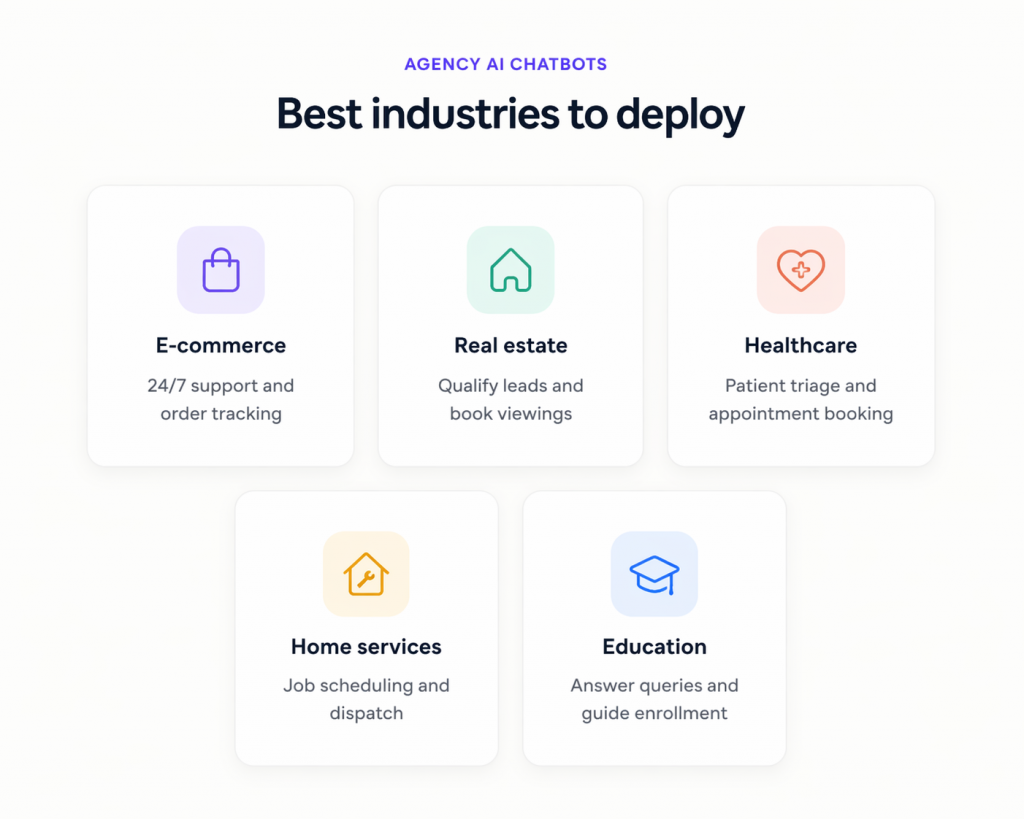
Not all industries convert at the same speed.
The fastest wins come from businesses where two factors are obvious:
When both are present, the value of instant responses becomes clear without heavy selling.
| Industry | Inquiry Volume | Urgency | Priority |
|---|---|---|---|
| E-commerce | High | High | ⭐⭐⭐⭐⭐ |
| Real Estate | Medium | High | ⭐⭐⭐⭐ |
| Healthcare | High | Medium | ⭐⭐⭐⭐ |
| Home Services | Medium | High | ⭐⭐⭐⭐ |
| Education | Medium | Medium | ⭐⭐⭐ |
According to Baymard Institute, a significant portion of cart abandonment happens because customers don’t get answers when they need them.
That makes chatbot ROI easy to demonstrate:
Most agencies get stuck on pricing because they focus on cost.
Clients don’t buy chatbots. They pay for outcomes:
When pricing is tied to these results, it becomes easier to justify and easier to close.
Based on agency benchmarks, platform costs, and typical SMB use cases, most chatbot retainers fall between $300–$500 per month.
This range works because:
That combination creates strong margins without overcomplicating the offer.
| Plan | Price | Includes |
|---|---|---|
| Starter | $299/mo | Website chatbot, basic training |
| Growth | $499/mo | Multi-channel deployment, deeper training |
| Pro | $799+/mo | Advanced workflows, higher limits, priority support |
Simple pricing reduces friction. Fewer choices lead to faster decisions.
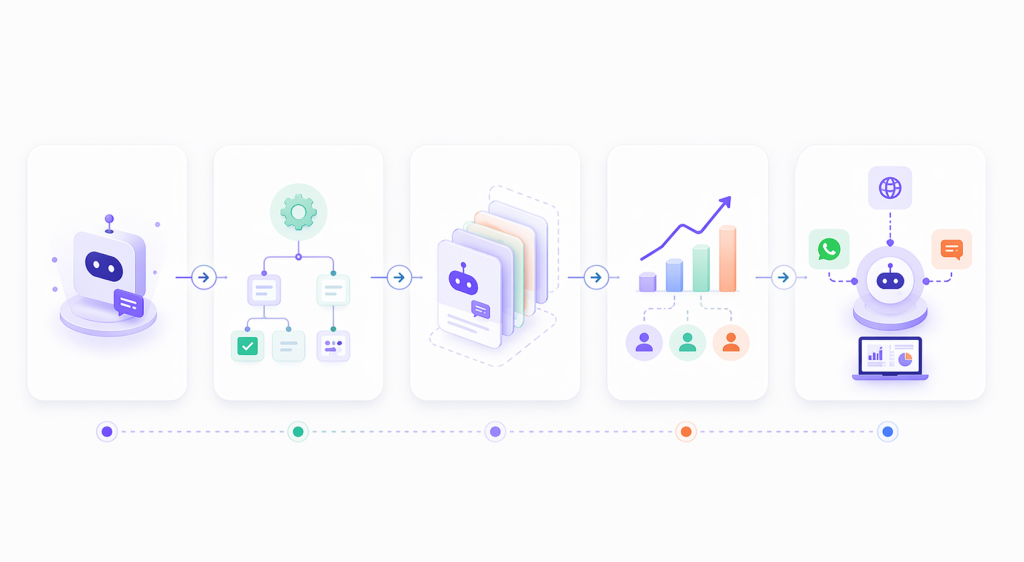
The first few clients prove the model. Scaling turns it into a business. Without structure, growth creates complexity. With the right systems, each new client becomes easier to onboard, manage, and retain.
Scaling does not come from doing more work. It comes from making the same process repeatable. Standardize onboarding, training, and optimization so each new client takes less time without reducing quality.
After a few clients, patterns start to repeat. The same questions, use cases, and responses appear across similar businesses. Capture these and turn them into reusable templates so you can launch faster and stay consistent.
Your role should shift as you grow. Spend less time on setup and small changes, and more time on acquiring clients, improving performance, and expanding accounts. That is where real growth happens.
Scaling is not just about more clients. It is about getting more value from each one. Multi-channel deployment, deeper training, and additional use cases increase revenue without significantly increasing workload.
Retention depends on clarity. Show clients what the chatbot is doing, how many conversations it handles, and where it adds value. When results are visible, the service becomes harder to replace.
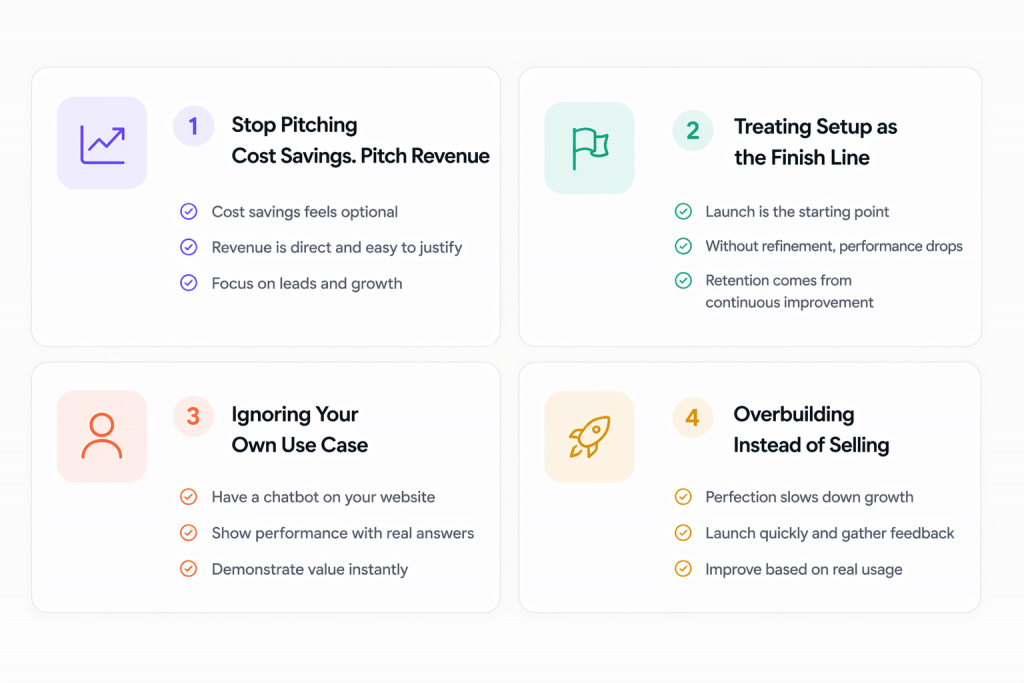
Most agencies don’t fail because of demand. They fail because of how they position and execute the service.
These mistakes are common and easy to fix once you see them.
Cost savings is a weak angle. It feels optional.
Revenue is direct and easier to justify.
Instead of:
“We reduce workload”
Say:
“We help you capture leads you’re currently losing”
This shift makes the value immediate and improves close rates.
Launch is not the outcome. It is the starting point.
Without ongoing refinement, performance drops and the system becomes less useful.
Retention depends on continuous improvement, not initial setup.
If you’re selling chatbot services, your website should have one.
A working chatbot:
This removes friction in sales and reduces the need for long explanations.
Many agencies spend too much time trying to build the “perfect” system.
That slows down growth.
Start simple:
Speed matters more than perfection at the beginning.
Avoiding these mistakes keeps the model simple, scalable, and easier to sell.
Most agencies earn between $300 and $500 per client per month for standard chatbot setups. The real growth comes from stacking clients—10 to 15 clients can generate consistent recurring income. As your systems improve, adding new clients requires less effort, making the model scalable.
No coding or technical infrastructure skills are required. Success depends more on understanding client businesses, customer behavior, and refining chatbot responses to match real-world interactions.
An initial version can typically go live within a few days if you have access to website content, FAQs, and basic data. Ongoing improvements happen after launch as you refine responses based on real conversations.
Businesses with high inquiry volume and slow response times are easiest to convert. This includes service providers, e-commerce stores, real estate agencies, and local businesses where missed messages often mean lost revenue.
Track simple metrics like conversations handled, leads captured, and response time improvements. Clients also notice reduced repetitive tasks and better follow-ups over time, which clearly demonstrates value.
Incorrect responses can occur early on. You improve accuracy by monitoring conversations, refining responses, and setting clear escalation rules so complex queries are handed off to a human.
Using an existing platform is usually the better option. It allows you to focus on client results instead of technical development, helping you grow faster and avoid unnecessary complexity.
Around 10 to 20 clients is typically enough to build a stable and predictable income stream. At that point, growth becomes more about refining processes than acquiring new clients.
Small and mid-size businesses often benefit the most. Chatbots help them respond faster and compete effectively without hiring additional staff, delivering immediate value.
Start with businesses you already understand. Build a simple chatbot using their website content and demonstrate how it handles real customer questions. Seeing instant responses makes the value clear without a lengthy sales pitch.
A profitable AI chatbot service is not built by installing a tool and hoping it works. It is built through understanding the client’s workflow, setting up the right system, and improving it over time. That is where the real value comes from. As the chatbot handles more conversations, it becomes more aligned with the business, more useful to the client, and more difficult to replace.
For agencies, this creates more than short-term revenue. It creates a service that can compound. The more clients you work with, the better your delivery becomes, the faster onboarding gets, and the easier it is to scale without rebuilding everything from scratch. Platforms like YourGPT make that easier by giving agencies the infrastructure to launch quickly, train on real business data, deploy across channels, and keep improving performance after launch.
The opportunity is there. Execution decides who builds recurring revenue and strong client relationships. Agencies that treat this as a serious service are far more likely to win long term.
Calculate cost per ticket with one formula and a free calculator, then compare it with the cost of a conversation an AI agent resolves.
Omnichannel support means every channel answers from the same knowledge. Train one AI agent, pick your first channel, and test that answers match.

Self-learning AI agents log the questions they miss. Learn how human review turns those gaps into trained answers and how to run the weekly loop.
Train an AI agent on your return policy, connect the Shopify template in AI Studio to check real orders, and route exceptions to your team.
WISMO means Where Is My Order. Measure your WISMO share from last month’s tickets, fix the tracking gaps, and let an agent answer order status.
Run WordPress customer service alone. Train a YourGPT agent on your help pages, test it on real tickets, install the plugin, and get only the exceptions.