Selling White-Label AI to Clients: A Practical Guide for Agencies

Rajni
Last updated on May 28, 2026
Selling white-label AI services means owning outcomes, not reselling tools. Focus on the right clients, measurable use cases, integrations, privacy, pricing, support, and performance tracking so AI reduces workload, improves response times, protects revenue, and scales reliably.
Businesses want AI, but most do not know how to set it up properly. They are not asking which model is smartest. They are trying to figure out what to automate first, how to make it reliable, and where it will actually create business value.
That is where agencies, consultants, and service providers have an advantage. The opportunity is not just selling access to AI. It is helping businesses make the right decisions around model selection, prompt design, training data, and workflow setup.
If you are still defining the business model, start with this guide on what an AI agency is and how to build one. This article goes deeper into the selling side: how to package white-label AI services, qualify clients, price delivery, manage implementation, and retain accounts.
Most companies do not need more AI explanations. They need someone who can turn AI into a working system that reduces workload, improves response times, or helps teams move faster without adding chaos.
The providers who can do that well are not competing on features. They are solving the execution gap between AI interest and real implementation.
This blog breaks down how to sell AI services in that context, from identifying the right buyers to positioning, pricing, delivery, and what happens when things go wrong.
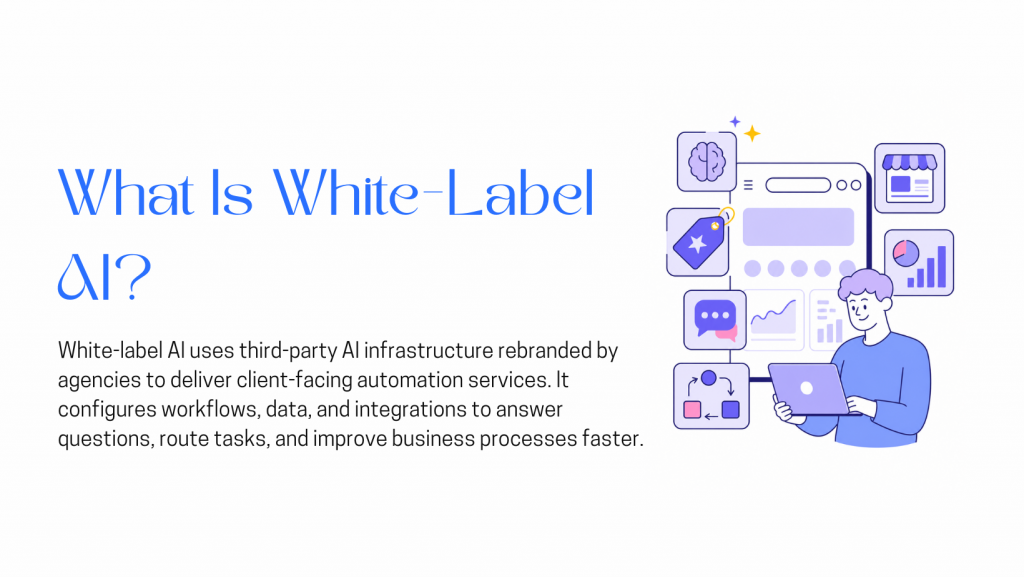
Before anything else, this needs to be clear: white-labeling AI is not reselling a tool. It is taking operational ownership of an AI system on behalf of a client, under your brand or theirs.
When a business buys white-label AI from you, they expect you to handle the parts they do not understand. That includes prompt design, workflow logic, integration with their existing systems, escalation rules, and performance over time. They are not buying a login. They are buying a working system with someone accountable behind it.
Most agencies enter this space thinking about setup costs and monthly fees. The ones who succeed long-term think about what it costs to maintain five clients at once when each one has a slightly different CRM, a different support workflow, and a different definition of what “working” looks like.
White-label AI SaaS platforms have made this more manageable by handling the infrastructure layer, so agencies can focus on configuration and client outcomes rather than model hosting and API management. But the accountability still sits with you. Choosing the right platform matters because your time is the real constraint, not the technology.
If you are still comparing white-label options, this guide to the top white-label SaaS platforms to resell breaks down the platform side in more detail. This article focuses on the service model: how to position, price, sell, deliver, and manage AI services once you have the right foundation in place.
Before signing any client, ask yourself:
If the answer to any of these is unclear, sort that out before scaling.
AI services are almost never bought by a single decision-maker. In most organizations, AI purchases move through a shared decision process where multiple stakeholders evaluate the same proposal through completely different risk lenses.
Understanding this dynamic is critical. Most AI deals do not fail because the technology is weak. They fail because one stakeholder feels uncertain, exposed, or unconvinced and quietly slows the decision without ever saying no.
Operations teams are usually the first to push for AI adoption because they live closest to the friction.
They deal with overflowing queues, manual handoffs, repeated customer requests, and processes that break as volume grows. Their concern is not whether AI is impressive. It is whether it actually removes work from their team’s day.
They ask practical questions: Which tasks disappear entirely? How much time do we realistically save each week? Does this reduce backlog, or does it just move it elsewhere?
In real buying situations, operations leaders often become internal champions only after they see concrete impact. When a support manager can say “we closed 42% fewer tickets manually last month,” the conversation changes.
Operations teams support projects they can defend internally with numbers, not promises.
Finance teams act as gatekeepers, not because they dislike AI, but because they are trained to distrust projections that depend on best-case assumptions.
They focus on total implementation and ongoing costs, when savings actually begin, how ROI will be measured, and what happens if results arrive slower than expected.
McKinsey’s finding that only 6% of companies achieve meaningful EBIT impact from AI is widely understood in finance teams. This makes them cautious, especially when AI is positioned as transformational rather than operational.
Finance resistance often appears late in the process. A deal that feels approved suddenly pauses when someone asks “how exactly are we validating this?” Conservative assumptions, clear benchmarks, and defined review checkpoints build confidence and keep momentum.
Finance teams approve AI projects when downside risk feels contained and measurement feels credible.
IT teams rarely own the budget, but they often decide whether a project survives implementation.
Their concerns are practical and non-negotiable: Can this integrate cleanly with our existing systems? Where does data flow and who can access it? How are security, permissions, and logging handled? Who owns maintenance after launch?
Generic reassurances fail here. IT teams expect specific answers about APIs, authentication, escalation paths, and failure handling.
Many AI initiatives quietly die at this stage. Not because IT says no, but because unanswered questions slow approvals, delay access, or block integration timelines.
Executives do not evaluate AI as a feature set. They evaluate it as leverage.
Their questions focus on outcomes: Does this materially improve customer experience? Does it allow us to scale without proportional hiring? Does it create an advantage competitors cannot easily copy?
Executives respond to clarity, not complexity. Faster response times, improved decision quality, and operational flexibility resonate more than technical detail or cost breakdowns alone.
If leadership cannot explain why an AI initiative matters beyond efficiency, it rarely becomes a priority.
Most sales guides focus entirely on finding good clients. This one will also tell you who to walk away from, because a bad-fit client is more expensive than no client.
Some clients are excited about AI but are not ready to connect the systems it needs. CRM access may be delayed, helpdesk permissions may be unclear, or product data may sit across different tools. That does not make them a bad fit, but it does mean the project needs setup alignment before full implementation.
If access is still blocked after the first couple of weeks, clarify the real dependency. IT may be reviewing the connection, legal may be checking data handling, or operations may still be deciding which workflows to automate first. Once that is clear, reset the timeline around the actual blocker so the project has enough access and ownership to deliver a useful result.
Some businesses expect AI to go live and show results within two weeks. That can work for a narrow use case, but larger implementations need time for setup, testing, workflow review, and team alignment. Rushing this stage usually creates weak handoffs, missed edge cases, and results the client cannot trust.
During discovery, ask what success should look like at 30, 60, and 90 days. If the timeline does not match the scope, clarify it before the contract is signed. A realistic launch plan protects the client experience and gives the AI system a better chance of performing well.
AI adoption becomes difficult when the company is not aligned internally. The technology may work, but the project can still slow down if the team pushing for AI is disconnected from IT, employees are unclear about how their roles will change, or the executive sponsor disappears after approval.
Before taking on the client, check whether there is real ownership behind the project. You do not need every stakeholder to be fully convinced on day one, but you do need a clear sponsor, a cooperative implementation team, and a company that is ready to use the system once it goes live.
Some businesses want AI for a problem that is better solved by a simpler fix. A company drowning because their CRM data is a mess does not need AI. They need data hygiene. A team missing deadlines because of unclear ownership does not need automation. They need a project manager.
If the core problem is process, leadership, or data quality, AI adds a layer of complexity on top of an already broken foundation. The honest move is to say so, even if it means losing the deal.
AI services are easiest to sell when the problem is already visible inside the business. The client does not need to be convinced that something is broken. Their team already feels it through repeated questions, slow replies, missed follow-ups, manual checks, scattered knowledge, or work that keeps moving between tools.
The mistake is starting with the AI idea first. A better approach is to start with the work. What does the team repeat every day? Where do customers wait too long? Which requests need the same information before anyone can act? Which tasks depend on the same rules again and again?
These are the problems worth studying because they give the AI agent a clear job.
For example, a support team may spend hours answering delivery, refund, account, or booking questions. A sales team may receive leads without enough context to qualify them. An operations team may copy details between forms, spreadsheets, CRMs, and internal tools. HR may answer the same onboarding or policy questions every week. Finance may keep checking invoice status, payment details, and receipts manually.
These are not vague “AI assistant” ideas. They are specific business problems with a clear cost.
Look for problems with three signals:
If those three signals are present, the use case becomes easier to scope. The agent may answer a question, collect missing details, check a system, qualify a request, summarize a case, route the issue, trigger the next step, or prepare a handoff for a human.
Useful opportunities can come from many parts of the business:
The useful question is not “where can we add AI?” The useful question is “which repeated task is costing time, delaying response, or creating extra handoff work?”
Once the problem is clear, the AI scope becomes much easier to define. Start with the smallest useful job. Connect it to the right knowledge or system. Then measure whether it reduces work, speeds up response, improves routing, or gives the human team better context.
This is not an IT checklist item. It is a deal-level conversation that needs to happen before scoping begins.
When you build AI systems for clients, customer data typically passes through third-party APIs including the underlying language model. Many businesses have not thought through what that means legally, and many agencies have not thought through what that means for their liability.
The questions you need to answer with every client before signing:
What data is going where? If the AI handles customer inquiries, names, emails, and account details are likely being processed by external APIs. Get specific about which ones and what their data retention policies are.
What regulations apply? In Singapore and Southeast Asia, PDPA governs personal data. In Europe, GDPR. In healthcare in the US, HIPAA. In financial services, additional regulations layer on top. You do not need to be a lawyer, but you need to know which framework applies and confirm your platform is compliant with it.
What are your clients telling their customers? Businesses that deploy AI in customer-facing roles often need to update their privacy policies, and in some regions, they are required to disclose when a customer is interacting with an AI. Build this into your onboarding checklist.
Who is liable when things go wrong? This belongs in your contract, not as an assumption. Define clearly what happens if the AI produces incorrect information that a customer acts on. Define what constitutes a data incident and who is responsible for notifying affected parties.
Skipping these conversations early means having them under pressure later, usually after something has gone wrong.
Most AI offers fail for one reason: they are positioned as software.
That forces buyers to evaluate you on features, compare you to other tools, and negotiate on price.
Feature-led positioning sounds impressive but does not help a business buyer make a decision. “Our chatbot uses advanced natural language processing with multi-turn conversation handling” creates work for the prospect: they must translate technical capability into business impact themselves. If they cannot do that in 10 seconds, they stop listening.
Your AI offer should be positioned as capacity, cost control, or revenue protection. Use outcomes that a decision-maker can repeat in a budget meeting without you present:
“Resolve 60% of routine inquiries instantly, without agent involvement.”
“Reduce support workload enough to avoid hiring one additional agent this quarter.”
“Recover lost leads after hours by responding in under 10 seconds.”
“Cut repeat-question volume by 40 to 60% within 30 to 60 days.”
Use this four-step structure in your pitch, demo, and proposal.
Start with the problem they already feel. Name the operational pain in plain terms: repetitive tickets, slow response times, missed leads, peak-hour overload.
Quantify the cost of inaction. Put numbers on it. Hours spent, monthly labor cost, lost conversions, lower CSAT. If the cost stays vague, your price will feel high.
Connect AI directly to that problem only. Describe the smallest AI scope that fixes the issue. “AI handles the top 25 repeat questions and escalates the rest to humans.” Avoid explaining the entire platform.
Prove it with comparable cases. Reduce perceived risk with realistic evidence: similar companies, similar volume, similar outcome ranges. Concrete examples beat abstract claims because they feel repeatable.
This is the most common objection agencies face in 2026, and most handle it poorly—either by going on the defensive or launching into a features comparison.
The honest answer is: for some tasks, they should just use ChatGPT. If someone needs to draft emails or summarize documents internally, a general-purpose AI tool is fine.
What those tools do not provide is a system built around the client’s specific workflows, trained on their data, integrated with their existing tools, monitored for performance, and maintained by someone accountable for outcomes.
When a prospect says “why can’t we just use ChatGPT,” the right response is not to argue. It is to ask: “Who on your team will configure it, connect it to your CRM, monitor what it gets wrong, and fix it when it drifts? If you have someone for that, you might not need us. If you do not, that is the gap we fill.”
The value you are selling is not access to AI. It is the judgment, configuration, integration, and accountability that turns a general AI tool into a working business system. That is a real and defensible difference. State it plainly.
Similarly, off-the-shelf vertical SaaS tools with AI built in are real competition. They are faster to deploy and often cheaper. The honest response is that they cover the generic 80% well and the specific 20% badly. If a client’s competitive advantage lives in that 20%, a generic tool will not get them there.
Pricing depends on perceived value, not delivery cost. But it also depends on understanding what you are actually selling at each engagement stage.
One-time implementations with clear deliverables. Typical range: $20,000 to $60,000.
What drives the range is not complexity alone. It is the number of integrations required, the quality of the client’s existing data, the number of stakeholders involved in sign-off, and how much change management support is needed. A clean implementation with good data and a decisive client sits at the lower end. A messy legacy environment with multiple departments and fragmented data sits at the higher end.
Before quoting in this range, map every integration required and confirm API access exists. Unvalidated integrations are where fixed-scope projects lose margin.
Monitoring, optimization, and improvements. Typically 15 to 25% of build cost annually.
The retainer needs to be scoped specifically. “Ongoing support” is not a scope. Define how many hours are included, what type of changes are covered, and what triggers an out-of-scope conversation. AI systems need regular tuning as client data changes and edge cases accumulate. That work has a real cost.
Upfront build plus monthly support. This balances predictability and long-term value.
This works well when the client needs a clear capital expense for the build and a manageable operating expense for maintenance. It also protects you from doing unlimited support work under a fixed build fee.
Per conversation, lead, or task. Scales with growth but requires careful tracking.
Be cautious here. Usage-based models are easy to propose and hard to manage. Clients who scale faster than expected see bills that feel surprising. Clients who scale slower feel like they are paying for nothing. If you use this model, set a floor that covers your minimum overhead and a ceiling above which pricing resets into a flat tier.
Pilots are where deals convert or die. Yet most agencies treat them as an informal test run with no structure.
A well-structured pilot does three things: it defines success criteria before it starts, it runs for a fixed time (typically 30 to 60 days), and it has a clear conversion path to a full contract if those criteria are met.
If the client wants a pilot but will not commit to success criteria, that is a signal. Either they do not know what success looks like, or they are using the pilot as a way to delay committing. Both situations need addressing before you agree to the pilot, not during it.
Pilot pricing should cover your actual cost of setup and monitoring, nothing more. The goal is not to make money on the pilot. It is to reduce the client’s perceived risk enough to move to a full engagement.
Whatever model you choose, set clear expectations early. Define what is included in the base service and what counts as additional scope. AI projects expand easily as clients discover new capabilities. Protect your margins by documenting add-ons upfront.
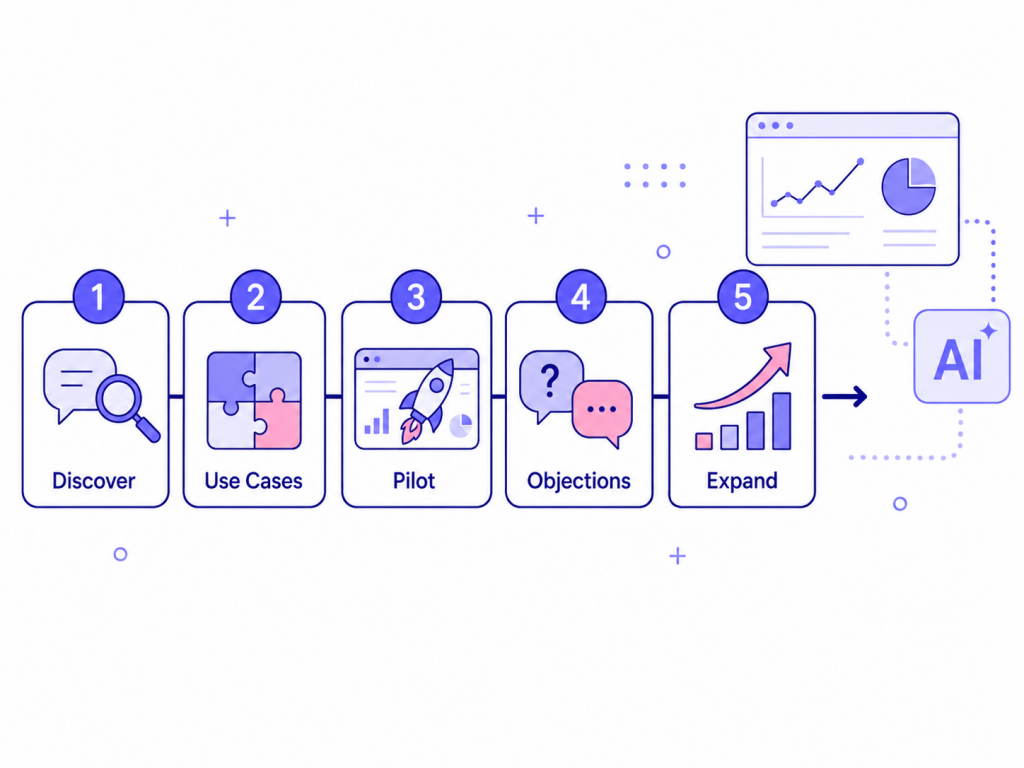
A repeatable sales process matters more than a perfect pitch. These five steps cover what actually moves an AI deal from first conversation to signed contract.
Research shows 80% of value comes from workflow redesign, not technology alone. That means the implementation conversation needs to start before the contract is signed, not after.
Key implementation principles: set realistic expectations, monitor performance from day one, create feedback loops, provide training and documentation, and design for scale.
Deploying AI is the easy part. Getting people to use it, trust it, and work alongside it is where most projects stall.
Employees who fear job displacement will route around AI systems, avoid escalating to them, or find workarounds that make performance data look worse than it is. This is not malicious. It is a normal human response to perceived threat. Ignore it and you will spend three months troubleshooting a technically sound system that no one is actually using.
Before launch, work with your client to communicate clearly about what the AI will handle and what it will not. Be specific about which tasks are changing and which jobs are not at risk. Vague reassurances do not work. Concrete role descriptions do.
Build internal champions at the team level, not just at the executive level. The support manager who sees their team’s workload drop is a far more credible advocate to their peers than any executive announcement.
Plan a structured launch, not a quiet rollout. A formal kickoff with clear messaging, a training session, and a documented feedback channel signals that the organization is taking this seriously. It also gives employees a legitimate way to surface problems rather than working around the system silently.
Every AI system will at some point produce a wrong answer, misroute a customer, or handle an edge case badly. This is not a failure of the technology. It is the nature of probabilistic systems. What separates good agencies from bad ones is how they prepare for it.
The agencies that handle AI failures well are the ones clients stay with long-term. The ones that go quiet or shift blame are the ones who lose the contract at renewal.
“Monitor performance from day one” means nothing without defining what you are monitoring. Here are the metrics that actually matter for client-facing AI systems.
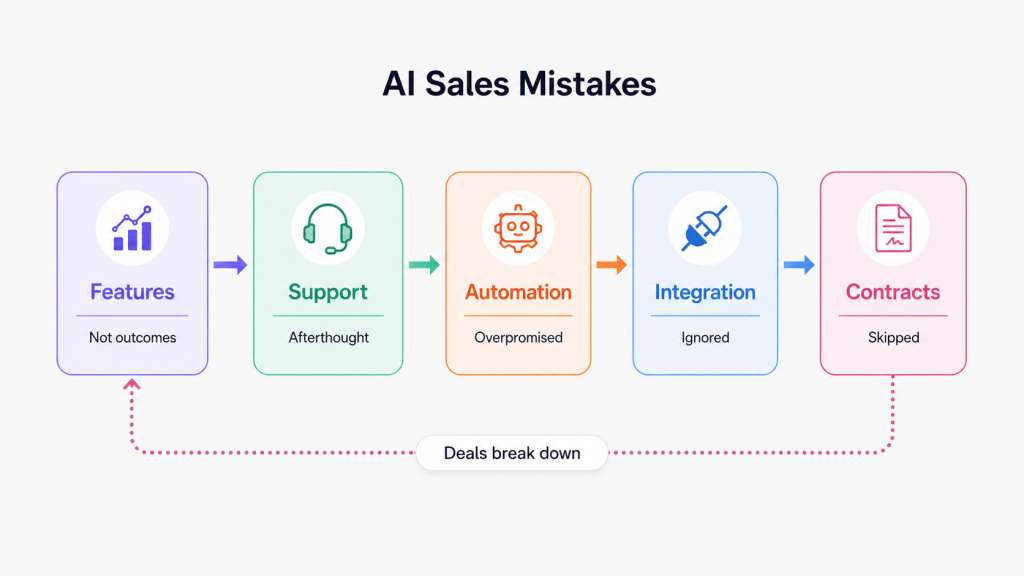
White-label AI does not fail because the technology is weak. It fails because expectations are wrong from the first conversation.
“Our AI uses advanced natural language processing with multi-turn conversations” does not help a business decide anything. What works is: “This will resolve around 60% of routine support tickets automatically and save your team roughly 15 hours every week.” If a buyer cannot repeat your value in plain language to finance or leadership, your positioning is not ready.
White-label clients expect ownership, not instructions. They do not want to manage workflows, debug edge cases, or retrain systems. If your platform requires code changes for small updates, your time cost will compound quickly across multiple clients. Choose platforms where changes are configuration-based, integrations are reliable, and escalation logic is simple to control.
“This will handle every customer question perfectly” fails the moment a conversation escalates. A more credible position: “This will automatically handle about 60 to 70% of routine questions. The rest will escalate with full context so your team resolves them faster.” Clients do not expect perfection. They expect honesty and improvement.
“Sure, we can integrate with your CRM” sounds simple until you discover the CRM is custom-built, undocumented, and locked behind approvals. Before pricing anything, ask which systems must connect, whether usable APIs exist, who controls access, and how long approval usually takes. Always discover integration risk before quoting.
Without a contract, every new request becomes a negotiation and every delay becomes your responsibility. Your agreement should clearly define what you are delivering, what is out of scope, how success is measured, how support works, and how payment and termination are handled. Contracts do not slow sales. They prevent confusion and protect both sides.
Job displacement: Reframe as productivity. AI handles the work that prevents your team from doing the more valuable work. This is most credible when you can point to specific tasks that will move off their plates rather than making a generic reassurance.
Price: Reframe as ROI. If the cost of inaction is $15,000 a month in labor and delayed response times, a $30,000 implementation pays back in two months. Make the math explicit.
Fit: Solve with pilots. A structured pilot with defined success criteria reduces the perceived risk of committing to a full engagement.
Timing: Frame as competitive risk. Every month of delay is a month a competitor who has already deployed AI is responding to customers faster, closing leads quicker, and operating with lower cost per interaction.
Objections are buying signals. Address them with data, proof, and clear next steps.
White-label AI means using an AI platform or system under your own brand, or your client’s brand, while you manage the setup, workflows, integrations, and ongoing performance. It is not just reselling access to an AI tool. The real value comes from turning AI into a working business system that solves a specific operational problem.
White-label AI services are a strong fit for agencies, consultants, automation specialists, SaaS providers, and service businesses that already help clients improve operations, customer support, sales, or internal workflows. The best providers are not just technically skilled; they understand business problems, client expectations, and measurable outcomes.
Good candidates usually have repetitive manual work, high customer inquiry volume, slow response times, missed leads, or data-heavy processes that are not being used effectively. AI works best when the business already has digital systems, measurable workflows, and enough volume to justify automation.
A business may not be ready for AI if its data is messy, its processes are unclear, its systems are disconnected, or it cannot provide access to the tools AI needs to work with. AI should not be used to cover up broken operations. In some cases, the better first step is improving data quality, workflow ownership, or internal processes.
Focus on business outcomes instead of technical features. For example, instead of saying “our AI uses advanced natural language processing,” say “this system can reduce routine support tickets by 40% to 60% and help your team respond faster without hiring more staff.” Buyers need value they can easily explain to finance, leadership, and their teams.
The honest answer is that ChatGPT may be enough for simple internal tasks like drafting emails or summarizing documents. But business AI services are different because they are configured around the client’s workflows, connected to their systems, trained on their data, monitored for performance, and maintained over time. You are selling accountability, not just access to AI.
Pricing depends on the scope, integrations, data quality, and level of ongoing support. The blog suggests fixed-scope AI implementation projects often range from $20,000 to $60,000, while retainers may be priced at 15% to 25% of the build cost annually. Many providers also use hybrid models with an upfront setup fee plus monthly support.
Yes, but the pilot should be structured. A good pilot has clear success criteria, a fixed timeline, and a defined path to a full contract if the results are achieved. A pilot should not be an open-ended experiment. It should reduce risk for the client while helping both sides confirm whether the use case is worth scaling.
The most useful metrics include containment rate, escalation quality, resolution time, customer satisfaction, and accuracy drift. These help show whether AI is actually reducing work, improving customer experience, and staying reliable over time. Reporting should include a short explanation of what improved, what needs attention, and what will be optimized next.
You should prepare for this before launch. Define what counts as a serious failure, create escalation paths, monitor low-confidence responses, and prepare client-facing response templates. AI systems are not perfect, so trust depends on how quickly and transparently issues are handled. Contracts should also clarify liability, data incidents, and responsibilities.
Selling AI successfully has almost nothing to do with technology and everything to do with judgment.
The agencies and consultants who win long-term are not the ones who explain models most fluently. They are the ones who understand business pain before proposing solutions, disqualify bad-fit clients early, set expectations that reality can actually meet, handle failures with transparency, and take genuine ownership of outcomes over time.
When AI is positioned as operational leverage rather than software, decisions move faster and relationships last longer. When performance is tracked, reported, and actively improved, clients renew without being sold to. When something breaks and you handle it honestly, trust deepens instead of fracturing.
That is what separates a vendor who demos AI from a partner who delivers it. For agencies that want the delivery layer already built, YourGPT’s AI agency platform helps create branded AI agents, connect workflows, manage client knowledge, and deliver AI services without building the infrastructure from scratch.
The real opportunity is not selling AI features. It is becoming the partner businesses trust to reduce workload, protect revenue, and scale intelligently. That positioning compounds. Clients who trust you expand. Referrals come without asking. Renewals become automatic.
With the right foundation under you and genuine ownership of outcomes in front of you, AI stops being a liability you have to defend and becomes repeatable, compounding growth you can actually predict.
YourGPT helps agencies and consultants deliver branded AI agents for client support, sales, and operations. Connect knowledge sources, automate workflows, manage conversations, and track performance from one platform.
Built for agencies, consultants, and service providers delivering AI solutions for clients.
Connect your website AI agent to a CRM with YourGPT. Capture lead details, map contact fields and verify the record your sales team will use.


Use YourGPT to help Black Friday shoppers choose products, check orders and understand returns. Prepare your answers and team before the sale.
Add in-app chat support to your SaaS or mobile app. Place it on the screens where users stall, pass who they are, and hand hard cases to your team.
Group new-account tickets by onboarding stage, train an AI agent on your docs, and place it in the product where new users get stuck.

AI agents can now find and buy products for shoppers. See what agentic commerce changes for a Shopify store and which support jobs stay yours.

Build a Halloween shopping assistant for Shopify with YourGPT. Set up product recommendations, stock checks, cart actions and human support before launch.
