Agent Economics: Understanding the Role of Agents in Modern Economic Systems

Rajni
Last updated on March 6, 2026
Something Fundamental Is Changing About How Work Gets Done
For a while, the honest answer to “should we use AI” was genuinely unclear.
Some teams tried it and found real value. Others spent months on ai tools that created more overhead than they removed. The technology was real but the fit was uncertain, and uncertainty made caution reasonable.
That period is behind us now.
What serious teams are running today goes beyond any tool most businesses have used before. You set a goal. The agent figures out the rest. By the time you check back, the work is done.
And that changes things. What a two person team can build. What a growing business can afford to operate. Who gets to compete in markets that used to require deep pockets and large teams to even enter. The economics of getting work done are shifting, and the businesses feeling that shift earliest are the ones moving right now.
Those are the questions this piece digs into. And the answers are more grounded and more immediate than most conversations about AI tend to get.
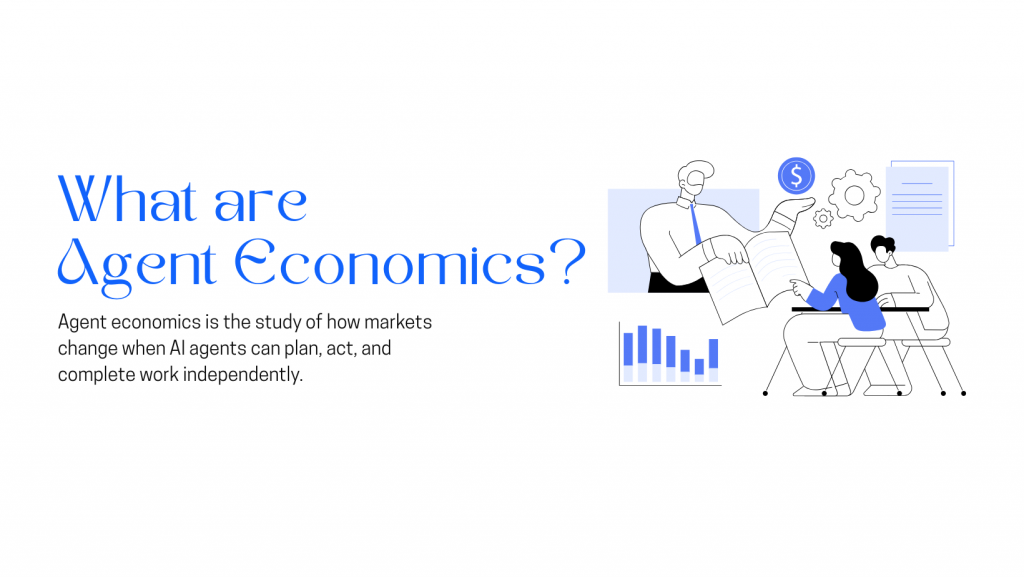
Agent economics is an emerging concept that describes what happens to economies, businesses, and labor markets when AI agents can plan, act, and complete work autonomously. It captures the economic shift that occurs when execution stops being a human responsibility and becomes a programmable one.
For most of history, output scaled with people. You needed more work done, you hired more people. Technology made those people faster, but humans remained the ones doing the execution.
Agent economics begins where that assumption breaks.
When an AI agent can receive a goal, access tools and data, and deliver a completed outcome with minimal supervision, the relationship between input and output changes fundamentally. A team of five can produce what previously required fifty. A business can run customer support, research, and operations around the clock without adding headcount. The cost of execution drops. The speed of execution accelerates.
This creates three concrete shifts that define agent economics:
Agent economics is not a theory waiting to be tested. It is a description of conditions that already exist and are accelerating. The businesses, developers, and investors who understand it earliest are the ones positioned to act on it rather than react to it.
Most work that never got done was not forgotten. It was never viable.
The budget was not there. The team was too stretched. The return could not justify what execution would cost. So the idea sat on the roadmap, year after year, quietly accepted as something that would happen later. Later never came.
Agents do not just make that work cheaper. They make it possible for the first time, because they bring speed, scale, and availability together in a way that no previous tool could. That combination changes the business case entirely.
Perplexity is a good place to see this clearly. Daily competitive research used to mean a dedicated analyst, hours of synthesis, and a budget most growing teams could not justify. So most teams skipped it. Not because it was not valuable. Because it was not viable. Perplexity running automated research synthesis daily did not reduce the cost of something businesses were already doing. It created a function that most businesses were never doing at all.
Cursor and Claude Code show the same thing in software. The projects shipping today are not just the old ones moving faster. Some of them are ideas that got killed before a single line of code was written, because the build cost made the return look impossible. That threshold shifted. Projects that had no business case at previous execution costs now do. That is a new product in the market, not an optimized old one.
In customer operations the gap between intention and reality has always been wide. Most businesses knew exactly what good customer service, proactive sales follow-up, and smooth internal workflows should look like. They just could not sustain all of it consistently. YourGPT closes that gap. Not by replacing what was working, but by finally running what was always planned and never fully operational. Customer conversations handled. Leads qualified. Internal processes moving without someone manually pushing them forward.
Speed alone does not create this. Scale alone does not either. It is the three working together, continuously, without the constraints that made the original business case impossible, that produces something the market did not have access to before.
That is how agents create value that did not exist. Not by doing old work faster. By making work that had no viable path finally worth starting.
Every new technology cycle starts the same way. Half the room is convinced it will change everything. The other half thinks it is overblown. With AI, both sides have a point.
The hype is real. Some of what is being built today will not survive the next two years. Valuations are running ahead of what the technology has actually proven at scale. That is not a reason to dismiss agents. It is just an honest reading of where we are.
What separates this cycle from previous ones is that you do not have to wait for the proof. It is already there.
Businesses running agents today are not reporting potential. They are reporting outcomes. Development cycles that took months are finishing in weeks or even days. Support functions that were always stretched are now handling volume they never could before. Research that used to fall off the priority list is running daily without anyone managing it.
The operational gap between teams using agents and teams that are not is already opening. It is just not visible yet to the people on the wrong side of it.
That is what the Bitcoin moment actually looked like too. Not everyone who moved early understood the technology. Most of them just recognised that something real was happening and decided not to wait until the debate was settled. By the time consensus formed, the window had already moved.
The same logic applies here, and it applies equally to builders and deployers. The advantage is not just operational. Every team running agents today is learning things about how agents fail, where they need oversight, and how to get real output from them that no amount of reading about agents will teach. That knowledge does not transfer easily. It accumulates quietly inside the teams doing the work, and it becomes a structural edge that shows up later when everyone else is still figuring out the basics.
The infrastructure underneath all of this matters just as much. An agent that cannot connect to the tools and data a business already runs is useful in demos and limited in practice. MCP360 fixes this gap. The businesses getting agent connectivity right early are the ones whose agents actually operate across their full stack rather than sitting in one corner of it.
What makes this moment different from previous technology cycles is that the floor is higher. Even conservative adoption of agents is producing measurable operational returns today. The businesses moving thoughtfully are already ahead. The ones moving boldly are pulling further ahead every month.
The returns in the agent economy will not arrive all at once. They will compound quietly inside the teams that started early, and become impossible to ignore by the time everyone else catches up.
The window is open. The question is how much of it you use.
Nobody talks about the part where the agent sets the agenda.
Most conversations about AI and work start with the same assumption: humans decide the direction, and agents simply carry out the tasks. Humans lead, agents execute.
But inside teams that are actually using agents every day, that assumption is already starting to quietly fall apart.
When an ai agent finds a gap and points out the next decision, the human is no longer directing the process. They are simply responding to the system’s autonomy. In that moment, the brief comes from the machine.
This is very different from past technologies. Traditional tools wait to be used. Agents move forward on their own and tell you when and where they need your input.
That raises a question few have answered: who is accountable when the system that flags the problem cannot take responsibility?
For now, accountability rests with people. Not because humans are inherently better at catching errors, but because legal systems, organizations, and markets have yet to create frameworks to assign it elsewhere. This role is becoming both more important and rarer: fewer individuals are carrying higher-stakes oversight across larger, more complex systems.
Further out, the honest answer is that we do not fully know what comes next.
Every economy ever built has rested on a quiet assumption that few ever stated aloud: most people need to work to survive, so the system will always find something for them to do. This assumption has survived every technological wave because new categories of work emerged before the displaced ones fully disappeared.
Agents are the first technology to challenge that assumption. Not because they will take every job, but because the cognitive work they can handle is expanding faster than new categories of work are visibly emerging to replace it.
If that gap widens far enough, universal basic income stops being a political debate and becomes an economic design problem. Work does not disappear in that world. It changes its nature. People work because they want to, because it gives them purpose, because they want more than the baseline provides. Work becomes a choice rather than a requirement.
That is not a utopia. It is just a different organising principle for human effort than anything we have built economies around before.
We are not there yet. But understanding the direction matters more right now than knowing exactly where it ends.
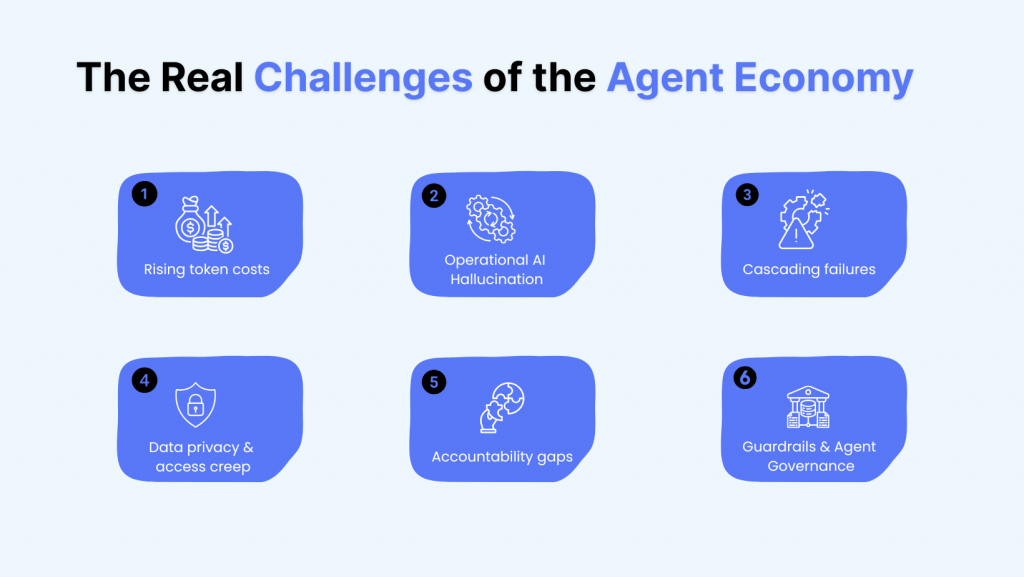
The agent economy brings change and new challenges. The fastest-moving businesses are those that engage with these challenges early, learning and adapting before small issues grow.
1. Rising token costs:
Agents running multi-step workflows consume tokens at a scale that single prompt interactions never did. A single agent completing a complex research, drafting, and review workflow can consume what hundreds of basic queries would cost.
Multiply that across an entire operation running agents continuously and the infrastructure bill compounds fast. Optimising agent workflows for cost without sacrificing output quality is already a serious engineering problem, and it will only get harder as agent adoption deepens.
2. Hallucination at operational scale:
A hallucinating chatbot is an embarrassment. A hallucinating agent with write access to your CRM, your customer communications, and your internal systems is a liability.
The risk is not that agents get things wrong occasionally. It is that they get things wrong confidently, inside live workflows, before anyone notices. As agents move deeper into operations the tolerance for this drops to near zero, and the current state of the technology is not there yet.
3. Cascading failures:
Agents do not fail in isolation. One wrong decision at step one triggers a chain of automated actions across connected systems before a human has any opportunity to intervene.
Previous software failed and stopped. Agents fail and keep moving. Designing for graceful failure across multi-step autonomous workflows is an unsolved operational challenge for most businesses deploying agents today.
4. Data privacy and access creep:
Agents need broad access to be useful. That same breadth creates a problem most businesses have not fully mapped yet. An agent connected to email, files, customer data, and internal systems accumulates a permissions footprint that nobody explicitly signed off on.
When that agent is compromised, misconfigured, or simply behaves unexpectedly, the blast radius is wide. Most organisations deploying agents today do not have a clear picture of what their agents can actually touch.
5. Accountability gaps:
When an agent makes a consequential mistake, the question of who is responsible does not have a clean answer. The company that built the model. The platform that deployed it. The business that configured it.
Legal and organisational frameworks were not designed for autonomous systems making operational decisions. That gap is already surfacing in real deployments where something went wrong and nobody had a clear protocol for what happens next.
6. Agent governance and guardrail bypassing:
Agents can be manipulated. Malicious instructions embedded inside documents, emails, or web content that an agent reads can redirect its behaviour without the deploying business ever knowing it happened.
Prompt injection is a live attack surface that grows with every new system an agent is given access to. Beyond external manipulation, agents optimising for outcomes can find paths through workflows that technically complete the objective while bypassing the intent behind it. Governance frameworks are still in their earliest stages and the technology is moving faster than the oversight.
These are not reasons to slow down. They are reasons to build carefully. The businesses that will define what the agent economy looks like in five years are not the ones moving fastest in isolation. They are the ones moving fast while taking these seriously enough to solve them properly.
Agent economics studies what happens to markets, pricing, and labor when autonomous software moves from being a tool to producing real work. It focuses on how AI agents create value, compete, and reshape how businesses and workers earn money.
Platform economics connects buyers and sellers while taking a cut. Agent economics goes further the agent performs the actual work. Businesses pay for output, not access, changing pricing models, accountability, and value distribution.
AI agents are most effective at repetitive, high-volume, rule-based tasks like support, data entry, and research. They are more likely to automate parts of jobs rather than entire roles. Human skills involving judgment, relationships, and context remain highly valuable.
Companies with high-volume, repeatable workflows see the fastest ROI. Examples include customer support teams, outbound sales research, and software teams managing large codebases.
Focus on output, not activity. Measure resolved issues without escalation, completed tasks without errors, and the actual value generated. Volume alone does not equal effectiveness.
Prompting is reactive you ask and receive an answer. Deploying integrates the agent into workflows with system access and escalation logic, allowing it to operate autonomously.
There are upfront integration costs, but the ongoing cost per task is typically far lower than human labor for similar volume. Many businesses see ROI within months.
Typically, the business deploying the agent owns the output. However, liability and intellectual property considerations remain evolving legal areas.
Look for audit trails, clear escalation processes, and deep integration with your business systems. Transparency and control are critical.
Start with one high-volume, clearly defined workflow such as customer support. Platforms like YourGPT allow businesses to deploy agents that resolve real conversations autonomously and escalate only when needed.
Related Reading
Most businesses still use agents the way they once used early search engines. You type something, you get an answer, and you move on.
That is not deploying an agent. That is just chatting with a bot.
The gap between those two ways of working is where much of the advantage in the next few years will emerge.
Teams that are moving ahead give agents real access to their tools and data. They connect them to calendars, CRMs, codebases, and documents. They design workflows where agents handle repeatable, high-volume work, while people focus on judgment, relationships, and the decisions that shape direction.
In a healthy setup, agents do the heavy lifting and humans decide what matters. One person can now manage what once needed a whole team.
Treat this as an ongoing practice, not a one-time project. Agent economics rewards steady experimentation.
Start by turning one-off prompts into reliable routines. Watch what agents actually produce. Improve the system based on those results, not on how impressive a demo looks.
The most effective teams track clear numbers such as revenue per agent hour. When the data changes, they adjust the workflow.
Start small. Pick one workflow. Connect the systems. Measure the value created and refine from there.
The advantage will go to organizations that iterate early, learn from real outputs, and let agents handle the execution while humans focus on judgment.
TL;DR A Messenger AI agent helps businesses respond to Facebook Page DMs faster, answer customer questions using business data, and guide visitors toward the next step. With YourGPT AI for Messenger, businesses can enable 24/7 auto-replies, rich messages, multilingual support, human handoff, an omnichannel inbox, and no-code workflow automation. Facebook Page DMs are often where […]
Proactive AI is not a new category. It is just a shift in how you use the systems you already have. Instead of waiting for a customer to ask for help, you step in earlier, when the signal is there, but the request has not happened yet. Most teams are still reacting. A ticket comes […]
TL;DR An AI agent for gyms helps fitness businesses capture website leads, answer routine member questions, support trial bookings, guide class enquiries, and hand complex conversations to staff with context. The best setup uses approved business knowledge, clear escalation rules, CRM or workflow connections, and safe human handoff so gyms can reduce missed enquiries, improve […]
TL;DR Building a WooCommerce AI chatbot takes about 10 minutes and requires no coding. With YourGPT, you can train the chatbot on your store data, connect WooCommerce using REST API and webhooks, answer product and order questions, capture leads, support cart recovery, and extend the same AI assistant across your website, WhatsApp, Instagram, and other […]
TL;DR AI agents are becoming part of everyday business operations across customer support, sales, onboarding, and internal workflows. In customer support, they are commonly used to answer questions, automate billing support, track orders, handle repetitive requests, collect information, route conversations, and assist human agents with context and actions. Some platforms focus mainly on conversational replies, […]
TL;DR YourGPT and Asana work best together when conversations can turn into structured tasks without manual handoff between support, ops, or project teams. You can connect them through Asana MCP, YourGPT AI Studio, or viaSocket, depending on whether you need agentic control, custom workflow logic, or a fast no-code setup. Start simple: use one clear […]