The best large language models (LLMs) in 2026

Neha
Last updated on June 10, 2026
The leaderboard changed hands three times in a single week in March 2026. Not a month. A week. An open-weight model briefly held the top spot on SWE-bench Pro. Then a new Claude arrived and reclaimed it nine days later. Then GPT-5.5 launched with a fully retrained architecture and took the Intelligence Index lead. All inside 26 days.
If you are still choosing AI models based on a post from late 2025, you are making decisions with stale data. The models this post was originally written about have been replaced, retrained, or structurally outpaced.
This guide covers the best AI models available right now in mid-2026, what each one actually wins at, with real benchmark scores, honest pricing, and the specific use cases where it outperforms the field.
Large Language Models (LLMs) are AI systems trained on large volumes of text to process and generate language. They’re used in tasks like answering questions, writing content, assisting with code, and retrieving information.
Leading models as of June 2026, including Claude Opus 4.8, GPT-5.5, Gemini 3.1 Pro, Kimi K2.6, and DeepSeek V4, have developed distinct strengths across coding, reasoning, context length, deployment options, and cost efficiency. The best model depends on the specific work you need it to perform rather than its position in a general ranking.
The question is not which model scores highest on a single benchmark. It is which model wins on the dimension that matters for your work. Five factors separate models in production:
General intelligence scores have become nearly useless at the top tier. GPQA Diamond, which tests graduate-level physics and biology reasoning, is now saturated around 93-94% across GPT-5.5, Claude Opus 4.8, and Gemini 3.1 Pro. All three are effectively tied.
The benchmarks that still show meaningful spread are SWE-bench Pro for real-world coding, Terminal-Bench 2.0 for agentic execution, and Humanity’s Last Exam for frontier multi-domain reasoning. Those are the numbers worth checking before you pick a model.
High performance at any cost is not a strategy. It is a runway problem.
Inference cost as of June 2026: Claude Opus 4.8 runs at $5 per million input tokens and $25 per million output. GPT-5.5 is $5 in, $30 out. Gemini 3.1 Pro is $2 in, $12 out, and outputs 120.3 tokens per second, roughly twice Claude’s throughput. DeepSeek V4 sits at around $0.28 per million input tokens, 18x cheaper than Claude Opus on input alone.
If you’re comparing providers based on operating costs, try our AI Token Calculator to estimate token expenses across different models and workloads.
At scale, model selection is a cost architecture decision as much as a capability one. A model that costs twice as much and performs 10% better is often the wrong pick for production workloads running millions of requests a month.
Window size and retrieval accuracy are not the same thing. Do not confuse them.
Claude’s verified long-context retrieval accuracy sits at 97.2% at 1M tokens in independent testing. Llama 4 Scout offers a 10M token window, but practical retrieval accuracy at that scale is still being independently verified.
A large window with poor recall is not useful for document-based workflows. Before routing long-document tasks to any model, ask for the retrieval accuracy number, not just the context limit.
In direct testing from April 2026, Claude Opus 4.7 hallucinated at 36% on long-form factuality tasks. GPT-5.5 tested at 86% on the same benchmark. That is a gap with real consequences for client-facing content, legal summaries, or research outputs where accuracy is the product.
The gap narrows considerably in retrieval-augmented agent setups, where the model grounds its answers in external sources rather than internal weights. Know which situation you are building for before treating hallucination rate as a secondary concern.
Regulated industries, healthcare teams, and fintech companies often cannot send data to third-party API endpoints.
Open-weight models like Llama 4, Kimi K2.6, and DeepSeek V4 can be self-hosted with no outbound data transfer. For closed-source options, Anthropic offers Zero Data Retention (ZDR) at the enterprise tier. OpenAI and Google offer equivalent protections under enterprise agreements.
The rule is simple: establish your data requirement before your capability requirement, not after you have already built on a model that fails a compliance review.
For global teams or audiences, the model should support multiple languages with equal quality.
Good multilingual support means you won’t need separate setups or external translation tools.
| Model | Developer | Best For | Input Cost (per 1M tokens) | Access |
|---|---|---|---|---|
| Claude Opus 4.8 | Anthropic | Coding, writing, long-context work | $5 | API, Claude.ai |
| Claude Sonnet 4.6 | Anthropic | Writing quality, instruction-following | $3 | API, Claude.ai |
| GPT-5.5 | OpenAI | Autonomous agents, computer use | $5 | API, ChatGPT |
| Gemini 3.1 Pro | Google DeepMind | Frontier reasoning at lower cost, throughput | $2 | API, Gemini |
| Kimi K2.6 | Moonshot AI | Agentic workflows, multi-agent systems | $0.95 | API, Open weights |
| DeepSeek V4 | DeepSeek AI | Cost-sensitive production, coding at scale | ~$0.28 | API, Open weights |
| Grok 4 | xAI | Frontier knowledge, 2M context | API | API, X platform |
| Qwen 3.7 Max | Alibaba Cloud | Best value in top-10 reasoning | $1.25 | API, Open weights |
| Llama 4 Scout / Maverick | Meta | Self-hosted, ultra-long context, no vendor lock-in | Free (self-host) | Open weights, API |
Different language models are good at different things. Some handle long documents better, some are stronger at reasoning, and others are built to work with tools or structured data.
This list covers the top 5 LLMs to consider in 2026 what each model is good at, where it fits best, and when it makes sense to use it.
Claude Opus 4.8 is Anthropic’s current flagship, released May 28, 2026. It sits at the top of the Artificial Analysis Intelligence Index and leads every major real-world coding benchmark available right now. It is the model powering Cursor, Windsurf, and Claude Code — the three tools most professional developers reach for daily in 2026. That kind of adoption in production tooling tells you more than any launch post.
Where it stands out:
Strengths:
Limitations
Ideal use cases
Legal and compliance document analysis, agentic coding workflows, technical documentation, and research summaries where a wrong output has real consequences. If your workload does not require that level of reliability, Claude Sonnet 4.6 at $3 in and $15 out covers roughly 80% of the same capability at a fraction of the cost. Route routine work there. Save Opus for what genuinely requires it.
GPT-5.5 is OpenAI’s current flagship and the default model running inside ChatGPT as of April 2026. It was the first OpenAI model since GPT-4.5 to use a fully retrained base architecture, and it sits within one point of Claude Opus 4.8 on the Artificial Analysis Intelligence Index. Its specific edge over Claude is narrow but real: autonomous multi-step execution.
Where it stands out
Strengths
Limitations
Ideal use cases
When the task is clearly defined and requires multi-step execution across tools, GPT-5.5 performs well. It is particularly strong in computer-use tasks, agentic workflows, and multi-tool automation, making it a good fit for teams already invested in OpenAI’s ecosystem where reliable execution and orchestration matter more than raw output quality.
Gemini 3.1 Pro launched on February 20, 2026, and quickly changed the economics of frontier AI. It ranks within three points of Claude Opus 4.8 and GPT-5.5 on the Artificial Analysis Intelligence Index. The difference is not raw capability. The difference is that Gemini delivers near-frontier performance at a significantly lower cost.
Where it stands out
Strengths
Limitations
Ideal use cases
High-volume production pipelines that need frontier-quality reasoning without frontier pricing, Google Workspace-native workflows, multimodal document analysis across diverse file types, and any application where throughput and cost efficiency matter more than peak writing or coding quality.
Kimi K2.6 is a 1-trillion-parameter open-weight model released by Moonshot AI on April 20, 2026. It was built specifically for agentic and multi-agent systems, not general chat. It activates only 32B parameters per forward pass, keeping inference cost well below what the total parameter count implies. At $0.95 per million input tokens, it delivers serious agentic capability at a fraction of what closed-source alternatives charge.
Where it stands out
Strengths
Limitations
Ideal use cases
Multi-agent orchestration systems, long-horizon autonomous coding tasks, browser-based research agents, and any workflow that needs agentic capability at open-weight pricing. If your team is running thousands of agent calls per day and cannot absorb closed-source API costs, Kimi K2.6 is the most credible alternative available right now.
MiniMax M3 is an open-weight model released on June 1, 2026 by Shanghai-based MiniMax. It combines frontier-level coding performance, a 1 million token context window, and native multimodal capabilities across text, images, and video within a single model. It is based on MiniMax Sparse Attention (MSA) architecture reduces compute requirements at 1 million tokens to roughly one twentieth of the previous generation, making long-context processing practical for real-world applications rather than a theoretical benchmark.
Where it stands out
Strengths
Limitations
Ideal use cases
Long-horizon coding agents, autonomous research workflows, large-scale multi-document analysis, and production deployments where a 1M-token context window provides clear value and cost efficiency matters. Teams already using Kimi K2.6 for agentic workloads should evaluate M3 directly, as its pricing and coding benchmark performance position it as a strong alternative.
Some of the strongest coding models available include DeepSeek Coder v3, GPT-4.5 Turbo, and Meta’s Code LLaMA based on LLaMA 3. These models are capable of handling complex code generation and debugging tasks effectively.
Yes, models with open weights like LLaMA 4 and DeepSeek v3 can be deployed locally on your own hardware or private servers. Just ensure your infrastructure meets the necessary resource requirements.
To reduce hallucinations, consider using retrieval-based methods that source answers from verified data, manually verifying critical outputs, and incorporating a review or approval step—especially in sensitive workflows.
Yes, most advanced language models as of 2026 support over 50 languages. Features like multilingual responses, language detection, and translation have become much more robust.
Only if you’re using a self-hosted model or one designed for secure enterprise environments. Otherwise, it’s best to anonymize any private or sensitive data before sharing it with a language model.
There is no single best AI model in 2026. That question has been replaced by a better one: which model is right for this specific task, at this cost, under these constraints?
Claude Opus 4.8 is where you go when the output cannot be wrong. GPT-5.5 is where you go when the agent needs to run on its own for hours. Gemini 3.1 Pro is where you go when you need frontier-quality reasoning without the frontier price tag. Kimi K2.6 and MiniMax M3 are where you go when you want open-weight agentic performance without paying closed-source API rates. DeepSeek V4 is where you go when cost at scale is the constraint that matters most.
None of these models win everything. The teams getting the most out of AI in 2026 are not betting on one model and hoping it holds. They are routing tasks — matching the right model to the right job, swapping when the leaderboard shifts, and building workflows that do not collapse every time a new release drops.
The practical implication: if you are building AI agents or automating customer-facing workflows, the model you pick today may not be the model you are running six months from now. Locking your architecture to a single provider makes that transition painful. Building on a platform that abstracts the model layer makes it a configuration change.
That is what YourGPT is designed for. Define your workflow once. Switch models underneath without rebuilding. The leaderboard will keep moving — your product does not have to move with it every time.
Define your workflow once. Swap Claude, GPT-5.5, Gemini, or any open-weight model underneath without rebuilding your stack.
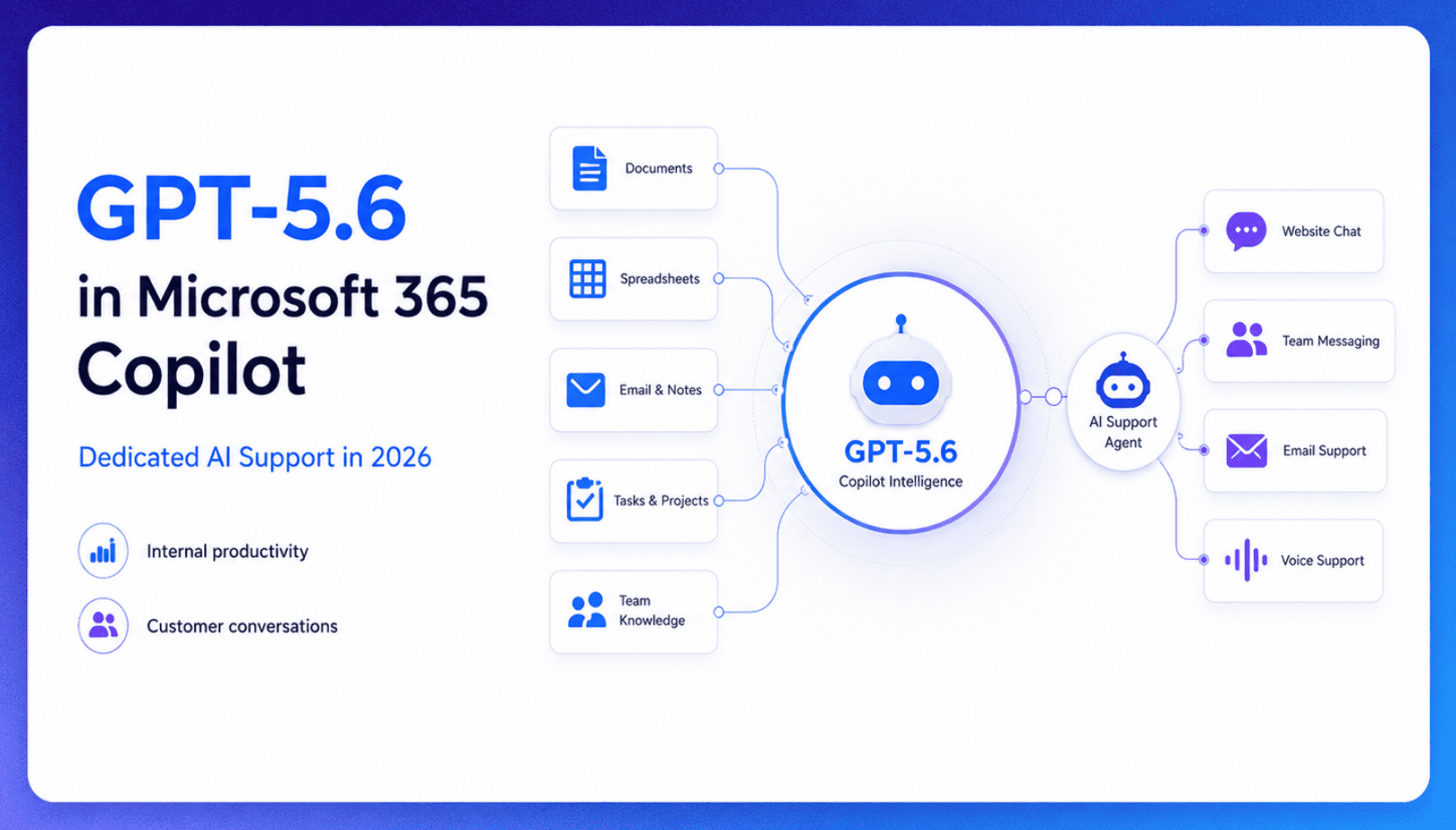
TL;DR Microsoft made GPT-5.6 the preferred model across Word, Excel, PowerPoint, Copilot Chat, and Cowork on July 9, 2026, focusing on internal workplace productivity rather than customer-facing support. Dynamics 365 Service Agent also reached general availability, but it mainly helps human support representatives manage cases within Microsoft’s existing permission structure and requires separate licensing. A […]

TL;DR Cheap frontier models now compete for the same high-volume support workloads, with DeepSeek V4 remaining the lowest-cost option in this comparison. Kimi K2.6 and GLM-5.2 are open-weight and self-hostable, while Qwen 3.7 Plus is proprietary and available only through an API. Claude Haiku 4.5 is the only model here that its developer explicitly recommends […]
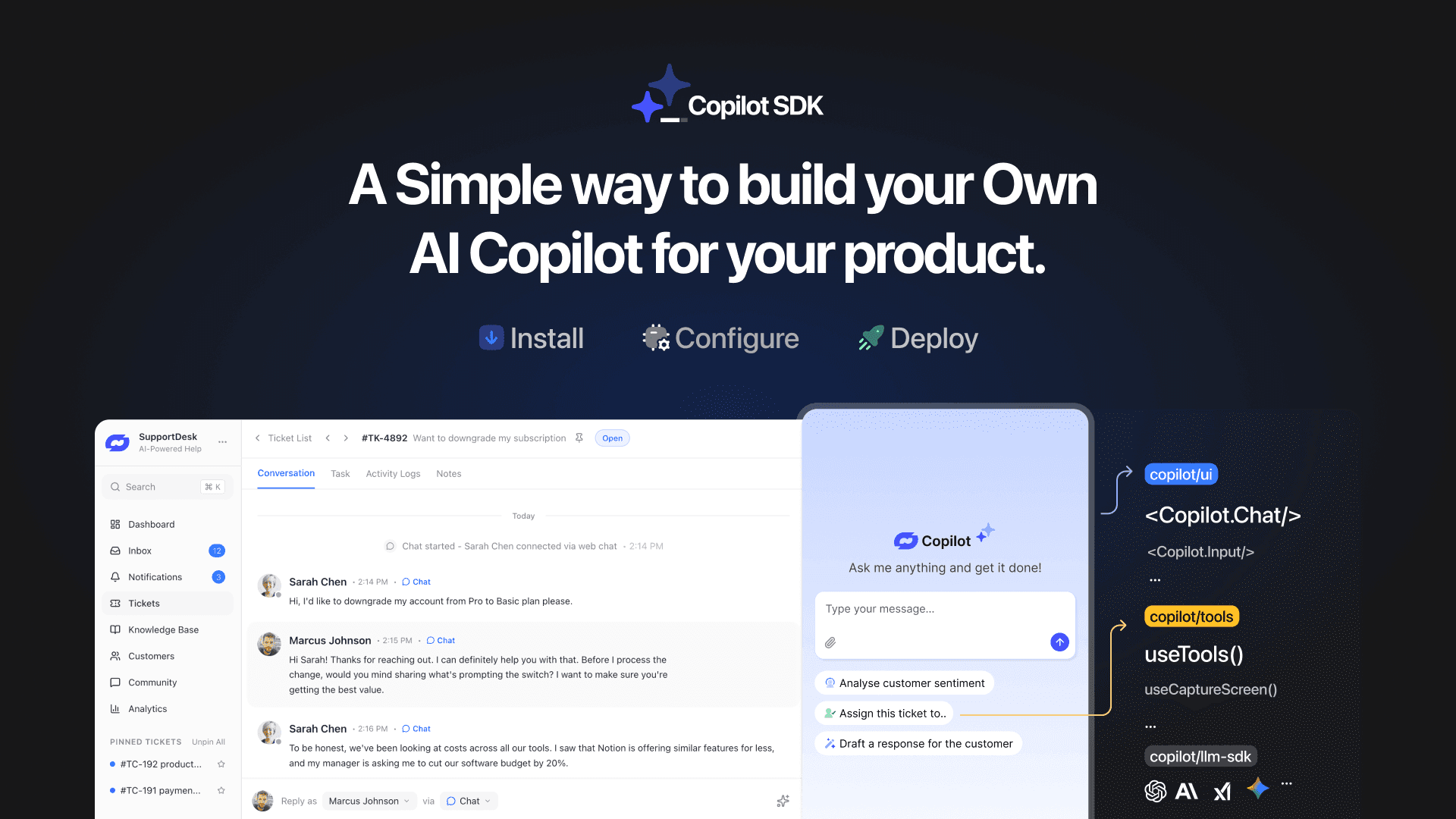
TL;DR YourGPT Copilot SDK is an open-source SDK for building AI agents that understand your application state, user context, and what is happening inside your product. Instead of working like isolated chat widgets, these agents connect directly with your product and can take real actions within existing workflows. This helps teams build contextual AI experiences […]

TL;DR YourGPT 2.0 adds AI Studio for building, testing, and debugging automated workflows. It includes native MCP integration for more than 100 tools, upgraded voice agents, and native SDKs for iOS and Android applications. With shared context across web, WhatsApp, Instagram, Telegram, and mobile, YourGPT turns conversations into real actions across support, sales, and operations. […]

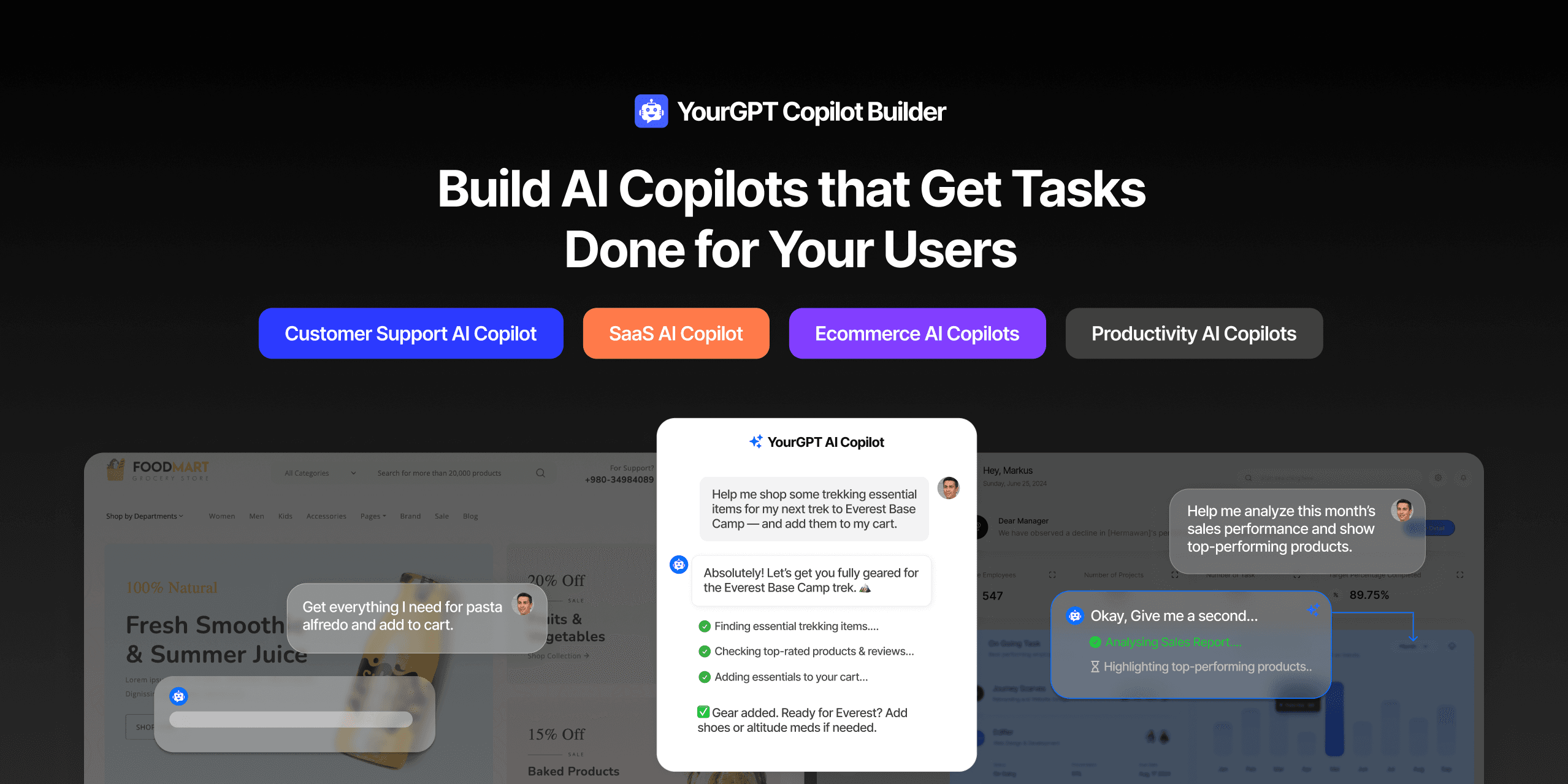
TL;DR Most AI tools provide answers but still leave users to complete the task through search results, settings pages, or checkout flows. AI Copilot Builder closes that gap by executing registered actions directly inside the product instead of only explaining what to do. Search, cart updates, account changes, and multi-step bookings can all happen within […]
TL;DR Building an AI-powered Telegram bot does not require custom development. BotFather provides the Telegram bot token, while a no-code platform like YourGPT handles AI training, free-form conversations, and the Telegram connection. This guide covers the full setup, from creating the bot in BotFather to connecting it with YourGPT and taking it live. Most Telegram […]