Top 17 AI Voice Agent Platforms Guide (2026)

Rajni
Last updated on October 13, 2026
The best AI voice agent platform in 2026 depends on your workflow, call volume, technical resources, and how much control your team needs.
YourGPT is a good fit for businesses that need AI agents to handle conversations, take real-time actions, and connect with support, sales, and operational workflows.
Vapi works well for developer teams building custom voice infrastructure, while PolyAI is better suited for large enterprises replacing legacy IVR systems in contact centers.
We’ve all seen the perfect voice AI demo. It sounds incredibly human and navigates the scripted scenario flawlessly. But reality hits hard the second a frustrated customer interrupts with an entirely new problem, and that’s usually where the system breaks down.
The 2026 market is saturated.
On paper, every major platform promises the exact same capabilities. You simply won’t spot issues or awkward conversational loops by reading a vendor website. Those critical flaws only reveal themselves once the system is handling live traffic. By then, ripping out the software to migrate to a new vendor will cost you heavily in both time and customer trust.
Feature lists are practically useless for making this decision.
This blog evaluates 17 voice AI platforms based entirely on their real-world performance and community. We examine what they are fundamentally built to do and where they actually fail, giving you the practical reality behind their pricing structures.
Traditional phone systems were built for predictable workloads, but modern call volumes rarely follow a steady schedule. Moving to voice AI is more than just adding a layer of automation. It is a fundamental shift in how support teams are structured and how they scale.
Ultimately, voice AI does more than just deflect calls. It rebuilds the entire workflow so your human agents only step in when they are truly needed.
The platforms below cover the strongest options for 2026. Each one is evaluated on its core features, strengths, limitations, pricing, and the workflows it fits best.
Not every platform here is built for the same situation. Some suit developers who need full control over how an agent is built. Others are better for businesses that need something running quickly without technical resources. A few are built specifically for large enterprise environments.
Here is a closer look at each one.
YourGPT is an AI-first platform for building and operating conversational agents, including voice AI agents, across customer support, sales, and business workflows.
It enables businesses to deploy AI agents that handle both inbound and outbound interactions across channels such as chat, messaging, and phone, while maintaining context throughout the conversation lifecycle. These agents are designed to manage interactions as part of broader workflows, allowing businesses to run conversations and operational processes within a single system.
Mid-to-large-sized businesses that need a single platform to handle both conversational AI and operational workflows without stitching together multiple tools. Strongest fit when agents need to take real actions during calls, not just collect information.
Olivia AI, built by Pete & Gabi, is an automated sales software specifically designed for two kinds of customer engagement/campaigns: customer reacquisition and win backs.
Olivia AI engages cold accounts directly from your CRM, initiates personalized conversations, handles objections in real time, and seamlessly routes qualified leads to your sales team, without any human intervention.
Subscription-based sales and service teams can use Olivia AI to re-engage inactive customers without expanding their workforce. It helps recover dormant accounts efficiently when teams lack the time or resources to follow up. Ideal for businesses focused on maximizing existing customer value rather than generating new leads.
YeldaAI is a AI voice agent platform designed to automate high-volume phone interactions for enterprises, public organizations, and customer service teams. It enables businesses to deploy no-code AI callbots capable of handling real operational tasks like bookings, payments, authentication, and intelligent call routing while integrating directly with existing business systems.
Mid-to-large-sized businesses, public organizations, healthcare providers, hospitality groups, insurers, retailers, telecom companies, and call centers needing to automate large volumes of customer calls without building internal AI infrastructure.
Vapi is a developer-focused platform for building and operating voice AI agents that can handle real-time conversations across phone calls and web interfaces.
It is designed as an infrastructure layer for voice agents, giving teams the ability to define how conversations are structured and how voice interactions fit into their overall systems, rather than providing a fixed, ready-made solution.
Engineering teams building custom voice infrastructure from scratch who need full control over every layer of the stack. Not suitable unless you have dedicated developer resources to build and maintain the integration.
Retell AI is a voice AI platform designed to build, deploy, and manage AI phone agents. These agents handle real-time conversations over inbound and outbound calls. It provides the infrastructure needed to create conversational voice agents that operate through phone systems.
Businesses use it to automate and manage call-based interactions such as support, outreach, and customer engagement within a controlled and monitored setup.
Technical teams that need a reliable, phone-focused voice agent without the complexity of a full enterprise platform. Works well for automating structured call types like appointment handling, order status, and basic support queries.
Anve Voice AI is a platform for creating voice AI agents for websites. It allows businesses to add conversational voice experiences directly to their site, so visitors can talk to an AI agent naturally instead of relying only on chat, forms, or menus.
The platform is designed to help website visitors ask questions, navigate pages, fill forms, and book appointments through voice-based conversations. It focuses on fast website deployment, multilingual support, and on-page actions that let the AI agent interact with the website itself.
SaaS companies, e-commerce stores, professional services, healthcare providers, and SMB websites that want to add voice AI engagement directly to their own website without the complexity or overhead of a traditional contact-center platform.
Botphonic AI is a low code platform for building AI call assistants that helps automated phone conversations. It is widely used for customer support , lead qualification, appointment booking, and business workflows. Moreover, it enables users to create voice assistants using a visual interface, and allows them to connect with knowledge sources.
The platform is designed for businesses that want to launch AI phone agents quickly while maintaining the flexibility to customize prompts, workflows, and even integrations. It actively balances ease of use with enough configuration options that supports a wide range of customer-facing voice automation use cases.
Small and medium-sized businesses, agencies, and startups that want to deploy AI phone agents quickly without investing in custom voice infrastructure or dedicated engineering resources.
JoyzAI Sales Agent is built specifically for Indian SMBs selling on calls and WhatsApp. Unlike standalone AI dialers, JoyzAI combines AI calling, WhatsApp automation, CRM, workflows, contacts, tickets, and analytics into one platform.
It can call prospects from your database, answer inbound leads 24/7, qualify them, schedule meetings, follow up on WhatsApp, update your CRM, and route hot leads to your team, without manual effort.
JoyzAI is best for Indian SMBs losing deals to slow response times, reps burning 7-8 hours a day on qualification instead of closing, and follow-ups forgotten on sticky notes. It works across industries to automate inbound/outbound calling, qualify leads 24/7, and manage every customer conversation from one platform.
Bland AI is a platform for creating AI-powered phone agents that can conduct real conversations over phone calls.
It is designed to automate voice-based interactions by enabling AI agents to handle inbound and outbound calls over traditional telephony systems. The platform focuses on making phone communication programmable, allowing businesses to deploy agents that operate at scale and fit into existing operational workflows.
Developers running high-volume outbound calling campaigns that require programmable, scalable phone infrastructure. Better suited to operations teams with engineering support than to businesses looking for a quick deployment.
Forethought is an AI customer support platform focused on enterprise support automation. It helps teams automate customer service workflows such as ticket triage, agent assistance, knowledge retrieval, and support process automation.
The platform is most relevant for teams comparing broader AI customer support solutions where voice is only one part of the evaluation. While Forethought has strong positioning in enterprise support automation, its voice-specific capabilities are less clearly highlighted in public materials compared to vendors that focus directly on AI voice agents or outbound call automation.
Forethought is best for teams comparing broader AI customer support automation platforms where voice is one consideration among several automation priorities. It is especially relevant for enterprise support teams evaluating AI-driven ticket triage, agent assist, workflow automation, and support efficiency improvements.
PolyAI is an enterprise-focused conversational voice AI platform designed to handle customer service phone calls through natural, human-like interactions.
It is built around the idea of replacing rigid, menu-based call systems with AI agents that can understand free-form speech, maintain context, and manage full customer conversations over the phone. The platform is primarily used by large organizations to automate high-volume support interactions while still preserving a natural conversational experience.
Large enterprises running high-volume contact centers where natural, free-form phone conversations need to replace legacy IVR systems. Requires budget, implementation time, and internal resources to deploy properly.
Synthflow is a no-code platform for building AI voice agents that handle phone conversations in real time.
It allows users to design and deploy voice-based workflows using a visual setup, where the agent can answer calls, follow conversation flows, and connect with external business tools to complete tasks. The platform is focused on making phone-based automation easier to build and run without requiring deep technical setup.
Non-technical business owners who need to automate straightforward inbound or outbound call flows without developer involvement. Reaches its limits quickly when conversation logic becomes dynamic or deeply branched.
Voiceflow is a platform for designing and building AI agents for both chat and voice-based interactions. It is built around the idea of mapping conversations in a structured way before deploying them as working agents.
Teams use it to define how an assistant should respond, handle different user paths, and connect with external systems, turning conversation design into something that can be directly implemented and used in real applications.
Product and conversation design teams that need a structured environment to prototype, test, and deploy multi-channel agents collaboratively. Most valuable when the design and iteration process matters as much as the final deployment.
Cartesia is a voice AI platform designed to power real-time speech in applications. It provides speech models and infrastructure that allow developers to convert text into speech, process spoken input, and build voice-enabled experiences inside their own products.
The platform is mainly focused on the voice layer of AI applications. It is useful for teams that already have their own app logic, workflows, or AI models in place and need fast, natural speech input and output for real-time conversations.
Cartesia is best for teams building voice-driven products where speech is one part of a larger system. It works well when you already have business logic, workflows, or AI models in place and need a reliable real-time voice layer for speech input and output.
SquadStack AI is an outcome-driven AI voice agent platform designed for high-volume sales, lending, activation, and customer engagement workflows. Its AI voice agents are built to handle real-time customer conversations across industries where speed, connectivity, and conversion quality matter.
The platform is trained on 600M+ minutes of real Indian sales calls, helping it understand cultural nuance, buyer intent, and sales conversations more accurately. SquadStack can automate complex end-to-end journeys such as lead qualification, product demos, onboarding, renewals, collections, and post-sale follow-ups.
SquadStack AI is best for teams that want real revenue outcomes, not just automated voice conversations. It is a strong fit for BFSI, edtech, healthcare, e-commerce, logistics, and consumer brands that need scalable AI voice agents for lead qualification, sales, onboarding, renewals, collections, appointments, and post-sale journeys.
Prosper AI is a voice AI platform for healthcare, automating patient and payer calls end-to-end, including scheduling, eligibility checks, prior auths, claims follow-ups, billing, and more. Its voice AI agents connect phones, faxes, and clearinghouses in one flow, and integrate with more than 80 EHR and practice management systems. Teams can customize call flows without engineering support and review results with healthcare-specific QA features.
Unlike point solutions limited to appointment scheduling or basic call handling, Prosper AI supports continuous workflows that span interactions with patients, providers, and payors, to deliver financially cleared appointments through coordinated patient and payor interactions. The result is fewer point solutions, lower operational risk, and reliable automation across the entire patient journey, from first call to final reimbursement.
Health systems, specialty groups, and RCM teams looking to automate high-volume administrative calls across the full patient journey, not just one part of it.
XBert AI is Nextiva’s AI receptionist and customer service assistant designed to handle calls, chats, SMS messages, and appointment bookings. It learns from a business’s website, policies, FAQs, and workflows to provide relevant responses rather than relying on generic scripts. The platform also connects with Nextiva’s communication tools, allowing businesses to manage AI and human interactions within one system.
Unlike developer-focused voice AI platforms, XBert AI emphasizes ready-to-use automation with minimal technical setup. It can manage routine customer requests, update appointments, and transfer complex issues to human agents with conversation context. This makes it suitable for businesses looking to reduce missed calls and repetitive support work without building their own voice AI infrastructure.
Small and midsize businesses looking to automate inbound calls, customer inquiries, and appointment scheduling without extensive technical setup. It is particularly suitable for teams using Nextiva or seeking a managed AI receptionist with built-in communication tools and security controls.
| Platform | Primary Use Case | Technical Requirement | Conversation Handling | Action During Call | Best Deployment Size |
|---|---|---|---|---|---|
| 1. YourGPT | Inbound and outbound AI agents for support, sales, and business workflows | Low to Medium | Multi-turn conversations with strong context retention across channels | Yes, bookings, updates, workflow triggers, and business system actions | Mid-market to Enterprise |
| 2. Olivia AI | Customer reactivation, win-back campaigns, and CRM-based sales outreach | Low to Medium | Personalized sales conversations based on CRM history and behavior | Yes, lead qualification, objection handling, routing, and CRM follow-up | SMB to Mid-market sales teams |
| 3. YeldaAI | No-code voice AI for customer service calls and appointments | Low | Customizable customer-service voice conversations with fast bot testing and deployment | Yes, appointment scheduling, payment handling, FAQ resolution, confirmations, and integrations | SMB to Mid-market customer service teams |
| 4. Vapi | Custom voice infrastructure for developers building AI agents from scratch | High | Fully customizable real-time voice conversations with flexible model control | Yes, via API calls, backend actions, and external integrations | Any scale with dedicated engineering resources |
| 5. Retell AI | Inbound and outbound phone call automation for structured workflows | Medium to High | Low-latency multi-turn calls with memory, interruption handling, and handoff | Yes, via tool calling, API integrations, and real-time data updates | SMB to Mid-market |
| 6. Anve Voice | Voice AI agents for websites that talk, navigate pages, fill forms, and book appointments | Low | Natural website-based voice conversations with multilingual support | Yes, page navigation, form filling, and appointment booking | SMB websites, SaaS, ecommerce, healthcare, and services |
| 7. Botphonic | No-code and low-code AI voice agents for inbound and outbound calls, sales, support, and appointments | Low to Medium | Real-time multi-turn voice conversations with interruption handling, intent detection, and multilingual support | Yes, appointment booking, lead qualification, CRM updates, transfers, webhooks, and API-driven workflows | SMB to Enterprise |
| 8. JoyzAI | No-code omnichannel AI chatbot for customer support, lead capture, and repetitive business workflows | Low | Knowledge-grounded multilingual conversations across websites, WhatsApp, Instagram, and custom apps | Yes, intent-based workflows, API actions, query resolution, lead capture, and human escalation | SMB to Mid-market |
| 9. Bland AI | High-volume programmable inbound and outbound phone call automation | High | Structured conversational pathways with branching logic | Yes, via tool calling, webhooks, API integrations, and human handoff | Mid-market to Enterprise |
| 10. Forethought | Enterprise AI customer support automation where voice is one consideration | Medium | Support automation for ticket triage, agent assist, and knowledge retrieval | Limited public detail for voice-specific actions | Enterprise support teams |
| 11. PolyAI | Replacing legacy IVR systems in large contact centers | High | Free-form speech with context retention, interruptions, and topic switching | Yes, via deep enterprise integrations with CRM, billing, and booking systems | Large Enterprise |
| 12. Synthflow | No-code AI voice agents for simple inbound and outbound call flows | Low | Visual multi-step call flows with conditions, branching, and subflows | Yes, via API triggers, scheduling actions, and external integrations | SMB to Mid-market |
| 13. Voiceflow | Designing and prototyping multi-channel chat and voice agents | Low to Medium | Structured flows with branching, conditions, and knowledge base grounding | Yes, via API blocks, function blocks, and external execution | SMB to Enterprise design and product teams |
| 14. Cartesia | Real-time voice layer for products, apps, and custom AI systems | High | Real-time speech processing with low-latency STT and TTS | No native workflow execution; requires external systems for actions | Developer teams building voice-enabled products |
| 15. SquadStack AI | Outcome-driven AI voice agents for sales, lending, activation, and collections | Medium | Real-time sales conversations trained on Indian sales data and buyer intent | Yes, CRM syncing, lead prioritization, QA review, and follow-ups | High-volume revenue and operations teams |
| 16. Prosper AI | Healthcare voice automation for patient access and revenue cycle workflows | Medium | Healthcare-specific inbound and outbound calls across patient and payer workflows | Yes, scheduling, eligibility checks, prior auth, claims, billing, and EHR updates | Healthcare providers, specialty groups, and RCM teams |
| 17. XBert AI | AI receptionist for customer calls, chat, SMS, and appointment scheduling | Low | Business-trained AI conversations with automated responses, agent assistance, and human handoff | Yes, appointment booking, rescheduling, calendar and CRM updates, call summaries, and transfers | SMB to Mid-market businesses |
For teams benchmarking enterprise-grade voice AI with sub-second latency and deep CRM/telephony integration, this comparison of enterprise AI voice agent platforms covers production-ready options with real deployment outcomes across insurance, retail, and financial services.
With so many platforms available, the decision comes down to understanding your own situation before looking at features. Here are the key questions worth working through before committing to a platform.
The platform with the most features is not always the best one. It is the one that works best for your needs, meets your team’s abilities, and is still affordable at the volume you actually work at.
For small businesses, Synthflow, XBert AI, and Botphonic are worth considering because they offer tools for handling calls, booking appointments, and answering common questions without extensive development. The best option depends on your call volume, budget, and whether you need a standalone phone agent or integrations with existing business tools.
Yes. Voice AI agents can independently handle routine calls, including appointment scheduling, order status checks, lead qualification, and basic troubleshooting. Platforms such as YourGPT can also trigger workflows and perform actions in connected business systems. However, complex complaints, sensitive requests, and situations requiring human judgment should have a clear escalation process.
Voice AI pricing varies by provider, call volume, and included features. Developer-focused platforms such as Vapi and Retell AI generally charge based on usage, with additional costs for AI models or telephony. Other providers offer monthly subscriptions or custom enterprise pricing. Before choosing a platform, calculate the total cost of call minutes, phone numbers, integrations, and support rather than comparing base prices alone.
Yes, some platforms support multiple communication channels. For example, YourGPT supports voice agents alongside website chat and messaging integrations such as WhatsApp. This can help businesses manage customer conversations and automate workflows within one platform instead of maintaining separate tools. However, channel availability and shared conversation context depend on each provider’s configuration and integrations.
A properly configured voice AI agent should recognize when a request falls outside its capabilities and transfer the call to a human representative. Platforms such as Retell AI, PolyAI, and YourGPT support human handoff workflows. Before deployment, test whether the agent transfers relevant conversation details so customers do not have to repeat their problems.
Start with a small group of common customer requests and test the agent using real-world situations. Include interruptions, background noise, different accents, unexpected questions, and requests that require human assistance. Track successful task completion, response delays, failed actions, and handoff accuracy. Run a limited pilot before increasing call volume to identify problems that scripted demonstrations may miss.
Finding the right voice AI agent in 2026 is less about the longest feature list and more about fit. The best platform is the one that matches your workflow, call volume, team capacity, and customer expectations.
Start by defining what the agent needs to handle. For simple call flows, a no-code tool may be enough. For full control over call logic, models, and telephony, a developer-first platform may make more sense. For high-volume sales, support, healthcare, or enterprise service workflows, you need a system that can manage context, integrations, escalations, and real actions reliably.
Do not rely only on polished demos. Test each platform with real customer questions, background noise, interruptions, edge cases, and handoff scenarios. Also review how well it updates your CRM, follows compliance needs, and performs at your expected call volume. The right voice AI agent should work consistently in daily operations, not just in a controlled demo.
For businesses that want AI agents to manage conversations and workflows across support, sales, and operations, YourGPT is a better option to consider. It is built for teams that need more than basic call answering, especially when agents need to take action, keep context, and connect with business systems.
Deploy AI voice agents that handle calls, take action, and connect with your business workflows.
The reader can shortlist one or two platforms by primary job, existing stack, action depth, handoff, governance, and billing unit.

A practical breakdown of Gorgias Helpdesk and AI Agent pricing, including what counts toward each allowance, how to compare plans and how to budget with your own volumes.
Choose Halloween ecommerce campaigns that fit your products, with AI agent workflows, offer worksheets, launch tests and order measurement.
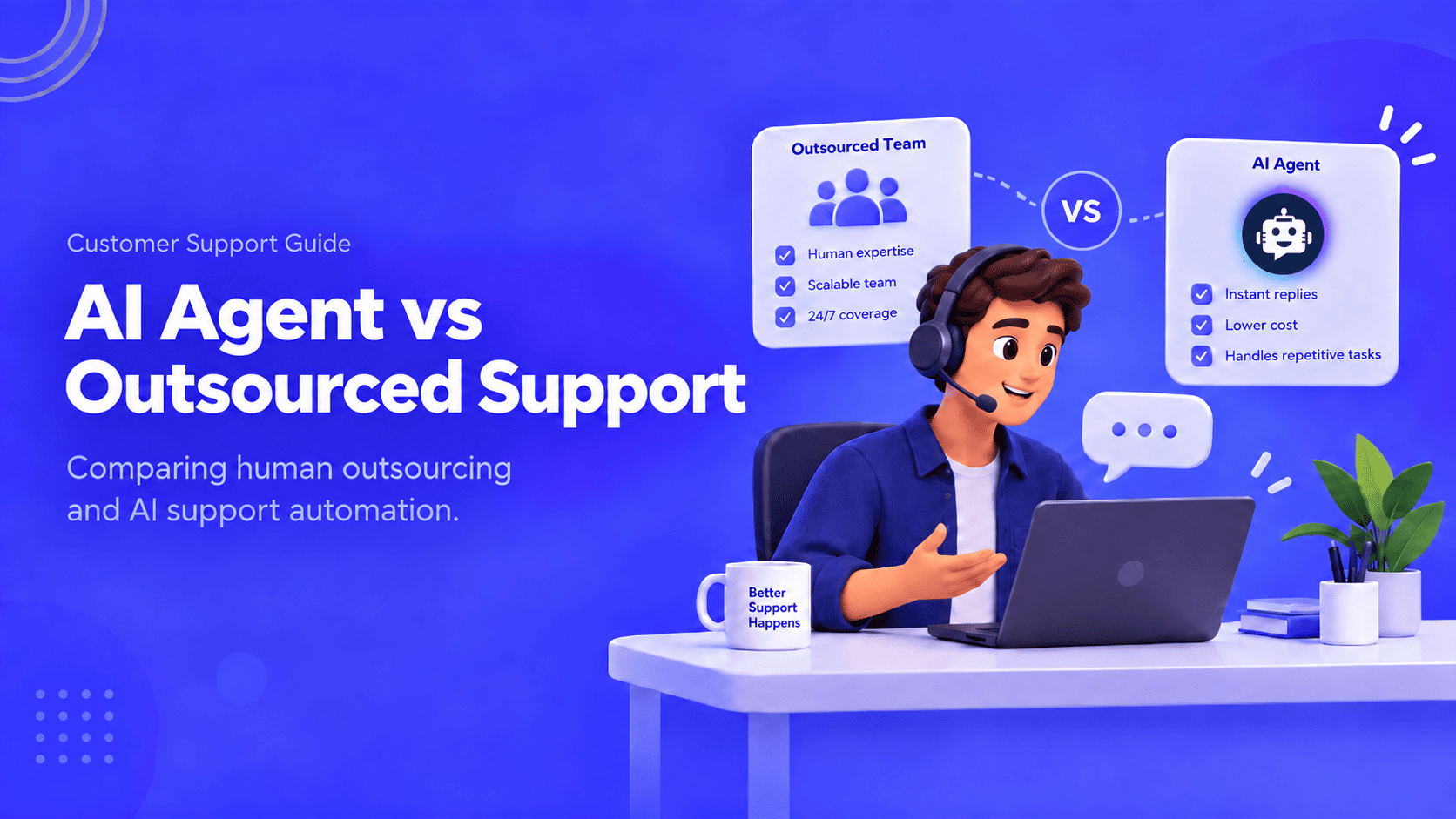
Compare outsourcing customer service with an AI agent using your own ticket mix, a cost model you fill in, and a clear rule for a hybrid split.
Export the Zendesk ticket archive, train an AI Agent on the help center, and test one real ticket before you stop the old queue.


Compare six Yuma alternatives by ecommerce capabilities, helpdesk compatibility, pricing and human handoffs to choose a replacement for your support team.
