5 Best Shopify Apps to Increase Post-Purchase Upsells in 2026

Rajni
Last updated on September 3, 2026
Post-purchase is a high-intent moment many Shopify stores underuse. The right upsell flow can increase AOV, improve retention, and capture valuable customer data through relevant offers like warranties, accessories, and care plans. This guide focuses on five Shopify post-purchase upsell apps for 2026 that help turn the checkout completion stage into a revenue opportunity.
A customer buys a premium product, reaches the confirmation stage, and still has buying intent. They may need an accessory, extended protection, a warranty plan, a refill, a spare part, faster service, or product registration. If that moment is handled with a generic product recommendation, the store misses a revenue opportunity. If it is handled with the right post-purchase flow, the same order can produce higher AOV, richer customer data, better retention, and cleaner customer communication.
This is where post-purchase upsell apps become useful.
For a store selling beauty devices, the next offer could be an extended protection plan. For a consumer electronics seller, it could be warranty registration, serial number capture, and an accessory bundle. For an apparel store, it could be a discounted matching product. For a home appliance seller, it could be a care plan, replacement filter, or support registration. The offer has to match the product, the customer’s intent, and the operational reality behind the business.
You may be here since your store already gets orders, but AOV growth has slowed. You may also have customers buying through retail, marketplaces, offline channels, and your own website, which means customer data sits in different places. Your team may want stronger post-purchase revenue, cleaner ownership records, better support workflows, and a more useful way to turn buyers into repeat customers.
So, in this blog, we will walk through five Shopify apps that can support post-purchase upsells in 2026. We will cover what each app does, where it fits, key features, integrations, reviews, pricing, and which type of store should consider it.
The best are post-purchase upsells apps on Shopify are:
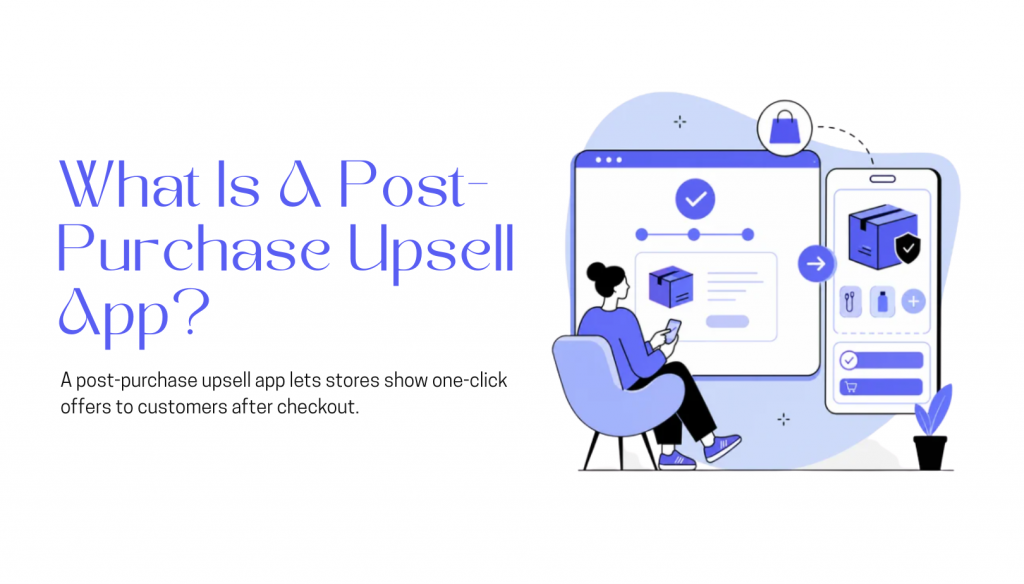
You can think of a post-purchase upsell app as the layer between order confirmation and the customer’s next useful action.
Once payment is completed, the app gives the store a controlled way to show a relevant offer or action without sending the customer back into the original checkout flow. The buyer may see a one-click add-on, a thank-you page offer, an extended protection plan, a warranty registration prompt, a refill option, a bundle upgrade, or a service-related next step.
Well, the important part is context.A normal product recommendation usually says, “Here are more products.” A strong post-purchase upsell flow says, “Here is what makes your recent purchase more complete.”
For example, after buying a blender, the customer may see a replacement jar, cleaning kit, recipe add-on, or protection plan. After buying a beauty device, they may see refill heads, serum packs, warranty activation, or extended coverage. After buying a backpack, they may see packing cubes, rain covers, or luggage tags.
For the store, the app usually handles three things:
Offer placement: where the offer appears after payment, such as a post-purchase page or thank-you page.
Offer logic: which product, plan, discount, or action appears based on what the customer bought.
Offer tracking: how much revenue, acceptance, and engagement each campaign creates.
The stronger apps also connect this stage with customer data, support, loyalty, email flows, and product ownership. That is why these tools are useful beyond short-term AOV growth.
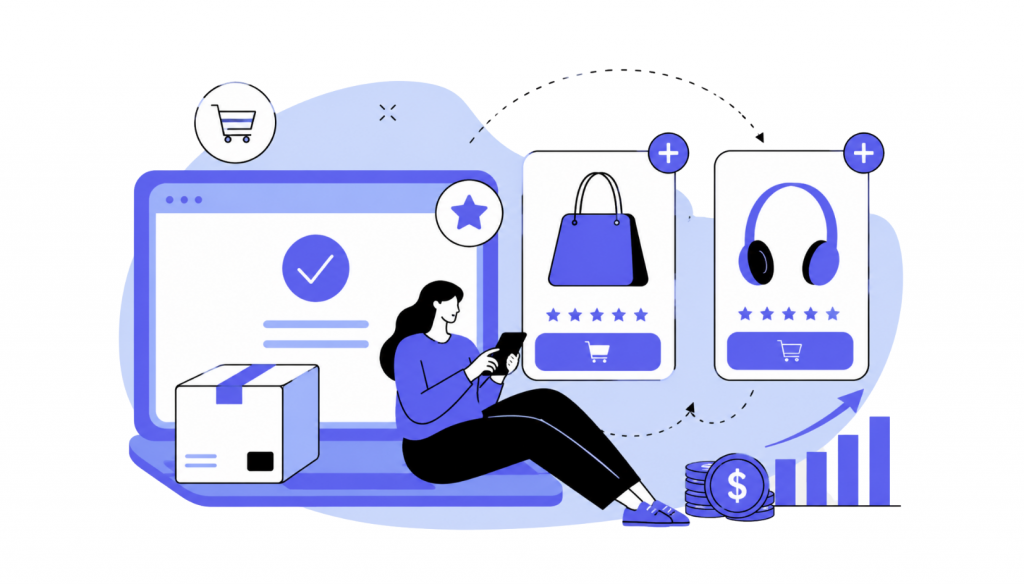
Once checkout is completed, the customer has already said yes to the main product. The next question is: what would make that purchase better, safer, easier to use, or more complete?
That is where post-purchase upsell apps create revenue.
For a phone buyer, the natural next step may be a case, screen protector, charger, or extended protection. For a coffee machine buyer, it may be filters, cleaning tablets, beans, or warranty registration. For a beauty device buyer, it may be replacement heads, serum refills, a care kit, or a protection plan.
The offer becomes stronger when it answers a need the customer already understands.
A good post-purchase upsell flow usually creates revenue in four practical ways:
Customers often buy the main product and forget the smaller item that completes it. They buy the printer and forget the ink. They buy the appliance and forget the filters. They buy the device and forget accessories.
Post-purchase apps let stores show that missing add-on right after payment, while the purchase is still fresh.
2. It sells convenience
A customer may pay extra for faster service, priority processing, a refill pack, a subscription, or a bundle that saves them another order later. These offers work well because they reduce effort for the buyer.
For example, a skincare customer may accept a refill bundle. A pet product buyer may add a subscription pack. A home appliance buyer may choose a care kit.
3. It creates data for future revenue
Post-purchase revenue also comes from better follow-up. If a store knows which product a customer owns, when they bought it, which channel they used, and whether they registered it, the next campaign becomes much more specific.
A coffee machine owner can receive filter reminders. A headphone buyer can receive accessory offers. A customer with an expiring warranty can receive an extension offer. A retail buyer who scans a QR code can become part of the store’s direct customer database.
So the value of a post-purchase upsell app is not limited to one extra product after checkout. The better apps help stores sell the right add-on, capture useful customer data, improve support visibility, and create future revenue paths from the same order.
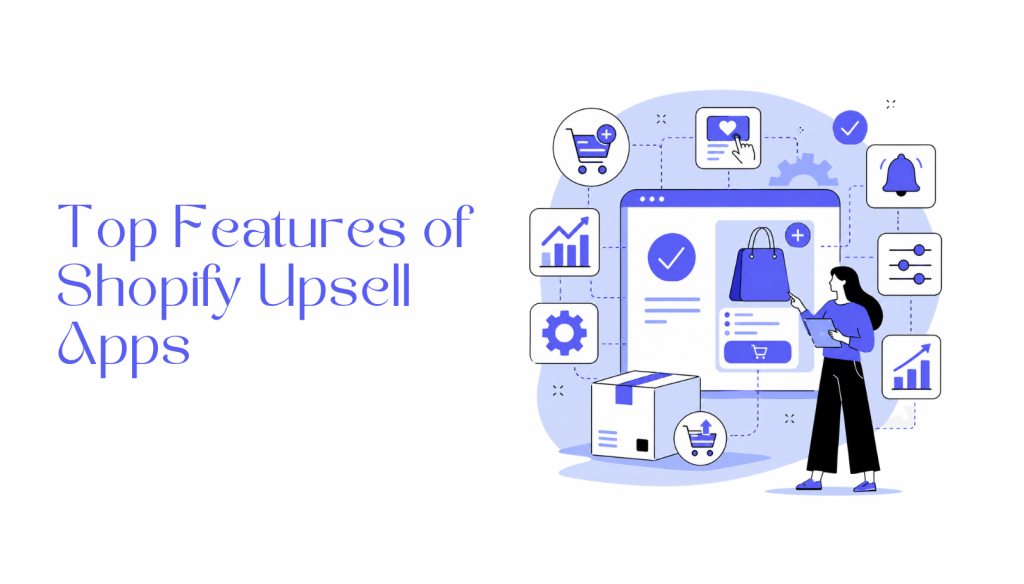
The best Shopify apps for post-purchase upsells should do more than display an extra product after payment. The app should help you show the right offer, at the right stage, to the right customer, with enough tracking to know whether the campaign is actually adding revenue.
Before choosing an app, look at these core features.
The main feature to check is one-click upselling. Once a customer completes payment, they should be able to accept the offer without going through checkout again.
This matters because extra steps reduce acceptance. If the buyer has to re-enter payment details, revisit the cart, or complete another long flow, the offer loses momentum. A smooth one-click experience gives the customer a faster way to add a relevant product, upgrade, warranty, refill, bundle, or service option to the same order.
2. Smart Offer Targeting
Every customer should not see the same offer.
A buyer who purchases a premium product may need a protection plan or accessory bundle. A buyer who places a smaller order may respond better to a low-cost add-on. A customer buying from a specific collection may need a matching product.
Strong apps should let you target offers based on:
With better targeting, the offer feels more relevant and the campaign has a stronger chance of increasing AOV.
3. Flexible Offer Types
A good app should support different offer formats, because every product category has a different upsell path.
For example, one store may need frequently bought together offers. Another may need discounted add-ons. Another may need thank-you page offers, warranties, subscriptions, priority processing, free shipping upgrades, or product bundles.
Look for flexibility across post-purchase offers, cross-sells, downsells, bundle offers, discount-based offers, and thank-you page promotions. This gives your team more room to test what buyers actually accept.
4. Design And Brand Control
Post-purchase offers should look connected to the store experience. If the offer page looks disconnected, trust drops and acceptance can suffer.
The app should let you control layout, product images, text, buttons, savings display, branding, mobile design, and offer preview. Mobile experience deserves extra attention since many post-purchase decisions happen on smaller screens.
5. Analytics And Testing
Post-purchase upsells need clear measurement. A useful app should show impressions, acceptances, conversion rate, revenue generated, average order value uplift, click-through rate, and funnel performance.
A/B testing is also valuable if your team wants to compare offers, discounts, copy, or layouts. Without tracking, it becomes difficult to know whether an upsell is helping revenue or only adding noise to the customer journey.
6. Integrations With Your Existing Stack
Your app should connect cleanly with Shopify checkout and Shopify Admin. Beyond that, integrations with email platforms, analytics tools, helpdesks, CRMs, pixel tracking, and customer communication tools can make the post-purchase flow far more useful.
When upsell data connects with the rest of your stack, teams can create better follow-ups, segment customers more accurately, and understand which offers create long-term value.
Post-purchase upsell apps can look similar from the outside, but the real difference appears in the use case. Some apps are built for one-click product add-ons. Some are better for thank-you page offers. Some go deeper into analytics, AI recommendations, or campaign targeting. Others connect upsells with product registration, warranty activation, customer data, and support workflows.
Here are five apps worth considering in 2026.
Best for: AI agents for customer support, sales automation, operational workflows, and omnichannel customer engagement.
YourGPT is an AI-first platform for building and running AI agents across websites, apps, and messaging channels. It offers a no-code agent builder for simple use cases and an AI Studio for advanced workflows, enabling both basic support automation and complex multi-step operations.
It executes real-time actions during conversations and functions as a full AI execution layer for support and sales.
YourGPT fits teams that want to automate customer interactions while also connecting them to real business actions. Agents can answer queries, trigger workflows, update systems, and assist users across support and sales journeys.
Its ability to handle multimodal inputs like text, images, and audio helps resolve customer issues faster with better context. Omnichannel deployment ensures consistent experiences across websites, apps, and messaging platforms.
YourGPT includes no-code agent builder, AI Studio, AI helpdesk, multimodal understanding (text, images, audio, documents), multiple AI models, training and knowledge sources, omnichannel deployment, multilingual support, analytics, security and compliance, and integrations.
It integrates with Shopify, WordPress, Webflow, Framer, Squarespace, Crisp, Intercom, Zapier, Make, Pabbly, Stripe, and custom APIs, with support for MCP and code execution.
YourGPT offers custom pricing based on business needs and usage.
Choose YourGPT if: you want AI agents for support, sales, and operations that can execute real-time actions, handle multimodal inputs, and run across multiple channels.
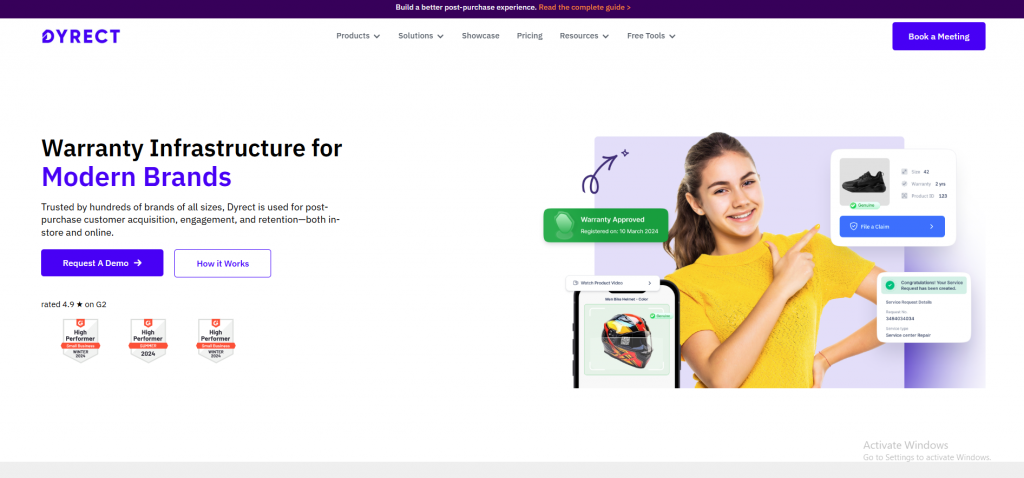
Best for: Warranty registration, extended protection plans, product ownership data, omnichannel customer capture, loyalty, claims, and post-purchase upsells.
Dyrect is a strong fit for stores selling physical products where the customer journey continues after delivery. It suits categories such as consumer electronics, mobile accessories, appliances, kitchen products, beauty devices, baby gear, fitness equipment, outdoor gear, tools, luggage, and other durable products.
The main value of Dyrect is that it turns product registration into a post-purchase revenue and data channel. Customers can register products through QR codes or a website, activate warranty, access a digital warranty card, and use a self-serve customer portal. During that flow, the store can offer extended protection, accessories, spare parts, care plans, or loyalty incentives.
Dyrect is useful for stores selling across multiple channels. A customer may buy from a retail store, marketplace, offline event, distributor, or the main online store. With QR-based registration and serial number automation, the brand can still capture ownership data and bring that customer into a direct database.
For example, a consumer electronics seller can capture serial numbers, product details, customer contact data, purchase channel, and warranty status. A beauty device brand can offer an extended protection plan during registration. An appliance seller can promote replacement filters, care kits, or service plans after warranty activation.
Dyrect includes warranty registration, product registration, QR-based registration, digital warranty cards, customer portals, custom registration fields, claims management, claim tracking, repair and replacement workflows, serial number automation, custom branding, custom upsell options, analytics, and fraud claim prevention on higher plans.
It also integrates with Klaviyo, Gorgias, HubSpot, Mailchimp, Zendesk, and Zoho Desk, which is useful for connecting post-purchase data with email, CRM, support, and service workflows.
Dyrect offers a Free Forever plan. Paid plans start at $19/month, with higher tiers at $49/month and $149/month for claims, repairs, replacements, billing, invoices, estimates, and advanced service workflows.
Choose Dyrect if: your store needs post-purchase upsells linked with warranty, protection plans, registration, serial numbers, claims, support, first-party data, and omnichannel customer visibility.
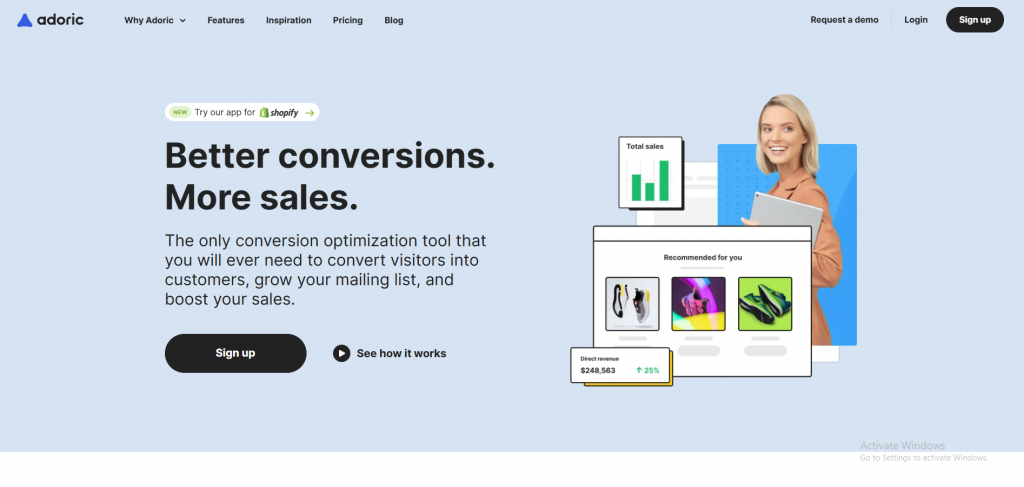
Best for: Free one-click post-purchase offers, product recommendations, discounts, timers, and beginner-friendly upsell campaigns.
Adoric Post Purchase Upsell is built for merchants who want a clean way to show offers after checkout. It fits stores that want to test post-purchase revenue without adding a complex workflow.
The app lets merchants create checkout-based upsell offers and target them by product, product tag, collection, and related rules. This can work well for stores with natural product pairings.
Adoric is useful for stores selling products with clear add-ons. A skincare store can offer refills or travel-size products. A fashion store can recommend a matching item. A gadget seller can offer a cable, case, or related accessory.
Its strength sits in practical offer building. Merchants can use automatic discounts, countdown timers, frequently bought together offers, buy more save more campaigns, and mobile-friendly display options.
Adoric includes one-click post-purchase upsells, checkout upsells, product recommendations, frequently bought together offers, buy more save more offers, automatic discounts, countdown timers, custom branding, click-through tracking, conversion tracking, recommendation performance, and funnel performance.
The app integrates with Shopify Admin and checkout.
Adoric is listed as free, which makes it useful for merchants testing post-purchase upsells for the first time.
Choose Adoric if: you want a free, clean, checkout-based upsell app with product recommendations, discounts, timers, and straightforward campaign tracking.
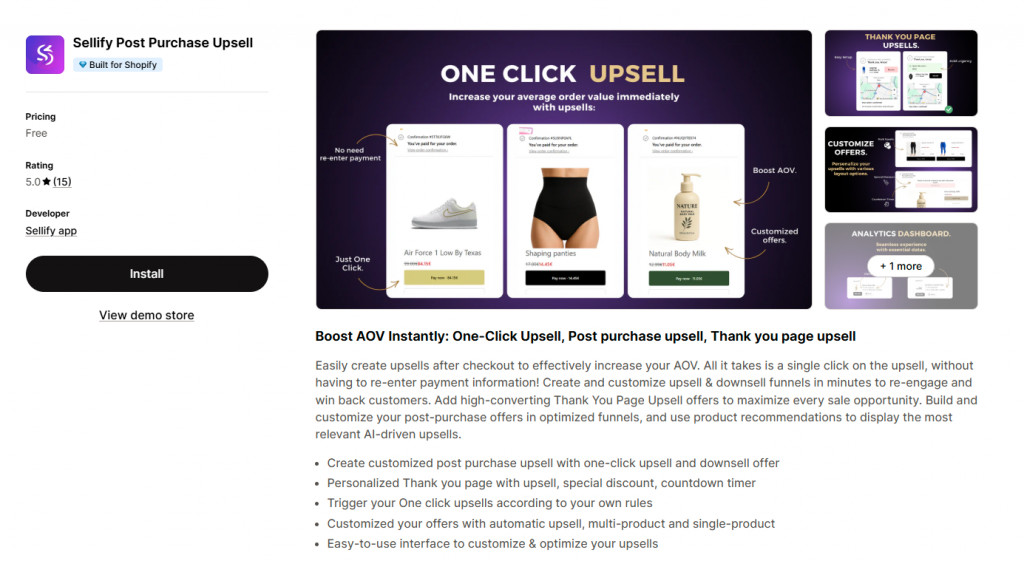
Best for: Upsell and downsell funnels, thank-you page offers, AI recommendations, warranty offers, add-ons, and priority processing.
Sellify is a strong choice for merchants who want more than a single post-checkout offer. It supports funnel-style selling, which means stores can show an upsell and then present a downsell if the buyer skips the main offer.
This gives merchants more room to recover revenue after checkout. A customer who passes on a larger bundle may still accept a smaller add-on, lower-cost accessory, or discounted service option.
Sellify works well for stores with several possible add-on paths. A camera store can offer batteries, bags, memory cards, or protection. A pet store can offer treats, grooming tools, or subscription packs. A skincare store can offer bundles, refill packs, or trial sizes.
The app also supports thank-you page offers, which gives stores another chance to show relevant products after the main post-purchase offer.
Sellify includes one-click post-purchase upsells, thank-you page upsells, upsell and downsell funnels, single-product offers, multi-product offers, automatic upsells, AI-driven product recommendations, special discounts, countdown timers, warranty offers, free shipping offers, product add-ons, priority processing, custom trigger rules, click-through tracking, conversion tracking, recommendation performance, and funnel performance.
It integrates with Shopify Admin and checkout.
Sellify is listed as free.
Choose Sellify if: your store needs flexible post-purchase funnels with upsells, downsells, thank-you page promotions, AI recommendations, warranties, free shipping offers, and product add-ons.
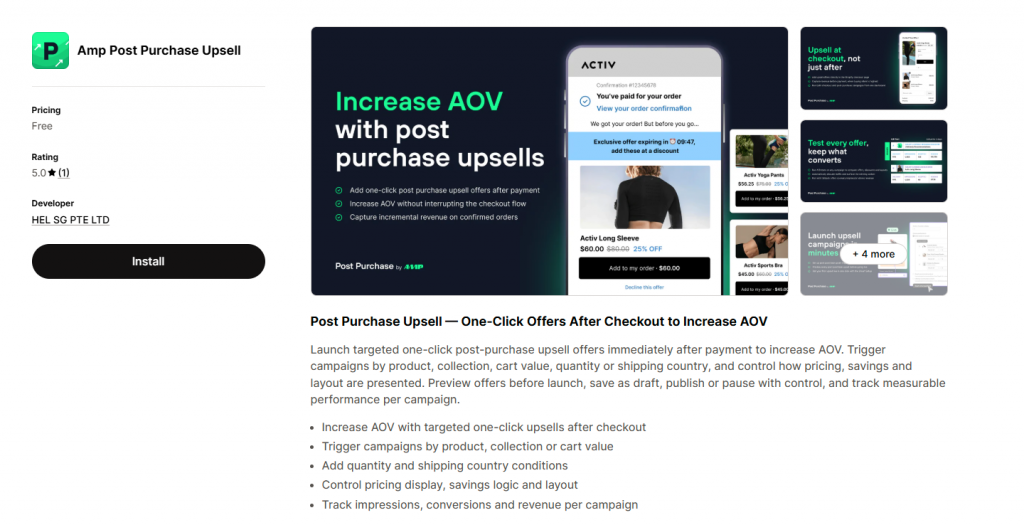
Best for: Campaign targeting, cart value rules, shipping country rules, product triggers, collection triggers, and campaign-level reporting.
Amp Post Purchase Upsell is a newer option with a clear strength: targeting control. It lets merchants create one-click post-purchase offers and trigger them based on product, collection, cart value, quantity, and shipping country.
Amp works well for merchants that want different offers for different order situations. A high-value order can trigger a premium add-on. A lower-value order can trigger a small accessory. A buyer from a specific country can see a region-specific offer. A collection-based purchase can trigger a matching product.
This makes Amp useful for stores with several product categories, international orders, or margin-sensitive campaigns.
Amp includes one-click post-purchase upsells, product-based triggers, collection-based triggers, cart value triggers, quantity rules, shipping country rules, pricing display controls, savings logic, layout control, campaign previews, draft saving, publish and pause controls, product add-ons, frequently bought together offers, impressions, acceptances, acceptance rate, and revenue reporting.
Pixel tracking can run through Shopify Customer Events when Meta, Google, or TikTok pixels are configured inside Shopify.
Amp is listed as free.
Choose Amp if: your store needs post-purchase offers based on product, collection, cart value, quantity, shipping country, or campaign-specific targeting rules.
| App | Best For | Primary Use Case | Key Features | Pricing | Choose If |
|---|---|---|---|---|---|
| YourGPT | AI agents for customer support, sales automation, operational workflows, and omnichannel customer engagement | Building and running AI agents across websites, apps, and messaging channels | No-code agent builder, AI Studio, AI helpdesk, multimodal understanding, multiple AI models, knowledge sources, omnichannel deployment, analytics, integrations, MCP, and code execution | Custom pricing based on business needs and usage | You want AI agents for support, sales, and operations that execute real-time actions, handle multimodal inputs, and run across multiple channels |
| Dyrect: Warranty Registration And Upsell | Warranty registration, extended protection plans, product ownership data, loyalty, claims, and post-purchase upsells | Turning product registration into a post-purchase revenue and customer data channel | Warranty registration, QR-based registration, digital warranty cards, customer portals, claims management, repair workflows, serial number automation, custom upsells, analytics, and fraud prevention on higher plans | Free Forever plan; paid plans start at $19/month, with higher tiers at $49/month and $149/month | Your store needs upsells linked with warranty, protection plans, registration, serial numbers, claims, support, first-party data, and omnichannel customer visibility |
| Adoric Post Purchase Upsell | Free one-click post-purchase offers, product recommendations, discounts, timers, and beginner-friendly upsell campaigns | Showing clean checkout-based upsell offers after purchase | One-click post-purchase upsells, checkout upsells, product recommendations, frequently bought together offers, buy more save more offers, automatic discounts, countdown timers, branding, and funnel tracking | Listed as free | You want a free, clean, checkout-based upsell app with product recommendations, discounts, timers, and straightforward campaign tracking |
| Sellify Post Purchase Upsell | Upsell and downsell funnels, thank-you page offers, AI recommendations, warranty offers, add-ons, and priority processing | Creating flexible post-checkout funnels with upsells and downsells | One-click post-purchase upsells, thank-you page upsells, upsell and downsell funnels, single-product offers, multi-product offers, AI recommendations, discounts, timers, warranty offers, free shipping offers, add-ons, and tracking | Listed as free | Your store needs flexible post-purchase funnels with upsells, downsells, thank-you page promotions, AI recommendations, warranties, free shipping offers, and product add-ons |
| Amp Post Purchase Upsell | Campaign targeting, cart value rules, shipping country rules, product triggers, collection triggers, and campaign-level reporting | Triggering post-purchase offers based on order, product, collection, quantity, and shipping conditions | One-click post-purchase upsells, product triggers, collection triggers, cart value triggers, quantity rules, shipping country rules, pricing controls, savings logic, layout control, previews, draft saving, publish and pause controls, add-ons, and revenue reporting | Listed as free | Your store needs post-purchase offers based on product, collection, cart value, quantity, shipping country, or campaign-specific targeting rules |
Post-purchase upsells in 2026 need to be sharper than a “you may also like” block. Customers can spot a random offer instantly. The apps that create stronger revenue are the ones that match the offer to the product, the purchase stage, and the next action the buyer is likely to take.
For stores selling low-consideration products, a one-click add-on, bundle, discount, or thank-you page offer may be enough. For stores selling higher-value physical products, the stronger opportunity often sits in protection plans, warranty registration, spare parts, serial number capture, and ownership-based follow-ups.
That difference should guide the app choice.
If your store mainly needs post-checkout product offers, tools like Adoric, Sellify, and Amp can help you test discounts, add-ons, funnels, recommendations, and targeting rules. They are useful for improving AOV through cleaner offer placement after payment.
If your products require registration, warranty support, extended protection, customer data, or service workflows, the post-purchase upsell strategy needs a deeper system. In that case, Dyrect fits better because the upsell is connected to ownership, coverage, and customer data rather than only another product recommendation.
For YourGPT readers, the main takeaway is: choose the app based on the next monetizable action after purchase. For one store, that action may be an accessory. For another, it may be a care plan. For another, it may be warranty registration plus an extended protection offer.
The right post-purchase app should turn that next action into a smooth, trackable, revenue-generating flow.
Use YourGPT to build smarter customer flows that connect support, sales, product ownership, and follow-up actions after every purchase.
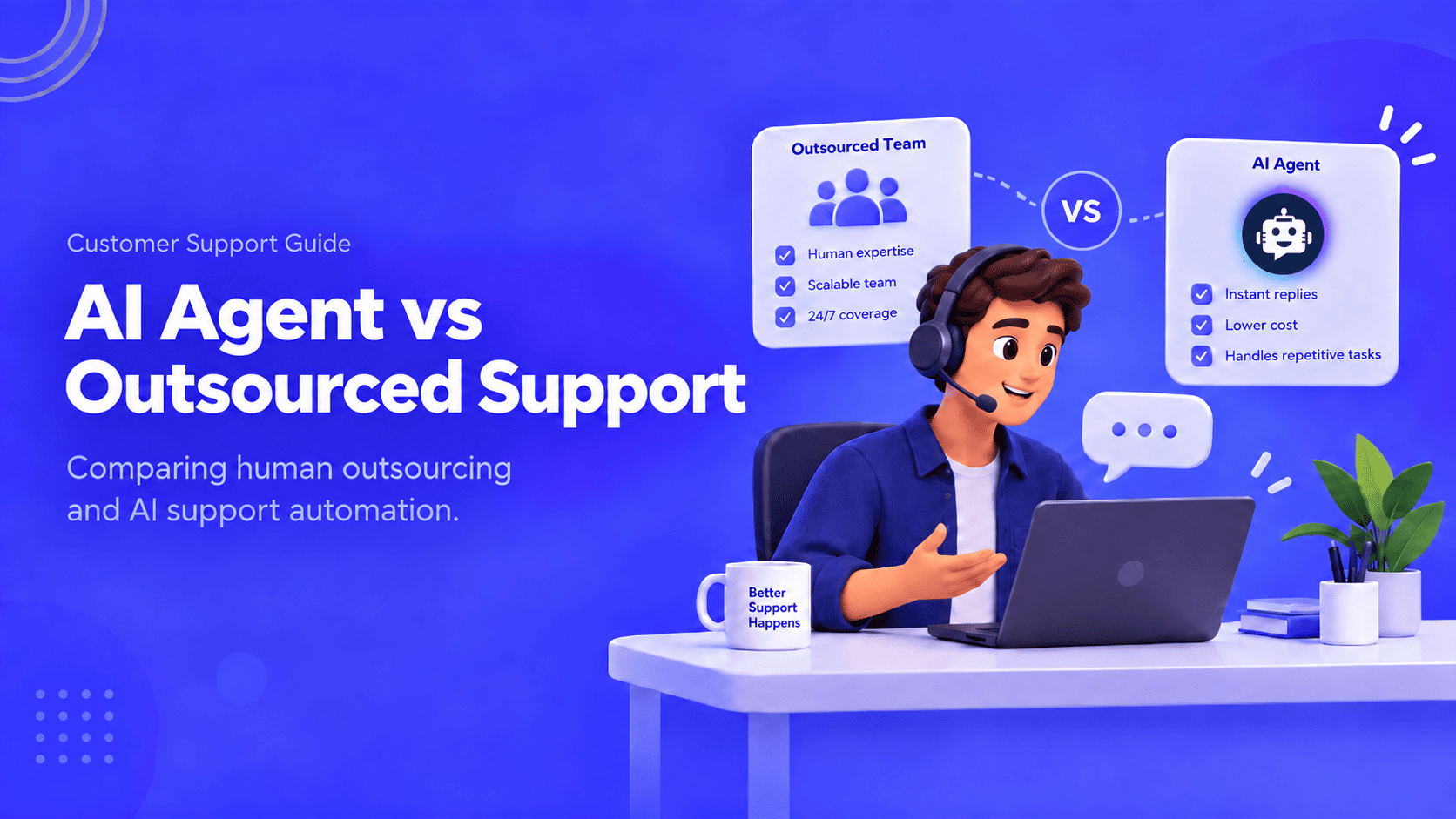
Compare outsourcing customer service with an AI agent using your own ticket mix, a cost model you fill in, and a clear rule for a hybrid split.
Export the Zendesk ticket archive, train an AI Agent on the help center, and test one real ticket before you stop the old queue.

Compare six Yuma alternatives by ecommerce capabilities, helpdesk compatibility, pricing and human handoffs to choose a replacement for your support team.

Move from Gorgias with a verified ticket archive, tested AI workflows, human handoff and a channel cutover plan before ending your subscription.
TL;DR The Gorgias AI Agent is the automation layer inside the Gorgias helpdesk, split between a Shopping Assistant for pre-purchase conversations and a Support Agent for post-purchase support. A connected Shopify store is required, and Gorgias documentation rules out platforms such as BigCommerce, Magento, and WooCommerce for the AI Agent. Billing runs on two separate […]

TL;DR Gorgias is the closest Richpanel alternative for Shopify stores that need native order actions directly inside support tickets. YourGPT fits stores that want one AI agent handling requests across web, WhatsApp, Instagram, and email, while Tidio and Re:amaze suit smaller teams looking for lighter, lower-cost options. Richpanel’s AI pricing starts around $500/month for two […]