Top 10 Alternatives to Sierra AI in 2026

Rajni
Last updated on June 5, 2026

Sierra AI is built for enterprise customer experience teams that want highly guided AI agent deployments, but it may not be the right fit for teams that need faster setup, clearer pricing, broader channel coverage, or more control over workflow execution.
The strongest Sierra AI alternatives are not just chatbot tools. They differ by deployment model, workflow depth, voice support, helpdesk integration, omnichannel coverage, and how easily teams can connect AI agents to real business systems.
For teams that want AI agents to resolve customer requests across web chat, WhatsApp, email, voice, and internal workflows, YourGPT is a strong alternative to evaluate alongside platforms like Decagon, Ada, Kore.ai, Zendesk AI, and Cognigy.
Sierra AI is an enterprise AI agent platform for conversational AI in customer support and customer experience automation.
The company was founded by Bret Taylor and Clay Bavor and publicly launched in February 2024 after operating in stealth. Sierra is positioned around AI agents that can handle customer conversations, follow brand guidelines, connect with business systems, and support outcome-based pricing for enterprise teams.
Sierra AI is primarily designed for large enterprise environments with longer deployment cycles, high-touch onboarding, and managed implementation support.
While that approach can work for complex contact center operations, it may feel restrictive for teams that want faster iteration, more direct control over agent behavior, or greater flexibility across channels and workflows.
Some teams need more flexibility over how their agents are built and updated. Others may prioritize transparent pricing, faster deployment, broader channel coverage, workflow control, or the ability to connect AI conversations with tools such as CRMs, helpdesks, ecommerce platforms, calendars, and internal systems.
This is why Sierra AI alternatives are worth evaluating.
This guide compares the top Sierra AI alternatives for customer support and CX teams across automation, integrations, deployment flexibility, pricing, and operational fit, so you can choose a platform that aligns with how your business actually works.
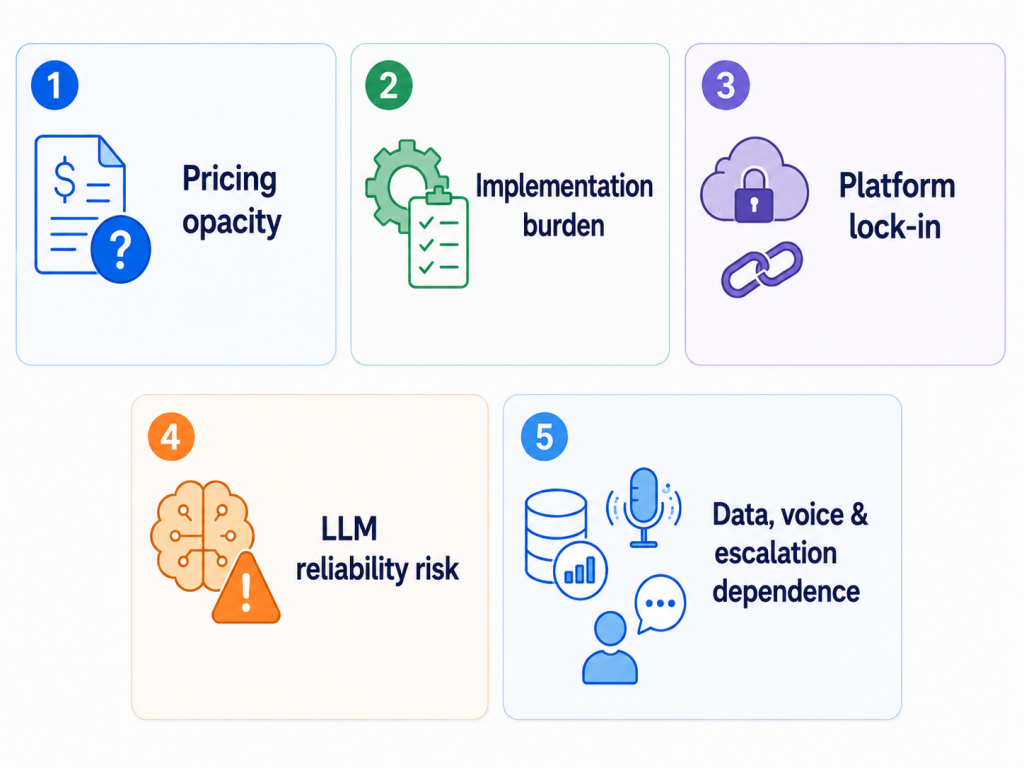
Sierra AI is a strong enterprise AI-agent platform for customer experience automation, especially for brands that need action-taking agents across chat, voice, email, SMS, WhatsApp, and other channels. However, businesses should evaluate the following limitations before committing:
Sierra’s outcome-based pricing can make budgeting difficult. Costs may rise unexpectedly during high-volume periods such as product recalls, outages, seasonal spikes, or support surges. It can also be difficult for finance and procurement teams to audit what exactly counts as a “successful resolution,” especially when outcomes involve partial fixes, abandoned conversations, escalations, or customer dissatisfaction.
Sierra is not a lightweight plug-and-play chatbot. It works best for enterprises with clean knowledge bases, stable policies, strong backend systems, and technical teams ready to support integration. Complex API connections, legacy systems, CRM workflows, payments, authentication, and regulated processes can require significant engineering effort and professional services support.
Customers build agents inside Sierra’s proprietary Agent OS, which can create platform dependency over time. Journeys, prompts, policies, integrations, testing data, traces, and agent logic may not be easy to export or migrate. Operations teams may also face limits when trying to make fast structural changes without technical support or vendor involvement.
Even with guardrails, supervisors, simulations, and regression testing, Sierra’s AI agents can still make mistakes. Risks include hallucinations, off-brand responses, prompt injection, jailbreaks, context failures, policy violations, and edge-case errors. Because Sierra agents interact directly with customers and may perform real business actions, failures can create public brand damage and operational risk.
Sierra’s results depend heavily on the quality of the company’s data, knowledge base, APIs, policies, and backend systems. Poor documentation, inconsistent rules, outdated content, or weak integrations can reduce agent performance. Voice deployments add further challenges such as latency, accents, interruptions, background noise, authentication, payments, and escalation handling. Human support is still necessary for sensitive, ambiguous, high-value, or exception-heavy cases.
There are several platforms that go beyond managed AI services and offer flexible architectures, transparent pricing, and real operational control. These tools help teams handle workflows, multichannel communication, and task execution with greater ownership and adaptability.
Below are the top Sierra AI alternatives teams commonly evaluate in 2026, starting with AI-first agent platforms built for real operational work.
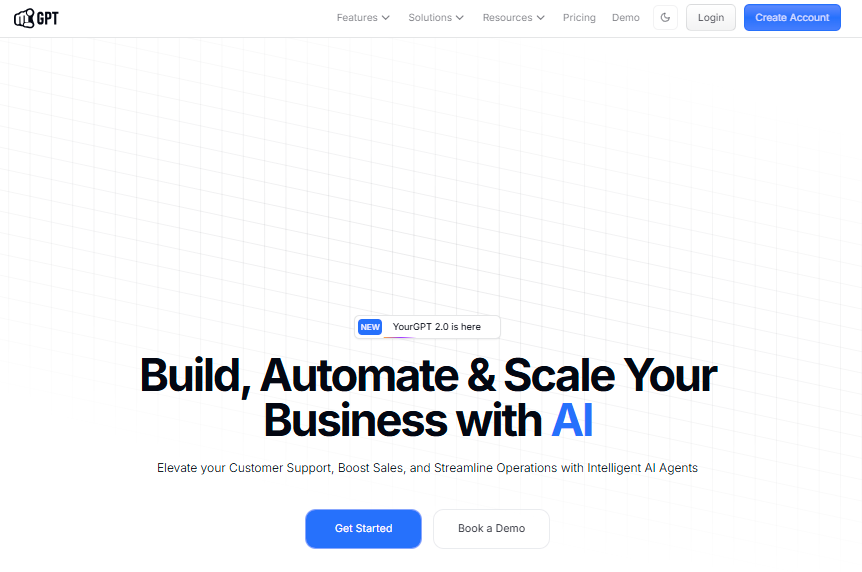
YourGPT is an AI-first platform designed to build and run autonomous AI agents across customer support, sales, and internal operations. Instead of stopping at answering questions, YourGPT agents complete tasks, trigger workflows, and resolve requests inside the conversation.
Teams can launch simple knowledge bots using the no-code builder, then scale into advanced automation using the AI Studio for structured workflows and system integrations.

Decagon targets fast-moving support organizations that want to configure AI agent behavior using plain-language workflows. Its Agent Operating Procedures allow CX teams to define agent logic in plain English without engineering support.
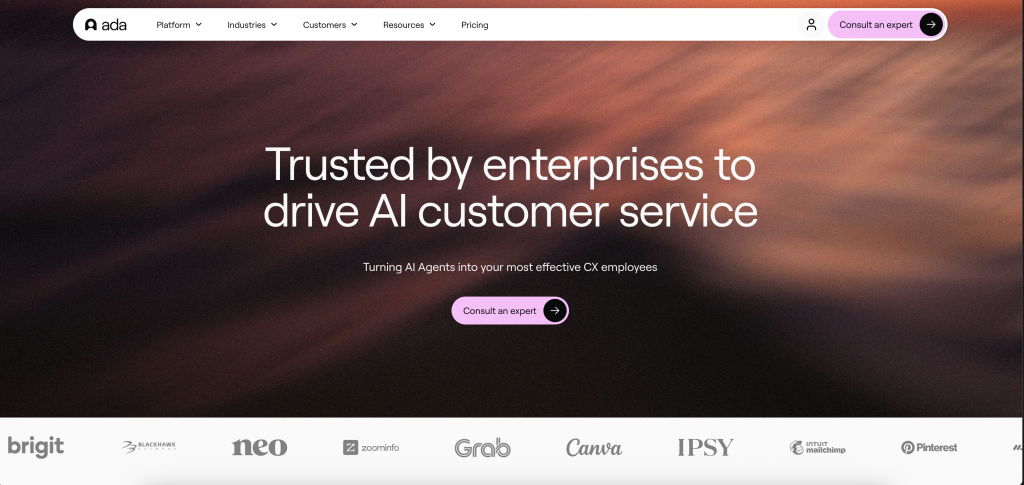
Ada is a digital-first customer service platform focused on automation across chat and messaging with expanding voice support. It is designed for CX teams that want to own and iterate on automation without engineering dependencies.
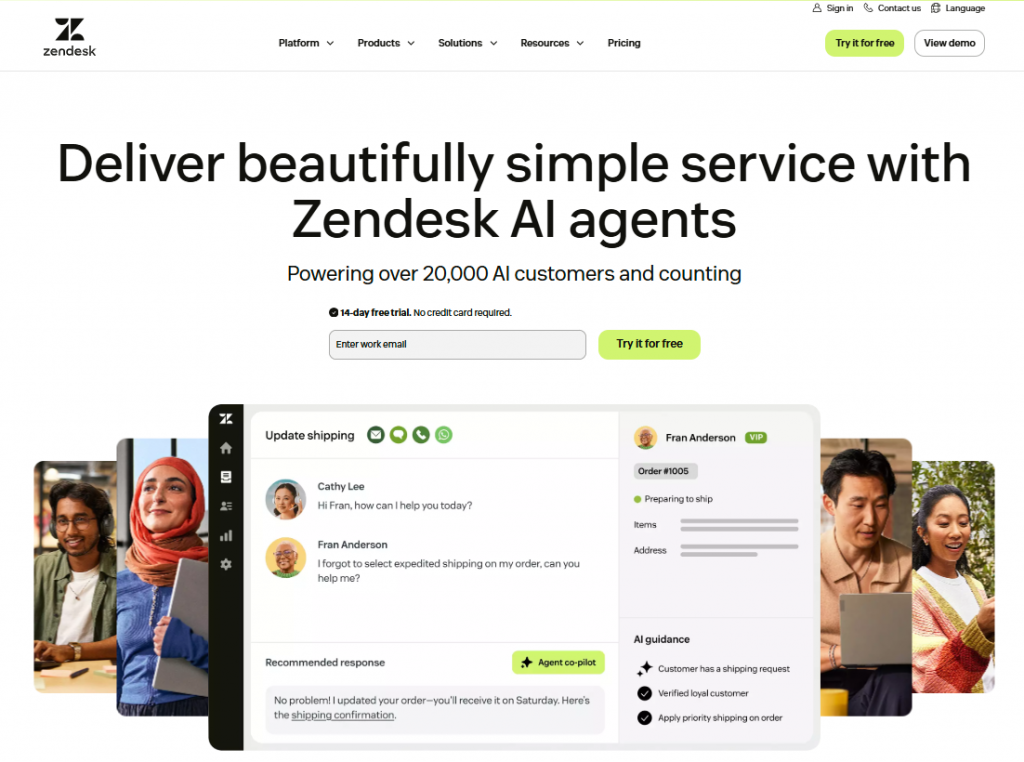
Zendesk AI is an AI-powered customer service platform built into Zendesk’s helpdesk ecosystem. It combines AI agents, ticketing, messaging, live chat, voice, knowledge base, routing, automation, and human agent workflows in one platform. Zendesk says its AI agents can handle customer enquiries across messaging, email, voice, social, web, and mobile channels, with automation potential of up to 80% depending on implementation and use case.

Kore.ai is an enterprise platform for building and orchestrating AI agents across customer experience, employee experience, and operational workflows. It offers both no-code configuration and pro-code development options with support for cloud, hybrid, and on-premises deployments.
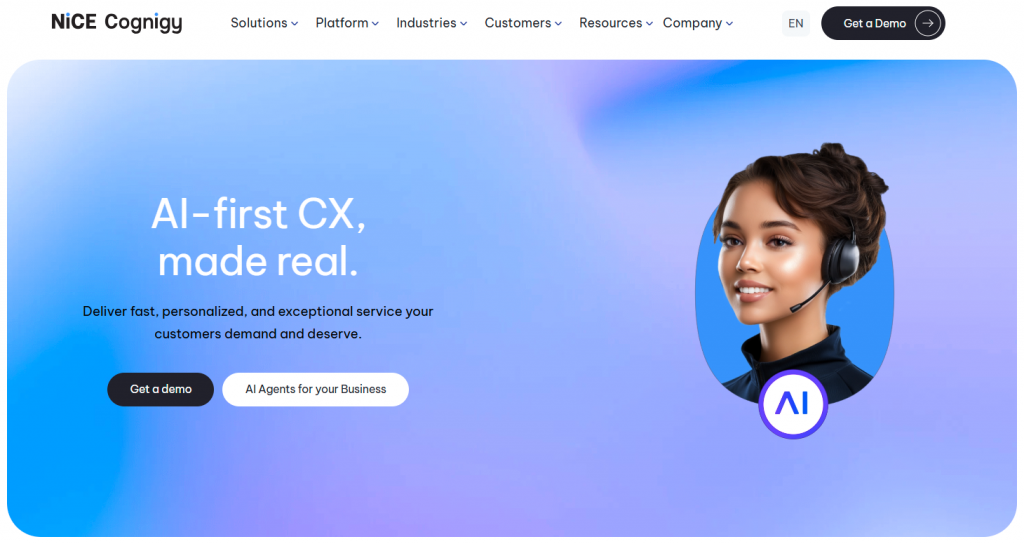
Cognigy provides enterprise conversational automation for contact center teams that need AI support across both voice and digital channels. It helps businesses create multilingual customer experiences, automate common service requests, and manage conversations across web chat, messaging apps, and phone support.
It is especially useful for large enterprises already using the NICE CXone ecosystem because it integrates closely with contact center workflows, routing, analytics, and agent handoff. As a Sierra AI alternative, Cognigy is best suited for companies that need scalable automation, strong voice AI, and enterprise-grade control.
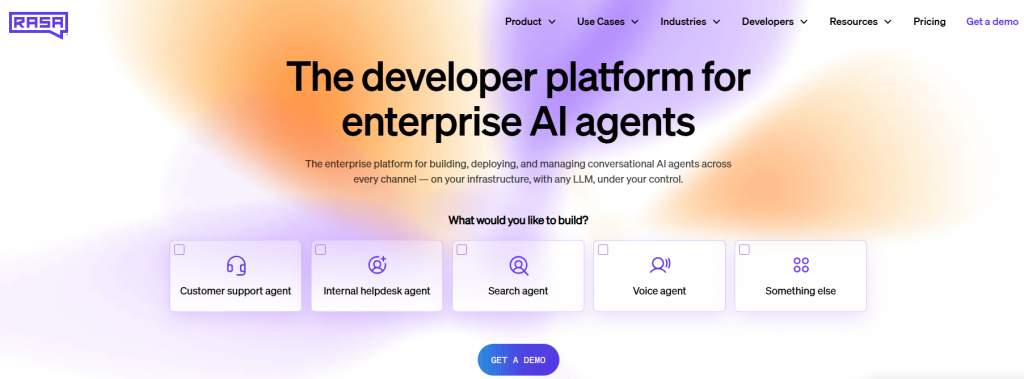
Rasa is an open-source conversational AI framework designed for enterprises that need full ownership of their AI agent infrastructure. Unlike managed platforms, Rasa gives engineering teams direct control over natural language understanding, dialogue management, and system integrations across self-hosted environments.
It is built for complex, logic-driven conversational systems and is commonly used in regulated industries that require data sovereignty and architectural independence.
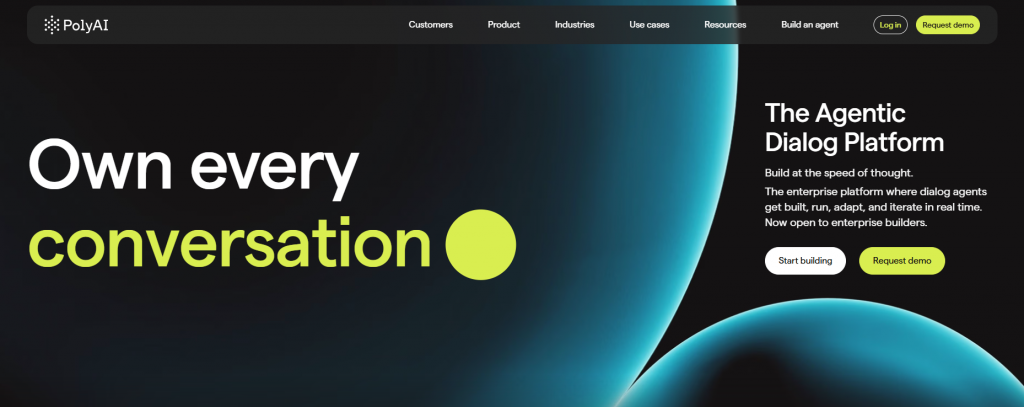
PolyAI is a voice-first enterprise platform designed for natural, phone-based customer interactions. It helps contact centers automate high-volume calls, answer customer questions, complete routine tasks, and reduce pressure on live agents while keeping conversations fluid and human-like.
As a Sierra AI alternative, PolyAI is best suited for businesses that prioritize voice automation over chat-based support. Its proprietary speech recognition and reasoning models make it useful for complex call center environments where reliability, natural language understanding, and scalable phone support are important.
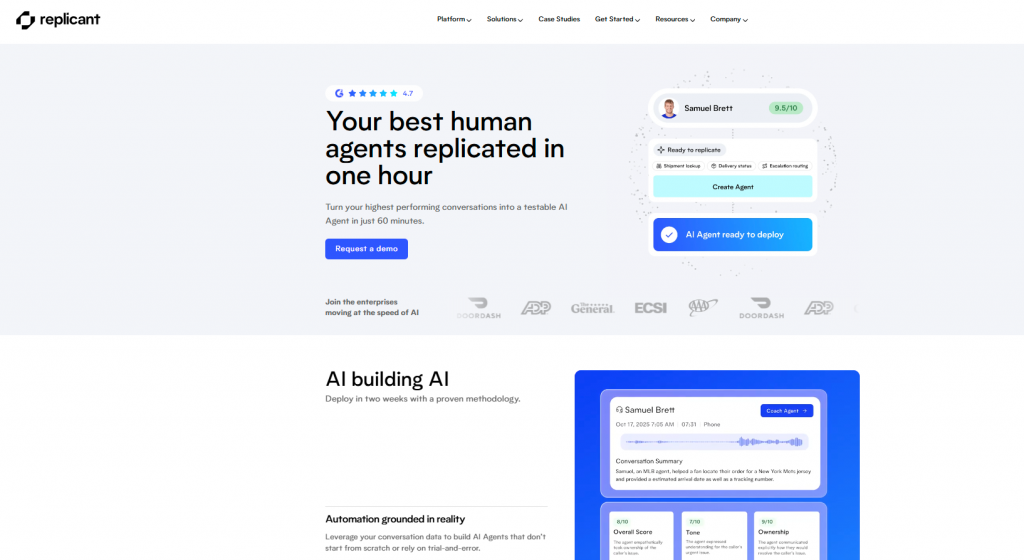
Replicant focuses on voice automation for contact centers that handle large volumes of repetitive customer calls. It helps businesses automate common phone inquiries, reduce wait times, and free live agents to focus on more complex or sensitive customer issues.
As a Sierra AI alternative, Replicant is useful for teams that want to launch voice AI based on their existing call data. By training from past call recordings and transcripts, it can better match a company’s real support processes, customer language, and escalation patterns while reducing cold-start setup time.
Parloa provides enterprise contact center automation for voice and messaging across more than 130 languages. It is designed for high-stakes and regulated environments where businesses need secure, reliable AI agents that can support customers throughout the full service lifecycle.
As a Sierra AI alternative, Parloa is best suited for large enterprises that need multilingual automation, strong voice AI, and deep contact center integration. It connects natively with CCaaS platforms such as Genesys, NICE, and Five9, as well as CRM systems like Salesforce and SAP.
Choosing the right AI platform is not about picking the tool with the longest feature list. It is about choosing a system that fits how your team works today and can scale as your automation needs grow.
The best platforms reduce manual effort, keep conversations consistent across channels, and help resolve customer requests without constant human involvement. Here’s what to evaluate:
A platform should be simple to launch and easy to maintain as your use cases expand.
Check how quickly your team can build agents, update content, adjust workflows, and manage conversations. If every small change requires technical support or vendor involvement, adoption will slow down.
The right tool should let your support or operations team make everyday updates without depending on developers for every change.
Customers contact businesses through websites, messaging apps, email, and phone. Managing each channel separately creates inconsistent responses and missed conversations.
Look for a platform that centralizes communication and allows the same AI logic to work across channels.
Ask whether the AI can manage conversations across web chat, WhatsApp, email, voice, and other messaging channels from one interface instead of forcing your team to maintain separate workflows.
Not every customer request should be handled by AI. Complex, emotional, or sensitive issues need quick human support.
A better platform should hand conversations to live agents without losing context. Customers should not have to repeat their issue, share the same details again, or restart the conversation.
Test how escalation works during demos. The handoff should feel seamless for both the customer and the agent.
AI should do more than answer basic questions. The most useful platforms connect directly to business systems and complete tasks inside conversations.
Look for tools that can update records, trigger notifications, process requests, check live data, create tickets, or perform workflow actions.
Platforms that only provide information may reduce some repetitive questions. Platforms that take action can reduce workload and resolve issues more completely.
Good reporting helps teams understand what is working and where automation needs improvement.
Check whether the platform shows resolution rates, automation success, response quality, workload trends, escalation reasons, and customer experience metrics.
Without clear analytics, it becomes difficult to improve conversations, identify gaps, or prove the impact of AI on daily operations.
Every business has different tools, processes, and customer journeys. The platform should be flexible enough to support your specific workflows.
Look for deep integrations with CRMs, help desks, contact center platforms, ecommerce systems, internal databases, and other business software.
Also check whether the platform supports custom conversation logic, scenario-specific flows, and workflow automation that matches how your team already operates.
Before choosing a platform, consider how much ownership your team needs over agent logic, data, workflows, and system behavior.
Some managed platforms are easier to launch but create more vendor dependency. Self-hosted or code-first options offer more control but usually require more technical resources.
The right choice depends on your team’s priorities. If you want speed and simplicity, a managed platform may be better. If you need data sovereignty, custom architecture, or deeper control, choose a platform that gives your team more ownership.
Sierra AI is built for enterprise-grade AI customer experiences, but some teams need different tradeoffs around deployment speed, pricing visibility, workflow ownership, infrastructure control, or channel coverage. The evaluation is no longer only about conversational quality. Buyers are also checking how much operational control the platform gives after deployment.
Enterprises should evaluate escalation logic, workflow orchestration, live system integrations, channel continuity, analytics visibility, compliance requirements, pricing structure, and ownership after launch. AI response quality matters, but complex support teams also need control over how decisions, handoffs, and actions happen.
YourGPT, Zendesk AI and Kore.ai, are relevant options for omnichannel support. YourGPT is strongest when a team wants AI agents across web chat, WhatsApp, email, voice, and messaging channels with connected handoff and workflow execution. Zendesk AI is strongest when Zendesk is already the core helpdesk.
PolyAI, Parloa, Replicant, Cognigy, and YourGPT are relevant for voice automation.
Not always. In many teams, AI support platforms sit across the helpdesk, knowledge base, CRM, order system, and messaging channels rather than replacing everything at once. The more important shift is that AI is becoming an operational layer for routing, escalation, workflow execution, and customer context.
Rasa is one of the strongest options for organizations that want self-hosting, deep customization, and architectural control. It is usually a better fit for technical teams with engineering resources, compliance requirements, or strict data sovereignty needs.
Growing companies usually need a platform that can start quickly but still support deeper workflows later. YourGPT is a strong fit here because it combines accessible deployment with enterprise-grade AI agent capabilities, including omnichannel support, knowledge grounding, workflow execution, voice, and human handoff.
The hard part moves from answering questions to coordinating work. The platform must maintain context across channels, connect with live systems, follow escalation rules, trigger approved actions, and let teams update workflows without breaking customer operations.
Compare platforms by deployment model, supported channels, workflow depth, integration quality, human handoff, analytics, security requirements, pricing structure, and how much control your team has after launch. A platform that demos well is not always the one that adapts well once real support operations change.
AI support tools now cover very different parts of the support stack.
The difference becomes clearer once you look past the demo. Some tools are mainly built to manage the conversation: answer quality, rollout controls, review flows, and safe deployment inside large support teams. Others sit closer to the actual support workflow: which systems the AI can access, which actions it can take, where escalation rules are defined, and whether the customer’s context carries over when they move from chat to voice.
In day-to-day support, the question is not always what the AI should say. It is what it can do after the message is understood. Can it check the customer’s plan? Can it follow the right workflow? Can it hand the case to a human with the useful context still attached? Can the team see why that handoff happened?
YourGPT is built for this layer of support. It connects conversations with workflows, business systems, human handoffs, and customer channels in one place.
That changes what teams can automate. A customer message can become a system lookup, a workflow step, a handoff with context, or a continued conversation on another channel.
For teams that only need answer automation, a lighter tool may be enough. For teams that want AI tied into the systems and workflows behind support, YourGPT gives them a more practical way to automate the customer journey without losing how the operation is managed.
YourGPT links conversations with your business systems, structured processes, and customer journeys.

Compare six Yuma alternatives by ecommerce capabilities, helpdesk compatibility, pricing and human handoffs to choose a replacement for your support team.


Move from Gorgias with a verified ticket archive, tested AI workflows, human handoff and a channel cutover plan before ending your subscription.

TL;DR The Gorgias AI Agent is the automation layer inside the Gorgias helpdesk, split between a Shopping Assistant for pre-purchase conversations and a Support Agent for post-purchase support. A connected Shopify store is required, and Gorgias documentation rules out platforms such as BigCommerce, Magento, and WooCommerce for the AI Agent. Billing runs on two separate […]

TL;DR Gorgias is the closest Richpanel alternative for Shopify stores that need native order actions directly inside support tickets. YourGPT fits stores that want one AI agent handling requests across web, WhatsApp, Instagram, and email, while Tidio and Re:amaze suit smaller teams looking for lighter, lower-cost options. Richpanel’s AI pricing starts around $500/month for two […]
TL;DR Shopify Inbox is a good free option for stores that only need basic storefront chat and simple customer conversations. Stores usually look for alternatives when they need multichannel support, stronger team workflows, or automated order actions. YourGPT is strongest for cross-channel AI automation, Gorgias for Shopify-native order workflows, and Tidio for smaller stores that […]
TL;DR Tidio recently restructured its top paid plan, and many 2026 reviews still describe the old pricing model. Confirm current pricing directly on Tidio’s site before budgeting. Lyro, Tidio’s AI agent, runs on Anthropic’s Claude rather than ChatGPT. Only the Premium tier carries a guaranteed resolution rate, well below the average Tidio advertises elsewhere. Billing […]