Best 8 AI Agents for Customer Support Websites in 2026

Rajni
Last updated on June 5, 2026
AI customer support platforms in 2026 go beyond answering questions. They connect with business systems to resolve issues across chat, email, and voice.
YourGPT is built for AI-first automation that executes real tasks across support, sales, and operations, while Intercom focuses on conversation-driven support with a mix of AI and human workflows.
The right choice depends on how you operate. Choose AI-first platforms for faster resolution and automation, or conversation-focused tools for structured messaging and engagement.
Customer support in 2026 is driven by AI agents that deliver fast, consistent, and complete resolutions across every channel. Businesses are adopting intelligent systems that handle customer queries, automate workflows, and scale support operations while maintaining high-quality interactions.
Modern AI agents go beyond conversations and focus on real outcomes. They connect with CRMs, process refunds, update accounts, and manage workflows across chat, email, voice, and social platforms. This shift has defined a new standard for what the best AI agent for customer support should deliver.
To identify the best AI agents for customer support, we evaluated leading platforms based on resolution quality, omnichannel capabilities, ease of setup, integration depth, and pricing clarity. Each tool was tested against real-world support scenarios to ensure practical value. Here are the platforms that stand out in 2026.
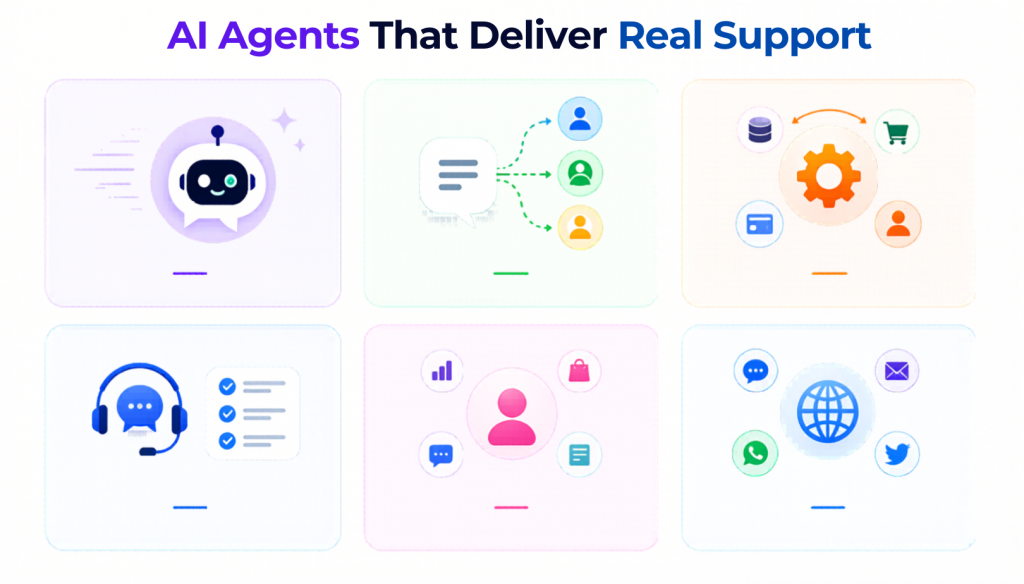
AI agents are now part of the actual support workflow, not just a layer on top of it. Teams are using them to handle both the volume and the complexity of customer interactions, often starting small and expanding as they see results.
Most platforms on this list support several of these use cases. The difference is in how well they execute them, especially when it comes to taking action rather than just responding.
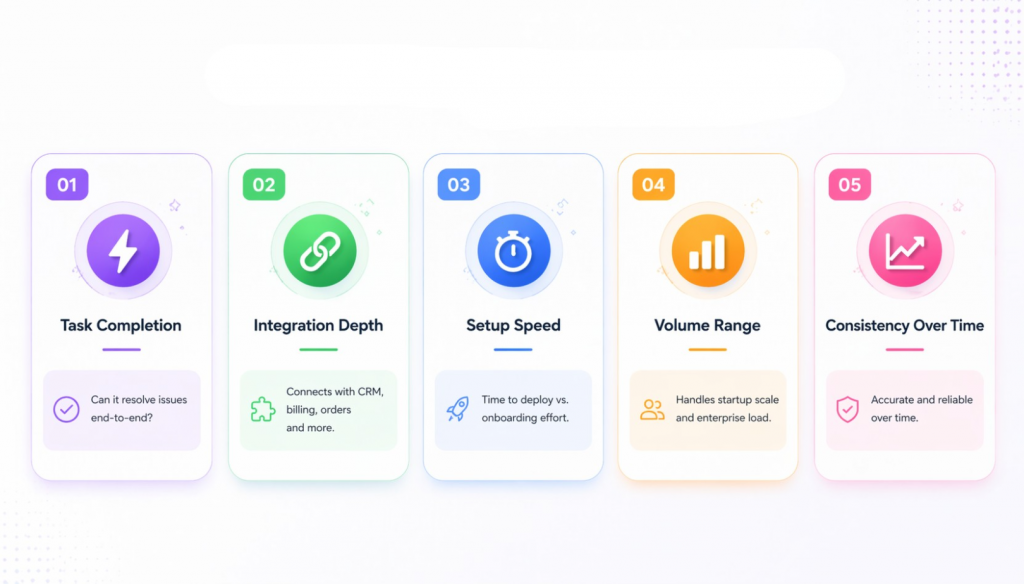
There are dozens of AI tools that look impressive in a demo. Far fewer hold up when you plug them into a real support environment. The selection here is based on how these platforms perform when they are actually handling customer requests.
The first filter was simple. Can the AI agent resolve issues on its own, or does it stop at suggesting replies? Platforms that could take action across systems ranked higher than those limited to conversation.
Support does not happen in isolation. The tools needed to connect with CRMs, billing systems, order management, and helpdesks. Without that, even a good AI model becomes limited.
Some platforms can be deployed in a few hours with existing content. Others require structured data, engineering support, and longer onboarding cycles. Both have value, but they serve very different teams.
The list includes tools that work for startups handling a few hundred tickets and platforms built for enterprises managing thousands daily. The goal was to cover real scenarios, not just ideal ones.
Initial performance matters, but what matters more is how the system behaves after weeks of usage. Tools that improve with data, maintain accuracy, and adapt to new scenarios stood out.
Pricing, branding, and feature lists were considered, but they were not the deciding factors. The focus was on how well each platform handles real customer support work once it is live.
| Rank | Platform | Best For | Quick Take |
|---|---|---|---|
| 1 | YourGPT | AI-first support, sales, and operations automation | Best for teams that want no-code AI agents, omnichannel support, and the ability to handle real tasks across chat, email, and voice. |
| 2 | Intercom | Conversation-first customer support and engagement | Strong choice for SaaS teams that want live chat, AI-assisted support, and proactive messaging in a single platform. |
| 3 | Ada CX | Enterprise AI automation | Good fit for large teams that want to automate high-volume support with structured workflows and escalation control. |
| 4 | Decagon | Autonomous support workflows | Built for enterprises that want AI agents to execute full workflows, not just respond to queries. |
| 5 | Fini | High-volume B2C autonomous support | Autonomous AI support that resolves voice, chat, and email issues with real actions like refunds and cancellations. |
| 6 | Kore.ai | Custom enterprise AI systems | Ideal for organizations that need deep customization, compliance, and integration with enterprise systems. |
| 7 | Forethought | Ticket automation and AI assistance | Works well for teams focused on reducing ticket volume and improving agent productivity. |
| 8 | Gorgias | Ecommerce support | Best for Shopify and ecommerce brands handling orders, refunds, and customer queries with store integration. |
Ranked and reviewed based on real-world resolution quality, setup experience, integration depth, and total cost of ownership.
Best for: no-code AI-powered customer support and automation across chat, email, and voice for businesses of all sizes.
YourGPT is a no code platform built that help businesses build ai agents customer support, sales, and operations. While many tools focus only on answering questions, YourGPT goes further by allowing AI agents to complete real tasks, reducing manual effort and improving response times.
The platform works across websites, WhatsApp, Slack, Messenger, Instagram, LINE, email, and voice, bringing all interactions into one unified system. This makes it easier for teams to manage conversations, automate workflows, and maintain full context across channels without switching tools.
What makes YourGPT different is its no-code approach combined with action-based automation. Teams can build and deploy AI agents using existing documents, FAQs, or website content, without relying on developers. It also includes built-in voice capabilities through PhoneAI, allowing businesses to handle both inbound and outbound calls using AI in over 100 languages.
Another strong advantage is the multi-model playground. Teams can test models like Claude and GPT side by side before deploying, helping improve accuracy based on real use cases instead of guesswork.
Overall, YourGPT is a good choice if you want an AI agent that does more than just answer questions. It helps automate real workflows and scale support operations without increasing team size.
But if your use case is limited to simple ticket handling or email-only support, a more basic helpdesk tool might be enough.
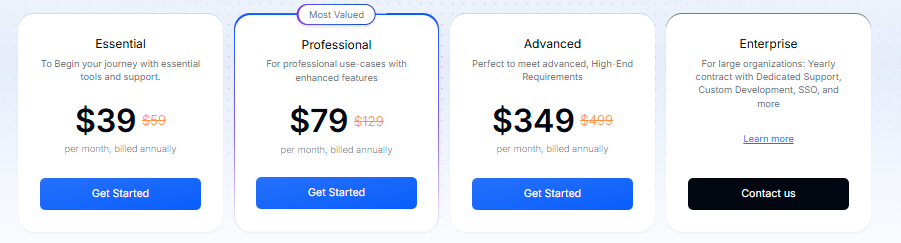
YourGPT offers structured monthly plans based on usage and features:

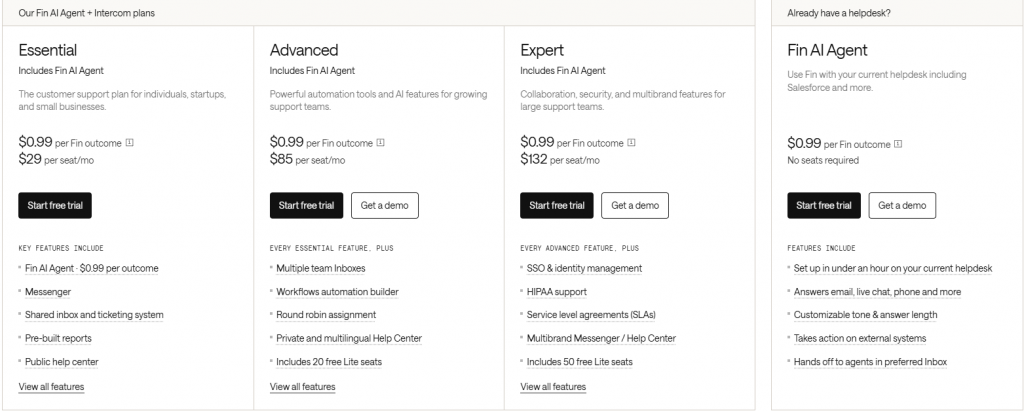
Best for: conversation-first customer support with AI automation and in-app messaging for SaaS and product-focused teams.
Intercom is a customer messaging platform designed to help businesses manage in-app and website conversations while combining AI automation with human support. Unlike traditional helpdesks, it focuses on conversations rather than tickets, making it a strong fit for product-led teams.
The platform works across websites and apps, allowing teams to manage customer interactions through a unified inbox. This helps maintain context across touchpoints and ensures consistent responses across support and sales conversations.
What makes Intercom different is its conversation-first approach. Instead of relying on ticket queues, it organizes support around ongoing user interactions. Its AI assistant, Fin, uses help center content to answer customer queries and routes more complex issues to human agents when needed.
Intercom also includes tools for proactive engagement. Teams can send targeted messages, guide users through onboarding flows, and create product tours to improve user activation and retention.

Best for: Large enterprises that need high automation rates across multiple channels with strong control over workflows.
Ada CX is an AI customer service platform designed for enterprises that need to automate high volumes of support interactions while maintaining consistent and personalized experiences. Unlike traditional support tools, it focuses on resolving queries through intelligent automation rather than just assisting agents.
The platform works across chat, email, mobile, and voice, allowing teams to manage customer interactions within a unified system. This helps maintain context across channels and ensures that responses remain accurate and aligned with business workflows.
What makes Ada CX different is its AI Reasoning Engine. Instead of simply answering questions, it evaluates each request and decides whether to respond, take action, or escalate to a human agent. This allows it to manage more complex workflows compared to basic chatbots.
Ada CX is built for scale, making it suitable for organizations that handle thousands of conversations daily. It also supports enterprise-grade security, compliance requirements, and deep integrations with existing business systems.

Best for: Large enterprises that want AI agents to fully automate customer support operations across systems.
Decagon is an enterprise AI support platform built to automate customer conversations across chat, email, voice, and SMS. It is designed for businesses that want to move beyond basic chatbots and deploy AI agents that can handle support workflows end to end.
The platform works across multiple communication channels, allowing teams to manage conversations and automate processes within a unified system. This helps reduce manual effort while maintaining full context across interactions and touchpoints.
What makes Decagon different is its Agent Operating Procedures (AOPs). Instead of writing code, teams can define workflows in natural language. This combines flexibility with structured logic, allowing AI agents to not only respond to queries but also execute tasks across connected systems.
Decagon focuses on action-based automation rather than just answering questions. It integrates directly with backend systems like CRM, billing, and support tools, enabling AI agents to resolve issues instead of simply guiding users.
Best for: High-volume B2C teams in regulated industries that want autonomous support resolution across voice, chat, and email.
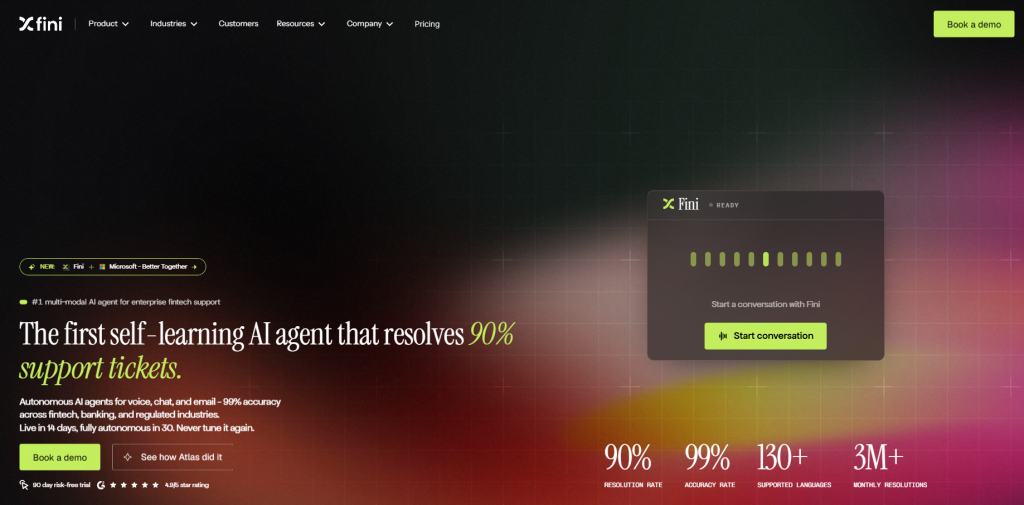
Fini is an autonomous AI customer support agent built to resolve customer conversations across voice, chat, and email. It is designed for high-volume B2C businesses that want to move beyond basic chatbots or agent-assist tools and deploy AI agents that can handle support workflows end to end.
The platform works across support channels on a single reasoning layer, helping teams manage interactions while keeping context intact. Instead of just answering questions or routing tickets, it completes tasks like refunds, cancellations, verifications, subscription updates, and account changes.
What makes Fini different is its retrieval-free architecture. Instead of relying on RAG pipelines or embeddings, Fini is built to maintain 99% accuracy with guardrails, audit trails, and traceability back to approved sources. This makes it especially useful for regulated industries where incorrect support answers can create risk.
Fini focuses on autonomous resolution rather than simple ticket deflection. It connects with existing help desks and backend systems such as Zendesk, Intercom, Salesforce, billing tools, and account systems, enabling AI agents to take real actions while escalating to humans with full context only when needed.

Best for: Enterprises that need a highly customizable AI platform with strong integrations, compliance support, and control over complex workflows.
Kore.ai is an enterprise conversational AI platform built to create AI agents across customer service, HR, and business operations. It is designed for organizations that need more than basic automation and require deep customization across multiple use cases.
The platform supports chat, voice, and IVR automation across various channels, allowing teams to manage interactions and workflows within a unified system. This helps businesses automate processes while maintaining full control over complex operations.
What makes Kore.ai different is its wide range of capabilities. It provides pre-built industry solutions along with strong integrations into enterprise systems such as CRM and ERP platforms. This allows organizations to deploy AI agents tailored to specific industries and workflows.
Kore.ai is also designed for enterprise environments, supporting both cloud and on-premise deployment. This makes it suitable for regulated industries that require strict data control, security, and compliance.

Best for: Companies that want to automate ticket resolution and improve support efficiency using AI agents.
Forethought is an AI-powered customer support platform designed to automate ticket resolution using agentic AI. It is built for teams that want to reduce response times and improve support efficiency by handling workflows end to end.
The platform works across chat, email, and other support channels, allowing teams to manage conversations and automate ticket handling within a unified system. This helps maintain context across interactions and reduces the need for manual intervention.
What makes Forethought different is its multi-agent system. Instead of relying on a single model, multiple AI agents work together to classify, resolve, and assist with support queries. These agents are trained on historical tickets and help center data, allowing them to deliver accurate and context-aware responses.
Forethought focuses on both answering questions and taking action. It uses business rules and past data to automate tasks, making it suitable for teams that want to move beyond basic chatbot automation.

Best for: E-commerce businesses that want a simple, AI-powered helpdesk with strong Shopify integration.
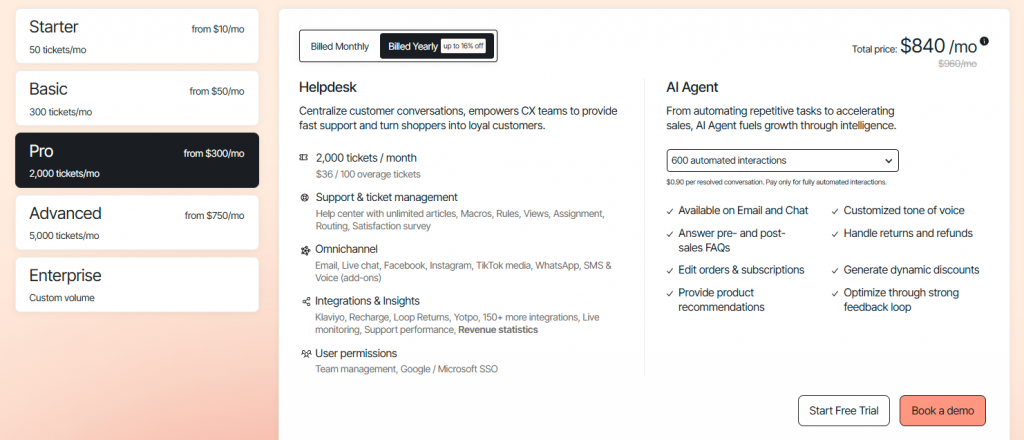
Gorgias is a customer support platform built specifically for e-commerce businesses, especially those using Shopify. It is designed to help teams manage customer queries related to orders, shipping, and returns with a mix of helpdesk tools and AI automation.
The platform works across email, chat, and social channels, allowing teams to manage conversations within a unified inbox. This helps maintain context across customer interactions while reducing the need to switch between tools.
What makes Gorgias different is its deep e-commerce integration. Support teams can view and manage order data directly within the helpdesk, enabling faster and more accurate responses. Its AI automation can handle common queries such as order status and returns using store data.
Gorgias focuses on practical use cases and quick deployment. It is built for e-commerce workflows rather than complex enterprise-level automation.
| Platform | Best For | Automation Level | Channels | Setup | Key Strength | Rating |
|---|---|---|---|---|---|---|
| YourGPT | AI-first automation across support, sales, ops | Very High (actions + workflows) | Web, WhatsApp, Email, Voice, Social | No-code | Executes real tasks, not just replies | 4.7/5 |
| Intercom | SaaS support and engagement | High (AI + human workflows) | Web, App, Email | Moderate | Conversation-first support | 4.5/5 |
| Ada CX | Enterprise automation | Very High (AI reasoning) | Chat, Email, Voice | Technical | Decision-based automation | 4.6/5 |
| Decagon | Full workflow automation | Very High (end-to-end agents) | Chat, Email, Voice, SMS | Technical | Automates full workflows | 4.9/5 |
| Fini | High-volume B2C autonomous support | Very High (autonomous resolution + real actions) | Voice, Chat, Email | Guided, live in 14 days | Resolves issues with real actions | 4.9/5 |
| Kore.ai | Enterprise customization | Very High (custom AI systems) | Chat, Voice, IVR | Advanced | Deep integrations + compliance | 4.6/5 |
| Forethought | Ticket automation | High (multi-agent system) | Chat, Email | Moderate | Reduces ticket workload | 4.3/5 |
| Gorgias | E-commerce support | Moderate (store-based automation) | Email, Chat, Social | Easy | Shopify integration | 4.6/5 |
Most teams do not fail because they pick a bad tool. They fail because the tool does not match how their support actually works.
Here is how to choose based on real conditions, not feature lists.
Before comparing tools, review your last 200 to 500 support conversations.
Look for patterns:
If your workload is mostly repetitive, most AI tools will help.
If your team spends time switching between tools and completing actions, you need an AI agent that can perform tasks, not just respond.
Platforms such as YourGPT, Decagon, and Ada are built for this.
Do not select tools based on supported channels. Select them based on real usage.
Check your data:
Choose based on actual behavior, not assumptions.
YourGPT works across chat, messaging, email, and voice.
Intercom works well for in-product conversations.
Gorgias fits e-commerce workflows tied to store data.
Many tools perform well in demos because they answer questions clearly.
The difference appears in real use:
Check if the platform can:
If not, your team still handles the work.
Platforms such as YourGPT, Decagon, and Zendesk AI focus on resolving requests.
AI tools require ongoing updates and improvements.
Ask:
If not, avoid tools that require heavy setup.
Choose based on what your team can maintain consistently.
Many platforms list large numbers of integrations. That does not guarantee usefulness.
Focus on:
If the AI cannot act on your systems, it becomes an extra layer instead of part of your workflow.
Some tools solve immediate problems. Others improve long-term operations.
If your goal is:
Your decision should reflect where your support is going.
If your team is repeatedly answering the same questions or struggling with high ticket volume during peak hours, it’s a strong signal that an AI agent can help reduce workload and improve efficiency.
Advanced AI agents can go beyond answering questions. They can perform actions like updating orders, processing refunds, and retrieving data, significantly reducing manual work.
No, many platforms are designed for non-technical users and allow training using existing content like documentation or websites. However, more advanced setups may require technical support.
Basic functionality like handling FAQs can work quickly. However, the system becomes significantly more effective after ongoing improvements and learning from real interactions.
A well-designed system will seamlessly transfer the conversation to a human agent with full context, ensuring a smooth customer experience without repetition.
No, modern platforms support omnichannel communication, allowing a single AI agent to handle conversations across WhatsApp, email, and website chat seamlessly.
AI systems require ongoing updates, including refining responses, updating content, and reviewing conversations to ensure continuous improvement and accuracy.
No, smaller teams often benefit even more because AI helps them handle higher volumes without needing to scale their team immediately.
If poorly implemented, yes. But with proper training and smooth handoffs, customers usually just experience faster and more efficient support.
Many teams focus too much on features instead of ensuring the platform integrates well with their workflow and systems, which can limit real-world effectiveness.
The AI customer support space in 2026 is mature, competitive, and genuinely useful. Every platform on this list solves real problems and delivers measurable results when deployed thoughtfully. The key is choosing the tool that fits your actual situation today, not the one with the longest feature list or the biggest marketing budget. A well-configured Tidio Lyro for a ten-person ecommerce team will outperform a poorly trained enterprise platform every time.
If you want a single recommendation that works across the widest range of business sizes and use cases, YourGPT is the strongest choice in 2026. It removes the two biggest blockers most teams face when adopting AI support: the need for technical resources to set it up, and the limitation of a single channel or model. The no-code builder, voice agents, omnichannel deployment, 100+ language support, and native integrations with Zendesk, Freshdesk, and Intercom give you a complete support infrastructure without an engineering team.
The companies that win on customer experience in 2026 are not the ones who bought the most sophisticated tool on day one. They are the ones who deployed carefully, trained their agents on real data, measured what mattered, and kept improving. Whichever platform you choose from this list, those habits will make more difference than the technology itself. Start with your five most frequent support scenarios, pick the tool that handles them cleanly, and build from there. Your customers will notice the difference within weeks.

Compare six Yuma alternatives by ecommerce capabilities, helpdesk compatibility, pricing and human handoffs to choose a replacement for your support team.


Move from Gorgias with a verified ticket archive, tested AI workflows, human handoff and a channel cutover plan before ending your subscription.

TL;DR The Gorgias AI Agent is the automation layer inside the Gorgias helpdesk, split between a Shopping Assistant for pre-purchase conversations and a Support Agent for post-purchase support. A connected Shopify store is required, and Gorgias documentation rules out platforms such as BigCommerce, Magento, and WooCommerce for the AI Agent. Billing runs on two separate […]

TL;DR Gorgias is the closest Richpanel alternative for Shopify stores that need native order actions directly inside support tickets. YourGPT fits stores that want one AI agent handling requests across web, WhatsApp, Instagram, and email, while Tidio and Re:amaze suit smaller teams looking for lighter, lower-cost options. Richpanel’s AI pricing starts around $500/month for two […]

TL;DR Shopify Inbox is a good free option for stores that only need basic storefront chat and simple customer conversations. Stores usually look for alternatives when they need multichannel support, stronger team workflows, or automated order actions. YourGPT is strongest for cross-channel AI automation, Gorgias for Shopify-native order workflows, and Tidio for smaller stores that […]
TL;DR Tidio recently restructured its top paid plan, and many 2026 reviews still describe the old pricing model. Confirm current pricing directly on Tidio’s site before budgeting. Lyro, Tidio’s AI agent, runs on Anthropic’s Claude rather than ChatGPT. Only the Premium tier carries a guaranteed resolution rate, well below the average Tidio advertises elsewhere. Billing […]