10 Chatbase Alternatives Compared: Which AI Support Platform Is Best?

Mitali
Last updated on July 2, 2026
Chatbase is a good option for basic FAQ-style bots, but many teams outgrow it when they need stronger automation and support workflows.
The best Chatbase alternatives offer live chat handoff, multi-channel support, task execution, better integrations, and more predictable scaling.
This guide compares 10 Chatbase alternatives built for modern customer conversations and growing support operations.
Chatbase is an AI chatbot platform that helps teams answer customer questions using website content, help docs, and uploaded files. But customer support has changed. Buyers now expect fast, accurate responses across every channel, while support teams need AI that does more than answer FAQs. They want automation that reduces repetitive work, improves response quality, and scales without adding manual setup.
That is where many teams start looking for Chatbase alternatives. As support volume grows, businesses may feel limited by Chatbase’s automation depth, workflow flexibility, channel coverage, or usage-based pricing. Modern teams often need AI that can collect customer details, route issues, trigger updates in connected systems, hand off to human agents, and support conversations across live chat, WhatsApp, social platforms, and more.
This blog covers ten Chatbase alternatives that give teams more flexibility. Each one takes a different approach, whether you want stronger automation, broader channel support, or easier control over complex support workflows. The goal is to help you find a platform that fits how your team works today and continues to scale as your business grows.
If you’re thinking about switching, this comparison will help you choose with confidence.
Chatbase works well for simple customer support needs. It is quick to set up and can answer basic, repetitive questions using website content, documents, and help center material. This makes it a practical option for solo founders, startups, and small teams that need a simple AI chatbot.
However, as support volume and customer expectations grow, some limitations become more noticeable. Teams handling complex workflows, multiple channels, human handoffs, and higher conversation volumes may need more control than Chatbase provides out of the box.
Chatbase supports basic AI actions and predefined responses, but it does not offer the same level of visual workflow control as more advanced support automation platforms.
This can make it harder to manage multi-step processes such as collecting customer details, verifying information, checking order status, routing issues, and triggering follow-up actions. As workflows become more complex, teams may need external automation tools to fill the gaps.
Like many AI chatbot tools, Chatbase can sometimes provide inconsistent or inaccurate answers, especially when the knowledge base is incomplete, outdated, or unclear.
The chatbot may answer correctly in one conversation but respond differently later, repeat information, or introduce details that were not present in the source content. For customer support teams, this can create reliability issues when accuracy is important.
Chatbase supports human handoff, but teams that need a full live chat inbox, advanced agent collaboration, ticket management, SLA tracking, or detailed support workflows may still need to connect it with another helpdesk or live chat platform.
This can add extra setup and make the support process less smooth, especially when agents need to manage ongoing customer conversations across multiple tools.
Chatbase allows teams to train the chatbot and provide instructions, but it can feel limited for businesses that need advanced behavior control.
There is less flexibility for complex branching, intent-based routing, conditional logic, custom escalation rules, or different flows for different customer types. This makes it harder to design a support experience that adapts to every scenario.
Chatbase uses message credits and plan-based limits, which can become a concern as customer conversations increase.
For small teams, the pricing may feel simple at first. But as usage grows, businesses may need higher plans or add-ons to support more messages, AI actions, team members, and training capacity. This can make costs harder to forecast for teams with seasonal spikes or fast-growing support volume.
Chatbase depends heavily on the quality and size of the content it is trained on. If your website, help docs, or uploaded files are outdated, incomplete, or spread across too many tools, the chatbot may struggle to give accurate answers.
Teams with large knowledge bases, frequent product updates, or complex internal documentation may need more control over source syncing, content organization, and answer governance to keep responses reliable over time.
| Platform name | Best for |
|---|---|
| YourGPT | AI agents that resolve support tasks end to end across web, WhatsApp, and messaging with workflow control |
| Intercom | Customer messaging with AI assistance and a unified inbox for chat, email, and in-app conversations |
| Zendesk | Scalable ticket-based support with omnichannel intake, routing, and reporting for structured teams |
| Botsify | Quick bot setup for websites and messaging apps with basic automation and human takeover options |
| Gorgias | Ecommerce support with order context and Shopify-first workflows inside a shared inbox |
| Hiver | Gmail-based helpdesk for teams that want email-first support with simple automation and SLAs |
| Kore.ai | Enterprise conversational AI for complex automation, security needs, and large-scale deployments |
| Help Scout | Simple, human-style customer support with shared inbox, knowledge base, and lightweight workflows |
| Kommunicate | Chat-based support with bot plus agent collaboration for websites and in-app customer service |
| Freshchat | Omnichannel messaging support with chat automation and agent productivity tools for growing teams |
These tools do more than answer questions. They handle tasks, manage multiple channels, and give better control for support operations. Here’s a list of the top alternative tools:
YourGPT is an AI-first platform for building and deploying autonomous AI agents across customer support, sales, and operations. Instead of only answering questions, YourGPT agents take real actions inside conversations triggering workflows, updating systems, and resolving issues before a ticket is ever created.
It combines a no-code builder for fast setup with an advanced AI Studio for multi-step logic, giving teams full control over how agents behave, escalate, and execute tasks in real time.
Intercom is a customer messaging and support platform that helps businesses manage all customer interactions in one place. It provides a single workspace for real-time conversations across channels. Teams can handle routine queries efficiently and hand off more complex issues to human agents seamlessly.
Zendesk is a customer service platform designed to help businesses manage all customer interactions efficiently. It centralizes support requests from multiple channels into a single system, allowing teams to track, organize, and resolve issues effectively. The platform provides a structured way to maintain service quality and ensure consistent responses to customers.
Botsify enables businesses and agencies to set up automated chat experiences without needing any coding. It helps teams create conversational agents and chatbots for tasks like customer engagement, lead capture, and handling routine queries. The platform supports deployment across websites, social media, and messaging apps, making it easier to reach users wherever they interact.
Gorgias is a support helpdesk focused on unifying customer conversations from multiple channels into one place. It centralizes messages from email, live chat, SMS, social platforms, and more so support teams can view and manage all interactions together. The system also connects with store and customer data, such as order details, helping agents resolve issues with full context.
Hiver is a helpdesk and support solution that brings customer communication into a shared workspace, helping teams manage, assign, and resolve conversations efficiently. It centralizes messages from email, chat, and other channels so support work can be tracked and coordinated in one place. The platform also connects with customer data to give agents context while handling support requests.
Kore.ai is an enterprise platform that enables organizations to deploy and manage conversational agents across chat and voice channels. It centralizes multiple agents in a single workspace and provides governance, monitoring, and integration tools to ensure secure and compliant operations. The platform supports customization to meet business needs, from simple deployments to complex enterprise workflows.
Help Scout provides a unified platform for managing customer conversations across multiple channels. Email, live chat, in-app messaging, and knowledge base content are all brought together, giving teams a clear view of every interaction. The platform is designed to suit support teams of any size. By streamlining routine tasks, it helps maintain personal, high-quality engagement with customers.
Kommunicate is an AI‑powered customer support platform that combines AI automation with human oversight. It helps teams manage conversations more efficiently and reduces repetitive tasks. The platform ensures smooth handoffs to live agents and allows businesses to maintain full control over their support workflows. It is quick to set up and works across multiple channels.
Freshchat is a conversational customer messaging and engagement platform from Freshworks. It helps businesses communicate with their customers in real time across websites, mobile apps, and social messaging channels. All conversations are centralized in one place, making it easier for teams to manage interactions efficiently. The platform supports both human agents and automated messaging, and is designed to scale for businesses of different sizes.
Selecting the right support tool starts with understanding how your team works today and how you expect customer volume and complexity to grow. The right platform should reduce manual effort, connect systems smoothly, and help resolve issues faster without creating new friction.
Before comparing tools, identify the outcomes that matter most to your business. This might include faster resolution times, fewer repetitive tickets, higher self-service rates, or improved customer satisfaction. Clear goals help you measure real impact instead of relying on feature lists.
Some platforms are built for quick setup with minimal configuration, while others require technical resources to manage advanced workflows. If your team prefers simplicity, choose a solution with no-code builders and guided setup. If you have technical support available, more customizable platforms may offer deeper control.
Look at where your customers actually reach out website chat, WhatsApp, email, social media, or voice. A strong platform should support your main channels without forcing you to juggle multiple tools or lose conversation context.
Basic bots handle FAQs. Stronger platforms automate multi-step processes such as collecting details, updating systems, routing requests, and triggering follow-ups. Prioritize tools that reduce real workload, not just reply faster.
Your support tool should connect easily with your helpdesk, CRM, ecommerce system, and internal tools. Smooth integration keeps workflows efficient and avoids manual copy-pasting or switching between platforms.
Good analytics show where automation succeeds, where customers struggle, and which issues repeat most often. These insights help improve processes and allocate team resources more effectively.
Choose a platform that handles increasing volume, new channels, and more complex workflows over time. The best tools reduce operational strain as your business scales instead of forcing another migration later.
YourGPT, Intercom, Freshchat, and Kommunicate let you create custom AI chatbots suited to your business needs. These chatbots can be trained on your own company data. You can shape the bot’s behavior, determine what information it can access, and define how it communicates with customers across different situations.
YourGPT, Intercom, and Freshchat include built-in live chat as a core part of their support experience, allowing teams to combine AI assistance with real-time human conversations. Gorgias also provides live chat, but it is mainly designed for e-commerce teams and works best when tied to order and customer data.
YourGPT, Botsify, and Kommunicate offer no-code builders. They provide drag-and-drop interfaces, templates, and pre-built workflows, allowing teams to create and manage chatbots quickly without technical expertise.
Consider features and performance, integration with existing systems, ease of use, workflow flexibility, analytics, and reliability. The platform should scale with ticket volume and maintain consistent service quality across all interactions.
Accuracy relies on clear workflows, organized knowledge, and training the chatbot on your own data. YourGPT, Intercom, Freshchat, and Kommunicate allow teams to do this. Confidence checks, topic limits, and references reduce mistakes. Regular updates and retraining keep responses relevant and reliable.
They use the same knowledge and rules across all channels. YourGPT, Intercom, Freshchat, and Kommunicate let teams reuse the same content for chat, email, and messaging apps, preventing inconsistencies.
No. Different teams have different needs, so there is no single platform that fits everyone perfectly. Advanced tools like YourGPT and Intercom combine AI with human support to help teams scale. YourGPT stands out for its stronger AI capabilities and higher ROI.
Yes. YourGPT, Intercom, Freshchat, and Kommunicate can answer routine questions automatically. When a conversation requires more context or judgment, a human can take over, ensuring both quick resolution and proper handling of complex issues.
Choosing a Chatbase alternative comes down to how well a platform handles real support work as volume grows. Basic bots can answer questions, but modern teams need automation that connects systems, manages workflows, and keeps conversations consistent across channels.
Platforms such as YourGPT, Intercom, Zendesk, and Freshchat are built for this next stage of customer support. They reduce manual effort, route complex cases with full context, and help teams resolve issues faster without increasing headcount.
Before switching, look at where your team spends the most time and which processes repeat daily. The right solution should automate routine work today while giving you the flexibility to scale smoothly as customer expectations rise.
Handle repetitive workflows across support, sales, and operations. Gain actionable insights to track performance and improve efficiency continuously.
Built for teams managing complex customer support workflows
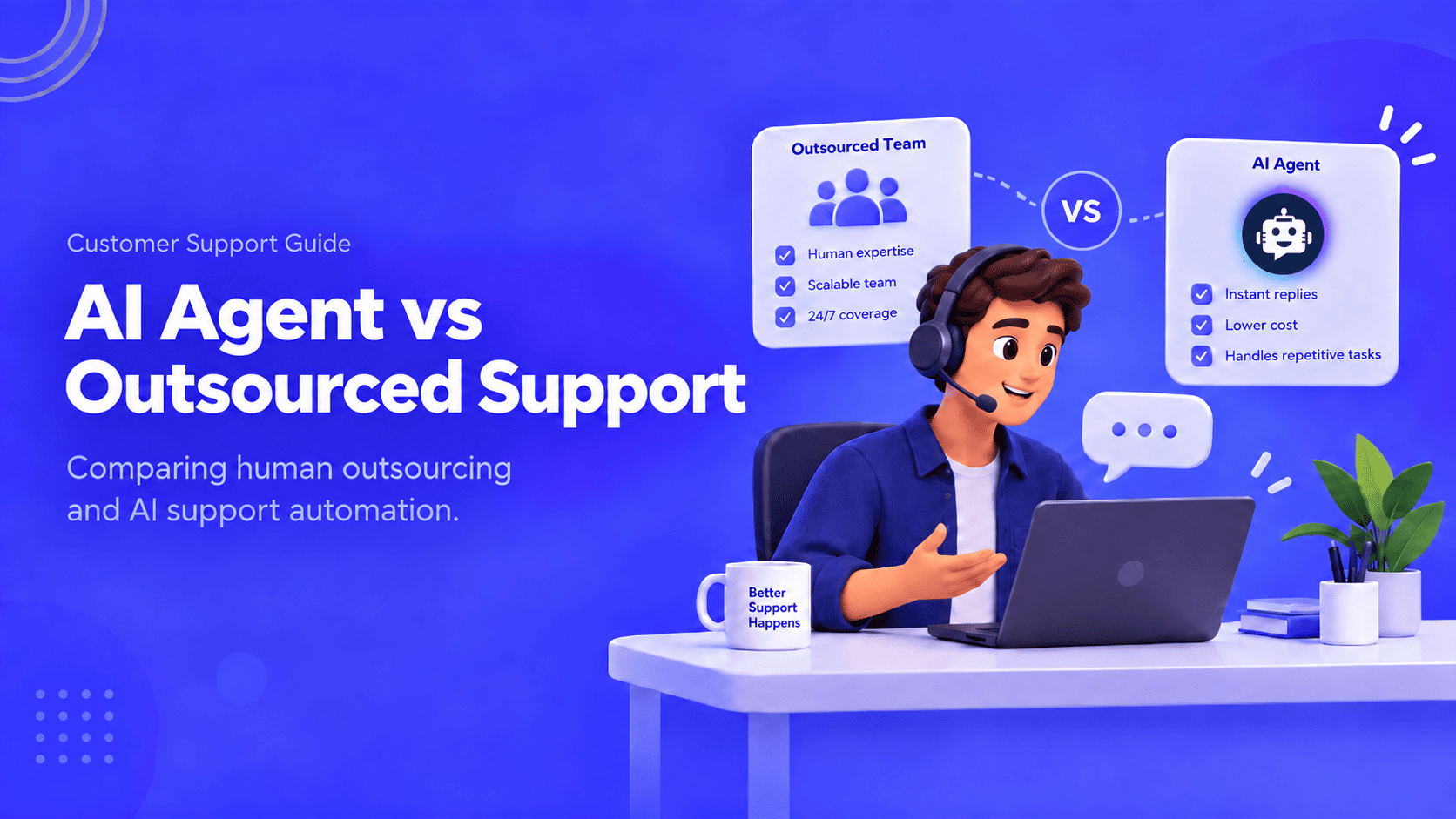
Compare outsourcing customer service with an AI agent using your own ticket mix, a cost model you fill in, and a clear rule for a hybrid split.

Export the Zendesk ticket archive, train an AI Agent on the help center, and test one real ticket before you stop the old queue.

Compare six Yuma alternatives by ecommerce capabilities, helpdesk compatibility, pricing and human handoffs to choose a replacement for your support team.


Move from Gorgias with a verified ticket archive, tested AI workflows, human handoff and a channel cutover plan before ending your subscription.
TL;DR The Gorgias AI Agent is the automation layer inside the Gorgias helpdesk, split between a Shopping Assistant for pre-purchase conversations and a Support Agent for post-purchase support. A connected Shopify store is required, and Gorgias documentation rules out platforms such as BigCommerce, Magento, and WooCommerce for the AI Agent. Billing runs on two separate […]

TL;DR Gorgias is the closest Richpanel alternative for Shopify stores that need native order actions directly inside support tickets. YourGPT fits stores that want one AI agent handling requests across web, WhatsApp, Instagram, and email, while Tidio and Re:amaze suit smaller teams looking for lighter, lower-cost options. Richpanel’s AI pricing starts around $500/month for two […]