Claude Opus 5 vs Fable 5: Which Should You Actually Run for Support? (2026)

Shreya Sharma
August 13, 2026
Claude Opus 5 launched on July 24, 2026, at half the API token price of Fable 5, while matching or outperforming it on several agentic benchmarks.
On AA-Briefcase, Opus 5 scored higher than Fable 5 at high and max effort while costing substantially less per task.
Fable 5 still leads on some coding evaluations and is designed for ambitious, multi-day autonomous work, but it requires 30-day data retention.
For customer-facing bots, Opus 5’s weaker AA-Omniscience results and higher hallucination rate deserve attention. For high-volume support, model tier and cost-efficiency may matter more than choosing the flagship model.
Anthropic’s own documentation makes the starting point clear. Its models overview tells customers to start with Opus 5, and reach for Fable 5 only when a task needs the highest capability available. A vendor rarely says this about its own top-tier model, and it shows how close the two have actually gotten on real work.
Fable 5 launched first, in June, as Anthropic’s most capable public model. Six weeks later, Opus 5 showed up costing half as much and closing most of the gap. Any team that had already built a support workflow around Fable 5 in those six weeks now has an actual decision to make. For a support team weighing the two, that guidance offers a useful starting point, though it doesn’t fully answer the question once real tickets enter the picture.
This piece works through what each model actually is, where each one wins. It also covers the risks that don’t show up in a launch announcement. And it covers which one belongs on a support queue, and where. This piece speaks directly to a support team making that call, keeping the focus on tickets, cost per resolution, and what happens when the model gets something wrong.
Both are current-generation Claude models from Anthropic, released six weeks apart, and both show up on the same pricing page and the same model picker. What separates them is what each one is built to do.
Key takeaway: Opus 5 is built to deliver most of Fable 5’s intelligence at a lower, more sustainable operating cost.
Key takeaway: Fable 5 excels when a task needs extended reasoning and autonomous execution sustained over a long stretch of work.
Anthropic’s own guidance for choosing between them is direct for a vendor talking about its own flagship. Its models overview tells customers to start with Opus 5, and step up to Fable 5 only for the workloads that genuinely need the highest available capability.
Pricing below is verified directly against Anthropic’s live pricing page as of this writing. Re-confirm before publishing anything with a hard number in it, since Anthropic updates this page independently of its launch posts.
| Spec | Claude Fable 5 | Claude Opus 5 | Why It Matters |
|---|---|---|---|
| Model ID | claude-fable-5 | claude-opus-5 | API and routing identifier |
| Input / MTok | $10 | $5 | Opus 5 costs half as much for input tokens |
| Output / MTok | $50 | $25 | Opus 5 also costs half as much for output |
| Batch input / output | $5 / $25 | $2.50 / $12.50 | Same 2:1 price difference |
| 5-min cache write | $12.50 | $6.25 | Lower cost for repeated prompts and knowledge bases |
| Cache read | $1 | $0.50 | Opus 5 remains cheaper on cache hits |
| Context window | 1M tokens | 1M tokens | No difference |
| Max output | 128K tokens | 128K tokens | No difference |
| Data retention | 30 days, mandatory, no ZDR | No retention requirement | Critical for compliance-sensitive teams |
| Fast Mode | Not listed | $10 / $50, ~2.5x speed | Faster Opus 5 mode at Fable 5’s standard rates |
| General availability | June 9, 2026 | July 24, 2026 | Opus 5 is six weeks newer |
The retention and Fast Mode rows are the two worth reading twice. Everything else lines up exactly as expected.
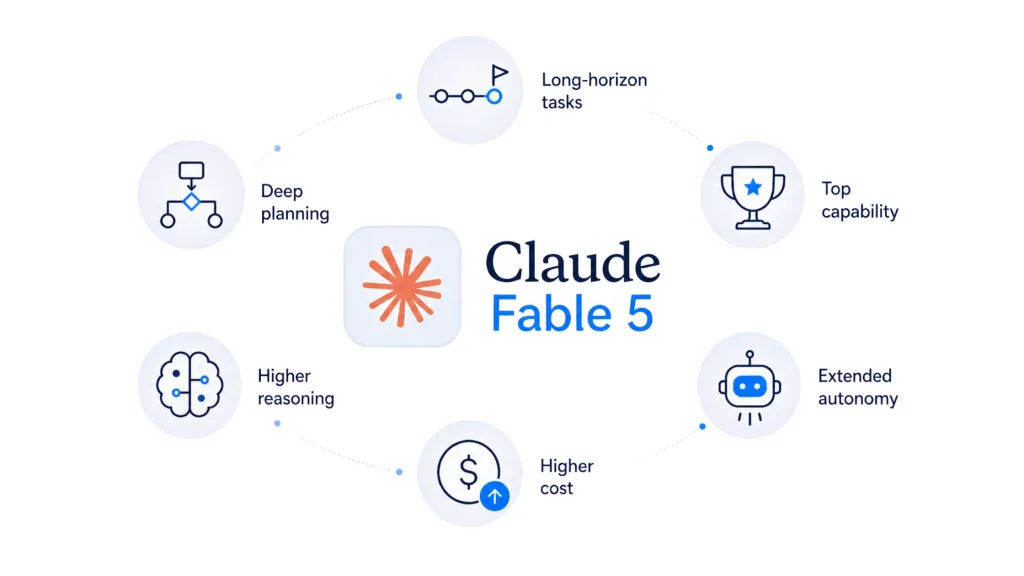
Fable 5’s lead is real but narrow, and it shows up in a specific kind of work, not across the board.
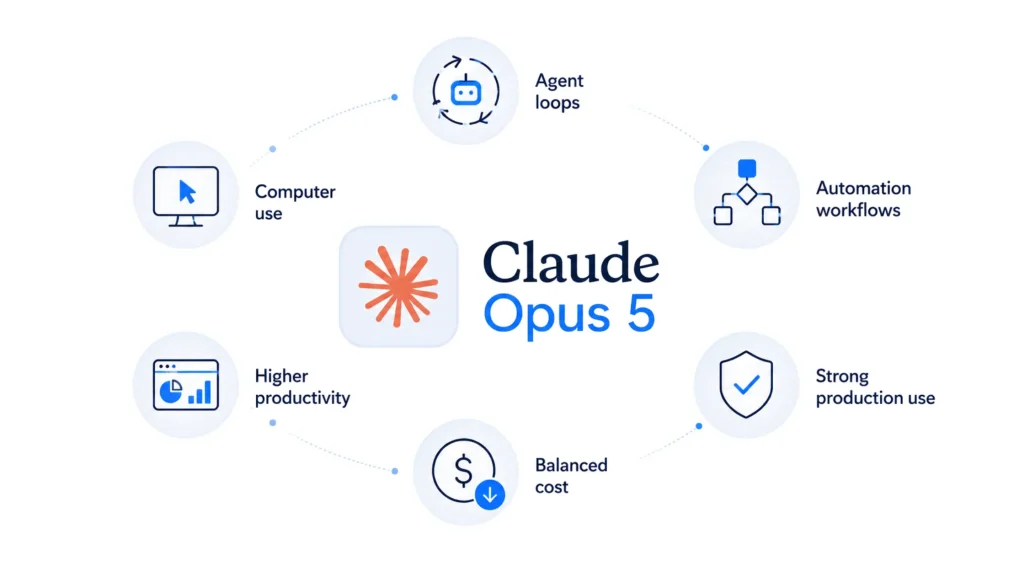
Flip to agentic and computer-use work and the picture reverses, and the gaps stop being decimal dust.
This is the section that matters most for anything customer-facing, more than any benchmark table above it.

Ticket type is one axis. Team size and stage is the other, and it changes how much either flagship’s price tag actually matters.
Recommendation: Opus 5
Recommendation: Mostly Opus 5, with Fable 5 used selectively
Recommendation: A hybrid approach across both models
This mirrors how mature AI support systems already route requests by complexity, the mechanics of which are covered next.
Picking one model for an entire queue is the easy decision. Picking the right model for each ticket is the one that actually controls the bill and the quality bar at the same time.
A basic version of this pattern looks like:
Every comparison in this piece up to this point has been framed as Opus 5 against Fable 5. That is how the decision usually gets presented. In production, it rarely stays a binary choice. A single queue holds order-status questions that need almost no reasoning next to multi-system billing disputes that need all of it, often within the same hour. Committing the whole queue to Fable 5 means paying flagship prices for tickets that never needed flagship reasoning. Committing the whole queue to Opus 5 means the small slice of genuinely hard tickets gets a model built for daily use. The days-long autonomous planning those tickets sometimes need is Fable 5’s job.
Routing solves both problems at once. It sends routine tickets to whichever model handles them at the lowest defensible cost. It reserves the expensive reasoning for the tickets that actually need it. A single best model is a leaderboard answer. A routed queue is a production answer.
The right pick depends on what a wrong answer costs on that specific ticket type.
| Ticket Type | Best Fit | Why |
|---|---|---|
| Complex, multi-system resolution (billing plus CRM plus shipping) | Opus 5 at high effort | On AA-Briefcase, Opus 5 at high effort outscored Fable 5 while costing less than half as much per task |
| Multi-day, highly autonomous workflow with human review at the end | Fable 5 | Anthropic specifically positions Fable 5 for ambitious, long-running asynchronous work and agents that can operate for days |
| Cybersecurity or biology workflows likely to trigger Fable 5 safeguards | Opus 5 | Opus 5’s cybersecurity classifiers are expected to intervene about 85% less often than Fable 5’s, and some biology requests blocked on Fable 5 can route to Opus 5 |
| High-volume, routine tickets: order status, FAQs, tracking | Neither flagship | Both are priced and built for harder work. See the cheap frontier model roundup for models better suited to this volume |
| Anything customer-facing and unsupervised | Neither, on its own | Grounding, retrieval, validation, and confidence-gated handoff can matter more to answer reliability than model tier alone |
| A compliance baseline that requires zero data retention | Opus 5 with a ZDR-enabled API configuration | Fable 5 requires 30-day data retention and is not available under zero data retention |
The short version: default to Opus 5 at high effort for the hard tickets that used to justify Fable 5’s price tag, keep Fable 5 for the narrow slice of genuinely multi-day autonomous work, and keep both flagships off the routine 70 to 80 percent of a queue entirely.

This is where the decision above turns into an actual, running support bot.
Both have a 1M-token context window and a 128,000-token maximum output. Fable 5 costs $10 per million input tokens and $50 per million output tokens, compared with Opus 5 at $5 and $25. Fable 5 retains advantages on some evaluations, while Opus 5 leads on several agentic and computer-use benchmarks. On AA-Briefcase, Opus 5 at high effort scored above Fable 5 while costing less than half as much per task.
Opus 5 costs $5 per million input tokens and $25 per million output tokens. Fable 5 costs exactly double at $10 and $50. Both use the same Batch API and prompt-caching discount structure, so the 2:1 price difference also holds across standard, batch, and prompt-cache pricing.
Neither should be the default for high-volume, routine tickets such as order status or FAQs. For harder tickets involving complex, multi-system resolution, Opus 5 at high effort offers a strong balance of capability and cost. Fable 5 is particularly well suited to genuinely multi-day, highly autonomous workflows where maximum capability matters more than cost.
On Artificial Analysis’s AA-Omniscience benchmark, yes. Opus 5 recorded a 50% hallucination rate and lower factual-knowledge performance than Fable 5. That does not mean Opus 5 will hallucinate more in every application. For customer-facing bots, grounding answers in a controlled knowledge base and routing uncertain responses to a human remains important regardless of the model used.
It can be, but teams should check their retention requirements first. Fable 5 requires 30-day data retention for safety monitoring and is not available under zero data retention. Opus 5 does not have Fable 5’s model-specific 30-day retention requirement and can be used with eligible ZDR configurations.
High effort is a practical starting point for demanding support workflows. On AA-Briefcase, Opus 5 at high effort showed a strong balance between performance and cost. Max effort can improve results further, but it uses more output tokens and costs more per task, so it is better reserved for the smaller share of tickets that genuinely need additional reasoning.
YourGPT lets teams choose between models from OpenAI, Anthropic, Google, and xAI without locking a support bot to a single model provider. The specific Claude models available can change as providers release new models and they are added to the platform, so check the model settings inside Studio for the current list.
Anthropic suspended Fable 5 access on June 12, 2026, following a US export-control directive, and restored access on July 1 after the controls were lifted. A support stack tied to Fable 5 without a fallback model could lose service during a provider-level suspension. On a platform such as YourGPT, where the model can be changed through configuration, workloads can shift to another available model without rebuilding the bot.
Opus 5 changes the calculus behind six weeks of Fable 5 deployments. It closes most of the agentic-benchmark gap at half the price, and on Artificial Analysis’s own benchmark, it beats Fable 5 outright at a fraction of the cost. Fable 5 still leads a short list of coding benchmarks and remains the right tool for genuinely multi-day, autonomous work.
Neither belongs on the routine tickets that make up most of a real queue. That job goes to a cheaper, faster tier. What decides how either flagship performs on its suited tickets hasn’t changed. It’s what the model is grounded in. It’s also what it can do without a human checking first. And it’s how fast a wrong answer gets caught before it reaches a customer.

Compare six Yuma alternatives by ecommerce capabilities, helpdesk compatibility, pricing and human handoffs to choose a replacement for your support team.

Move from Gorgias with a verified ticket archive, tested AI workflows, human handoff and a channel cutover plan before ending your subscription.


TL;DR The Gorgias AI Agent is the automation layer inside the Gorgias helpdesk, split between a Shopping Assistant for pre-purchase conversations and a Support Agent for post-purchase support. A connected Shopify store is required, and Gorgias documentation rules out platforms such as BigCommerce, Magento, and WooCommerce for the AI Agent. Billing runs on two separate […]


TL;DR Gorgias is the closest Richpanel alternative for Shopify stores that need native order actions directly inside support tickets. YourGPT fits stores that want one AI agent handling requests across web, WhatsApp, Instagram, and email, while Tidio and Re:amaze suit smaller teams looking for lighter, lower-cost options. Richpanel’s AI pricing starts around $500/month for two […]

TL;DR Shopify Inbox is a good free option for stores that only need basic storefront chat and simple customer conversations. Stores usually look for alternatives when they need multichannel support, stronger team workflows, or automated order actions. YourGPT is strongest for cross-channel AI automation, Gorgias for Shopify-native order workflows, and Tidio for smaller stores that […]

TL;DR Tidio recently restructured its top paid plan, and many 2026 reviews still describe the old pricing model. Confirm current pricing directly on Tidio’s site before budgeting. Lyro, Tidio’s AI agent, runs on Anthropic’s Claude rather than ChatGPT. Only the Premium tier carries a guaranteed resolution rate, well below the average Tidio advertises elsewhere. Billing […]