Voiceflow Review 2026: Pricing, Pros & Cons

Rajni
Last updated on August 19, 2026
Voiceflow’s official pricing page no longer displays public self-serve plan prices. As of July 2026, it separates pricing into a usage-based Agencies & Partners plan and a Businesses plan that requires contacting sales, replacing the older Starter, Pro, and Business tiers.
Most third-party pricing trackers still reference the previous structure, consistently listing Pro at $60/month and Business at $150/month, with additional editor seats costing $50 each per month.
Voiceflow uses a monthly credit system to power AI agents. When your included credits are exhausted, agents stop responding until you purchase more credits or your monthly allowance resets.
Because public pricing has changed while many comparison sites still show older plans, it’s important to verify current costs and usage limits directly with Voiceflow before making a purchase decision.
Voiceflow shipped its V4 platform in April 2026, separating agent logic into Playbooks for open-ended reasoning and Workflows for deterministic processes. Its model-agnostic stack supports OpenAI, Anthropic, Google, and other providers.
On G2, Voiceflow holds a 4.6/5 rating across 110 reviews. Users frequently praise its ease of use, while credit-billing confusion and gaps in enterprise analytics appear among the common complaints. Voiceflow also lists SOC 2 Type II, ISO/IEC 27001:2022, GDPR, and HIPAA compliance on its security page.
Pricing has changed more noticeably. Voiceflow previously offered three self-serve plans plus enterprise pricing. Today, its pricing page directs visitors either to an agency plan or a business option that requires booking a demo, with no public business pricing shown.
That matters because many 2026 pricing articles still reference the previous $60 and $150 plans. Those figures were once valid and remain useful historical reference points, but they no longer reflect what Voiceflow currently displays.
This review covers what changed, how Voiceflow works after the V4 release, its strengths and limitations, and its pricing situation. It draws on Voiceflow’s documentation, G2 reviews, and third-party pricing trackers rather than a hands-on trial account.
Voiceflow is a visual, no-code platform for designing, building, and deploying conversational AI agents across chat and voice. Teams drag steps onto a canvas, wire up logic, connect a knowledge base, and publish the result to a website widget, a phone line, or both. Founded in 2018 by Braden Ream, Tyler Han, Andrew Lawrence, and Michael Hood, the company started as Storyflow, a tool for building Amazon Alexa skills, before pivoting into the broader conversational AI platform it is now. Voiceflow has raised roughly $39 million across several funding rounds from investors including OpenView Venture Partners, Felicis Ventures, and True Ventures, and it lists customers such as StubHub, JP Morgan Chase, and Trilogy on its site.
The product looked very different a year ago. What used to be a mostly deterministic flow builder, drag a block, connect an arrow, repeat, now runs on a hybrid model the company calls V4.
Status. Live and changed. Voiceflow’s pricing page, reviewed in July 2026, no longer lists numeric self-serve prices for its Business plans. Instead, it separates buyers into two paths: the Agency & Partner track with self-serve, usage-based billing, and the Business track, which now requires a demo request.
What stays the same. Voiceflow still uses its credit-based billing system. Chat messages, phone minutes, and LLM tokens consume credits, with usage rates varying by AI provider and model according to Voiceflow’s official credits documentation.
What’s actually unknown. It’s unclear whether the Starter, Pro, and Enterprise pricing commonly referenced across 2026 comparison sites still reflects current self-serve rates, or whether Voiceflow has shifted toward negotiated pricing for most customers. The live pricing page doesn’t confirm either scenario, and the credit-rate table is generated dynamically, allowing rates to change without a public changelog.
What to do about it. Treat any third-party Voiceflow pricing including the figures mentioned in this review as an estimate until verified. Before setting a budget or comparing platforms, confirm the latest pricing through Voiceflow’s self-serve signup flow or by requesting a demo.
Two different pictures exist side by side right now, and a buyer needs both.
What Voiceflow’s live pricing page shows today
| Track | Access | What’s Listed |
|---|---|---|
| Agencies & Partners | Self-serve signup, free trial, no credit card | Transparent usage-based billing, multi-client workspace management, white-labeling, and access to all major model providers |
| Businesses | Demo required | Implementation support, omnichannel deployment, observability, and team roles and permissions. No public price listed |
What most 2026 third-party trackers still describe (sourced to Featurebase, CheckThat.ai, and Ringly.io, last checked mid-2026, not independently confirmed on Voiceflow’s current live page)
| Plan | Price | Editors | Credits/mo | Notes |
|---|---|---|---|---|
| Starter | Free | 1 | Small one-time grant | Sandbox use only, agents stop at the limit |
| Pro | $60/mo | 1 (+$50/mo each additional) | ~10,000 | GPT-4 and Claude access, up to 20 agents |
| Business | $150/mo | 1 (+$50/mo each additional) | ~30,000, scaling to higher tiers | Unlimited agents, priority support, advanced privacy controls |
| Enterprise | Custom | Custom | Custom | SSO, private cloud, dedicated account manager. Median reported contract around $217,500/year , based on a small sample of verified purchases |
Annual billing reportedly saves 10% on the base subscription, though that discount doesn’t extend to per-seat editor add-ons, which stay at $50 a month regardless of billing cadence, according to the same trackers.
The credit system is the part that trips people up in reviews, and it hasn’t changed in mechanism even as the plan structure around it has. Every chat message, every phone minute, and every LLM call draws down a shared monthly pool. Heavier models draw faster. Once the pool hits zero, agents reportedly stop responding until the next billing cycle, with no manual top-up on self-serve plans per multiple trackers, though this is exactly the kind of detail that’s worth confirming directly given how much else has shifted on the pricing page this year.
Voiceflow agents can touch customer conversation data, connected business systems through API calls and MCP tools, and, on voice deployments, live phone conversations. That makes this section a real evaluation item here, well beyond a checkbox exercise.
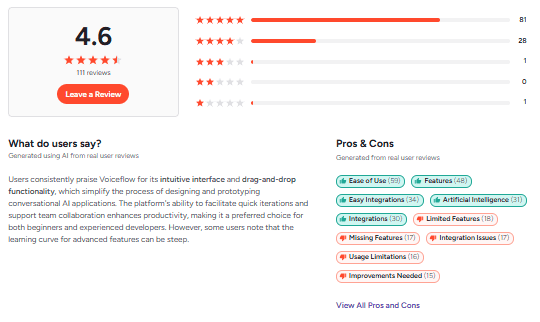
On G2, Voiceflow sits at 4.6 out of 5 across 110 reviews as of late June 2026, a strong score in the bot-platform category and on par with or ahead of most named competitors: Botpress rates 4.5/5 across 412 reviews, Intercom’s Fin rates 4.5/5 across a much larger 3,706, and Kore.AI rates 4.6/5 across 382.
Trustpilot mostly tells a thinner story here, not a contradictory one. Voiceflow’s Trustpilot page shows a sample small enough, around 15 total reviews, that treating any single star figure as representative would overstate its reliability. It’s a pattern worth noting on its own. Trustpilot activity correlates loosely with billing and support friction in this category, and a platform with relatively few Trustpilot reviews next to a solid G2 base suggests fewer customers reaching the level of frustration that drives someone to leave an unprompted complaint, though it isn’t proof either way by itself.
The pattern across G2 reviews is consistent enough to trust directionally. Praise clusters tightly around ease of use, customization, and support responsiveness. Complaints cluster around credit billing clarity and gaps in enterprise-grade analytics and voice tooling, exactly the areas the product roadmap seems to be actively working through given the pace of 2026 releases.
This review draws on Voiceflow’s own pricing, docs, and security pages, G2’s aggregated review data, and cross-checked third-party pricing trackers, not a hands-on trial account. Here’s specifically what informed each judgment:
We did not assign Voiceflow a single weighted score. That would require a live test account running real traffic against the credit system, not published documentation and aggregated reviews.
Voiceflow fits best for teams that want granular, visual control over conversation logic, whether that’s an agency building for many clients or a product team that wants a design-first collaborative canvas. Outside that profile, a few alternatives come up often.
| If Your Priority Is | Choose | Why |
|---|---|---|
| Skipping manual flow design entirely and deploying natively across chat, voice, and social without third-party connectors | YourGPT | AI-native agents trained on your content directly, with native WhatsApp, Instagram, and voice (PhoneAI) in one platform |
| Full code-level control and self-hosting | Botpress | Open-source and developer-focused, at the cost of a steeper setup |
| The fastest possible docs-to-bot path | Chatbase | Minimal configuration, though limited to a single agent per plan and no deterministic flow builder |
| Deep Google Cloud integration | Dialogflow | Tight fit for teams already standardized on Gemini and GCP |
| Granular, visual control over both chat and voice conversation logic | Voiceflow | Best fit for design-first teams and agencies who want to map every branch by hand |
A broader roundup of Voiceflow alternatives and a dedicated guide to AI voice agent platforms are worth reading if voice, more than chat, is the deciding factor. For a general framework on what to check in any platform before committing budget, this buyer’s checklist for support AI agents applies just as well to Voiceflow as to any competitor.
Yes. Voiceflow’s Starter tier is free and includes a small one-time credit grant meant for testing the interface, not production use. Agents on the free tier stop responding once that initial credit allotment is used up.
Voiceflow’s live pricing page no longer publishes self-serve numeric plans for its business track, splitting instead into a usage-based agency track and a demo-gated business track. Most 2026 third-party trackers still describe a Pro plan at $60 a month for one editor and a Business plan at $150 a month, both plus $50 a month per additional editor seat, though these figures should be confirmed directly since they’re no longer visible on Voiceflow’s current site.
According to third-party pricing trackers, agents stop responding entirely once the monthly credit pool is exhausted, with no manual top-up available on self-serve plans. Treat this as a production risk to plan around, since a busy month could take a customer-facing agent offline entirely, not just as a minor billing inconvenience.
It’s capable but not best-in-class on voice specifically. G2 reviews repeatedly flag voice functionality as an area with more gaps than the chat side of the platform, and at least one long-time user prefers a dedicated voice platform for that piece of their stack while keeping Voiceflow for chat.
Voiceflow is a design tool. You manually map conversation paths using flows, decision nodes, and now Playbooks and Workflows. YourGPT is AI-native. It learns from your knowledge base directly and doesn’t require building flows by hand for most use cases. Voiceflow offers more granular manual control for teams that want it. YourGPT prioritizes faster deployment and native omnichannel coverage, including voice through PhoneAI, without stacking separate tools.
Yes, both platforms offer one. Voiceflow’s Starter tier is free indefinitely but credit-limited. YourGPT’s trial runs 7 days with no credit card required.
For a team that wants visual, hands-on control over exactly how a conversation branches, especially an agency managing many client builds from one collaborative workspace, Voiceflow remains one of the stronger options in the category, and the V4 release genuinely closes gaps (MCP support, model flexibility, deterministic-plus-autonomous logic) that used to be real limitations.
The catch in 2026 isn’t the product. It’s the pricing page. Budget against numbers you can confirm directly through signup or a demo, not against the $60 and $150 figures still circulating across last year’s reviews, this one included where it cites them for historical context. Run the credit math against your actual expected volume before committing to an annual plan, and if manual flow design isn’t something your team wants to own, weigh that against an AI-native alternative before signing.

Compare six Yuma alternatives by ecommerce capabilities, helpdesk compatibility, pricing and human handoffs to choose a replacement for your support team.


Move from Gorgias with a verified ticket archive, tested AI workflows, human handoff and a channel cutover plan before ending your subscription.


TL;DR The Gorgias AI Agent is the automation layer inside the Gorgias helpdesk, split between a Shopping Assistant for pre-purchase conversations and a Support Agent for post-purchase support. A connected Shopify store is required, and Gorgias documentation rules out platforms such as BigCommerce, Magento, and WooCommerce for the AI Agent. Billing runs on two separate […]

TL;DR Gorgias is the closest Richpanel alternative for Shopify stores that need native order actions directly inside support tickets. YourGPT fits stores that want one AI agent handling requests across web, WhatsApp, Instagram, and email, while Tidio and Re:amaze suit smaller teams looking for lighter, lower-cost options. Richpanel’s AI pricing starts around $500/month for two […]

TL;DR Shopify Inbox is a good free option for stores that only need basic storefront chat and simple customer conversations. Stores usually look for alternatives when they need multichannel support, stronger team workflows, or automated order actions. YourGPT is strongest for cross-channel AI automation, Gorgias for Shopify-native order workflows, and Tidio for smaller stores that […]
TL;DR Tidio recently restructured its top paid plan, and many 2026 reviews still describe the old pricing model. Confirm current pricing directly on Tidio’s site before budgeting. Lyro, Tidio’s AI agent, runs on Anthropic’s Claude rather than ChatGPT. Only the Premium tier carries a guaranteed resolution rate, well below the average Tidio advertises elsewhere. Billing […]