Ecommerce Customer Service: The AI-Agent Playbook for 2026

Rajni
July 18, 2026
The Shift: Support bots used to answer questions. In 2026, AI agents resolve them by reading live order and carrier data, then taking direct action. They can issue refunds, update addresses, and close WISMO tickets without human involvement.
The Stakes: WISMO and refund requests already account for a large share of a typical support queue. During BFCM, that queue becomes a flood, exactly when delayed responses can cost brands the most.
Key Difference: Most AI agents charge per resolution, so costs rise with ticket volume. YourGPT uses a flat, shared-credit plan instead, which means a record sales month does not automatically produce a record support bill.
The Result: Brands that automate WISMO, returns, and refunds first, then add clear guardrails and human escalation for complex cases, can reduce support costs without compromising refund accuracy or customer satisfaction.
A delayed package should not create a five-message support thread. A refund request should not sit in a queue while an agent checks the same order details and policy again.
Yet many ecommerce support teams still work this way.
Most post-purchase tickets come down to the same questions: Where is my order? How do I return this? When will my refund arrive? Can I exchange or change my order?
Traditional chatbots can share policies and tracking links. AI agents go further by reading live order data, checking eligibility, generating return labels, issuing approved refunds, and escalating unusual cases with full context.
The biggest shift in 2026 is not faster replies. It is moving from answering questions to resolving them.
For ecommerce brands, that means fewer repetitive tickets, faster resolutions, and more time for human agents to handle fraud concerns, damaged orders, and high-value cases. It also gives support teams a better way to manage sudden volume spikes during Black Friday, Cyber Monday, product launches, and shipping disruptions.
This playbook explains which workflows to automate first, what guardrails returns and refunds need, and how to measure whether AI is actually solving customer problems.
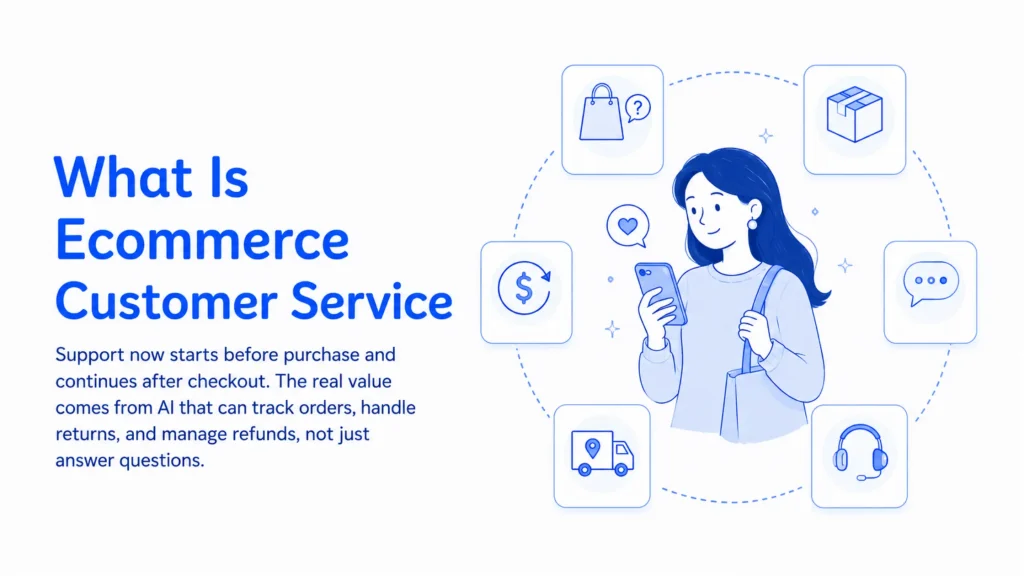
Ecommerce support splits into two halves. Before the purchase, it’s product questions and checkout help. After the purchase, it’s tracking, returns, refunds, and exchanges, and that second half is where most of the ticket volume and most of the cost sits.
The line that matters in 2026 isn’t chatbot versus human. It’s answering a question versus solving the problem. A chatbot can tell a shopper they have 30 days to return something. An agent checks the purchase date, confirms the item qualifies, generates a return label, and states the exact refund date, all without the shopper repeating themselves to a second person.
The gap between marketing claims and reality is wide enough to plan around. Gorgias advertises that it can automate 60% of email and chat conversations. Independent reviews of real deployments put the actual range closer to 26–56%, depending heavily on how much of a store’s ticket volume needs a direct action (a refund, an address change) versus a plain answer. That gap isn’t unique to Gorgias. Publicly reported automation and deflection numbers across the AI-support category tend to run well above independently measured, enterprise-wide medians, which is a pattern worth checking for in any vendor’s pitch, ours included.
The two terms get used interchangeably, and that’s a mistake worth correcting before building anything.
Multichannel means a shopper can reach a store through several channels: email, chat, WhatsApp, Instagram. Omnichannel means the conversation itself, and the context behind it, moves with the shopper across those channels.
Picture a shopper who opens a live chat about a delayed order, gets no resolution, and emails the next day. In a multichannel setup, they explain the whole thing again from scratch. In an omnichannel setup, the agent already has the order details, the chat transcript, and the prior resolution attempt before typing a reply. That difference is exactly what a WhatsApp-to-live-chat handoff either preserves or destroys, and it’s the reason “omnichannel” shows up so often in AI-agent marketing without much explanation of what it actually requires. In practice, that means one connected system rather than several bolted-together tools reporting into the same dashboard.. The difference between what the companies say and what actually happens is what you should pay attention to when you’re planning.
Response-time expectations vary by channel, and missing them in the wrong place costs more than a satisfaction score. In ecommerce, it usually costs the sale.
The channel matters less than whether the answer is grounded in the shopper’s actual order. A fast reply that’s wrong about the delivery date does more damage than a slightly slower one that’s right.
That volume is never evenly distributed. It spikes hardest during peak season, exactly when a store can least afford slow support. Support volume during BFCM week jumps 80% or more for most ecommerce stores, with some seeing their ticket load hit 2 to 4 times normal. Shoppers don’t lower their expectations to match. During the holiday season, 71% expect a reply within five minutes, and 61% say they’ll switch to a competitor after a single bad support experience. Meanwhile, return-request volume spikes another 25–45% in the week after Christmas, so the surge doesn’t end when the shipping does.
Hiring temp agents for six peak weeks doesn’t touch the actual problem, since they’re still learning the return policy while the queue backs up. What works is an agent that already knows the order, the carrier status, and the policy before the customer finishes typing the question. Adoption moved just as fast. Sixty-six percent of customer service organizations were running AI agents in 2026, up from 39% in 2025, a 1.7x jump in a single year, according to Salesforce’s State of Service: AI Agents Edition report. Seventy percent of the organizations that deployed agents reported measurable value within 60 days, and the metric that improved most wasn’t handle time or productivity. It was customer satisfaction.
Three things came together to make this shift possible. Large language models got better at understanding intent instead of just matching keywords. Integration layers matured enough that an agent can call a carrier API or a Shopify order directly, instead of guessing from a stale export. And running that inference got cheap enough to use at the volume ecommerce support actually needs.
The result is an agent that does three things a script never could:
This is where platform architecture actually matters, and it’s worth naming what sits underneath the word “AI.” Take YourGPT, a no-code AI agent platform used by more than 10,000 teams to automate support, sales, and operations. Its AI Studio builds these flows on a visual canvas, with conditional logic, native API calls into order and CRM systems, and custom code steps for anything store-specific. The same agent that answers “where’s my order” can check a return window, generate a label, and route the edge case to a person. Answers are grounded in RAG against a store’s actual product catalog and policies rather than a generic model’s guess, and a knowledge-conflict-detection layer flags contradictory training data before it reaches a customer. Model choice isn’t locked to one vendor either: OpenAI, Anthropic, Google, and xAI models are all available depending on the task.
Tracking the wrong metric, or reading the right one the wrong way, is how a support operation ends up optimizing for a score instead of an outcome. Five metrics matter most for an ecommerce team running AI agents.
Deflection and resolution should rise together. When they drift apart, the automation is either not handling meaningful issues, or it’s optimizing for the metric instead of the outcome the shopper actually cares about.
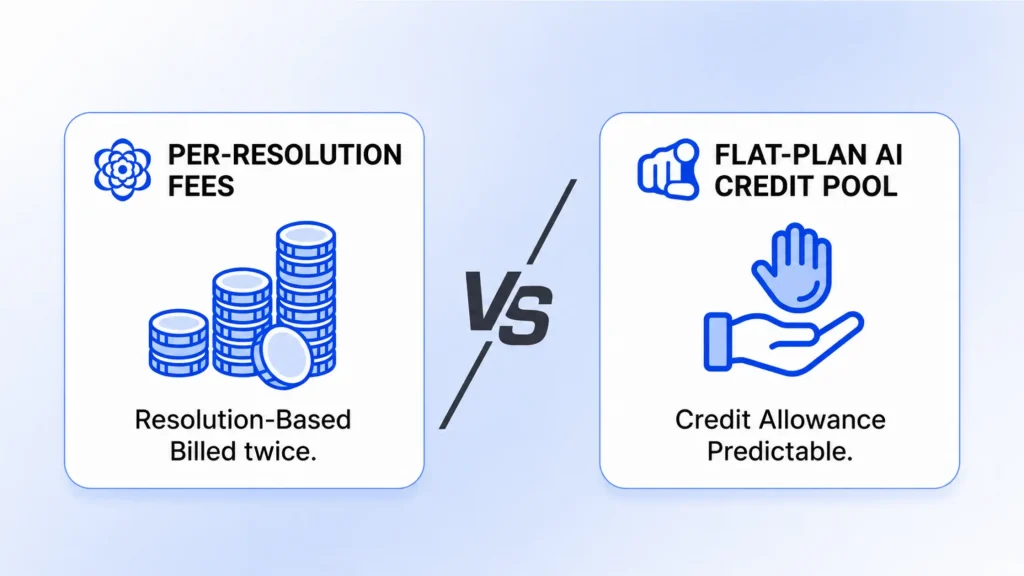
This is the part most comparisons skip, and it’s the part that decides the actual bill. The two biggest ecommerce-support incumbents both price their AI on a per-resolution basis, and both get more expensive exactly when the automation is working.
Gorgias bundles a ticket-based helpdesk (roughly $10 to $900 a month across its published tiers) with a separate AI Agent add-on charged per resolved conversation: $1.00 on monthly billing, $0.90 on annual. The detail that catches merchants off guard is that an AI-resolved ticket gets billed twice, once as a helpdesk ticket and again as an automation fee, per Gorgias’s own billing documentation. And because pricing is tied directly to ticket volume, seasonal spikes like Black Friday and Cyber Monday can double or triple a monthly bill with no change in team size.
Intercom Fin works on a similar logic. Seats start around $29 a month (Essential, annual), and Fin itself is billed separately at $0.99 per outcome, with a 50-outcome monthly minimum. Run the math at real ecommerce volume and it adds up fast. At 2,100 resolutions a month against an 8-seat Advanced plan, that lands around $2,960 a month before add-ons. Worth noting for anyone budgeting past this year, Salesforce announced a roughly $3.6 billion agreement to acquire Intercom (Fin) in June 2026. The deal was signed but not yet closed as of this writing, and pricing hasn’t changed as a result. It’s still a live variable worth watching for anyone signing a multi-year contract right now.
| Platform | Pricing Model | Starting Cost | AI / Automation Fee | What Happens in a Record Month |
|---|---|---|---|---|
| Gorgias | Ticket tiers plus a per-resolution AI fee | $10–$900/month, from Starter to Advanced | $0.90 annually or $1.00 monthly per AI-resolved conversation, billed on top of the ticket fee | The bill can double or triple during a BFCM-level spike |
| Intercom Fin | Per-seat pricing plus a per-outcome AI fee | Around $29 per seat/month for Essential, billed annually | $0.99 per outcome, with a 50-outcome monthly minimum | AI costs scale directly with resolution volume, with no cap |
| YourGPT | Flat tier with a shared AI-credit pool | $39/month for Essential annually or $59/month when billed monthly | Included in the credit allowance, with no per-resolution charge | Credit usage rises, but the plan cost does not |
If cost predictability during peak season matters as much as the automation itself, that structural difference is worth weighing before signing an annual contract with either incumbent.
For ecommerce specifically, the pitch is breadth. The same agent handling a WISMO question can flag a cross-sell opportunity, log a signal for the sales team, and hand a fraud-flagged refund to a human, all inside one no-code build. Most stores run three separate tools to cover that same ground.
AI Studio’s native MCP integration lets that agent pull live carrier and order data through a single connector, without custom API work for every data source. A self-learning loop also improves accuracy from real conversations, so a policy change doesn’t require a manual retraining cycle.
Shoppers don’t only reach out through a website widget. YourGPT deploys the same agent across WhatsApp, Instagram, Messenger, and native iOS and Android SDKs, so a customer messaging an Instagram DM about a delayed order gets the same order-aware answer as one using live chat on the site. Pricing runs on the shared credit pool described above, so that consistency doesn’t come with a bigger invoice the one week it matters most. The full feature set, including AI Helpdesk for the knowledge-base side of support, is covered in the complete feature list.
Handing an agent the power to issue refunds and touch order data deserves more than a footnote.
Return fraud is real, growing, and increasingly AI-assisted. The National Retail Federation’s 2025 Retail Returns Landscape report puts roughly 9% of all retail returns as fraudulent, with total US retail returns projected at $849.9 billion for 2025. Eighty-five percent of retailers surveyed already use AI to detect or prevent return fraud, and 71% of consumers say a poor returns experience makes them less likely to shop with that retailer again.
The newest wrinkle is generative AI working against the retailer instead of for it. In March 2026, Boll & Branch CEO Scott Tannen caught a customer submitting AI-generated photos of a “torn” bedding set that had actually arrived intact. One of the images carried a visible AI watermark, and the tear pattern didn’t match how cotton actually frays. Tannen’s team asked the customer to verify the damage over a FaceTime call. The customer never responded. Fraud-prevention platforms have since flagged this as a fast-growing category, with fraud rings now offering “returns-as-a-service” to help less technical shoppers fabricate convincing claims.
An agent that can autonomously approve a refund needs published, specific controls. “It’s smart” is not a control. At minimum:
| Guardrail | What It Does |
|---|---|
| Value Caps | Refunds above a set dollar threshold require human approval, with no exceptions. |
| Fraud-Risk Scoring | Mismatched shipping addresses, repeated return patterns, and synthetic-looking photos trigger a review before approval. |
| Return-Window and Final-Sale Logic | The agent checks eligibility against the brand’s actual return policy instead of relying on a generic assumption. |
| Escalation Path | Any ambiguous request is routed to a human agent with the full conversation and customer context instead of generating a guess. |
Ask any vendor, YourGPT included, how conditional logic caps refund amounts, how knowledge-conflict detection prevents an agent from applying an outdated return policy, and where the human-in-the-loop handoff triggers on a suspicious or high-value case. If those answers aren’t specific, that’s the gap to worry about.
Data handling is the other half of this. An agent trained on customer and order history should run on a platform where compliance is verifiable, backed by real certifications rather than a vague privacy promise. On YourGPT’s own site, SOC 2 Type II and GDPR-compliant badges are shown live as of this writing, but compliance claims are exactly the kind of detail worth reverifying directly with any vendor at the point of purchase, rather than assuming it from a blog post.
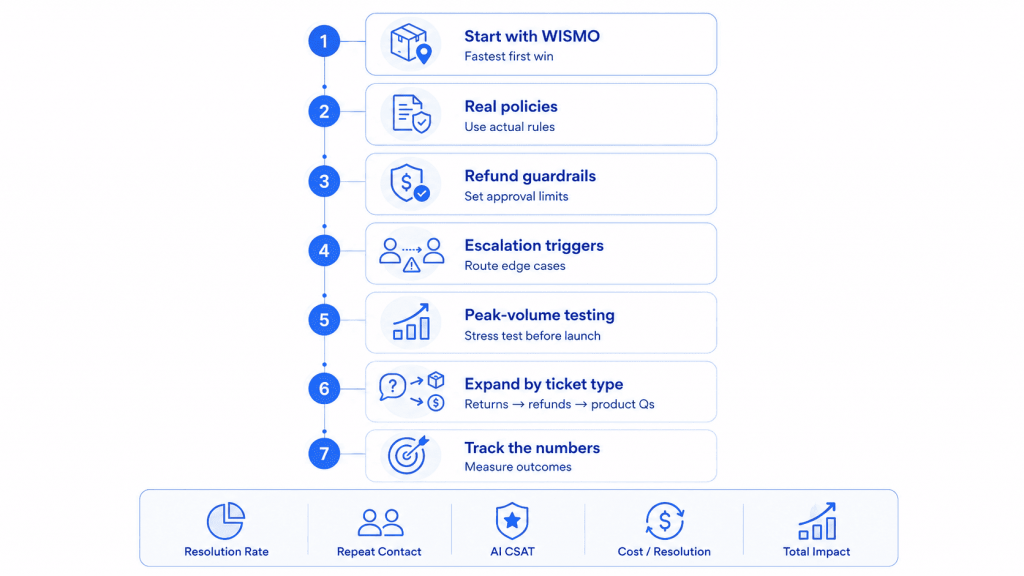
Skip the instinct to automate everything at once. Most rollouts stumble when a team connects every channel and every ticket type in the first month. This sequence works better, one category at a time.
WISMO stands for “where is my order,” the most common post-purchase support ticket. Its sibling, WISMR, means “where is my refund” and follows the same pattern after a return. Together, the two typically account for 25% to 50% of ecommerce support volume during a normal week.
A chatbot answers from a script or FAQ page. An AI agent reads live order and carrier data, checks the request against the store’s actual return policy, and can issue a refund or generate a return label itself. One describes the solution. The other delivers it.
Multichannel means a shopper can contact a store through several channels. Omnichannel means the conversation and its context move with the shopper across those channels. A chat that starts on the website and continues over email does not require the shopper to explain the issue again.
The cost depends on the pricing model. Gorgias and Intercom Fin charge per resolution, roughly $0.90 to $1.00 and $0.99 respectively, on top of a base plan, so the bill grows directly with ticket volume. YourGPT uses a flat-tier model with a shared AI-credit pool, starting at $39 per month with annual billing, so a busy month does not automatically mean a larger invoice. Confirm current pricing directly with each vendor before budgeting.
Only when the right guardrails are in place. Return fraud accounts for roughly 9% of retail returns, and AI-generated fake damage photos are a growing tactic. A well-configured agent should cap unattended refund amounts, run fraud-risk checks, verify return eligibility, and escalate anything ambiguous to a human.
Resolution rate and deflection rate should be read together rather than separately. Rising deflection with flat or falling resolution can mean tickets are being closed instead of solved. CSAT and first-contact resolution, or FCR, complete the picture. FCR below roughly 60% may indicate an access or authority problem, while high CSAT without fewer repeat contacts suggests the underlying issue remains unresolved.
Start with WISMO. It is a high-volume, low-complexity ticket type, making it one of the fastest areas in which to prove value. Connect the agent to live order and carrier data first, then expand into returns, return labels, and refund-status requests.
Yes. YourGPT connects with Shopify, WooCommerce, Magento, and BigCommerce, bringing order and customer data into the same AI agent that handles website chat, WhatsApp, and Instagram conversations. This gives shoppers the same order-aware support regardless of where they contact the business.
AI agents handle the same workflows at a higher volume. Because the agent already has access to live order and carrier data, a WISMO spike does not necessarily require adding support headcount. The main cost risk during BFCM is a per-resolution pricing model that becomes more expensive precisely when automation is resolving the most requests.
Ecommerce customer service comes down to repetition: where’s my order, where’s my refund, can I return this, the same handful of requests from a different customer every time, at a scale no help desk was ever staffed to absorb. What changed in 2026 is that agents stopped answering and started acting, reading live order data and knowing exactly when to hand a case to a person instead of guessing.
What’s still worth deciding is which platform earns that responsibility: one that publishes its refund guardrails, prices fairly during the busiest week of the year, and treats a WhatsApp message with the same precision as a live chat widget. Compare the pricing and feature set directly against whatever’s already running in the stack before the next peak season arrives.

TL;DR An FAQ chatbot answers repetitive questions by matching user queries with a knowledge base and returning grounded responses using rules, AI retrieval, or both. Modern FAQ chatbots use confidence checks to deliver instant answers for strong matches and fall back to broader retrieval or human handoff when confidence is low. Rule-based bots work well […]
TL;DR Multimodal chatbots let customers share photos, screenshots, documents, video, or audio directly in a conversation, giving AI more context than text alone. YourGPT’s Attachment Capture node in AI Studio can collect these files mid-conversation, while vision-capable AI models can analyze and understand their contents. Key use cases include ecommerce returns, insurance and warranty claims, […]
A customer asks where their order is. A traditional bot pastes a tracking link and calls it done. An agentic system checks the carrier API, sees the shipment stuck at a depot, applies a credit under the delay policy, updates the CRM, and messages the customer before they’ve had time to get annoyed. Same question. […]
TL;DR A ticketing system converts requests that arrive by email, chat, phone, or web form into trackable records with an owner, a status, and a priority level. Centralizing requests this way cuts response delays, gives support teams visibility into backlogs, and creates a record useful for reporting and audits. Options range from lightweight help desk […]

TL;DR Insurance platforms are using AI to automate claims support, quote intake, and policy servicing, reducing reliance on call centers and static forms. This guide compares five commonly shortlisted platforms: YourGPT, Ada, Sierra AI, Decagon, and Forethought. None are purpose-built exclusively for insurance, so configuration flexibility and proven insurance use cases matter. Pricing ranges from […]

TL;DR The core distinction is retrieval versus training. RAG pulls outside documents into a prompt when an answer is generated, while fine-tuning changes a model’s weights during a separate training step. The 2026 shift matters because OpenAI’s wind-down of its self-serve fine-tuning platform, announced in May 2026, closed off the default path many teams expected […]