AI for SEO: The 2026 Workflow (Research, Draft, Optimize)

Shreya Sharma
July 30, 2026
AI is now part of most SEO workflows, but the real advantage comes from using it within a disciplined process rather than simply producing content faster.
As Google AI Overviews and tools like ChatGPT answer more queries directly, content must be structured to earn both traditional search rankings and citations from AI assistants.
AI can support research, keyword expansion, briefs, drafts, and content refreshes, while humans remain responsible for strategy, fact-checking, and final editing. Publishing large volumes of unreviewed AI content creates the biggest SEO risk and can lead to severe traffic losses.
AI is now part of nearly every SEO workflow, used for keyword research, content briefs, outlines, drafts, optimization, and content refreshes. The old advantage, publishing faster than the competition, is gone, since fast publishing is available to almost anyone now. What separates a team that grows organic traffic in 2026 is the workflow behind the content.
Search itself has split into two audiences. Google’s AI Overviews, ChatGPT, Perplexity, and other answer engines now answer many queries directly, pulling clicks from pages that still rank at the top. A page has to rank in traditional search and stay well-sourced enough for an AI system to cite it directly. Quality control matters more than it did two years ago.
AI helps with specific tasks: surfacing opportunities, building outlines, drafting fast, and flagging stale content. It cannot replace strategy, accuracy, or editorial judgment. This guide walks through all six steps and the biggest risk to avoid, publishing scaled, unedited AI content that looks efficient today and wrecks organic traffic later.
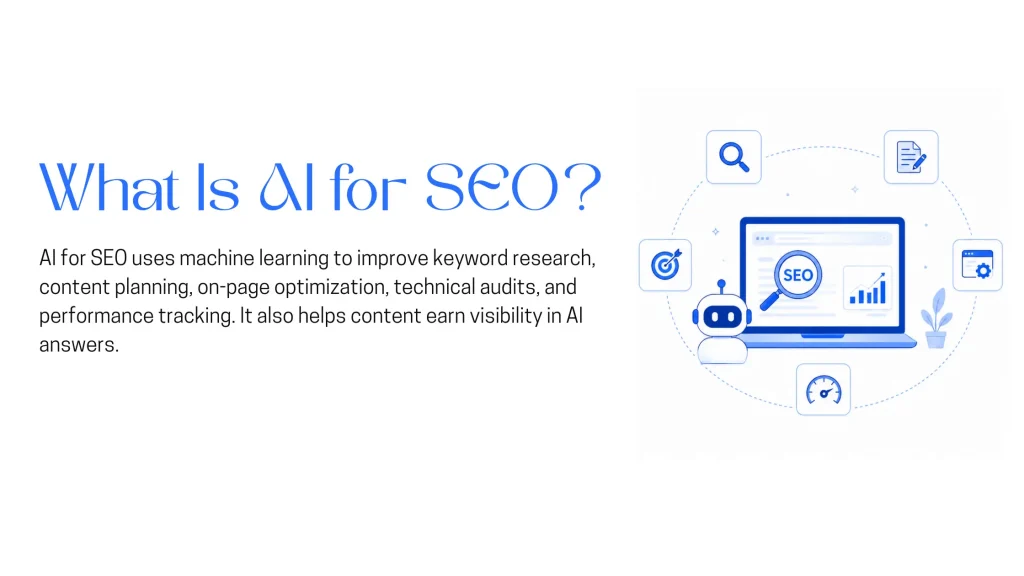
AI for SEO covers the whole search workflow, including keyword research, intent classification, content briefs, drafts, on-page optimization, technical audits, and performance analysis. It also covers a second surface, earning citations in AI answers on ChatGPT, Perplexity, Gemini, and Google’s AI Overviews, known as generative engine optimization (GEO).
AI is strong at pattern work:
AI is weak at judgment work:
Google’s own position supports this split. Its guidance says AI-assisted content is acceptable when it is original, helpful, and people-first, while using AI to generate many pages without adding value violates the spam policy on scaled content abuse. The method of production is neutral. The value of the output is everything.
Two numbers explain the shift.
Every page you publish now has to work on two surfaces at once. It has to rank in the classic SERP, and it has to be clear, well-sourced, and extractable enough for AI systems to cite it. The six-step workflow below is built for both.
Skipping straight to drafting is the single most common reason AI content underperforms.
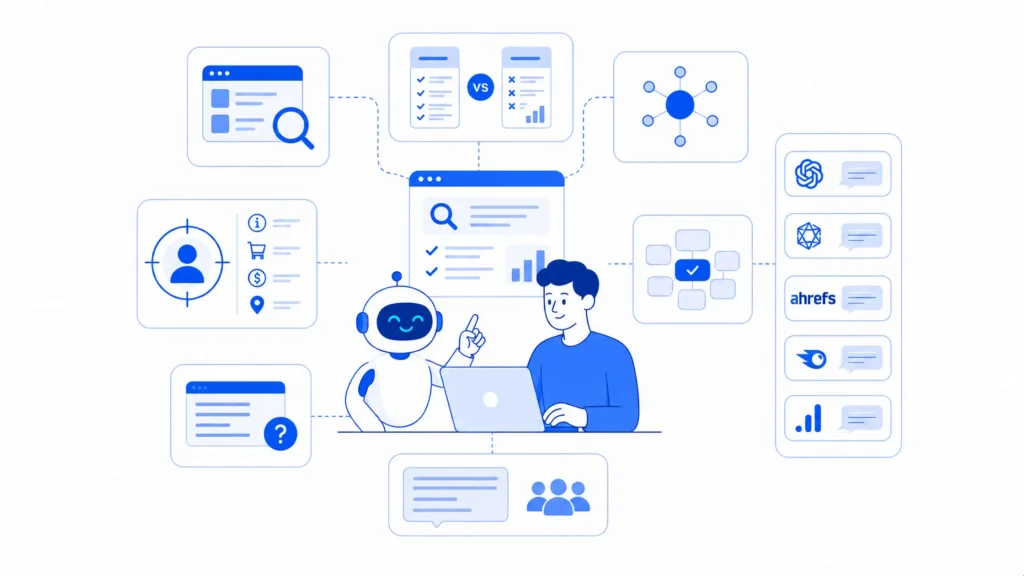
Weak research is still the failure point of most AI content. Before drafting anything, use AI to map the terrain around your target keyword.
Recommended tools: ChatGPT and Perplexity for intent classification, topic discovery, and fast competitor summaries. Ahrefs and Semrush for keyword volume, clustering, and gap data. Google Search Console for the queries your own site already gets impressions for but is not ranking well on, often the cheapest content ideas available.
Agent-based stacks can skip manual tab-switching and call these tools directly through Model Context Protocol (MCP). Connectors like MCP360 bundle many tools in one configuration, and platforms including YourGPT support MCP natively. More in our guide to MCP servers growth-focused businesses use.
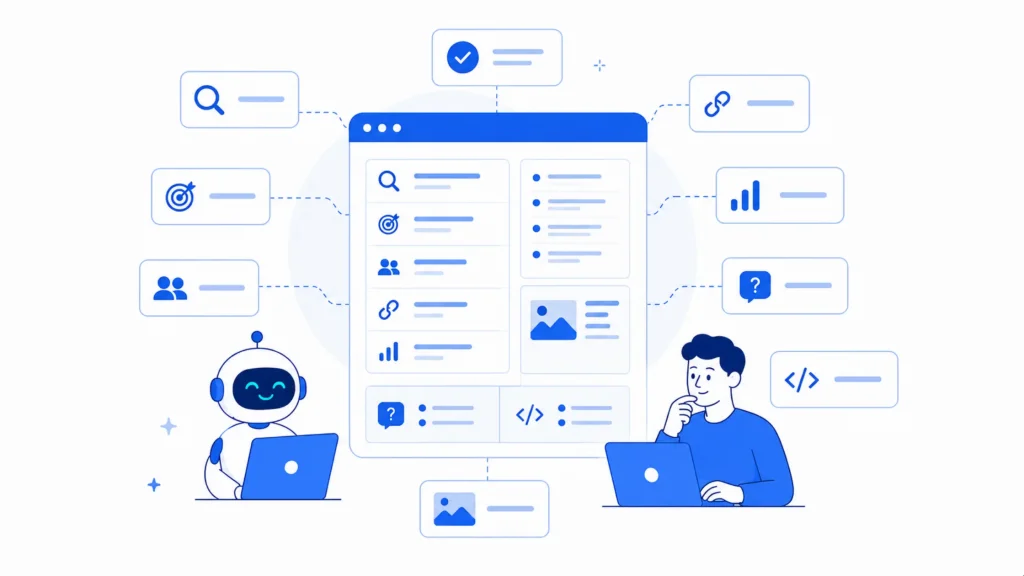
A brief is the single highest-leverage AI document in this workflow. A precise one means one revision round on the draft instead of five. Have AI assemble the first version from your Step 1 research, then have a human review it before drafting starts. A strong brief covers:
Treat this as a checklist, not a script. A brief tells the draft what to cover. It should never dictate exact phrasing.
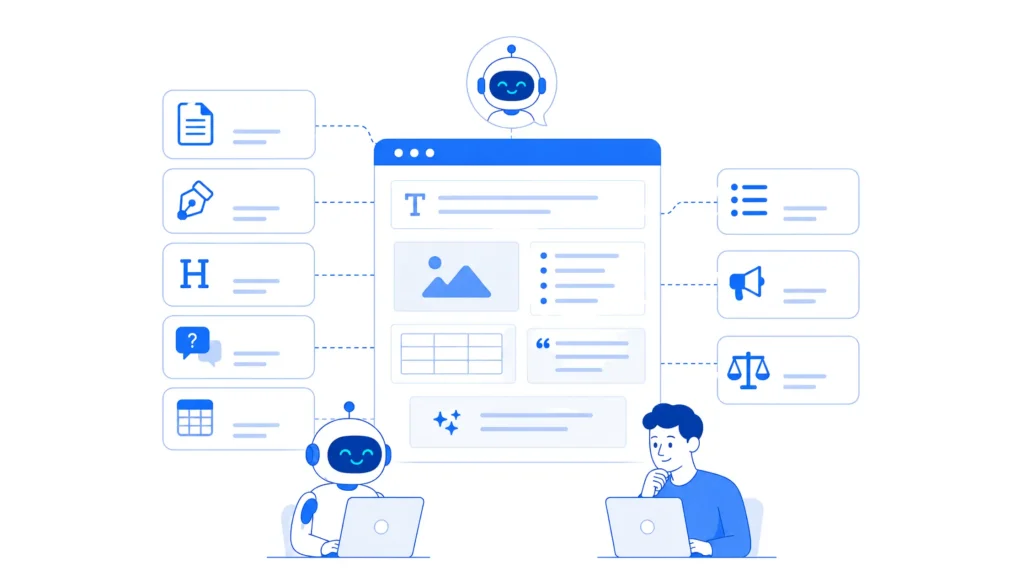
The blank page is where AI earns its keep fastest. Given a solid brief, a model can produce a genuinely useful first pass on several pieces at once.
Never publish AI output without editing. Ahrefs found 97% of content marketers review and edit AI content, and only 4% publish it straight from the model, feeding Google’s spam-fighting systems. A real edit pass adds a specific detail, traces numbers to their source, commits to one recommendation, and matches how your team talks. More in our guide on how to humanize AI-generated content.
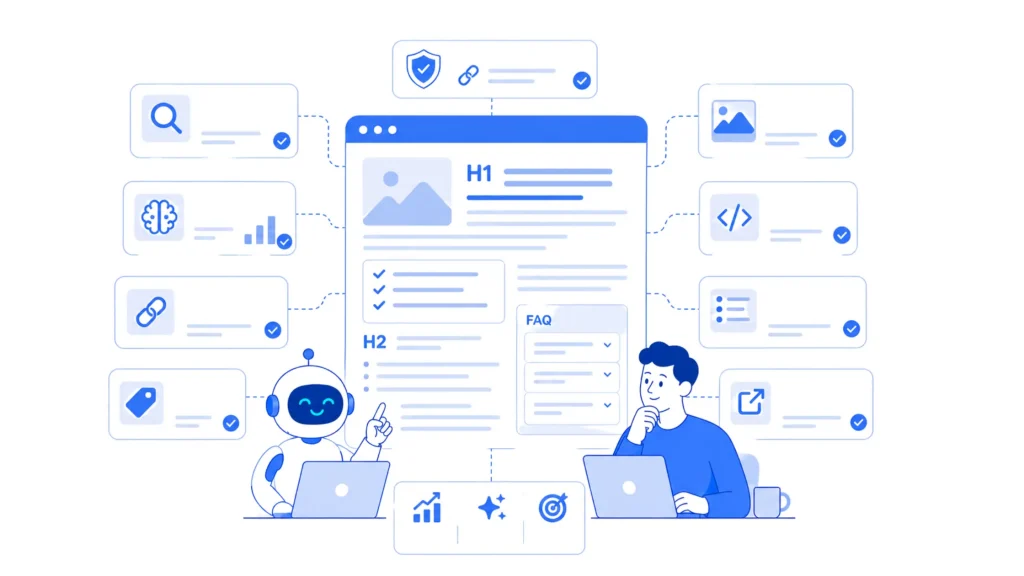
Once the draft holds up, optimize it for the classic SERP and AI answer engines at the same time.
Skip the gimmicks. Google’s own guidance on optimizing for generative AI features says to ignore tactics like content chunking and llms.txt files for Google Search, and to keep investing in the fundamentals above instead.
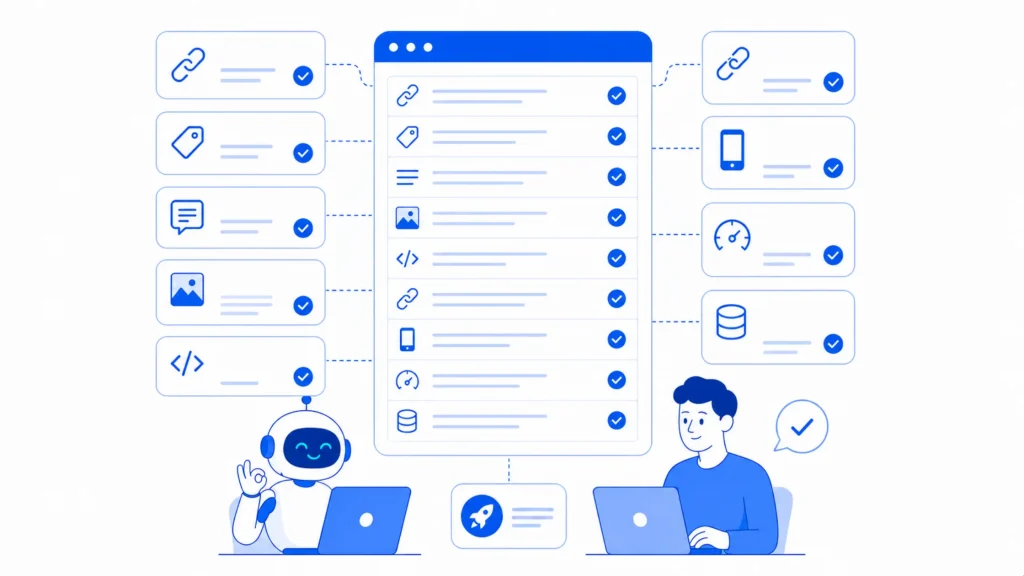
Publishing is where good content quietly loses rankings to careless setup. Run this checklist before anything goes live.
AI can generate most of the inputs here (alt text, meta variants, schema JSON), but a human should still run the final check before the page goes live.

Many teams treat publishing as the finish line and never come back. That is a mistake. Refreshing existing content is one of the highest-ROI activities in SEO, and it is one most teams overlook. AI makes it cheap enough to run on a real schedule.
Freshness has a measurable payoff beyond Google, too. An Ahrefs analysis of 17 million citations across seven AI platforms found AI assistants cite pages that are on average 25.7% fresher than organic Google results, with ChatGPT showing the strongest recency preference. Changing the publish date without changing the substance does nothing. Google has warned against exactly that.
The failure modes here are severe enough to deserve their own section, because the same tools that speed up the workflow can end a domain.
The mitigation for all four risks is the same workflow discipline this guide describes: human review on every page, verified sources for every claim, and publishing velocity your editorial capacity can sustain.
No. AI can speed up research, drafting, and technical checks, but nobody holds a model accountable when a claim is wrong or a page misrepresents a brand. A specialist still owns the calls that carry real consequences: which keyword is worth chasing, what claim goes on the page, and whether a draft is ready to publish.
Google’s own guidance says AI-assisted content is fine when it is original, helpful, and people-first. The real trigger for a penalty is scaled content abuse, meaning large volumes of thin, unedited pages published mainly to manipulate rankings regardless of who or what wrote them.
SEO optimizes a page to rank in classic search results. GEO, short for generative engine optimization, optimizes the same page to get cited inside AI-generated answers on tools like ChatGPT, Perplexity, and Google’s AI Overviews. The two overlap heavily in 2026, since clear structure, verified facts, and strong sourcing help with both.
Trace every number, quote, and claim back to its primary source before publishing. Models state fabricated statistics and misattributed studies with the same confidence as accurate ones, so a quick read will not catch the errors. Treat any figure you cannot verify as unusable rather than probably fine.
Prioritize by business value rather than a fixed calendar. Pull pages losing clicks or impressions from Search Console and refresh the highest-value ones first. Fast-moving topics can be worth revisiting every quarter, while genuinely evergreen pages need far less frequent attention.
Fewer than most teams assume. One general LLM for research and drafting, one dataset provider for real search numbers, and Google Search Console, which is free and shows what your own site already ranks for, covers most of the workflow. Add a content optimization or agent layer only once that core stack is being used well. A longer tool list rarely fixes a workflow problem.
Not directly. YourGPT is an AI agent platform built for customer support, sales, and operations rather than a keyword or content tool. Where it connects to this workflow is architecture. Native MCP support lets a team plug research and SEO tools into the same automated system it already uses for other work, instead of running the AI side of SEO in a separate, disconnected tool.
Yes, when it clears the same bar every page has to clear: does it tell a reader something the current top ten results do not already say? A fast AI draft rarely does on its own. The pages that end up ranking are the ones where an editor added a detail, a number, or an angle none of the competing pages had.
AI for SEO in 2026 works best when it handles repeatable tasks such as keyword research, content briefs, first drafts, and quality checks. Your team should remain responsible for original data, real experience, factual accuracy, and editorial decisions the parts that make content useful and trustworthy.
Test the full process on one keyword this week and track the time saved, corrections needed, and final content quality. The same rule applies to AI agents used for support or sales through platforms such as YourGPT: automate repeated work, but keep human review for important decisions. Once the process produces consistent results, apply it to more articles and connect it with your AI automation in marketing strategy.

TL;DR B2B customer service means supporting multiple people within the same account, including end users, admins, finance or procurement contacts, and executive sponsors, each with a different definition of a resolved ticket. Traditional support bots handle one conversation at a time and often lose account context when requests move between contacts, channels, or teams, forcing […]


TL;DR A vector embedding is a list of numbers that represents meaning, placing similar concepts closer together in a mathematical space. AI chatbots use embeddings to match questions by meaning rather than exact wording, which is a core part of retrieval-augmented generation (RAG). Anthropic recommends Voyage AI for embeddings, while OpenAI, Google, and Cohere provide […]

TL;DR An FAQ chatbot answers repetitive questions by matching user queries with a knowledge base and returning grounded responses using rules, AI retrieval, or both. Modern FAQ chatbots use confidence checks to deliver instant answers for strong matches and fall back to broader retrieval or human handoff when confidence is low. Rule-based bots work well […]

TL;DR Multimodal chatbots let customers share photos, screenshots, documents, video, or audio directly in a conversation, giving AI more context than text alone. YourGPT’s Attachment Capture node in AI Studio can collect these files mid-conversation, while vision-capable AI models can analyze and understand their contents. Key use cases include ecommerce returns, insurance and warranty claims, […]

A customer asks where their order is. A traditional bot pastes a tracking link and calls it done. An agentic system checks the carrier API, sees the shipment stuck at a depot, applies a credit under the delay policy, updates the CRM, and messages the customer before they’ve had time to get annoyed. Same question. […]

TL;DR A ticketing system converts requests that arrive by email, chat, phone, or web form into trackable records with an owner, a status, and a priority level. Centralizing requests this way cuts response delays, gives support teams visibility into backlogs, and creates a record useful for reporting and audits. Options range from lightweight help desk […]