How to Build a Customer Experience Strategy (with AI) in 2026

Rajni
Last updated on July 17, 2026
A customer experience strategy is a documented plan for how people, process, and technology work together across every customer touchpoint, not just a support-team initiative.
Strong CX optimization can drive 5 to 10 percent revenue growth and reduce costs by 15 to 25 percent within two to three years, making it an executive-level priority.
Building a CX strategy takes six steps: audit your current experience, map the customer journey, choose the right metrics, design proactive AI-assisted touchpoints, close the retention loop, and review progress monthly.
AI can improve CX strategy, but it also adds risks around data handling, accuracy, and governance. Most strategies fail because there is no clear owner, too much planning without action, or CX is treated as a software purchase instead of an operating model.
A customer experience strategy is supposed to connect marketing, sales, product, and support around the same customer. In most companies, no such plan exists. Support tickets sit in one tool, NPS scores live in a dashboard nobody reviews regularly, and product teams learn about churn only after a renewal is already lost. Teams have plenty of customer feedback. What’s missing is a plan for acting on it.
Closing that gap takes more than a mission statement about putting customers first. It takes a working document that names who owns each touchpoint, which metrics prove the plan is working, and where automation actually helps instead of adding friction.
This blog covers what a customer experience strategy is, why AI makes 2026 a different moment for building one, the six steps to create one, and where the risk sits so you can manage it.
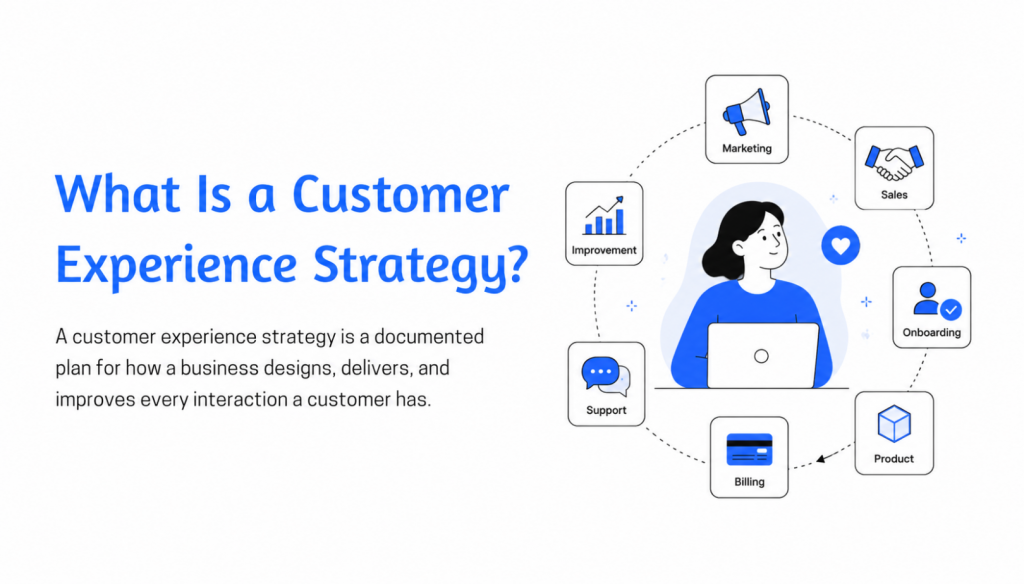
A customer experience strategy, sometimes shortened to cx strategy, is a documented plan for how a business designs, delivers, and improves every interaction a customer has with it, from the first ad they see to the renewal email eighteen months later. A customer experience plan is the same thing under a different name, usually the version stakeholders see once it’s broken into quarterly initiatives with owners and deadlines attached.
It is not the same as customer service. Service is one channel inside the strategy, the part that responds when something goes wrong. The strategy is the whole system: marketing’s first impression, the sales handoff, onboarding, the product itself, billing, and every support conversation that follows. A customer can have a great support call and still leave, because the actual problem was a confusing invoice nobody on the support team could see.
Any strategy worth writing down should answer four questions:
Skip any of these four and you have a set of good intentions, not a strategy.
The financial case for CX has been stable for years, and it holds up across industries, not just for companies with obvious customer-facing revenue on the line. McKinsey’s research backs this up: businesses that successfully transform their customer journeys see the improvement land in both the top line and the cost side within two to three years, not just in satisfaction scores that never translate into anything measurable. That’s the upside case. The downside case is just as well documented.
PwC’s 2025 Customer Experience Survey found that 52% of consumers had stopped buying from a brand after a bad experience with its products or services, and 29% stopped specifically because of a poor customer experience. Most of that 29% never complain first. They just stop ordering, and the first sign shows up weeks later as a churn number, long after the actual moment that lost them.
AI is raising the bar customers measure you against, whether or not you’ve adopted it yet. Zendesk’s 2026 CX Trends research, based on surveys of more than 11,000 consumers and CX leaders across 22 countries, found that 74% of consumers now expect round-the-clock service and 88% expect faster responses than they did a year ago. 85% of CX leaders say customers will abandon a brand over an unresolved issue even on the first contact. Customers aren’t comparing you to your direct competitor anymore. They’re comparing you to the fastest, most personalized experience they had anywhere that week.
Learn six practical steps to design a customer experience strategy that improves satisfaction, builds loyalty, and creates consistent value across every customer touchpoint.
Before changing anything, find out what’s actually happening. Pull your last six months of support tickets, NPS or CSAT results, churn data, and win-loss notes from sales, and look for the same complaint showing up in three or more places. That repetition is your starting signal, not a hunch about what feels broken.
Interview a handful of frontline employees too. Support agents and salespeople hear the unfiltered version of customer frustration daily, and they usually know exactly where the process breaks before any dashboard shows it.
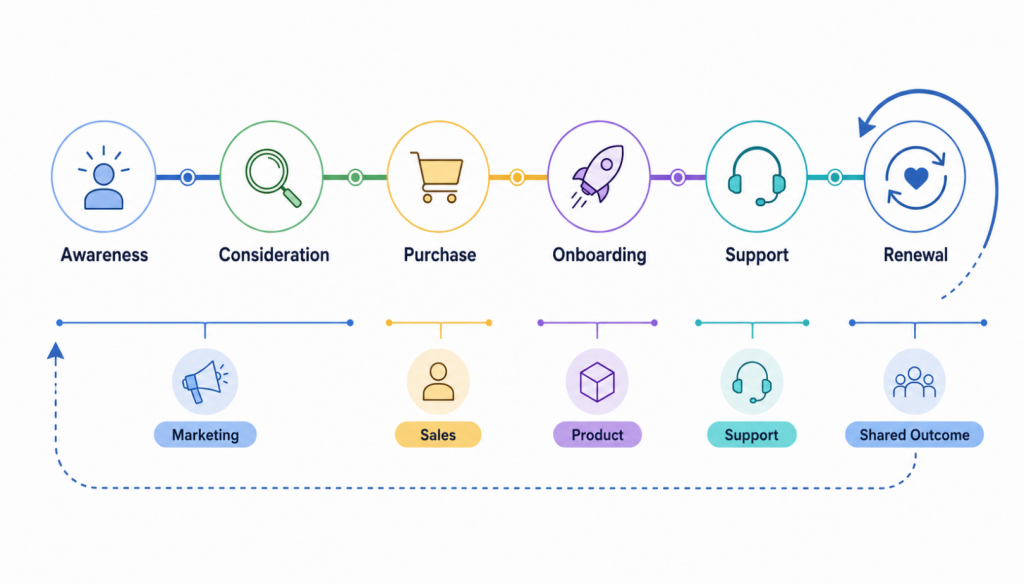
Once you know the rough shape of the problem, map it against the actual journey a customer takes, stage by stage, from first contact through renewal or cancellation. A customer journey map forces you to name every touchpoint and every handoff between teams, which is usually where things quietly fall apart.
Take a concrete case. A customer messages live chat at 6 PM about a late order. The agent’s shift ends before it’s resolved, so the case gets forwarded to an email queue the customer never agreed to use. Two days later the customer replies to that email, explaining the same problem again, this time to someone who has never seen the chat log. Nothing on an NPS dashboard captures that handoff. The journey map does, because it forces you to draw the line from live chat to email and ask who actually owns the customer once the channel changes.
Mark each stage with what the customer is trying to accomplish, not what your org chart says the team’s job is. “Getting a refund processed” is a customer goal. “Ticket escalation to billing” is an internal process, and customers shouldn’t have to understand it to get their money back.
A strategy without metrics is a set of opinions. Three metrics cover most of what you need. Net Promoter Score (NPS) measures long-term loyalty and whether customers would recommend you. Customer Satisfaction (CSAT) measures how a customer felt about one specific interaction. Customer Effort Score (CES) measures how much effort a customer had to spend to get an issue resolved, a request fulfilled, or a question answered, and it’s frequently the earliest warning sign of churn, since customers rarely complain about friction, they just quietly stop coming back.
Read the full breakdown of what CSAT is and how to use it if you’re setting this up for the first time. Pick one or two moments in the journey to measure each metric consistently, then track the trend monthly instead of chasing a single survey score.
Most support still waits for the customer to reach out first. Proactive customer service flips that. A payment fails to process, a shipment sits in the same city for three days, a login fails twice in a row. Each of these is a signal a system can catch automatically, hours or days before the customer notices something is wrong and picks up the phone.
A human support team can’t watch every account in real time for signals like these, which is one of the places AI genuinely earns its place in a cx strategy rather than being bolted on for the sake of having it. An AI agent trained on your policies and order data can catch the failed payment retry, message the customer with a fix before the order cancels automatically, and only loop in a human if the customer pushes back. YourGPT (Delta4 Infotech’s own AI customer service product, worth flagging since this is our blog) is built around that pattern. It’s designed to resolve up to 80% of repetitive inquiries like these on its own, cut support workload by up to 60%, and work across 100+ languages, with a human agent getting the full conversation history the moment a case needs escalation rather than starting from zero.
The tool matters less than the pattern. Resolve what’s repeatable instantly, and hand off what isn’t with everything the human needs to pick it up without asking the customer to repeat themselves.
Fixing problems only as they surface keeps a team playing catch-up forever. The stronger version closes the loop: collect feedback, act on it, and tell customers what changed because of what they said. That last step gets skipped constantly, and it’s the one that actually builds trust, since customers who see their feedback ignored twice stop bothering to give it a third time. The full set of retention strategies that support this loop, from voice-of-customer programs to churn-risk signals like a sudden drop in product usage, is worth a deeper look.
The math backs this up. Bain & Company’s long-running research on customer loyalty found that increasing retention by just 5 percent can lift profits by up to 95 percent, because retained customers cost less to serve, need less onboarding, and spend more per order the longer they stay. A modest reduction in preventable churn, in other words, usually outperforms an equivalent spend on new customer acquisition.
Set a monthly review of your core metrics against the previous month, not just against the same month last year. A year-over-year comparison hides a problem that started eight weeks ago. A month-over-month view catches it while it’s still small.
Bring product, support, and marketing into that review together, since friction usually starts in one team’s process and shows up as a complaint in another team’s inbox. Say CES drops sharply the week after a checkout redesign ships. Support sees the ticket spike first, but the fix belongs to product, and marketing needs to know before the next promotional email drives more traffic into the same broken flow. A review that includes only one of those three teams will misdiagnose the cause almost every time.
A strategy that sits in a slide deck from Q1 and never gets revisited stops being useful within a quarter. Put the review on the calendar before the strategy launches, not after the first metric moves in the wrong direction.
Putting AI into customer-facing touchpoints means handing it access to customer data, purchase history, and sometimes account actions like refunds or cancellations. That access needs guardrails, not just a rollout plan.
An AI agent can state a return policy, a price, or an order status that isn’t accurate. Train any AI agent strictly on your own documentation and policies, then add fallback rules so it hands off to a human instead of guessing when a query falls outside what it actually knows. Test this before launch, not after the first wrong answer reaches a customer.
Under GDPR, most AI deployments that process personal customer data meet the threshold for a Data Protection Impact Assessment, yet many companies treat an AI agent as just another piece of software and skip that step. Confirm what data the agent can see, how long it’s retained, and who can access the conversation logs before it goes live. Choose a platform with independent certifications like SOC 2 or ISO 27001 rather than taking a vendor’s word for its security posture.
Customers increasingly want to know when they’re talking to an AI agent versus a person, and regulators are moving the same direction. Build a clear disclosure into the first message of any AI-driven conversation, along with an easy path to a human. It costs almost nothing to implement and avoids the trust damage of a customer feeling deceived.
Avoid the most common CX strategy mistakes that can hurt customer satisfaction, weaken loyalty, and create inconsistent experiences across key touchpoints.
Customer service is one channel, the one that responds when something breaks. A customer experience strategy covers everything that leads up to that moment, including marketing, sales, onboarding, the product itself, and billing.
Most teams can complete the audit and journey map in two to three weeks. The full six-step build, including metric selection and a first monthly review cycle, usually takes six to eight weeks from kickoff to a working document leadership actually uses.
NPS, CSAT, and CES cover most of what you need. NPS tracks long-term loyalty, CSAT measures a single interaction, and CES catches friction before it turns into churn. Pick one or two moments in the journey to track each one consistently.
No. AI absorbs the repeatable, predictable requests, such as payment failures, shipping delays, and login issues, so human agents can spend their time on the cases that need judgment, not the ones that need patience.
Reactive support waits for the customer to notice a problem and reach out first. Proactive support catches the signal before that happens, such as a failed payment, a shipment stalled in transit, or a login failing twice in a row, and reaches out with a fix first. Most companies never build the second kind because it requires watching every account in real time, which is where automation and AI agents typically come in.
AI agents like YourGPT work well for proactive touchpoints and repetitive resolution, but they need guardrails. Train any AI agent strictly on your own documentation, add fallback rules so it hands off to a human instead of guessing, and disclose upfront when a customer is talking to an AI. Skipping any of those three steps is where the trust damage happens.
Three things matter most. First, whether it can resolve repetitive inquiries on its own instead of just routing tickets faster. Second, whether it hands a human agent the full conversation history on escalation, so the customer never has to repeat themselves. Third, independent security certifications like SOC 2 or ISO 27001 rather than a vendor’s word alone. YourGPT is built around resolving up to 80% of repetitive inquiries automatically and cutting support workload by up to 60% across 100+ languages.
The math behind a CX strategy is straightforward. Retained, satisfied customers cost less to serve and spend more over time, and businesses that treat CX as a coordinated system see it show up in revenue instead of staying a talking point in a quarterly deck. Start with the audit, map where the friction actually lives, pick metrics you’ll actually review monthly, and be deliberate about where AI helps versus where it introduces risk that needs its own governance.
None of the six steps here require a large budget or a reorg to begin. They require one owner willing to look at what the data already shows and act on it before the next customer walks away over something the team already knew about.
Use YourGPT to automate repetitive support, create proactive customer touchpoints, and deliver faster experiences across every stage of the customer journey.
Run WordPress customer service alone. Train a YourGPT agent on your help pages, test it on real tickets, install the plugin, and get only the exceptions.


Learn how to judge Shopify AI resolution rates with clear formulas, a worked example, ticket-level checks and practical ways to improve support quality.
TL;DR B2B customer service means supporting multiple people within the same account, including end users, admins, finance or procurement contacts, and executive sponsors, each with a different definition of a resolved ticket. Traditional support bots handle one conversation at a time and often lose account context when requests move between contacts, channels, or teams, forcing […]

TL;DR A vector embedding is a list of numbers that represents meaning, placing similar concepts closer together in a mathematical space. AI chatbots use embeddings to match questions by meaning rather than exact wording, which is a core part of retrieval-augmented generation (RAG). Anthropic recommends Voyage AI for embeddings, while OpenAI, Google, and Cohere provide […]
TL;DR An FAQ chatbot answers repetitive questions by matching user queries with a knowledge base and returning grounded responses using rules, AI retrieval, or both. Modern FAQ chatbots use confidence checks to deliver instant answers for strong matches and fall back to broader retrieval or human handoff when confidence is low. Rule-based bots work well […]
TL;DR Multimodal chatbots let customers share photos, screenshots, documents, video, or audio directly in a conversation, giving AI more context than text alone. YourGPT’s Attachment Capture node in AI Studio can collect these files mid-conversation, while vision-capable AI models can analyze and understand their contents. Key use cases include ecommerce returns, insurance and warranty claims, […]