RAG vs Fine-Tuning: Which One Does Your AI Agent Actually Need?

Rajni
August 10, 2026
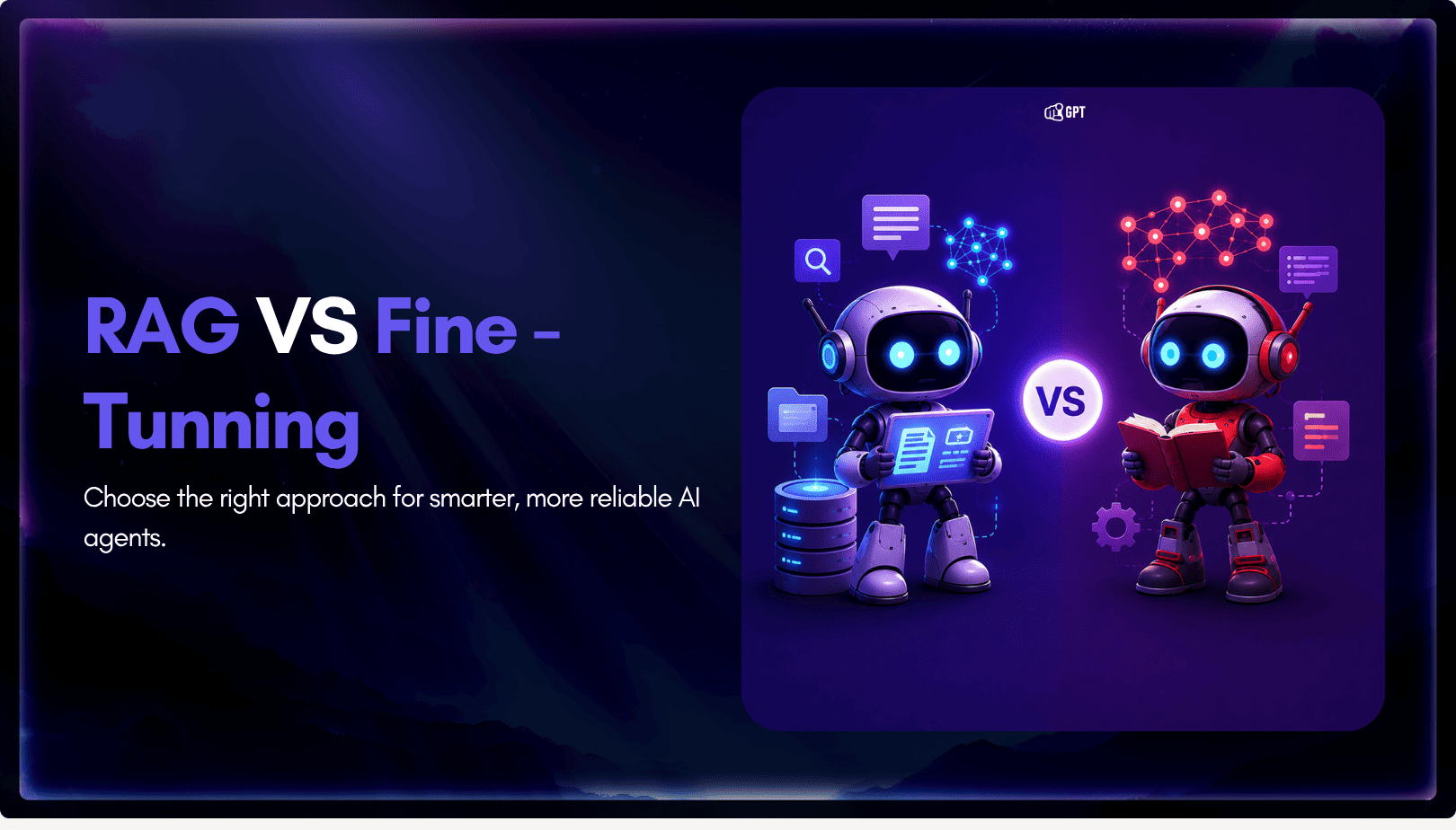
The core distinction is retrieval versus training. RAG pulls outside documents into a prompt when an answer is generated, while fine-tuning changes a model’s weights during a separate training step.
The 2026 shift matters because OpenAI’s wind-down of its self-serve fine-tuning platform, announced in May 2026, closed off the default path many teams expected to use for GPT models.
In practice, RAG works best for changing facts and knowledge, while fine-tuning is better suited to stable behavior, formatting, and tone.
For most support or sales agents, RAG is the default. Fine-tuning makes sense mainly for narrow, high-volume, stable tasks where consistent behavior justifies the extra training step.
Every AI agent needs to answer questions correctly. Some of those answers depend on facts the agent can look up. Others depend on how the agent is built to behave, like its tone or the format of its replies. RAG and fine-tuning are the two main ways to handle each kind of need, and picking the wrong one can leave a business with an agent stuck on outdated facts, or a training bill nobody needed to spend.
The choice has gotten more pressing lately too. In May 2026, OpenAI started closing its self-serve fine-tuning platform to new users, and the access window keeps narrowing from there. That change means fine-tuning a flagship model is not automatically on the table anymore, depending on which provider a business already uses.
This guide breaks down what RAG and fine-tuning actually do, when each one is worth the cost, and how the 2026 changes affect that decision for AI agents built to handle support, sales, or operations, the kind running in production instead of staying research demos.
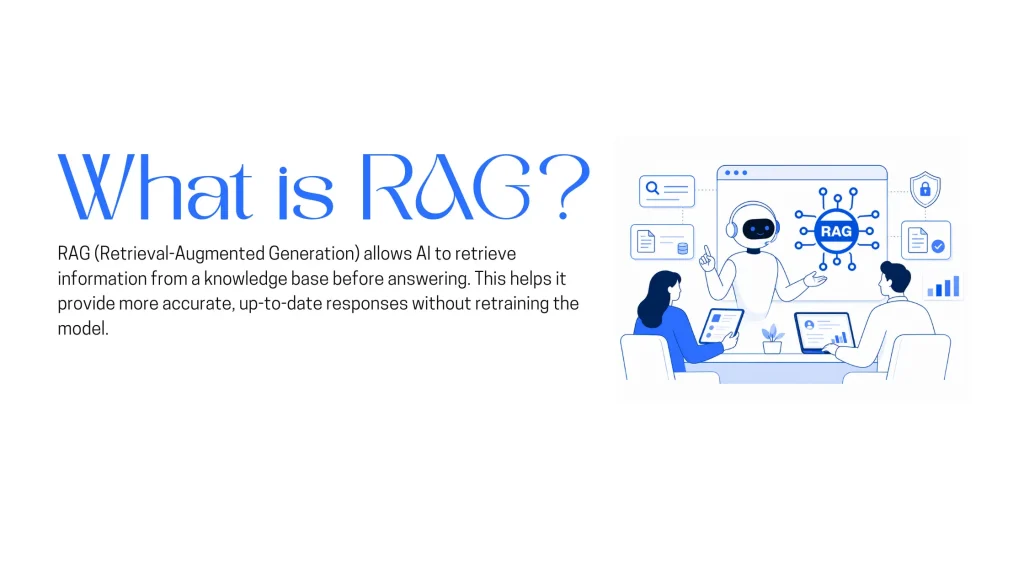
Retrieval-Augmented Generation (RAG) lets a language model pull in outside information at the moment it answers, instead of relying only on what it learned during training.
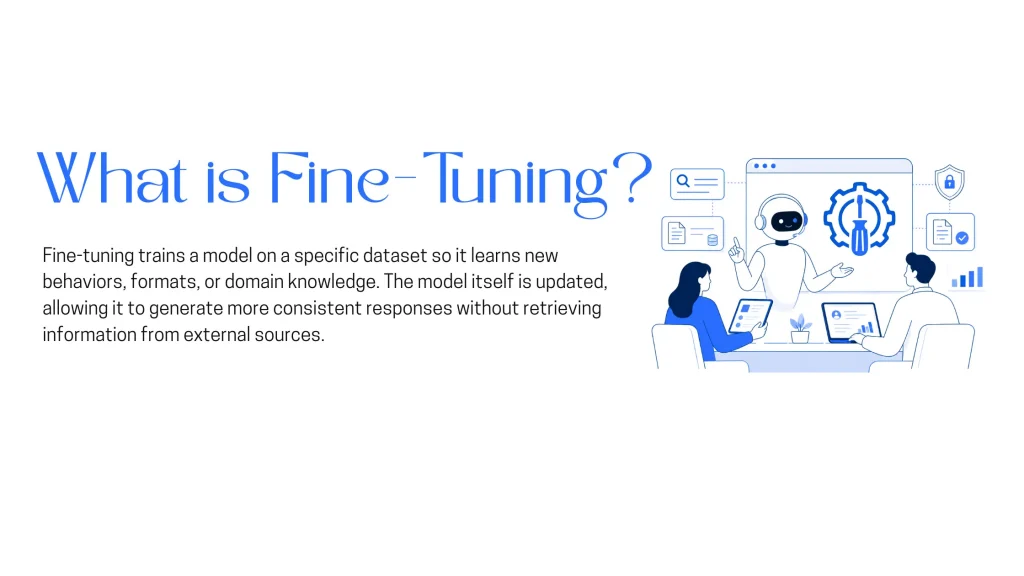
Fine-tuning changes the model itself, continuing training on a smaller, labeled dataset built for one task, instead of adding a retrieval step on top of it.
Most confusion in this comparison comes from treating RAG and fine-tuning as competing ways to answer the same question. They usually answer different questions. Fine-tuning is not primarily a knowledge tool. It’s a behavior tool, teaching a model to act a certain way every time. RAG works the other way, supplying knowledge while leaving behavior and voice largely as they were.
The table below breaks down where each one actually earns its keep:
| Fine-Tuning | RAG | |
|---|---|---|
| What it actually changes | The model’s weights, through additional training | Nothing in the model. Only the information placed in the prompt at answer time |
| What it’s strong at | Teaching a specific writing style, classification task, or reasoning pattern reliably, without a prompt spelling it out every time | Giving an existing model access to information it wasn’t trained on, updated as often as the source documents change |
| What it’s weak at | Staying current. A model fine-tuned on this quarter’s pricing knows only this quarter’s pricing until someone runs another training job | Forcing a specific output shape or a deeply internalized domain vocabulary |
| What it can’t do on its own | Add facts the model wasn’t trained on without a new training run | Teach a model new skills or a new voice. A retrieved passage about insurance underwriting supplies facts to reason with, without turning a general-purpose model into an underwriter |
For an AI agent handling live customer conversations, this split usually points toward RAG first. Support policies, pricing, product specs, and order data change constantly. Brand voice and escalation behavior matter too, but those are frequently solvable through system prompts and Studio-level rules without a full training run.
Weigh these six factors against the specific agent being built, separate from the topic in general. Together they usually point clearly toward one approach over the other.
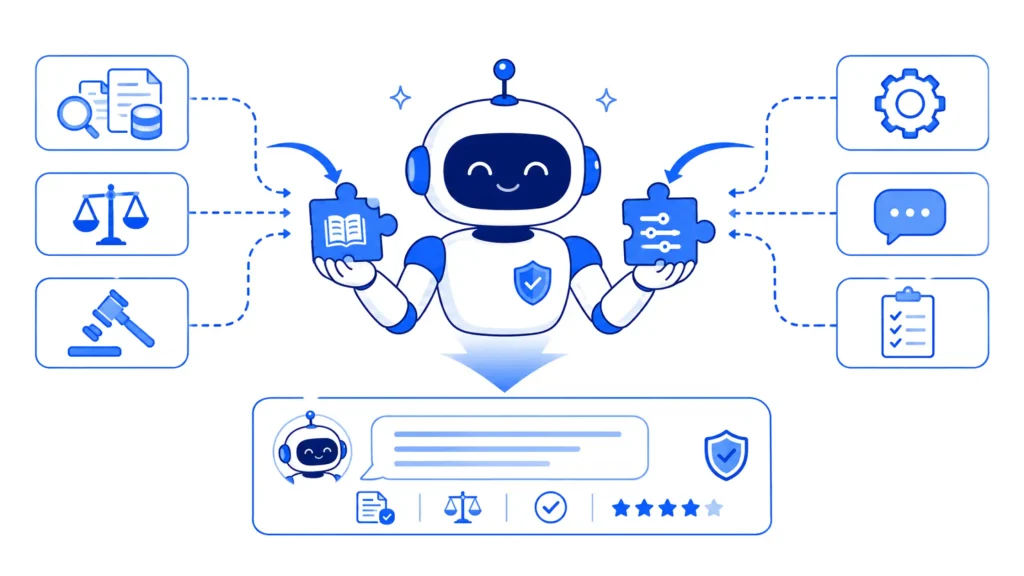
The two are not mutually exclusive, and most mature production systems end up running both, each handling a different half of the job. Knowledge goes to RAG. Behavior goes to fine-tuning.
RAG costs show up mostly at query time:
Fine-tuning costs show up mostly before anything ships, then again every time something changes:
RAG usually costs less to start, since no training run has to finish before an agent can answer its first question. Fine-tuning flips that. The upfront training cost gets followed by an ongoing maintenance cycle, since evaluation, retraining, and versioning do not stop once the first model ships.
These are the mistakes that show up most often once an agent moves from a demo into production. Some come from picking the wrong approach, others from executing the right one poorly.
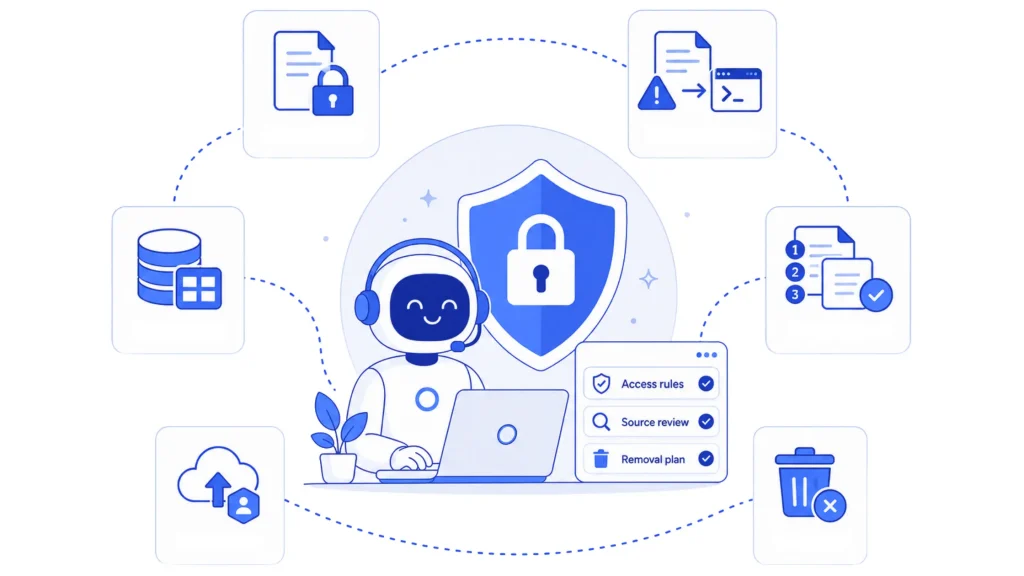
RAG and fine-tuning introduce different risk profiles, and both deserve attention before either goes into production.
A simple way to work through the decision for a specific agent:
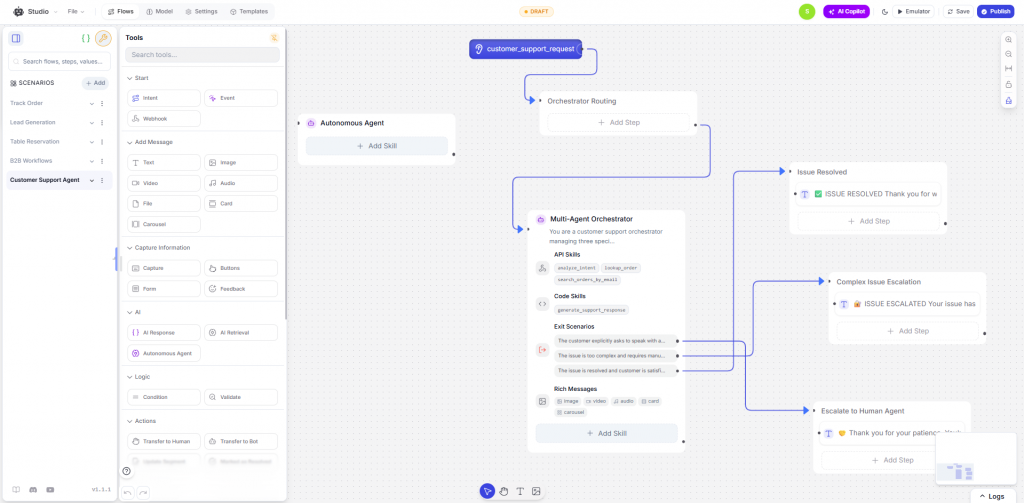
YourGPT built its own agent platform around one side of this tradeoff. Here’s how that architecture handles it in practice.
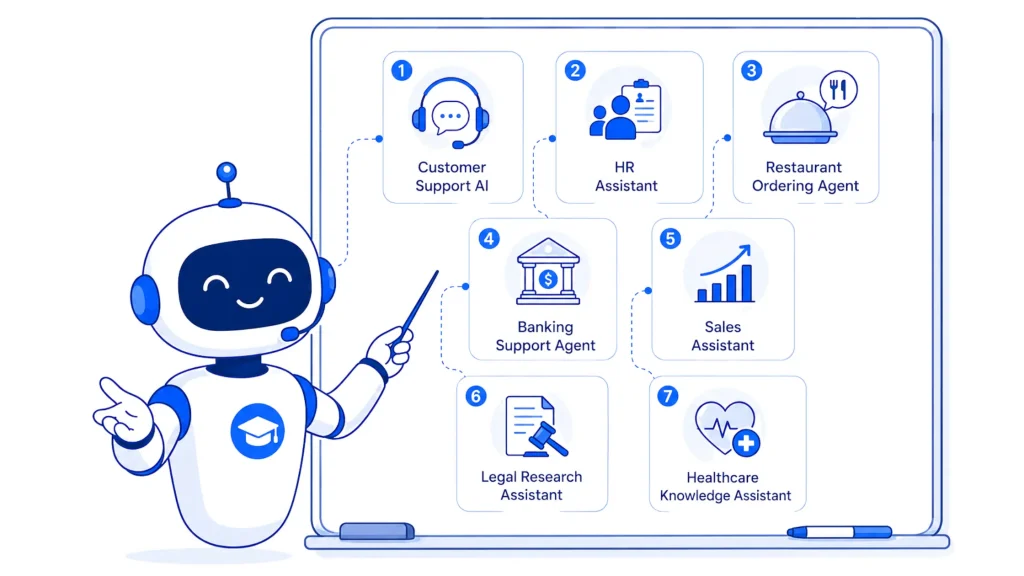
The pattern holds across seven common AI agent scenarios, using the factors covered above. The customer stories referenced below are all YourGPT deployments, cited here as concrete examples of the pattern, without functioning as independent benchmarks.
A support agent answering questions about pricing, refunds, and account issues needs facts that change on a normal support-team schedule. RAG is the clear fit. Talkmore, a Norwegian mobile operator, and Shockbyte, a game-server hosting provider, both built their support agents this way, training on subscription plans, billing guidance, and hosting documentation that gets updated as policies change instead of baked into a model that would need retraining every time something did.
Leave policies, benefits windows, and payroll rules update every time a handbook gets revised, which points toward RAG for the knowledge itself. The one case worth a hybrid layer is a high-volume HR inbox that also needs to route every inquiry into a fixed set of categories, like benefits, leave, or compliance, a narrow, stable classification task that fine-tuning handles well on top of that RAG-grounded base.
Menus, prices, and daily specials change more often than any training run could track, so RAG covers the knowledge side directly, while order-taking structure gets handled through Studio-level forms, no fine-tuned model required.
A regulated field like banking needs every answer traceable to a real policy document. SKNANB, a Caribbean bank, uses this pattern to keep responses aligned with its own current banking policies instead of a fixed set of trained-in rules that would drift out of compliance the moment a policy changed.
A sales agent needs current inventory, pricing, and promotions, which is a RAG job, plus a consistent, on-brand pitch across every conversation, which leans toward behavior shaping. Most teams get there with RAG plus Studio-level persona rules instead of a full fine-tune, and fine-tuning only earns its cost at volume high enough to justify baking a fixed qualification script directly into the model.
This is the scenario where the RAFT-style hybrid covered earlier actually earns its keep. Legal research needs both the current statute or case text, a retrieval problem, and reliable reasoning over exactly what that text says, the piece RAFT specifically trains for. Plain RAG can retrieve the right document and still misread it, and a narrow, high-stakes domain like this is where that gap justifies the extra training investment.
Coverage details, plan rules, and clinical guidelines change often enough that a fine-tuned model would need constant retraining to stay accurate, and getting this wrong carries real consequences. HealthBird, an insurance access platform, uses RAG for exactly this reason, training its agent on current plan information so answers stay traceable to what is actually covered instead of a snapshot from whenever the model was last trained.
Neither wins universally. RAG tends to be the better fit for agents that need current facts, source citations, or coverage across many topics. Fine-tuning tends to be the better fit for a narrow, high-volume, stable task where tone or output format matters more than the facts involved. Most production support and sales agents lean on RAG first and add fine-tuning only where it earns its cost.
Partially. OpenAI began winding down its self-serve fine-tuning platform in May 2026, closing new-job creation to organizations that hadn’t already run one, with the access window narrowing further on a set schedule through January 2027. Existing fine-tuned models keep working until their base model gets deprecated. Open-weight models remain fully tunable through techniques like LoRA regardless of what any single API provider does.
YourGPT’s AI Studio is built RAG-first, grounding every agent in retrieval by default instead of requiring a training run before it can go live. Behavior gets shaped through model choice across OpenAI, Anthropic, Google, xAI, and DeepSeek, Studio-level rules and conditional logic, and self-learning that improves from real conversations over time.
No. RAG needs documents to index instead of labeled training examples. There’s no dataset curation, no training run, and no GPU cost tied to teaching the model new behavior. What it needs instead is a well-organized, current knowledge base and a retrieval pipeline that can search it accurately.
Yes. Many mature production systems run both, using RAG to keep answers grounded in current facts while a lighter fine-tuning pass enforces a consistent tone, output format, or domain vocabulary. The “Can You Combine Both?” section above covers a concrete example of that pattern in a legal research tool.
Usually cheaper to start. RAG carries low upfront cost since no training run has to finish before an agent can answer its first question, though it adds an ongoing retrieval and inference cost to every query. Fine-tuning carries a higher upfront training cost that can pay back at very high, stable query volumes for one narrow task.
It goes stale until someone retrains it. A model fine-tuned on this quarter’s pricing keeps answering with that pricing until another training job runs, since there’s no way to update just the facts baked into a fine-tuned model’s weights. That gap is the main reason fast-changing information usually points toward RAG instead.
Yes. The free trial covers a full RAG-based agent setup, with no paid tier required to see whether retrieval alone closes the gap before spending on anything else.
RAG and fine-tuning solve different problems, and the 2026 shift in fine-tuning access makes that distinction more consequential than it was a year ago. RAG keeps an agent current without a training cycle. Fine-tuning locks in behavior at the cost of flexibility and, for several major providers now, a much narrower on-ramp than before.
A fast way to settle the question for a specific agent: pull the last month of source material and count how many times it actually changed. Frequent changes point straight to RAG. A handful of stable, high-volume tasks, like formatting refund responses the same way every time or routing tickets into a fixed set of categories, are where fine-tuning starts to earn its cost.
Before scoping a project around fine-tuning a frontier model, confirm the provider still offers that path and check whether prompt engineering on top of RAG can close the gap first. For most support, sales, and operations agents, it will.
Learn how to judge Shopify AI resolution rates with clear formulas, a worked example, ticket-level checks and practical ways to improve support quality.
TL;DR B2B customer service means supporting multiple people within the same account, including end users, admins, finance or procurement contacts, and executive sponsors, each with a different definition of a resolved ticket. Traditional support bots handle one conversation at a time and often lose account context when requests move between contacts, channels, or teams, forcing […]
TL;DR A vector embedding is a list of numbers that represents meaning, placing similar concepts closer together in a mathematical space. AI chatbots use embeddings to match questions by meaning rather than exact wording, which is a core part of retrieval-augmented generation (RAG). Anthropic recommends Voyage AI for embeddings, while OpenAI, Google, and Cohere provide […]

TL;DR An FAQ chatbot answers repetitive questions by matching user queries with a knowledge base and returning grounded responses using rules, AI retrieval, or both. Modern FAQ chatbots use confidence checks to deliver instant answers for strong matches and fall back to broader retrieval or human handoff when confidence is low. Rule-based bots work well […]
TL;DR Multimodal chatbots let customers share photos, screenshots, documents, video, or audio directly in a conversation, giving AI more context than text alone. YourGPT’s Attachment Capture node in AI Studio can collect these files mid-conversation, while vision-capable AI models can analyze and understand their contents. Key use cases include ecommerce returns, insurance and warranty claims, […]
A customer asks where their order is. A traditional bot pastes a tracking link and calls it done. An agentic system checks the carrier API, sees the shipment stuck at a depot, applies a credit under the delay policy, updates the CRM, and messages the customer before they’ve had time to get annoyed. Same question. […]